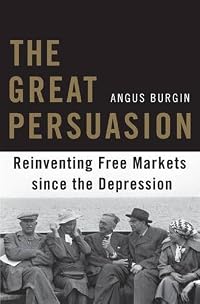
The Great Persuasion: Reinventing Free Markets Since the Depression
by Angus Burgin
On This Page
Description
Just as today's observers struggle to justify the workings of the free market in the wake of a global economic crisis, an earlier generation of economists revisited their worldviews following the Great Depression. The Great Persuasion is an intellectual history of that project. Angus Burgin traces the evolution of postwar economic thought in order to reconsider many of the most basic assumptions of our market-centered world. Conservatives often point to Friedrich Hayek as the most show more influential defender of the free market. By examining the work of such organizations as the Mont Pèlerin Society, an international association founded by Hayek in 1947 and later led by Milton Friedman, Burgin reveals that Hayek and his colleagues were deeply conflicted about many of the enduring problems of capitalism. Far from adopting an uncompromising stance against the interventionist state, they developed a social philosophy that admitted significant constraints on the market. Postwar conservative thought was more dynamic and cosmopolitan than has previously been understood. It was only in the 1960's and '70's that Friedman and his contemporaries developed a more strident defense of the unfettered market. Their arguments provided a rhetorical foundation for the resurgent conservatism of Barry Goldwater and Ronald Reagan and inspired much of the political and economic agenda of the United States in the ensuing decades. Burgin's brilliant inquiry uncovers both the origins of the contemporary enthusiasm for the free market and the moral quandaries it has left behind. show lessTags
Recommendations

































Member Recommendations
Member Reviews
This is a fascinating history of ideas in political economy that benefits from having been written by an historian rather than an economist. Burgin situates the foundation of the influential Mont Pèlerin Society in historical-contextual space and traces its evolution as part of an elaborate policy network that inspired and advised Anglo-American conservative leaders of the late 20th c. Between the lines, we get a lesson in how ideas are denatured as they trickle down from the scholarly elite to the realm of public opinion.
The key figures here are Friedrich Hayek, who founded the Mont Pèlerin Society in 1947, and Milton Friedman, who succeeded Hayek as the most influential advocate of the market mechanism. Both rejected the label show more ‘conservative,’ but Hayek comes off as much less doctrinaire and presumptuous in his postulates than Friedman. Friedman's great talent was for popularizing the notion than 'freedom' is essentially economic―but, given the nature of political discourse, popular ideas are inevitably simplistic ones.
Burgin mostly confines his discussion to the debate among supporters of the market system. In so doing, he exposes the range of arguments in favor of markets, and he allows the paradoxical, contradictory features of the ‘capitalist doctrine of freedom’ to reveal themselves. show less
The key figures here are Friedrich Hayek, who founded the Mont Pèlerin Society in 1947, and Milton Friedman, who succeeded Hayek as the most influential advocate of the market mechanism. Both rejected the label show more ‘conservative,’ but Hayek comes off as much less doctrinaire and presumptuous in his postulates than Friedman. Friedman's great talent was for popularizing the notion than 'freedom' is essentially economic―but, given the nature of political discourse, popular ideas are inevitably simplistic ones.
Burgin mostly confines his discussion to the debate among supporters of the market system. In so doing, he exposes the range of arguments in favor of markets, and he allows the paradoxical, contradictory features of the ‘capitalist doctrine of freedom’ to reveal themselves. show less
Fascinating history of the Mont Pelerin Society, a proponent of the morality and efficacy of free markets. Latter chapters deal with Milton Friedman's and the U of Chicago's influence on the Society.
Ratings
Members
- Recently Added By
Author Information

1+ Work 97 Members
Awards and Honors
Common Knowledge
- Canonical title
- The Great Persuasion: Reinventing Free Markets Since the Depression
Classifications
Statistics
- Members
- 97
- Popularity
- 330,722
- Reviews
- 2
- Rating
- (4.00)
- Languages
- English
- Media
- Paper, Audiobook, Ebook
- ISBNs
- 6