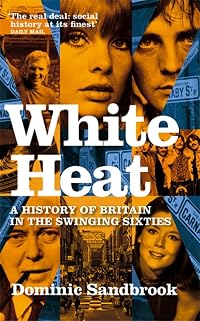
White Heat: A History of Britain in the Swinging Sixties
by Dominic Sandbrook
Sandbrook's A History of Britain (2)
On This Page
Description
Harold Wilson's famous reference to 'white heat' captured the optimistic spirit of a society in the midst of breathtaking change. From the gaudy pleasures of Swinging London to the tragic bloodshed in Northern Ireland, from the intrigues of Westminster to the drama of the World Cup, British life seemed to have taken on a dramatic new momentum. The memories, images and colourful personalities of those heady times still resonate today: mop-tops and mini-skirts, strikes and demonstrations, show more Carnaby Street and Kings Road, Harold Wilson and Edward Heath, Mary Quant and Jean Shrimpton, Enoch Powell and Mary Whitehouse, Marianne Faithfull and Mick Jagger. In this wonderfully rich and readable historical narrative, Dominic Sandbrook looks behind the myths of the Swinging Sixties to unearth the contradictions of a society caught between optimism and decline. show lessTags
Recommendations

















Member Reviews
A worthy slog through half - only half! - of the 1960s, which took me two attempts to finish but was well worth the effort. For someone who wasn't there to remember this decade, I found Dominic Sandbrook's thread to the needle eye approach very informative - mixing chapters on Harold Wilson and Northern Ireland with the Beatles, Stones and 'Swinging London', Sandbrook presents all the important aspects of life in Britain in a cool and clear style. His motto seems to be: don't believe everything you're told. Only the well-off seem to have really lived through the cliches: dolly birds, alternative society, flower power, sexual liberation. Most of the country just carried on regardless, from the late 50s into the early 70s.
The 60s was a show more decade of two halves - consumerism and the 'white heat' of Harold Wilson's promises for the future, much like Tony Blair and Labour in the 1990s, and then the reality, with deflation, devaluation, racism, sexism and fighting in Ireland. Some of the chapters bored me - economics, politics, unions - but the full picture of life for ordinary men and women is engrossing. Wilson's government did see in a lot of positive changes, but the infighting in the Labour party was almost farcical, with drunken George Brown and fierce Barbara Castle, and the economy was completely out of control (the more things change ...) Enoch Powell's racist campaign to stop - and even reverse - immigration is still shocking, but I was more taken aback by how domesticated women were expected to be, and by the fact that Jimmy Saville was once on a board of inquiry into pornography!
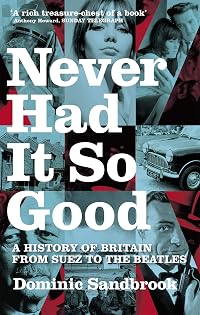
Each chapter is just long enough to give a potted history of the subject without being (too) boring, and there is a bibliography for readers who want to learn more. Not to mention Never Had It So Good by the same author, covering the first half of the decade! show less
The 60s was a show more decade of two halves - consumerism and the 'white heat' of Harold Wilson's promises for the future, much like Tony Blair and Labour in the 1990s, and then the reality, with deflation, devaluation, racism, sexism and fighting in Ireland. Some of the chapters bored me - economics, politics, unions - but the full picture of life for ordinary men and women is engrossing. Wilson's government did see in a lot of positive changes, but the infighting in the Labour party was almost farcical, with drunken George Brown and fierce Barbara Castle, and the economy was completely out of control (the more things change ...) Enoch Powell's racist campaign to stop - and even reverse - immigration is still shocking, but I was more taken aback by how domesticated women were expected to be, and by the fact that Jimmy Saville was once on a board of inquiry into pornography!
Each chapter is just long enough to give a potted history of the subject without being (too) boring, and there is a bibliography for readers who want to learn more. Not to mention Never Had It So Good by the same author, covering the first half of the decade! show less
I was 10 years old in 1964 and 17 years old in 1970, so I grew up, or at least was a teenager in the period covered by this book. The focus here is very much on the political history and social history of the country, with Harold Wilson very much at the heart of things.
The political history here is fascinating and very intimate. Sandbrook has drawn from a number of personal diaries to help make us feel we are in the room as events unfold. In general Sandbrook tells the story straight without going into too many what-if’s and what-they-should-have-done’s.
I think the social history sections of the book suffer the most from hindsight. The appreciation of styles in popular fashion, books or music can be very subjective and I certainly show more see the 1960s differently to Sandbrook through my particular rose-tinted glasses. The rise of pop/rock music is handled very thoroughly (if a little bleakly). The literature sections are good, but there could have been much more on the pulpier side of the book trade; I remember my local bookshop being full of classic science fiction and that genre having much greater prominence than it does today.
This is a detailed history with a very broad scope, which is why it runs to nearly 900 pages of dense text. The book is easy to read (no academic jargon) with a strong narrative flow. It should appeal to the casual reader with an interest in the period, but I think the length will put people off. show less
The political history here is fascinating and very intimate. Sandbrook has drawn from a number of personal diaries to help make us feel we are in the room as events unfold. In general Sandbrook tells the story straight without going into too many what-if’s and what-they-should-have-done’s.
I think the social history sections of the book suffer the most from hindsight. The appreciation of styles in popular fashion, books or music can be very subjective and I certainly show more see the 1960s differently to Sandbrook through my particular rose-tinted glasses. The rise of pop/rock music is handled very thoroughly (if a little bleakly). The literature sections are good, but there could have been much more on the pulpier side of the book trade; I remember my local bookshop being full of classic science fiction and that genre having much greater prominence than it does today.
This is a detailed history with a very broad scope, which is why it runs to nearly 900 pages of dense text. The book is easy to read (no academic jargon) with a strong narrative flow. It should appeal to the casual reader with an interest in the period, but I think the length will put people off. show less
Another outstanding entry in Dominic Sandbrook's history of post-war Britain. Sandbrook tackles every issue of the day and does an excellent job of following Harold Wilson's government from election success to sudden collapse.
As with Never Had It So Good, the pop culture of the day is given plenty of space and analysis. The Rolling Stones' rise from a little-known blues group to the bad boys of British rock is a fascinating read in itself and Sandbrook also takes on the myth that everyone in the UK drove a Mini, took copious amounts of drugs and slept around.
I've read that there is a third volume in the works and I cannot wait to read it.
As with Never Had It So Good, the pop culture of the day is given plenty of space and analysis. The Rolling Stones' rise from a little-known blues group to the bad boys of British rock is a fascinating read in itself and Sandbrook also takes on the myth that everyone in the UK drove a Mini, took copious amounts of drugs and slept around.
I've read that there is a third volume in the works and I cannot wait to read it.
Over 740 pages of small type but was it worth it...Absolutely yes. A follow up to his first volume covering 1956 to 1963, this one finished in 1970. And yes, there will be further volumes. The coverage of the politics of the period is first rate as is his analysis of music, films and literature of the period. Can recommend this without reservation.
Deep dive--1400+ pages--into British history from 1964-70. More politics than I need, but truly a treasure trove.
Ratings
Members
- Recently Added By
Author Information

38+ Works 1,818 Members
Series

Common Knowledge
- Original publication date
- 2006
Classifications
- Genres
- History, Nonfiction, General Nonfiction
- DDC/MDS
- 941.0856 — History & geography History of Europe British Isles Historical periods of British Isles 1837- Period of Victoria and House of Windsor 1945-1999 1960-1969
- LCC
- DA589.4 .S269 — History of Europe, Asia, Africa and Oceania Great Britain History of Great Britain England History By period Modern, 1485- 20th century
- BISAC
Statistics
- Members
- 273
- Popularity
- 118,768
- Reviews
- 5
- Rating
- (4.17)
- Languages
- English
- Media
- Paper, Audiobook, Ebook
- ISBNs
- 3
- ASINs
- 4