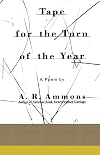
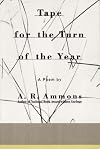
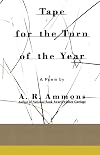
Tape for the Turn of the Year
by A. R. Ammons
On This Page
Description
In the form of a journal covering the period December 6, 1963, through January 10, 1964, A. R. Ammons’s long, thin poem was written on a roll of adding-machine tape, then transferred foot by foot to manuscript. He chose this method as a serious experiment in making a poem adapt to something outside itself. The tape determined both the length of the poem’s lines and when it ends. Tape for the Turn of the Year is a poem of infinite variety, blessed by the rich resources of one of this show more century’s greatest poets. By turns witty, serious, lyrical, and meditative, it is at once a superbly entertaining book and a significant literary achievement. show lessTags
Recommendations
















Member Reviews
The Material of Writing Before Materiality
Materiality, material culture, object-oriented ontology, thing studies, actor-network theory -- these are all kinds of theories that pay attention to the thingness of the thing: the physical book, the paper, pages, weight, and texture. My own project, Writing with Images, impinges on these topics whenever I find myself studying texts where the book itself is part of the work's expressive purpose. Anne Carson's "Nox" is an example. (I've written on that at some length in writingwithimages.com.)
Books like these are increasingly common, but they have earlier precedents. An interesting one is A.R. Ammons's "Tape for the Turn of the Year," which was typed on a single roll of adding-machine tape. As show more far as I can discover (I haven't called Cornell, which has the original reel), there is no scan of the tape, and no facsimile edition. The book transcribes the tape, so we don't see the original monospace typewriter font, and we can only imagine the edges of the reel on both sides of the irregularly formatted text. A typical passage:
1:26 pm:
I feel a little
shivery :
the cold's making--
forgive me--headway :
but I just had a baked ham
sandwich, glass of milk &
coffee,
that to be
transformed into
whatever ammunition
it can :
after this,
this long poem, I hope I
can do short rich hard
lyrics : lines
that can incubate
slowly
then fall into
symmetrical tangles :
lines that can be
gone over (and over)
till they sing with
pre-established rightness :
here, I plug on :
whatever the Muse
gives, I release [p. 143]
The wide margins conjure the invisible constraints Ammons gave himself, and he also writes intermittently about the roll itself, which is slowly unfurling, and how he re-rolls in an ashtray. Ammons may have known about Kerouac's "On the Road" scroll, done in the 1950s, and it is barely possible he knew about some of the early Fluxus experiments -- but my guess is he didn't know either. He was part-time at Cornell University at the time, and his points of reference are writers such as William Carlos Williams, Robert Lowell, Allen Ginsberg, Walt Whitman, and Robert Penn Warren.
All that is by way of explaining why it may never have occurred to Ammons to print a facsimile in monospace font with the tape made explicitly visible. He did have an interest in painting, and exhibited several times, but as I imagine it he wouldn't have thought that an image of the typewriter's embossed imprint, or even the red margins signalling the end of the tape is approaching (which he mentions several times; the red margins would have been visible at the center of the coiled tape roll as he worked) would have served any purpose except distracting readers from his voice. On the other hand, as the reader is reminded on every page, the project has a certain duration, requires specific arrangements (he unspools the tape at one point in order to take it with him on a trip out of town), and constrains every thought between its invisible margins. It is therefore a different kind of materiality, one that represents the physical stuff in words rather than images. It's an interesting kind of awareness of the material, unlike the literalism of today's theories, and immune from the preciousness that comes along with high-resolution color scans (as in Carson's book). When he asks himself
why do I need to throw
this structure
against the flow
which I cannot stop?
is there something
unyielding in me that
can't accept
the passing away of days [p. 87]
he doesn't mean the "structure" of the tape, its spools, his typewriter. He means the structure formed by their constraints, as they are represented in the book. That is a crucial, and I think moderate, ambitious, and sensible, alternative to today's insistence on the stuff itself, its mass, its weight, its look.
(As a poem, "Tape for the Turn of the Year" feels as though it is in the first wave of postmodernism. It is almost unedited; it contains all sorts of unpolished thoughts, including elephant jokes (haven't heard those since I was a child) and space- or time-filling observations, which he excuses by invoking the absence of the Muse. It also has flight of invention, and a wonderful, in the end entirely winning, mode of address to the reader ("reader, we've been thru / a lot together : / who are you?" p. 200). It's as memorable a high-wire act now as it was when I first read it, when Ammons was younger than I am now.) show less
Materiality, material culture, object-oriented ontology, thing studies, actor-network theory -- these are all kinds of theories that pay attention to the thingness of the thing: the physical book, the paper, pages, weight, and texture. My own project, Writing with Images, impinges on these topics whenever I find myself studying texts where the book itself is part of the work's expressive purpose. Anne Carson's "Nox" is an example. (I've written on that at some length in writingwithimages.com.)
Books like these are increasingly common, but they have earlier precedents. An interesting one is A.R. Ammons's "Tape for the Turn of the Year," which was typed on a single roll of adding-machine tape. As show more far as I can discover (I haven't called Cornell, which has the original reel), there is no scan of the tape, and no facsimile edition. The book transcribes the tape, so we don't see the original monospace typewriter font, and we can only imagine the edges of the reel on both sides of the irregularly formatted text. A typical passage:
1:26 pm:
I feel a little
shivery :
the cold's making--
forgive me--headway :
but I just had a baked ham
sandwich, glass of milk &
coffee,
that to be
transformed into
whatever ammunition
it can :
after this,
this long poem, I hope I
can do short rich hard
lyrics : lines
that can incubate
slowly
then fall into
symmetrical tangles :
lines that can be
gone over (and over)
till they sing with
pre-established rightness :
here, I plug on :
whatever the Muse
gives, I release [p. 143]
The wide margins conjure the invisible constraints Ammons gave himself, and he also writes intermittently about the roll itself, which is slowly unfurling, and how he re-rolls in an ashtray. Ammons may have known about Kerouac's "On the Road" scroll, done in the 1950s, and it is barely possible he knew about some of the early Fluxus experiments -- but my guess is he didn't know either. He was part-time at Cornell University at the time, and his points of reference are writers such as William Carlos Williams, Robert Lowell, Allen Ginsberg, Walt Whitman, and Robert Penn Warren.
All that is by way of explaining why it may never have occurred to Ammons to print a facsimile in monospace font with the tape made explicitly visible. He did have an interest in painting, and exhibited several times, but as I imagine it he wouldn't have thought that an image of the typewriter's embossed imprint, or even the red margins signalling the end of the tape is approaching (which he mentions several times; the red margins would have been visible at the center of the coiled tape roll as he worked) would have served any purpose except distracting readers from his voice. On the other hand, as the reader is reminded on every page, the project has a certain duration, requires specific arrangements (he unspools the tape at one point in order to take it with him on a trip out of town), and constrains every thought between its invisible margins. It is therefore a different kind of materiality, one that represents the physical stuff in words rather than images. It's an interesting kind of awareness of the material, unlike the literalism of today's theories, and immune from the preciousness that comes along with high-resolution color scans (as in Carson's book). When he asks himself
why do I need to throw
this structure
against the flow
which I cannot stop?
is there something
unyielding in me that
can't accept
the passing away of days [p. 87]
he doesn't mean the "structure" of the tape, its spools, his typewriter. He means the structure formed by their constraints, as they are represented in the book. That is a crucial, and I think moderate, ambitious, and sensible, alternative to today's insistence on the stuff itself, its mass, its weight, its look.
(As a poem, "Tape for the Turn of the Year" feels as though it is in the first wave of postmodernism. It is almost unedited; it contains all sorts of unpolished thoughts, including elephant jokes (haven't heard those since I was a child) and space- or time-filling observations, which he excuses by invoking the absence of the Muse. It also has flight of invention, and a wonderful, in the end entirely winning, mode of address to the reader ("reader, we've been thru / a lot together : / who are you?" p. 200). It's as memorable a high-wire act now as it was when I first read it, when Ammons was younger than I am now.) show less
Ratings
Members
- Recently Added By
Author Information

37+ Works 1,817 Members
Archie Randolph Ammons, 1926 - Poet and teacher A. R. Ammons was born in North Carolina in 1926. He served his country during World War II aboard a U.S. Navy destroyer escort in the South Pacific, which is where he began writing poetry. After he returned from duty, he attended Wake Forest College, North Carolina and the University of California, show more Berkley. He began teaching at Cornell University in 1964 and, in 1971, became a Goldwin Smith Professor of Poetry there. Ammons has authored nearly 30 books of poetry and some of those titles include "Garbage" (1993), which won the National Book Award and the Library of Congress's Rebekah Johnson Bobbitt National Prize for Poetry; "A Coast of Trees" (1981), which received the national Book Critics Circle Award for Poetry; "Sphere" (1974), which received the Bollingen Prize; and "Collected Poems 1951-1971" (1972), which won the National Book Award. Other honors include the Academy's Tanning Prize, the Poetry Society of America's Robert Frost Medal and the Ruth Lilly Prize. He has also received fellowships from the Guggenheim Foundation, the MacArthur Foundation, and the American Academy of Arts and Letters. Archie Randolph Ammons died on February 25, 2001. (Bowker Author Biography) show less
Classifications
Statistics
- Members
- 103
- Popularity
- 315,190
- Reviews
- 1
- Rating
- (4.06)
- Languages
- English
- Media
- Paper, Ebook
- ISBNs
- 5
- ASINs
- 3