
Billy Collins
Author of Sailing Alone Around the Room: New and Selected Poems
About the Author
Billy Collins has published six collections of poetry, including Questions About Angels and The Art of Drowning, Picnic, Lightning, his latest, sold more than 25,000 copies in its first year. He teaches at Lehman College of the City University of New York and at Sarah Lawrence College. He was named show more U.S. Poet Laureate in June 2000. (Bowker Author Biography) Billy Collins was born in New York City in 1941. He earned a BA from the College of the Holy Cross, and both an MA and PhD from the University of California-Riverside. Collins conducted summer poetry workshops at University College Galway and is the Poet in Residence at Burren College of Art in Ireland. He is also a professor of English at Lehman College (CUNY). In 1992, Collins was chosen to be the Literary Lion of the New York Public Library. He was named U.S. Poet Laureate in 2001 and held the title until 2003. Collins then served as Poet Laureate for the State of New York from 2004 until 2006. His poetry has appeared in anthologies, textbooks and periodicals including Poetry, The American Poetry Review, The American scholar, Harper's, The Paris Review and The New Yorker. He is the author of six books of poetry including "The Art of Drowning." His poems have also been selected to appear in The Best American Poetry of 1992, 1993 and 1997. His works have won various awards including the Bess Hokin Prize, the Frederick Bock Prize, the Oscar Blumenthal Prize and the Levinson Prize, all awarded by Poetry. He has received fellowships from the New York Foundation for the Arts, the National Endowment for the Arts and the Guggenheim Foundation. His collection of poems entitled Aimless Love made numerous best-seller lists in 2013. (Bowker Author Biography) show less
Image credit: Johns Hopkins Center for Talented Youth/Charles Beckman
Works by Billy Collins
Associated Works
Poetry Speaks to Children, Read & Hear [book & CD] (2005) — Guest, some editions — 672 copies, 16 reviews
The Book That Changed My Life: 71 Remarkable Writers Celebrate the Books That Matter Most to Them (2006) — Contributor — 411 copies, 18 reviews
The Spoken Word Revolution: Slam, Hip Hop, and the Poetry of a New Generation (2003) — Introduction, some editions — 248 copies
Teaching with Fire: Poetry That Sustains the Courage to Teach (2003) — Contributor — 223 copies, 1 review
The Poetry Pharmacy: Tried-and-True Prescriptions for the Heart, Mind, and Soul (2017) 196 copies, 5 reviews
From Totems to Hip-Hop: A Multicultural Anthology of Poetry Across the Americas 1900-2002 (2002) — Contributor — 182 copies
Eat, Memory: Great Writers at the Table: A Collection of Essays from the New York Times (2008) — Contributor — 180 copies, 6 reviews
The Year's Best Fantasy and Horror 2008: 21st Annual Collection (2008) — Contributor — 177 copies, 5 reviews
Light the Dark: Writers on Creativity, Inspiration, and the Artistic Process (2017) — Contributor — 162 copies, 5 reviews
Poetry Speaks Expanded: Hear Poets Read Their Own Work from Tennyson to Plath (2007) — Contributor — 157 copies, 2 reviews
Answering Back: Living Poets Reply to the Poetry of the Past (2007) — Contributor — 118 copies, 1 review
Leading from Within: Poetry That Sustains the Courage to Lead (2007) — Contributor — 114 copies, 3 reviews
Bullets Into Bells: Poets and Citizens Respond to Gun Violence (2017) — Contributor — 68 copies, 3 reviews
Best of The Oxford American: Ten Years from the Southern Magazine of Good Writing {anthology} (2002) — Contributor — 45 copies
Tagged
Common Knowledge
- Legal name
- Collins, William James
- Birthdate
- 1941-03-22
- Gender
- male
- Education
- College of the Holy Cross (BA, 1963)
University of California, Riverside (PhD) - Occupations
- professor (English)
visiting writer
poet - Organizations
- Lehman College
Sarah Lawrence College - Awards and honors
- US Poet Laureate (2001-2003)
New York State Poet (2004)
New York Public Library Literary Lion (1992)
Aiken Taylor Award (2011)
Frederick Bock Award (1992) - Nationality
- USA
- Birthplace
- New York, New York, USA
- Associated Place (for map)
- New York, USA
Members
Reviews

40 poems in 90 pages, organized in 4 sections. My plan was to read a section per day - and then I realized I was reading the last poem - I could not stop. It was a part of one of the first poems in this collection, called "Pulp Fiction", that seems to hold at least some of the keys to the whole collection (or even the author):
"It's been said that the truth will set you free,
but whenever I speak the truth no one believes it,
and whenever I hear the truth it makes me feel like a prisoner
on show more death row.
So, I tell stories to keep the truth alive without telling it.
So I create truth to keep me from becoming history:"
And that the whole collection is all about - a (semi-)autobiographic parts and invented pasts and futures merge with bizarre landscapes and images (nothing scarier than what Barbie may be thinking while sitting in her dollhouse). And all of them require just words - Padua doesn't play with the form of the poems or their position on the page - you don't need to see it (as many modern poets seem to require you to these days) and you don't need to try to decipher the line breaks and weird stops.
But then, he is a veteran of the New York's spoken-word literary scene (as the very short biography at the end of the book will tell you) and that explains a lot. These are not exercises of poetic form and invention - these are poems to tell people, stories in a poetic form. It is also nice to have a collection which is rooted in society and the present but without retelling you the news or containing all the rage towards the present (although there is some rage in the poems but there is also a lot of hope).
Billy Collins, the editor of the collection and the judge for the prize it won, has a very nice introduction both about the contest and about this collection. But don't read it before you read the collection -- I am so used to not trusting introduction that I skipped it and came back (and then reread the collection again after that). show less
"It's been said that the truth will set you free,
but whenever I speak the truth no one believes it,
and whenever I hear the truth it makes me feel like a prisoner
on show more death row.
So, I tell stories to keep the truth alive without telling it.
So I create truth to keep me from becoming history:"
And that the whole collection is all about - a (semi-)autobiographic parts and invented pasts and futures merge with bizarre landscapes and images (nothing scarier than what Barbie may be thinking while sitting in her dollhouse). And all of them require just words - Padua doesn't play with the form of the poems or their position on the page - you don't need to see it (as many modern poets seem to require you to these days) and you don't need to try to decipher the line breaks and weird stops.
But then, he is a veteran of the New York's spoken-word literary scene (as the very short biography at the end of the book will tell you) and that explains a lot. These are not exercises of poetic form and invention - these are poems to tell people, stories in a poetic form. It is also nice to have a collection which is rooted in society and the present but without retelling you the news or containing all the rage towards the present (although there is some rage in the poems but there is also a lot of hope).
Billy Collins, the editor of the collection and the judge for the prize it won, has a very nice introduction both about the contest and about this collection. But don't read it before you read the collection -- I am so used to not trusting introduction that I skipped it and came back (and then reread the collection again after that). show less
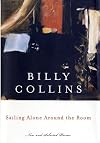
We locate an adjective for the weather.show more
We announce that we are having a wonderful time.
We express the wish that you were here
and hide the wish that we were where you are,
walking back from the mailbox, your head lowered
as you read and turn the thin message in your hands.
A slice of this place, a length of white beach,
a piazza or carved spires of a cathedral
will pierce the familiar place where you remain,
and you will toss on the table this reversible display:
a few square inches of where we
have strayed
and a compression of what we feel.
-from "American Sonnet"
In fairness, I should probably not have given Mr. Collins his second chance while I was taking a break from Marlon James' [b:Black Leopard, Red Wolf|40524312|Black Leopard, Red Wolf (The Dark Star Trilogy, #1)|Marlon James|https://images.gr-assets.com/books/1538656386s/40524312.jpg|48215793], giving that man's words the space and rest to hurt me really properly. Nor should I have picked up this small volume immediately after finishing Roz Chast's meditation on her parents' dying days in [b:Can't We Talk about Something More Pleasant?|18594409|Can't We Talk about Something More Pleasant?|Roz Chast|https://images.gr-assets.com/books/1421087235s/18594409.jpg|26340807]. But I have thirteen books out from the library and this seemed an easy one to get off the stack, and I really did need a break from Mr. James' wonderful-so-far book. So that is the state of your humble reviewer, a caveat in case any of you commit the folly of taking my not always humble opinion into account in what you read. Another caveat would be that when I find myself wishing a not so fond 'fuck you' to the poet in the midst of multiple poems, I think it best for all involved if I stop. Hence the DNF.
What has poor Mr. Collins done to earn such an impolite response? Perhaps not so much, besides waste my time and his. His poems are, after all, workmanlike examples of the craft, harmless meditations on teaching, chopping wood, the nature of reading and poetry, his parents deaths, all the waitpersons he's ever met and their someday deaths, and such. It's just that there's poetry for the sake of constructing a poem, issuing a musing (very like writing a postcard, I freely admit!), and then there's living a poem, tearing the words out of the desolation of life and death and bleeding them, sweating them into the shape of flame. To put it a different way, my very favorite poet right now is a stewardess who pours her struggles with identity, love, and her mother into beautiful burning meditations on her Tumblr, and her least trope would set Mr. Collins on fire. She won't ever be poet laureate. I doubt she'd even want to. She probably won't ever have a book of collected poems for me to set my five shining stars on. Maybe she wouldn't want that either. But I am the tiniest bit bitter about it.
Anyway, Mr. Collins and his poems are not horrible. He has his moments. (I see all of us reading ourselves away from ourselves,/straining in circles of light to find more light is brilliant! If only the rest of the poem were as good! A whole book of that, I would gladly crown with starlight!) But on the whole, if you want poetry, find you some real poetry. This is just postcards from where poetry is supposed to live. show less
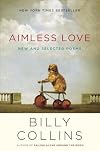
When they speak of the perfection of language, the power in a word, surely they are speaking about Billy Collins.
The everyday notice of the working poet.
The punch clock ignored and time stopped
for that insightful moment when meaning, great meaning,
is revealed.
The everyday becomes transcendent.
The nondenominational exalted.
The study of minor things.
Reflective moments that point to larger meaning.
A lost chesspiece, missed.
A paper cup.
Wind ripping thru thinning hair.
The remarkable show more differences inherent in an ordinary event,
a common occurance.
Noted with clarity — the importance of a gesture.
When the poem doesn’t work it is just a little off,
a frame not quite true.
More often the spark is bright and pure.
Take aim.
Billy Collins is always bright and pure. show less
The everyday notice of the working poet.
The punch clock ignored and time stopped
for that insightful moment when meaning, great meaning,
is revealed.
The everyday becomes transcendent.
The nondenominational exalted.
The study of minor things.
Reflective moments that point to larger meaning.
A lost chesspiece, missed.
A paper cup.
Wind ripping thru thinning hair.
The remarkable show more differences inherent in an ordinary event,
a common occurance.
Noted with clarity — the importance of a gesture.
When the poem doesn’t work it is just a little off,
a frame not quite true.
More often the spark is bright and pure.
Take aim.
Billy Collins is always bright and pure. show less
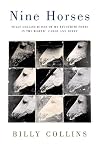
In Nine Horses, renown poet Billy Collins explores the little things we all experience in life, using an effective blend of conversational clarity and surprising turn-of-phrase to examine the everyday world—traveling, reading, domestic occurrences, memory—with a gentle sense of humor and wonder. The poems focus on ordinary experiences (a train ride, a day at the beach, a birthday gift, a walk in the woods), but often move into reflections on larger issues, such as time, mortality, and show more identity. The author invites the reader to see how small things carry hidden meanings, how language both reveals and conceals, and how we live our lives almost unknowingly.
Throughout the volume, you get the definite sense of the poet as an observer—and sometimes as both narrator and participant—moving through snapshots of life with wit, elegiac sentiments, and a deft twist of metaphor. There is also a recurring tension between what is present and what is absent: the tangible world we touch and the mystery behind it that we do not see. In that regard, the entire book feels less like a linear march from beginning to end and more like a collection of meditations on staying still long enough to notice and remember all the little moments that end up being so important.
I really should confess that I do not ordinarily read a lot of poetry and that this is the first collection of Collins’ work that I have encountered. (Thanks, by the way, to my book club for suggesting this as a departure from our usual literary fare.) So, I was probably more surprised than I should have been at the cadence and style the author chose to capture his thoughts in each of these poems. Also, I was not expecting how funny many of them were. While each of the more than four dozen entries in the volume merits attention, I did have my favorites, including “Royal Aristocrat”, “Love”, “Creatures”, “Study in Orange and White”, “Litany”, “To My Patron”, and “Balsa”. Nine Horses certainly will not be my last foray into Collins’ comforting and engaging world. show less
Throughout the volume, you get the definite sense of the poet as an observer—and sometimes as both narrator and participant—moving through snapshots of life with wit, elegiac sentiments, and a deft twist of metaphor. There is also a recurring tension between what is present and what is absent: the tangible world we touch and the mystery behind it that we do not see. In that regard, the entire book feels less like a linear march from beginning to end and more like a collection of meditations on staying still long enough to notice and remember all the little moments that end up being so important.
I really should confess that I do not ordinarily read a lot of poetry and that this is the first collection of Collins’ work that I have encountered. (Thanks, by the way, to my book club for suggesting this as a departure from our usual literary fare.) So, I was probably more surprised than I should have been at the cadence and style the author chose to capture his thoughts in each of these poems. Also, I was not expecting how funny many of them were. While each of the more than four dozen entries in the volume merits attention, I did have my favorites, including “Royal Aristocrat”, “Love”, “Creatures”, “Study in Orange and White”, “Litany”, “To My Patron”, and “Balsa”. Nine Horses certainly will not be my last foray into Collins’ comforting and engaging world. show less
Lists
Awards


You May Also Like


Associated Authors
Statistics
- Works
- 42
- Also by
- 53
- Members
- 12,758
- Popularity
- #1,837
- Rating
- 4.0
- Reviews
- 260
- ISBNs
- 123
- Languages
- 4
- Favorited
- 73

