
Tony Hoagland (1953–2018)
Author of What Narcissism Means to Me: Poems
About the Author
Anthony Dey Hoagland was born at Fort Bragg, North Carolina on November 19, 1953. He received a bachelor's degree in general studies from the University of Iowa and a master of fine arts degree from the University of Arizona. His first poetry collection, Sweet Ruin, was published in 1992. His other show more collections of poetry included What Narcissism Means to Me, Unincorporated Persons in the Late Honda Dynasty, Real Sofistikashun, Twenty Poems That Could Save America and Other Essays, and Priest Turned Therapist Treats Fear of God. He taught at the University of Houston. He died from pancreatic cancer on October 23, 2018 at the age of 64. (Bowker Author Biography) show less
Works by Tony Hoagland
Associated Works
The Best American Poetry 2014 (The Best American Poetry series) (2014) — Contributor — 89 copies, 1 review
Orpheus and Company: Contemporary Poems on Greek Mythology (1999) — Contributor — 52 copies, 1 review
Editor's Choice II: Fiction, Poetry & Art from the U.S. Small Press, 1978 to 1983 (Contemporary Anthology Series) (1987) — Contributor — 6 copies
Tagged
Common Knowledge
- Legal name
- Hoagland, Anthony Dey
- Birthdate
- 1953-11-19
- Date of death
- 2018-10-23
- Gender
- male
- Education
- Williams College
University of Iowa
University of Arizona - Occupations
- poet
- Awards and honors
- American Academy of Arts and Letters Academy Award (Literature, 2002)
- Nationality
- USA
- Birthplace
- Fort Bragg, North Carolina, USA
- Place of death
- Santa Fe, New Mexico, USA
- Associated Place (for map)
- USA
Members
Reviews
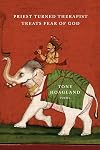
Published just four months before his death, this volume demonstrates [a:Tony Hoagland|78570|Tony Hoagland|https://images.gr-assets.com/authors/1408734157p2/78570.jpg]'s satire, his humor, and even his hope:
"My heroes are the ones who don’t say much.
They don’t hug people they just met.
They don’t play louder when confused.
They use plain language even when they listen."
"Wisdom doesn’t come to every Californian.
Chances are I too will die with difficulty in the dark."
Or from “Which show more Would You Prefer, A Story or an Explanation?”
“I can’t tell the difference between inner peace and mild depression, / writes her friend from Philadelphia, in small blue script / on the back of a postcard of Chagall.”
and my favorite, “Hope:”
“I didn’t belong in the Twenty-First Century. / I didn’t belong anywhere anymore. / I sat in my old-fashioned kitchen / staring at the green Formica counter. / That’s when the butterfly floated through the window, / and landed on the artificial flower.” show less
"My heroes are the ones who don’t say much.
They don’t hug people they just met.
They don’t play louder when confused.
They use plain language even when they listen."
"Wisdom doesn’t come to every Californian.
Chances are I too will die with difficulty in the dark."
Or from “Which show more Would You Prefer, A Story or an Explanation?”
“I can’t tell the difference between inner peace and mild depression, / writes her friend from Philadelphia, in small blue script / on the back of a postcard of Chagall.”
and my favorite, “Hope:”
“I didn’t belong in the Twenty-First Century. / I didn’t belong anywhere anymore. / I sat in my old-fashioned kitchen / staring at the green Formica counter. / That’s when the butterfly floated through the window, / and landed on the artificial flower.” show less
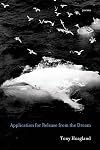
i enjoy Tony Hoagland's poetry. I started with his exceptional What Narcissism Means to Me ("No longer do I live by the law of me,/ No longer having the excuse of youth or craziness,/ And dying you know shows a serious ingratitude/ For sunsets and beehive hairdos and the precious green corrugated/ Pickles they place at the edge of your plate"). This new one, Application for Release from the Dream, is another standout. He's a playful poet, and there's a wistfulness here for what has been lost show more both personally (particularly his failed marriage) and more widely. In his "Ode to the Republic", he sees the positive in America's diminished stature - "It's good to be unimportant . . . There are worse things than being/ second burrito".
On the personal level, "a third choice exists/ between resignation and/ going around the bend . . ." That choice may be accepting our and the world's limitations. "What kind of idiot would think he even had a destiny?"
"The flaring force of this thing we call identity
as if it were a message, a burning coal
one carries in one’s mouth for sixty years,
for delivery
to whom, exactly; to where?”
He takes his own measure with a glint of humor: "All those years I kept trying and failing and trying/ to find my one special talent in this life--/ Why did it take me so long to figure out/ that my special talent was trying?"
Try reading some Tony Hoagland poetry. show less
On the personal level, "a third choice exists/ between resignation and/ going around the bend . . ." That choice may be accepting our and the world's limitations. "What kind of idiot would think he even had a destiny?"
"The flaring force of this thing we call identity
as if it were a message, a burning coal
one carries in one’s mouth for sixty years,
for delivery
to whom, exactly; to where?”
He takes his own measure with a glint of humor: "All those years I kept trying and failing and trying/ to find my one special talent in this life--/ Why did it take me so long to figure out/ that my special talent was trying?"
Try reading some Tony Hoagland poetry. show less
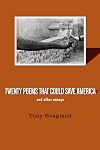
Tony Hoagland, Twenty Poems That Could Save America and Other Essays
Oh Tony, how I loved reading this book! This is Hoaglands second collection of essays. I read the first, Real Sofistikashun, and don’t remember being so bowled over, but perhaps I’ll read it again. At a different time of life, the same book seem a different book entirely.
The first few essays in Twenty Poems That Could Save America (even their titles excite me) concern diction, idiom (he’s all for common speech — show more think William Stafford, Billy Collins) — the shape and structure of poems, and their effects.
— Je Suis ein Americano: The Genius of American Diction
— Idiom, Our Funny Valentine
— Litany, Game, and Representation: Charting the Course from the Old to the New Poetry
— Poetic Housing: Shifting Parts and Changing Wholes
— Facts and Feelings: Information, Layering, and the Composite Poem
— Vertigo, Recognition, and Passionate Worldliness
These chapters are followed by several on specific poets, such as Dean Young; Frank O’Hara et al., Sharon Olds; Marie Howe, Jane Hirshfield, and Linda Gregg; and Bly. I was less interested in the chapters on specific poets. I liked best the one on Sharon Olds and least the one on Bly.
But the last, the title essay (which originally appeared in Harper’s online), about contemporary poetry and its potential (rightful?) place in American contemporary life, is the best and brightest. I wanted to underline everything. I have already reread more than once. Hoagland has strong opinions about the importance of language and poetry, how language has been co-opted and corrupted by business, politics, the media, and how its modern uses have made us distrustful — of language! It’s true.
I know that poets and critics are always going on about whether or not poetry is relevant to contemporary life and about how maligned poetry is. People I know don’t so much say they dislike it as that they don’t understand it. And, indeed, Hoagland maintains that many people think that poetry belongs to high culture and that they’re not clever enough to understand it or else that poetry just has nothing to say to them, nothing practical to say about the world.
As a remedy, Hoagland argues for an overhaul of the way poetry is taught in school, as well as a big change in the specific poems taught, so that poetry can be seen as contemporary and vital and full of meaning for ourselves, our country, the world. He believes that poetry can elevate our level of discourse, enrich us and our culture. He offers 20 poems that he believes have a lot to say to the citizens of contemporary America — not the only 20 such poems out there, but a selection. And they are wonderful. They reward many rereadings and endless musing.
Overall, a wonderful and passionate book about both the practice of poetry and the ways in which it can enrich our lives — "...for poetry is our common treasure house, and we need its aliveness, its respect for the subconscious, its willingness to entertain ambiguity; we need its plaintive truth telling about the human condition and its imaginative exhibitions of linguistic freedom, which confront the general culture's more grotesque manipulations. We need the emotional training sessions poetry conducts us through. We need its previews of coming attractions: heartbreak, survival, failure, endurance, understanding, more heartbreak."
Aslide: I was perplexed by the inclusion in Hoagland’s 20 of Whitman’s “I Heard the Learn’d Astronomer.” It’s a poem I’ve always disliked, but then I’m strongly opposed to championing anti-intellectualism. There’s a place for gazing at the stars, sure, but there’s also a place for learning. And how much more astounding the heavens, how much greater our wonder, when our gazing is informed by science! show less
Oh Tony, how I loved reading this book! This is Hoaglands second collection of essays. I read the first, Real Sofistikashun, and don’t remember being so bowled over, but perhaps I’ll read it again. At a different time of life, the same book seem a different book entirely.
The first few essays in Twenty Poems That Could Save America (even their titles excite me) concern diction, idiom (he’s all for common speech — show more think William Stafford, Billy Collins) — the shape and structure of poems, and their effects.
— Je Suis ein Americano: The Genius of American Diction
— Idiom, Our Funny Valentine
— Litany, Game, and Representation: Charting the Course from the Old to the New Poetry
— Poetic Housing: Shifting Parts and Changing Wholes
— Facts and Feelings: Information, Layering, and the Composite Poem
— Vertigo, Recognition, and Passionate Worldliness
These chapters are followed by several on specific poets, such as Dean Young; Frank O’Hara et al., Sharon Olds; Marie Howe, Jane Hirshfield, and Linda Gregg; and Bly. I was less interested in the chapters on specific poets. I liked best the one on Sharon Olds and least the one on Bly.
But the last, the title essay (which originally appeared in Harper’s online), about contemporary poetry and its potential (rightful?) place in American contemporary life, is the best and brightest. I wanted to underline everything. I have already reread more than once. Hoagland has strong opinions about the importance of language and poetry, how language has been co-opted and corrupted by business, politics, the media, and how its modern uses have made us distrustful — of language! It’s true.
I know that poets and critics are always going on about whether or not poetry is relevant to contemporary life and about how maligned poetry is. People I know don’t so much say they dislike it as that they don’t understand it. And, indeed, Hoagland maintains that many people think that poetry belongs to high culture and that they’re not clever enough to understand it or else that poetry just has nothing to say to them, nothing practical to say about the world.
As a remedy, Hoagland argues for an overhaul of the way poetry is taught in school, as well as a big change in the specific poems taught, so that poetry can be seen as contemporary and vital and full of meaning for ourselves, our country, the world. He believes that poetry can elevate our level of discourse, enrich us and our culture. He offers 20 poems that he believes have a lot to say to the citizens of contemporary America — not the only 20 such poems out there, but a selection. And they are wonderful. They reward many rereadings and endless musing.
Overall, a wonderful and passionate book about both the practice of poetry and the ways in which it can enrich our lives — "...for poetry is our common treasure house, and we need its aliveness, its respect for the subconscious, its willingness to entertain ambiguity; we need its plaintive truth telling about the human condition and its imaginative exhibitions of linguistic freedom, which confront the general culture's more grotesque manipulations. We need the emotional training sessions poetry conducts us through. We need its previews of coming attractions: heartbreak, survival, failure, endurance, understanding, more heartbreak."
Aslide: I was perplexed by the inclusion in Hoagland’s 20 of Whitman’s “I Heard the Learn’d Astronomer.” It’s a poem I’ve always disliked, but then I’m strongly opposed to championing anti-intellectualism. There’s a place for gazing at the stars, sure, but there’s also a place for learning. And how much more astounding the heavens, how much greater our wonder, when our gazing is informed by science! show less
Published just four months before his death, this volume demonstrates [a:Tony Hoagland|78570|Tony Hoagland|https://images.gr-assets.com/authors/1408734157p2/78570.jpg]'s satire, his humor, and even his hope:
"My heroes are the ones who don’t say much.
They don’t hug people they just met.
They don’t play louder when confused.
They use plain language even when they listen."
"Wisdom doesn’t come to every Californian.
Chances are I too will die with difficulty in the dark."
Or from “Which show more Would You Prefer, A Story or an Explanation?”
“I can’t tell the difference between inner peace and mild depression, / writes her friend from Philadelphia, in small blue script / on the back of a postcard of Chagall.”
and my favorite, “Hope:”
“I didn’t belong in the Twenty-First Century. / I didn’t belong anywhere anymore. / I sat in my old-fashioned kitchen / staring at the green Formica counter. / That’s when the butterfly floated through the window, / and landed on the artificial flower.” show less
"My heroes are the ones who don’t say much.
They don’t hug people they just met.
They don’t play louder when confused.
They use plain language even when they listen."
"Wisdom doesn’t come to every Californian.
Chances are I too will die with difficulty in the dark."
Or from “Which show more Would You Prefer, A Story or an Explanation?”
“I can’t tell the difference between inner peace and mild depression, / writes her friend from Philadelphia, in small blue script / on the back of a postcard of Chagall.”
and my favorite, “Hope:”
“I didn’t belong in the Twenty-First Century. / I didn’t belong anywhere anymore. / I sat in my old-fashioned kitchen / staring at the green Formica counter. / That’s when the butterfly floated through the window, / and landed on the artificial flower.” show less
Lists
Awards


You May Also Like


Associated Authors
Statistics
- Works
- 22
- Also by
- 20
- Members
- 1,518
- Popularity
- #16,944
- Rating
- 3.9
- Reviews
- 24
- ISBNs
- 35
- Favorited
- 10