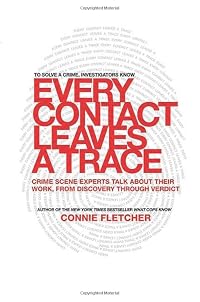
Every Contact Leaves a Trace: Crime Scene Experts Talk About Their Work from Discovery Through Verdict
by Connie Fletcher
On This Page
Description
Real crime scene investigation is vastly more complicated, arduous, bizarre, and fascinating than TV's streamlined versions. Most people who work actual investigations will tell you that the science never lies -- but people can. They may also contaminate evidence, or not know what to look for in crime scenes that typically are far more chaotic and confusing, whether inside or outside, than on TV. Forensic experts will tell you that the most important person entering a scene is the very first show more responding officer - the chain of evidence starts with this officer and holds or breaks according to what gets stepped on, or over, collected or contaminated, looked past, or looked over, from every person who enters or interprets the scene, all the way through the crime lab and trial. And forensic experts will tell you the success of a case can depend on any one expert's knowledge of quirky things, such as: "The Rule of the First Victim": (the first victim of a criminal usually lives near the criminal's home) Criminals' snacking habits at the scene"Nature's Evidence Technicians," the birds and rodents that hide bits of bone, jewelry, and fabric in their nestsThe botanical evidence found in criminals' pants cuffs Baseball caps as prime DNA repositoriesThe tales told by the application of physics to falling blood drops. Forensic experts talk about their expertise and their cases here. They also talk about themselves, their reactions to the horrors they witness, and their love of the work. For example, a DNA analyst talks about how she drives her family crazy by buccal-swabbing them all at Thanksgiving dinner. A latent print examiner talks about how he examines cubes of Jell-O at any buffet he goes to for tell-tale prints. A crime scene investigator gives his tips on clearing a scene of cops: he slaps "Bio-hazard" and "Cancer Causing Agent" stickers on his equipment. And an evidence technician talks about how hard it is to go to sleep after processing a scene, re-living what you've just witnessed, your mind going a hundred miles an hour. This is a world that TV crime shows can't touch. Here are eighty experts - including beat cops, evidence technicians, detectives, forensic anthropologists, blood spatter experts, DNA analysts, latent print examiners, firearms experts, trace analysts, crime lab directors, and prosecution and defense attorneys - speaking in their own words about what they've seen and what they've learned to journalist Connie Fletcher, who has gotten cops to talk freely in her bestsellers What Cops Know, Pure Cop, and Breaking and Entering. Every Contact Leaves A Trace presents the science, the human drama, and even the black comedy of crime scene investigation. Let the experts take you into their world. This is their book - their words, their knowledge, their stories. Through it all, one Sherlock Holmesian premise unites what they do and what it does to them: Every contact leaves a trace. show lessTags
Recommendations



Member Reviews
There is no "story" here, no unifying theme or grand scheme. It's just bits and pieces about the underlying premise that every contact at a crime scene leaves a trace of itself. Broken into nine chapters, the book covers crime scene processing, crime scene interpretation, trace evidence, evidence from bodies, DNA, what goes on in the crime lab, the reality of cold cases and the rigors of tesifying at trials.
In a way, the treatment is almost too light, not really providing detailed information about the various forensic disciplines examined. However, that may be a blessing since many of the disciplines are very, very complex.
Instead, Fletcher allows the real-life players to talk about their work, how it fits into the criminal justice show more process and their own feelings about being confronted with death and mayhem. Some of the interviewees were apparently not very articulate and the excerpts could have benefited from some editing.
On the whole, Fletcher provides a solid overview of forensics in the real world and demolishes without trying the myths perpetuated by CSI and other television concoctions. show less
In a way, the treatment is almost too light, not really providing detailed information about the various forensic disciplines examined. However, that may be a blessing since many of the disciplines are very, very complex.
Instead, Fletcher allows the real-life players to talk about their work, how it fits into the criminal justice show more process and their own feelings about being confronted with death and mayhem. Some of the interviewees were apparently not very articulate and the excerpts could have benefited from some editing.
On the whole, Fletcher provides a solid overview of forensics in the real world and demolishes without trying the myths perpetuated by CSI and other television concoctions. show less
This is so far the best book on forensic science I've read so far! I loved the personal accounts from the scientists, detectives, prosecutors, etc and what they really have to go through with their jobs. The humor was great too - loved the part about family pets eating their owners and why a cat will stare at you from across the room! Excellent book if you're into this stuff and I highly recommend it!
An interesting book.
This book gives first a counterbalance to the TV series with the same name as the book, which it is very pleasant, I must say.
Not that I'm dealing with police, forensics, etc., but still. The image you get from the series is biased and without you wanting it, you take those images along to what you hear about or see in the news about criminal cases.
So much for the comment on the background of the book.
The book is built logically, starting with the call to a crime scene and then further narrative about the steps that are taken. The people in the field are usually doing the talking in this book, preceded by an introduction. Although the stories are anonymous, they do voice the professional pride, frustration and even show more anger the reseachers and other people professionally connected to a case feel. Disruption of a crime scene by well-meaning police officers, lawyers, who make life hell for researchers when they are asked to present their findings in court.
Although the topic can not be classified as 'fun, I found it a very readable'and enjoyable book. A must for those interested in the subject. show less
This book gives first a counterbalance to the TV series with the same name as the book, which it is very pleasant, I must say.
Not that I'm dealing with police, forensics, etc., but still. The image you get from the series is biased and without you wanting it, you take those images along to what you hear about or see in the news about criminal cases.
So much for the comment on the background of the book.
The book is built logically, starting with the call to a crime scene and then further narrative about the steps that are taken. The people in the field are usually doing the talking in this book, preceded by an introduction. Although the stories are anonymous, they do voice the professional pride, frustration and even show more anger the reseachers and other people professionally connected to a case feel. Disruption of a crime scene by well-meaning police officers, lawyers, who make life hell for researchers when they are asked to present their findings in court.
Although the topic can not be classified as 'fun, I found it a very readable'and enjoyable book. A must for those interested in the subject. show less
Great book! I loved learning about forensic science in the words of the people who do it.
Excellent book. I feel like it gave a "human" side to the professions. I will be reading her other books soon!
Just skimmed through
Ratings
Members
- Recently Added By
Author Information
10 Works 386 Members
Connie Fletcher, the bestselling author of What Cops Know, was born on May 30, 1947, in Chicago. She received a B.A. in Classics and English Literature from Loyola University, and an M.A. and Ph.D. in English Literature from Northwestern University. She has been associate professor in communication at Loyola University in Chicago since 1986. show more Fletcher's other publications include Breaking and Entering, an expose about women police officers, and Pure Cop, an in-depth look at Chicago Police Specialty Units. (Bowker Author Biography) show less
Series
Belongs to Publisher Series
Common Knowledge
- Original title
- Every Contact Leaves a Trace
- Original publication date
- 2006
Classifications
- Genres
- Nonfiction, General Nonfiction
- DDC/MDS
- 363.25 — Society, Government, and Culture Social problems and social services Public Safety - Police, Crime Investigation Police services Criminal investigation & forensics
- LCC
- HV8073 .F54 — Social sciences Social pathology. Social and public welfare. Criminology Social pathology. Social and public welfare. Criminal justice administration Police. Detectves. Constabulary Police duty. Methods of protection Investigation of crimes. Examination
- BISAC
Statistics
- Members
- 57
- Popularity
- 536,822
- Reviews
- 6
- Rating
- (3.83)
- Languages
- Dutch, English
- Media
- Paper
- ISBNs
- 3
- ASINs
- 1