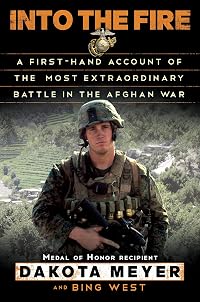
Into the Fire: A Firsthand Account of the Most Extraordinary Battle in the Afghan War
by Dakota Meyer
On This Page
Description
“The story of what Dakota did . . . will be told for generations.”—President Barack Obama, from remarks given at Meyer’s Medal of Honor ceremonyIn the fall of 2009, Taliban insurgents ambushed a patrol of Afghan soldiers and Marine advisors in a mountain village called Ganjigal. Firing from entrenched positions, the enemy was positioned to wipe out one hundred men who were pinned down and were repeatedly refused artillery support. Ordered to remain behind with the vehicles, show more twenty-one year-old Marine corporal Dakota Meyer disobeyed orders and attacked to rescue his comrades.
With a brave driver at the wheel, Meyer stood in the gun turret exposed to withering fire, rallying Afghan troops to follow. Over the course of the five hours, he charged into the valley time and again. Employing a variety of machine guns, rifles, grenade launchers, and even a rock, Meyer repeatedly repulsed enemy attackers, carried wounded Afghan soldiers to safety, and provided cover for dozens of others to escape—supreme acts of valor and determination. In the end, Meyer and four stalwart comrades—an Army captain, an Afghan sergeant major, and two Marines—cleared the battlefield and came to grips with a tragedy they knew could have been avoided. For his actions on that day, Meyer became the first living Marine in three decades to be awarded the Medal of Honor.
Into the Fire tells the full story of the chaotic battle of Ganjigal for the first time, in a compelling, human way that reveals it as a microcosm of our recent wars. Meyer takes us from his upbringing on a farm in Kentucky, through his Marine and sniper training, onto the battlefield, and into the vexed aftermath of his harrowing exploits in a battle that has become the stuff of legend.
Investigations ensued, even as he was pitched back into battle alongside U.S. Army soldiers who embraced him as a fellow grunt. When it was over, he returned to the States to confront living with the loss of his closest friends. This is a tale of American values and upbringing, of stunning heroism, and of adjusting to loss and to civilian life.
We see it all through Meyer’s eyes, bullet by bullet, with raw honesty in telling of both the errors that resulted in tragedy and the resolve of American soldiers, U.S.Marines, and Afghan soldiers who’d been abandoned and faced certain death.
Meticulously researched and thrillingly told, with nonstop pace and vivid detail, Into the Fire is the true story of a modern American hero.
“Sergeant Meyer embodies all that is good about our nation’s Corps of Marines. . . . [His] heroic actions . . . will forever be etched in our Corps’ rich legacy of courage and valor.”—General James F. Amos, Commandant of the Marine Corps. show less
Tags
Recommendations


Member Reviews
Dakota Meyer is one of only three Medal of Honor recipients of the Afghanistan War who lived to receive the award. Bing West has already told the dramatic story of the ambush at Ganjgal in 2009 in his previous book "The Wrong War". While the keyboard warriors in the Pentagon made sure to label the outcome of that ambush as "unknown" in Wikipedia, it was as clear a US defeat as the battle of Concord and Lexington was a US victory. It is high time that the US military accepted some responsibility to face reality and accept that the US forces can not and will not win every skirmish and battle. An Orwellian rewrite of Wikipedia will only fool some of the people all the time. It is also not worthy of the US military that it tried to rewrite show more Dakota Meyer's brave act of saving Afghan soldiers' lives into saving US soldiers' lives.
Meyer suffers from PTSD and feels guilty of not having been able to safe the lives of his comrades who were ambushed. The lives of the four US advisors on point were doomed in the Taliban attack from three sides on the Afghan army company. The loss of communication after signaling mayday meant their almost certain death, a conclusion probably drawn by the US commanders who refused both aerial and artillery support for the ambushed Afghans. Both of West's accounts are conspicuously silent about what went on in the US command post, while the account of the futile bravery of charging Dakota Meyer is mostly duplicated. The unwillingness of the US command to share responsibility with their Afghan partners and accept their information regarding artillery targets doomed the "stand up/stand down" approach, as the Afghans became the latest casualty in the US allied army disease: As soon as a native army starts to fight alongside or under US command, it looses its effectiveness compared to independent native forces.
Dakota Meyer, Kentucky salt of the earth and classic cannon fodder, started his own one man Charge of the Light Brigade which helped some of the wounded and trapped Afghan soldiers to return to their lines. The award of the Medal of Honor obscures the deeper failure of the US military in the Afghanistan War, which probably contributed to Meyer's realization into the futility of his action (which might have triggered the failed suicide attempt out of survivor's guilt). A "red badge of courage" might have helped lessen Meyer's mistaken guilt for the death of his comrades. Hopefully, Dakota Meyer will not follow the path of Ira Hayes. show less
Meyer suffers from PTSD and feels guilty of not having been able to safe the lives of his comrades who were ambushed. The lives of the four US advisors on point were doomed in the Taliban attack from three sides on the Afghan army company. The loss of communication after signaling mayday meant their almost certain death, a conclusion probably drawn by the US commanders who refused both aerial and artillery support for the ambushed Afghans. Both of West's accounts are conspicuously silent about what went on in the US command post, while the account of the futile bravery of charging Dakota Meyer is mostly duplicated. The unwillingness of the US command to share responsibility with their Afghan partners and accept their information regarding artillery targets doomed the "stand up/stand down" approach, as the Afghans became the latest casualty in the US allied army disease: As soon as a native army starts to fight alongside or under US command, it looses its effectiveness compared to independent native forces.
Dakota Meyer, Kentucky salt of the earth and classic cannon fodder, started his own one man Charge of the Light Brigade which helped some of the wounded and trapped Afghan soldiers to return to their lines. The award of the Medal of Honor obscures the deeper failure of the US military in the Afghanistan War, which probably contributed to Meyer's realization into the futility of his action (which might have triggered the failed suicide attempt out of survivor's guilt). A "red badge of courage" might have helped lessen Meyer's mistaken guilt for the death of his comrades. Hopefully, Dakota Meyer will not follow the path of Ira Hayes. show less
"You cannot exaggerate about the Marines. They are convinced to the point of arrogance, that they are the most ferocious fighters on earth- and the amusing thing about it is that they are."
Father Kevin Keaney, 1st Marine Division Chaplain
Yes, I am a Marine so my view may be a bit biased. Unlike Meyer, I served in the rather peaceful post-Vietnam Era. I read many of the Marine combat stories through the years and most were written by lieutenants, captains, on up to generals. There were also a few written by senior NCOs (NonCommissioned Officers). I always wondered what a lance corporal or a corporal would write on combat. That is the point where you are no longer a boot private and before your career takes priority. If you are a corporal show more and get busted it's a year before you get your rank back. It happens. It happened to me. If you are a senior NCO, you'll probably never get your rank back. If you are an officer, well, your career is finished. A corporal has that unique view of not being totally indoctrinated and yet relatively free to speak his mind.
Meyer starts a story typical of many Marines: Small town background, hunter, not really attached and looking for direction. He joined the Marines, went to Parris Island, Infantry school, and eventually sniper school. The book centers on his experience in the bloody fighting at Ganjgal. Meyer pulls no punches when it comes the disastrous planning and execution of the mission. Meyer and his team were advisors to the Afghan forces and stationed at an army compound. Meyer was ordered to stay back on this mission while the rest of his team went into Ganjgal. Essentially what happened was that the men walked into a kill zone. Stuck in the open and facing well-armed Taliban who crossed over from Pakistan, chaos ensued. The senior leadership located many miles away had their own impressions of what was happening on the battlefield, despite the radio communication from the people actually there. It was a disaster and one that could have been avoided. The description of the battle reminded me of the French generals, in World War I,miles away from the front line sending wave after wave of soldiers to their death thinking, "War's not so bad."
Meyer in this situation sees or rather hears what is going on and requests to enter Ganjgal to bring back his team. Refused several times he breaks orders. For a Marine, your fellow Marines are your brothers and you will do what is necessary to save them. Marines focus on teamwork and small groups. Your life is in the hands of those with you. There is a bond stronger than orders. Meyer's story is one of incredible bravery and selflessness that follows in a long tradition in the Marine Corps. Meyer gives credit where credit is due. He spoke up for the bravery of Army Captain Swenson, whose Medal of Honor package was "lost" by those "controlling" the battle from afar. He praises the actions of the army helicopter pilots. Meyer, however, shows his disgust of the higher headquarter's actions. He also explains the personal results that sometimes follow the action he saw.
Into the Fire is a raw, fast-paced, simply spoken, and spoken like a Marine account of Meyer's service in Afghanistan. He is not a disgruntled veteran. He loved the Marine Corps and was proud of his service. He presents the reader with an I was there. I saw everything and it is not how the command structure reported it. Very well done and exactly what I would expect from a fellow Marine. Semper Fi, Sergeant Meyer. show less
Father Kevin Keaney, 1st Marine Division Chaplain
Yes, I am a Marine so my view may be a bit biased. Unlike Meyer, I served in the rather peaceful post-Vietnam Era. I read many of the Marine combat stories through the years and most were written by lieutenants, captains, on up to generals. There were also a few written by senior NCOs (NonCommissioned Officers). I always wondered what a lance corporal or a corporal would write on combat. That is the point where you are no longer a boot private and before your career takes priority. If you are a corporal show more and get busted it's a year before you get your rank back. It happens. It happened to me. If you are a senior NCO, you'll probably never get your rank back. If you are an officer, well, your career is finished. A corporal has that unique view of not being totally indoctrinated and yet relatively free to speak his mind.
Meyer starts a story typical of many Marines: Small town background, hunter, not really attached and looking for direction. He joined the Marines, went to Parris Island, Infantry school, and eventually sniper school. The book centers on his experience in the bloody fighting at Ganjgal. Meyer pulls no punches when it comes the disastrous planning and execution of the mission. Meyer and his team were advisors to the Afghan forces and stationed at an army compound. Meyer was ordered to stay back on this mission while the rest of his team went into Ganjgal. Essentially what happened was that the men walked into a kill zone. Stuck in the open and facing well-armed Taliban who crossed over from Pakistan, chaos ensued. The senior leadership located many miles away had their own impressions of what was happening on the battlefield, despite the radio communication from the people actually there. It was a disaster and one that could have been avoided. The description of the battle reminded me of the French generals, in World War I,miles away from the front line sending wave after wave of soldiers to their death thinking, "War's not so bad."
Meyer in this situation sees or rather hears what is going on and requests to enter Ganjgal to bring back his team. Refused several times he breaks orders. For a Marine, your fellow Marines are your brothers and you will do what is necessary to save them. Marines focus on teamwork and small groups. Your life is in the hands of those with you. There is a bond stronger than orders. Meyer's story is one of incredible bravery and selflessness that follows in a long tradition in the Marine Corps. Meyer gives credit where credit is due. He spoke up for the bravery of Army Captain Swenson, whose Medal of Honor package was "lost" by those "controlling" the battle from afar. He praises the actions of the army helicopter pilots. Meyer, however, shows his disgust of the higher headquarter's actions. He also explains the personal results that sometimes follow the action he saw.
Into the Fire is a raw, fast-paced, simply spoken, and spoken like a Marine account of Meyer's service in Afghanistan. He is not a disgruntled veteran. He loved the Marine Corps and was proud of his service. He presents the reader with an I was there. I saw everything and it is not how the command structure reported it. Very well done and exactly what I would expect from a fellow Marine. Semper Fi, Sergeant Meyer. show less
INTO THE FIRE, by Dakota Meyer and Bing West, while certainly well-written and meticulously documented, in the end failed to really engage me as a reader. There are two reasons for this. One is that CO-authored books, to my mind, can never quite match the reality or the authenticity of a true memoir - i.e. one written solely by its subject/narrator. In that respect, INTO THE FIRE, simply did not quite ring true. By this I do not mean that I did not believe Meyer's story. I mean that I could not stop thinking that his story had been carefully organized and scrubbed by a talented and professional writer (Bing West), and I also kept wondering how much of the substantiating research about the Afghan war and the host country, not to mention show more the notes and timeline - all the stuff that 'fleshes out' a story about a single battle that lasted less than one day - had been dug out and skillfully addended by West.
The second reason I had trouble with Meyer's story is more difficult to explain. But I'll try. Samuel Hynes, a writer I have the highest admiration for (who was, incidentally, a combat veteran of WWII, and whose memoir, FLIGHTS OF PASSAGE, is a minor classic), once told me that one of the most important ingredients to a successful story is a likeable narrator. Much as I wanted to like Meyer, I couldn't. My problem with this began early, in the Introduction, when Meyer described his team, ending with, "The others were looking to do their jobs and return home; I was looking for a fight." And just a few pages later, still in the Intro, he describes his first 'kill' -
"I aim the gun. I'm a sniper; shooting is technique. No emotion ... I fire burst after burst, walking the tracers up the slope. I hit his legs first, then his back. I keep shooting until I'm tearing up a corpse. I rip through two hundred rounds ..."
This is followed by joking with his team members, no introspection, no sense of the enormity of the taking of life. And this is pretty typical of the strong, silent macho 'cowboy' attitude Meyer displays through most of the book. He relents only slightly when he tells of his subsequent and reluctant treatment for PTSD. In the Epilogue, Bing west asserts that, "These are his words and expressions. This is Dakota's account from start to finish." West also says, "The focus of this book is the character growth of Dakota Meyer." He says more, about the "grit" and the "invincibility" of the American warrior. And while I understand these terms, and found the minute-by-minute descriptions of Meyer's heroism and bravery under fire most compelling, I still could not bring myself to "like" Dakota Meyer. And I'm not sure how much growth of character has resulted from his horrific experience. I respect him and admire what he did. But that all-important story element Hynes told me about - likeability - was missing. I've talked about this with another friend, a retired Marine, who understood what I was saying and even agreed, but also noted, "Nevertheless a good man to have on your side in a fight." Too true. And there is not question in my mind thatDakota Meyer is absolutely deserving of the Medal of Honor.
So yes, a very well-written book, and a page-turner, but not really my kind of book, and I can't say I really enjoyed reading it. (Three and a half stars) show less
The second reason I had trouble with Meyer's story is more difficult to explain. But I'll try. Samuel Hynes, a writer I have the highest admiration for (who was, incidentally, a combat veteran of WWII, and whose memoir, FLIGHTS OF PASSAGE, is a minor classic), once told me that one of the most important ingredients to a successful story is a likeable narrator. Much as I wanted to like Meyer, I couldn't. My problem with this began early, in the Introduction, when Meyer described his team, ending with, "The others were looking to do their jobs and return home; I was looking for a fight." And just a few pages later, still in the Intro, he describes his first 'kill' -
"I aim the gun. I'm a sniper; shooting is technique. No emotion ... I fire burst after burst, walking the tracers up the slope. I hit his legs first, then his back. I keep shooting until I'm tearing up a corpse. I rip through two hundred rounds ..."
This is followed by joking with his team members, no introspection, no sense of the enormity of the taking of life. And this is pretty typical of the strong, silent macho 'cowboy' attitude Meyer displays through most of the book. He relents only slightly when he tells of his subsequent and reluctant treatment for PTSD. In the Epilogue, Bing west asserts that, "These are his words and expressions. This is Dakota's account from start to finish." West also says, "The focus of this book is the character growth of Dakota Meyer." He says more, about the "grit" and the "invincibility" of the American warrior. And while I understand these terms, and found the minute-by-minute descriptions of Meyer's heroism and bravery under fire most compelling, I still could not bring myself to "like" Dakota Meyer. And I'm not sure how much growth of character has resulted from his horrific experience. I respect him and admire what he did. But that all-important story element Hynes told me about - likeability - was missing. I've talked about this with another friend, a retired Marine, who understood what I was saying and even agreed, but also noted, "Nevertheless a good man to have on your side in a fight." Too true. And there is not question in my mind thatDakota Meyer is absolutely deserving of the Medal of Honor.
So yes, a very well-written book, and a page-turner, but not really my kind of book, and I can't say I really enjoyed reading it. (Three and a half stars) show less
"Into the Fire" is the inspiring story of Dakota Meyer, a U.S. Marine Infantryman / sniper. Meyer's dedication and bravery, exhibited while deployed to Afghanistan, led to his being nominated and receiving the Medal of Honor. Meyer's medal was the result of his making multiple rescue attempts to reach his brothers ambushed by Taliban forces. It's a quick read, and his story will make readers appreciative of the sacrifices of all our servicemen. On the other hand, the story will also anger many reading about bureaucratic rules of rear echelon officers more concerned with their promotions than about providing emergency support for front line troops under fire.
This was an interesting book about the absurdities of the Afgan war and one American who was thrust into the middle of it.
The protrayal of this particular battle, the mind-numbing senselessness of the "Rules of Engagement", the overriding politicizing of war, the lack engagement by the upper brass and the counteracting courage of the boots on the ground - in particular Dakota Meyer was fascinating to read.
Initially, this book came across a little awkwardly, Dakota's portrayal of himself as cocky and looking for a fight, made him hard to like at first.
But Dakota's journey after the fight was touching, honest and his soul searching real. The impact of war on everyday soldiers, even one looking for a fight like Dakota, exacts a toll on show more the psyche that is described well.
Worth reading. show less
The protrayal of this particular battle, the mind-numbing senselessness of the "Rules of Engagement", the overriding politicizing of war, the lack engagement by the upper brass and the counteracting courage of the boots on the ground - in particular Dakota Meyer was fascinating to read.
Initially, this book came across a little awkwardly, Dakota's portrayal of himself as cocky and looking for a fight, made him hard to like at first.
But Dakota's journey after the fight was touching, honest and his soul searching real. The impact of war on everyday soldiers, even one looking for a fight like Dakota, exacts a toll on show more the psyche that is described well.
Worth reading. show less
This memoir by Marine Medal of Honor winner Meyer is an excellent account of his actions during the battle against Taliban ambushers which killed most of his American team members and even more Afghan soldiers. Meyer is obviously a natural fighter and a skilled infantryman. That is the tale which coauthor Bing West consciously narrates. I was disappointed with the lack of clarity in parts of the book as new characters were introduced but only momentarily. I was glad that he named some superiors’ names whom were responsible for battle inactivity. He didn’t name others. As a story of a soldier this was good. As a tale of a Medal winner it lacked some drama that comes from years of reflection in hindsight. I don’t know of any books show more by Medal winners which aren’t outstanding. Meyer might have another better book in him down the line from now. show less
Excellent little book about the bravery of a CMH winning Marine corporal and his brothers in arms, some Army, some Afghan, in combat in Afghanistan. Another tale of tactical bravery and operational / strategic failures which seem, unfortunately, to typify the United States involvement in the later stages of the War in Afghanistan. Worthy of your time.
Members
- Recently Added By
Lists

Holding the Zero
56 works; 1 member
Author Information

2 Works 358 Members
All Editions
Awards and Honors
Common Knowledge
- Original publication date
- 2012-09-25
- People/Characters
- Dakota Meyer; Dodd Ali; Lieutenant Mike Johnson; Staff Sergeant Aaron Kenefick; Hospital Man 3rd Class James Layton; First Sergeant Christopher Garza (show all 7); Major Kevin Williams
- Important places
- Ganjigal, Afghanistan; Okinawa, Japan; Dab Khar Valley, Afghanistan; Camp Joyce, Afghanistan; Combat Outpost Monti, Afghanistan
- Important events
- Afghanistan War
- Epigraph
- The battle of Ganjigal resulted in the largest loss of American advisors, the highest number of distinguished awards for valor, and the most controversial investigations for dereliction of duty in the entire Afghanistan war. ... (show all)This is the story of a man who was awarded the Medal of Honor for his bravery in that battle.
- Dedication
- To Team Monti:
Lt. Michael E. Johnson
Staff Sgt. Aaron M. Kenefick
Corpsman 3rd Class James R. Layton
And to all the men and women who paid the ultimate sacrifice for our freedom:
Gunnery Sgt. Edwin W. John... (show all)son, Jr.
Staff Sgt. Kenneth W. Westbrook
Mary Kate Moore
Justin Nathaniel Hardin - First words
- Lt. Mike Johnson, our team leader, leaned his head way back next to my knees and shouted up the turret hole to me: “We’re gonna love it here! Look at those mountains, Meyer! Heavy stuff! Let’s go hiking!”
- Last words
- (Click to show. Warning: May contain spoilers.)In the case of Dakota, it was both— testimony to the invincibility of the American warrior.
Classifications
Statistics
- Members
- 318
- Popularity
- 100,681
- Reviews
- 12
- Rating
- (3.93)
- Languages
- English
- Media
- Paper, Audiobook, Ebook
- ISBNs
- 7
- ASINs
- 2