
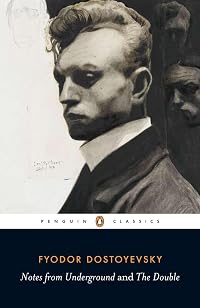
Notes from Underground / The Double
by Fyodor Dostoyevsky
On This Page
Description
A single, tormented, character dominates both of these short novels written at different stages of Dostoyevsky's career.Tags
Recommendations










Member Reviews
A genius of a book written by a mind that can effortlessly delve into the nuts, bolts and avagadros of the psyche.
Regard this extract:
Every man has reminiscences which he would not tell to everyone, but only to his friends. He has other matters in his mind which he would not reveal even to his friends, but only to himself, and that in secret. But there are other things which a man is afraid to tell even to himself, and every decent man has a number of such things stored away in his mind. The more decent he is, the greater the number of such things in his mind.
After the Upanishads, it took around 2500 human years for man to explore the innards of himself; By a drunkard and a pathological gambler to be this original, before the world show more wars, before the pentium processors, before blogging, before any one single man had any guts to sit in a corner and think for himself about himself and his insignificance in the scheme of things, is what makes this book a precious gem.
PS- My copy of the book is bound in an apt cover featuring the handsome self portrait of Kramskoy; Cant find it here. show less
Regard this extract:
Every man has reminiscences which he would not tell to everyone, but only to his friends. He has other matters in his mind which he would not reveal even to his friends, but only to himself, and that in secret. But there are other things which a man is afraid to tell even to himself, and every decent man has a number of such things stored away in his mind. The more decent he is, the greater the number of such things in his mind.
After the Upanishads, it took around 2500 human years for man to explore the innards of himself; By a drunkard and a pathological gambler to be this original, before the world show more wars, before the pentium processors, before blogging, before any one single man had any guts to sit in a corner and think for himself about himself and his insignificance in the scheme of things, is what makes this book a precious gem.
PS- My copy of the book is bound in an apt cover featuring the handsome self portrait of Kramskoy; Cant find it here. show less
Made me feel severely depressed and in need of human connection in the way only a Dostoyevsky novel can. Immediately questioned the meaning of my life and how I interact with the world. Pretentious bullshit, but I'll almost definitely cry over it the next time I get drunk.
A genius of a book written by a mind that can effortlessly delve into the nuts, bolts and avagadros of the psyche.
Regard this extract:
Every man has reminiscences which he would not tell to everyone, but only to his friends. He has other matters in his mind which he would not reveal even to his friends, but only to himself, and that in secret. But there are other things which a man is afraid to tell even to himself, and every decent man has a number of such things stored away in his mind. The more decent he is, the greater the number of such things in his mind.
After the Upanishads, it took around 2500 human years for man to explore the innards of himself; By a drunkard and a pathological gambler to be this original, before the world show more wars, before the pentium processors, before blogging, before any one single man had any guts to sit in a corner and think for himself about himself and his insignificance in the scheme of things, is what makes this book a precious gem.
PS- My copy of the book is bound in an apt cover featuring the handsome self portrait of Kramskoy; Cant find it here. show less
Regard this extract:
Every man has reminiscences which he would not tell to everyone, but only to his friends. He has other matters in his mind which he would not reveal even to his friends, but only to himself, and that in secret. But there are other things which a man is afraid to tell even to himself, and every decent man has a number of such things stored away in his mind. The more decent he is, the greater the number of such things in his mind.
After the Upanishads, it took around 2500 human years for man to explore the innards of himself; By a drunkard and a pathological gambler to be this original, before the world show more wars, before the pentium processors, before blogging, before any one single man had any guts to sit in a corner and think for himself about himself and his insignificance in the scheme of things, is what makes this book a precious gem.
PS- My copy of the book is bound in an apt cover featuring the handsome self portrait of Kramskoy; Cant find it here. show less
I imagine Notes was just as difficult when it was published as it is now. The "story" is depressing and starts only in the second part of the novel. During the first part, I kept thinking, "How can the depressed extremes of this character ever be interesting? Is this book one long whine by a self-involved jerk?" As I read on, I started to understand that the man was relentless in following his motivations to their unsentimental beginnings. Uh-oh. This guy is doing something that very few of us do, and he's bragging about it. At that point, I knew I had better read on, no matter painful it gets. A cruel, self-centered, honest person.
This book contains two short novels that have some thematic common ground, which helps to explain why Penguin housed them in a single volume.
Notes from Underground:
This is a very dark and surprisingly modern novella in which an unsympathetic narrator, a retired junior civil servant, describes his gradual alienation from society, initially in a description of his philosophy, but then through narrating some of the episodes that led to his downfall. This book prefigures some of the themes of Crime and Punishment.
The Double:
This is an earlier novella that is more of a comedy, though the core story is a dark vision. Once again the narrator is a St Petersburg civil servant. This one sees himself as an essentially honest person, but gradually show more falls from grace, then encounters his double, a lookalike answering to the same name, who gradually takes over the "hero's" life. A compelling vision of a broken man trapped in his own nightmare show less
Notes from Underground:
This is a very dark and surprisingly modern novella in which an unsympathetic narrator, a retired junior civil servant, describes his gradual alienation from society, initially in a description of his philosophy, but then through narrating some of the episodes that led to his downfall. This book prefigures some of the themes of Crime and Punishment.
The Double:
This is an earlier novella that is more of a comedy, though the core story is a dark vision. Once again the narrator is a St Petersburg civil servant. This one sees himself as an essentially honest person, but gradually show more falls from grace, then encounters his double, a lookalike answering to the same name, who gradually takes over the "hero's" life. A compelling vision of a broken man trapped in his own nightmare show less
Hey wait, are you a misanthrope? Do you feel betrayed and disappointed with life? Are you a bitter, bitter man? Why narrator, I never would have guessed! Why don't you spend the next hundred pages telling me about it? That sounds like loads of fun.
I've not much to say about this book that hasn't been said before. Both stories are nice and deep.
'Notes from Underground' - a mind bender!
'Notes from Underground' - a mind bender!
Members
- Recently Added By
Lists

Books Read in 2023
5,547 works; 145 members
Author Information

1,441+ Works 179,878 Members
One of the most powerful and significant authors in all modern fiction, Fyodor Dostoevsky was the son of a harsh and domineering army surgeon who was murdered by his own serfs (slaves), an event that was extremely important in shaping Dostoevsky's view of social and economic issues. He studied to be an engineer and began work as a draftsman. show more However, his first novel, Poor Folk (1846), was so well received that he abandoned engineering for writing. In 1849, Dostoevsky was arrested for being a part of a revolutionary group that owned an illegal printing press. He was sentenced to be executed, but the sentence was changed at the last minute, and he was sent to a prison camp in Siberia instead. By the time he was released in 1854, he had become a devout believer in both Christianity and Russia - although not in its ruler, the Czar. During the 1860's, Dostoevsky's personal life was in constant turmoil as the result of financial problems, a gambling addiction, and the deaths of his wife and brother. His second marriage in 1887 provided him with a stable home life and personal contentment, and during the years that followed he produced his great novels: Crime and Punishment (1886), the story of Rodya Raskolnikov, who kills two old women in the belief that he is beyond the bounds of good and evil; The Idiots (1868), the story of an epileptic who tragically affects the lives of those around him; The Possessed (1872), the story of the effect of revolutionary thought on the members of one Russian community; A Raw Youth (1875), which focuses on the disintegration and decay of family relationships and life; and The Brothers Karamazov (1880), which centers on the murder of Fyodor Karamazov and the effect the murder has on each of his four sons. These works have placed Dostoevsky in the front rank of the world's great novelists. Dostoevsky was an innovator, bringing new depth and meaning to the psychological novel and combining realism and philosophical speculation in his complex studies of the human condition. (Bowker Author Biography) show less

Fyodor Dostoyevsky has a Legacy Library. Legacy libraries are the personal libraries of famous readers, entered by LibraryThing members from the Legacy Libraries group.
Some Editions
Work Relationships
Common Knowledge
- Canonical title
- Notes from Underground / The Double
- Original publication date
- 1864 (Notes from Underground) (Notes from Underground); 1846 (The Double) (The Double)
- Important places
- St. Petersburg, Russia
- First words
- I am a sick man. ...I am an angry man.
- Canonical DDC/MDS
- 891.733
- Canonical LCC
- PG3326
Classifications
- Genres
- General Fiction, Fiction and Literature
- DDC/MDS
- 891.733 — Literature & rhetoric Asian Literature East Indo-European and Celtic literatures Russian and East Slavic languages Russian fiction 1800–1917
- LCC
- PG3326 — Language and Literature Slavic languages and literatures. Baltic languages. Albanian language Slavic. Baltic. Albanian Russian literature Individual authors and works 1800-1870 Dostoyevsky
- BISAC
Statistics
- Members
- 2,008
- Popularity
- 10,406
- Reviews
- 17
- Rating
- (3.98)
- Languages
- Catalan, English
- Media
- Paper, Ebook
- ISBNs
- 13
- ASINs
- 11