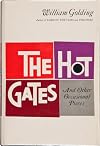
The Hot Gates
by William Golding
On This Page
Description
Twenty selections from the author's short prose which he considers his best: essays on teaching, sailing, the classical world, America, and two autobiographical pieces.Tags
Recommendations






















Member Reviews
A collection of miscellaneous short non-fiction from the early sixties, roughly divided into “people and places”, “books”, articles about his experiences on a lecture tour of the US, and a couple of pieces about childhood memories.
The title piece describes a visit to the site of the battle of Thermopylae (oddly never using the word “Thermopylae”), then there’s a curious little reflection on petty irritations — it will come as no surprise to anyone who’s ever seen a photo of Golding in later life that he was not fond of having his hair cut — a biographical sketch of Copernicus, and an interesting meditation on the English Channel, as seen from an airliner, where he brings in his own experience as a WWII naval officer show more and a yachtsman and his memories of living in the South West of England. All these make him seem like a very pleasant, reasonable sort of person, someone it would have been fun to chat with if you had been sitting next to him on a train. “Digging for pictures” is an account of his experiences assisting on an archaeological dig, in which we get a sense of where the interest in (pre-)history that led to The inheritors came from.
Probably the main reason for reading this book, though, comes in the “books“ section with Golding’s essay “Fables”, where he talks about the thought process that shaped Lord of the flies. And about the mixed blessings of being the author of a book that is read by millions of schoolchildren every year (“Dear Mr Golding, thank you very much for writing this book. However there are some things in it which we are not able to understand. We shall be glad therefore if you will kindly answer the following forty-one questions. A prompt reply would oblige as exams start next week…”). Other essays in this section seem to be commissioned reviews — the editor who got him to review new editions of Swiss family Robinson and Treasure Island was probably disappointed when Golding took genuine pleasure in rediscovering them and did not bring in a dark, post-LOTF viewpoint. And it’s slightly disappointing to see that his rediscovery of Jules Verne is more about the fundamental childishness of Verne’s adventure stories than about their proto-cyberpunk possibilities, anachronistic though that would have been.
The final two essays, “Billy the kid” and “The ladder and the tree”, are delightful dips back into childhood. Altogether, a charming and quite fascinating collection, although probably far from essential. show less
The title piece describes a visit to the site of the battle of Thermopylae (oddly never using the word “Thermopylae”), then there’s a curious little reflection on petty irritations — it will come as no surprise to anyone who’s ever seen a photo of Golding in later life that he was not fond of having his hair cut — a biographical sketch of Copernicus, and an interesting meditation on the English Channel, as seen from an airliner, where he brings in his own experience as a WWII naval officer show more and a yachtsman and his memories of living in the South West of England. All these make him seem like a very pleasant, reasonable sort of person, someone it would have been fun to chat with if you had been sitting next to him on a train. “Digging for pictures” is an account of his experiences assisting on an archaeological dig, in which we get a sense of where the interest in (pre-)history that led to The inheritors came from.
Probably the main reason for reading this book, though, comes in the “books“ section with Golding’s essay “Fables”, where he talks about the thought process that shaped Lord of the flies. And about the mixed blessings of being the author of a book that is read by millions of schoolchildren every year (“Dear Mr Golding, thank you very much for writing this book. However there are some things in it which we are not able to understand. We shall be glad therefore if you will kindly answer the following forty-one questions. A prompt reply would oblige as exams start next week…”). Other essays in this section seem to be commissioned reviews — the editor who got him to review new editions of Swiss family Robinson and Treasure Island was probably disappointed when Golding took genuine pleasure in rediscovering them and did not bring in a dark, post-LOTF viewpoint. And it’s slightly disappointing to see that his rediscovery of Jules Verne is more about the fundamental childishness of Verne’s adventure stories than about their proto-cyberpunk possibilities, anachronistic though that would have been.
The final two essays, “Billy the kid” and “The ladder and the tree”, are delightful dips back into childhood. Altogether, a charming and quite fascinating collection, although probably far from essential. show less
Every single one of these short essays and reviews by the master writer William Golding is worth reading, though not all are equally memorable or important. However, his short biography of Copernicus is one of the most thought-provoking and insightful pieces I have ever read about the early scientist, and is worth the price of admission alone.
A terrific little collection covering a whole load of different subjects. Subtitling it ‘occasional pieces’ really is deceptively modest. The collection’s themed on the importance of the imagination with each essay using imagination in some way. Hugely quotable and with some subtle language expressing subtle ideas, in words that needs to be read twice to appreciate or understand.
Some absorbing essays here; most prominently "Fables" which is illuminates the philosophical background to "Lord of the Flies". Golding's experience of the condition of man was as a "morally diseased creation", and that he would use the "literary convention of boys on an island" to illustrate this. He set out to contrast this fallen state of man, with the "paper cutouts" that Ballantyne produced in his optimistic and naive "The Coral Island".
"The Hot Gates" recalls the desperate stand of the Spartans against the Persians in 480 B.C.
"The Hot Gates" recalls the desperate stand of the Spartans against the Persians in 480 B.C.
A collection of essays by the author of "Lord of the Flies", of varying interest. Golding evidently was a true man of letters, interested in a wide range of topics, largely historical and bookish. The most interesting essay (and potentially the most useful to a student writing a book report) was his interpretation of various events and ideas from his most famous book.
I wasn't a huge fan of Golding before this book, but he's a skilled and thoughtful essayist.
Ratings
Members
- Recently Added By
Author Information

76+ Works 68,687 Members
William Golding was born in Cornwall, England on September 19, 1911. Although educated to be a scientist at the request of his father, he developed an interest in literature. At Oxford University, he studied natural science for two years and then transferred to a program for English literature and philosophy. He eventually became a schoolmaster at show more Bishop Wordsworth's School in Salisbury. During World War II, he joined the Royal Navy and was involved in the sinking of the German battleship Bismarck. After the war, he returned to Bishop Wordsworth's School and taught there until 1962. His first novel, Lord of the Flies, was published in 1954 and was made into a film in 1963. His other novels include The Inheritors, Free Fall, The Spire, The Pyramid, The Paper Men, Close Quarters, and Fire down Below. He won the Booker Prize for Rites of Passage in 1980 and the Nobel Prize for Literature in 1983. He also wrote plays, essays, and short stories. He was knighted by Queen Elizabeth II in 1988. He died on June 19, 1993. (Bowker Author Biography) show less
Classifications
Statistics
- Members
- 164
- Popularity
- 197,205
- Reviews
- 6
- Rating
- (3.82)
- Languages
- English
- Media
- Paper, Ebook
- ISBNs
- 7
- ASINs
- 10