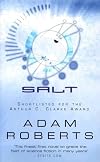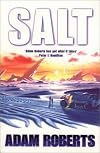
Salt
by Adam Roberts
On This Page
Description
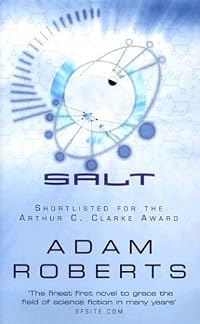
Two narrators tell the story of the simmering tensions between their two communities as they travel out to a new planet, colonise it, then destroy themselves when the tensions turn into outright war. Adam Roberts is a new writer completely in command of the SF genre. This is a novel that is at once entertaining and philosophical. The attitudes and prejudices of its characters are subtlety drawn and ring completely true despite the alien circumstances they find themselves in. The grasp of show more science and its impact on people is instinctive. But above all it is the epic and colourful world building that marks SALT out - the planet Salt rivals Dune in its desolation and is a suitably biblical setting for a novel that is powered by the corrupting influence of imperfectly remembered religions on distant societies. From the early scenes set on a colony ship towed by a massive ice meteorite, to the description of a planet covered in sodium chloride, to the chilling narrative of a world sliding into its first war this is a novel from a writer who shouts star quality. show lessTags
Recommendations










Member Reviews
Science fiction is often at its best when it uses a hard-edged fantasy of alternative reality to cast a light on our own species. A desolate world, whether that of 'Dune' or of Sterling's 'Involution Ocean', can often clear the imaginative palate.
Entering a desolate world allows us to concentrate on human reactions instead of being boondoggled by the writer showing off 'gizmos' or a multiplicity of thought experiments. The desolate world is the thought experiment. What is it to be human when the human needs to survive in such conditions?
Roberts' brilliant book avoids cliche at every stage of the game. For a start, it postulates conflicting positions within one quasi-Biblical religious tradition rather than the hackneyed science versus show more religion position instinctive to much science fiction. The conflict is well within a belief system.
Settlers undertake a somewhat ramshackle interstellar trek to a new world to escape a busted homeland (shades of the religious migrations of the European past). The conflicts, which are subtle to start with, begin on the journey there.
The story depends on a truth - that no religious (or ideological) tradition can be represented by a single personality type and that every such tradition will tend to break down into its major personality components, the authoritarian and the libertarian. Both are doomed not to understand each other.
Roberts lands these latter day pilgrims on a disappointingly harsh salty world of not merely desolation but high levels of radiation. The new arrivals (who find it effectively lifeless) have to be resourceful in coming to terms with it. They build contrasting societies.
The skill of the author at this point lies not only in creating a desolation we can believe in but also a humanity we know. Neither side in what becomes all-out war is either entirely good or bad. We understand the points of view of both sides and puzzle at their extremities.
Roberts shuttles between the voices of a disciplined and well-intentioned military strong man and a self-centred anarchistic settler forced into guerrilla leadership who simply cannot see that rape is rape in a particularly disturbing scene.
No one understands the consequences of their actions. The 'strong man' thinks he does and is confused when things do not turn out as planned. The anarchic narcissist does not care but lives in the moment regardless of the consequences or effects on others. Freedom does not look good here.
It is, in fact, an extended parable about the way brutal violence and force, reluctant in the name of order and self-deluding or passionate and liberationist but also downright nasty, emerge out of mutual incomprehension. Neither side is capable of entering into the logic of the other.
On the one side, we have a militaristic capitalist society that sees survival as necessitating order yet the ordering cannot be truly said to be fascist or vile. On the other, we have a self-centred anarchic culture of individualists.
We may admire the freedom of the latter only to be uncomfortable about its Stirnerite solipsisms and the ease by which it switches from free love and communalism towards the dark pleasures of Jungerian violence in apparent defence of itself.
We may deplore the lack of freedom and pomposities of a culture of hierarchy and self-belief amongst the authoritarians but we can also see them as victims (at least in their own eyes) of the terrorism of irrationalism in the cause of freedom. Yet they had triggered all this by their own crass behaviours.
Lack of resources on a salted planet, ambition to be hegemonic, refusal to live and let live, locked-in ideologies, resourcefulness (as much amongst the libertarians as the authoritarians in the conduct of war) and actual or repressed emotion make this a true reflection of our own species.
No matter where we may go - not excluding Mr. Musk's Mars - our species will take its psychological and emotional baggage with it alongside its cunning and inventiveness. The gloomy suspicion is that war and conflict are built into our species and that good intentions will be no defence. show less
Entering a desolate world allows us to concentrate on human reactions instead of being boondoggled by the writer showing off 'gizmos' or a multiplicity of thought experiments. The desolate world is the thought experiment. What is it to be human when the human needs to survive in such conditions?
Roberts' brilliant book avoids cliche at every stage of the game. For a start, it postulates conflicting positions within one quasi-Biblical religious tradition rather than the hackneyed science versus show more religion position instinctive to much science fiction. The conflict is well within a belief system.
Settlers undertake a somewhat ramshackle interstellar trek to a new world to escape a busted homeland (shades of the religious migrations of the European past). The conflicts, which are subtle to start with, begin on the journey there.
The story depends on a truth - that no religious (or ideological) tradition can be represented by a single personality type and that every such tradition will tend to break down into its major personality components, the authoritarian and the libertarian. Both are doomed not to understand each other.
Roberts lands these latter day pilgrims on a disappointingly harsh salty world of not merely desolation but high levels of radiation. The new arrivals (who find it effectively lifeless) have to be resourceful in coming to terms with it. They build contrasting societies.
The skill of the author at this point lies not only in creating a desolation we can believe in but also a humanity we know. Neither side in what becomes all-out war is either entirely good or bad. We understand the points of view of both sides and puzzle at their extremities.
Roberts shuttles between the voices of a disciplined and well-intentioned military strong man and a self-centred anarchistic settler forced into guerrilla leadership who simply cannot see that rape is rape in a particularly disturbing scene.
No one understands the consequences of their actions. The 'strong man' thinks he does and is confused when things do not turn out as planned. The anarchic narcissist does not care but lives in the moment regardless of the consequences or effects on others. Freedom does not look good here.
It is, in fact, an extended parable about the way brutal violence and force, reluctant in the name of order and self-deluding or passionate and liberationist but also downright nasty, emerge out of mutual incomprehension. Neither side is capable of entering into the logic of the other.
On the one side, we have a militaristic capitalist society that sees survival as necessitating order yet the ordering cannot be truly said to be fascist or vile. On the other, we have a self-centred anarchic culture of individualists.
We may admire the freedom of the latter only to be uncomfortable about its Stirnerite solipsisms and the ease by which it switches from free love and communalism towards the dark pleasures of Jungerian violence in apparent defence of itself.
We may deplore the lack of freedom and pomposities of a culture of hierarchy and self-belief amongst the authoritarians but we can also see them as victims (at least in their own eyes) of the terrorism of irrationalism in the cause of freedom. Yet they had triggered all this by their own crass behaviours.
Lack of resources on a salted planet, ambition to be hegemonic, refusal to live and let live, locked-in ideologies, resourcefulness (as much amongst the libertarians as the authoritarians in the conduct of war) and actual or repressed emotion make this a true reflection of our own species.
No matter where we may go - not excluding Mr. Musk's Mars - our species will take its psychological and emotional baggage with it alongside its cunning and inventiveness. The gloomy suspicion is that war and conflict are built into our species and that good intentions will be no defence. show less
A fine debut, though one that feels like a debut! It's a novel of two halves, the first half being a Le Guin homage (The Dispossessed meeting Left Hand..), and the second turning into a surprise novel of ideas. Its faults are obvious, not least that there isn't really a plot (though this doesn't have to be a fault, its just that the setting cries out for it), but that certainly not fatal. The surprise novel of ideas left me melancholy, I was desperately hoping for Als to win somehow, and the ideas that were floating round my head didn't reassure me about the world. There was nothing here that was new to me, and perhaps that helped, because it made the people of Als more identifiable to me, and thus increased my emotional connection to show more them. Maybe someone not steeped in the history and theories of anarchism might not have cared so much about Als. I would be interested to read what a self-confessed conservative reactionary would make of the book - would they identify as wholly with Senaar as I did with Als, look upon Barlei as flawed but in the right as I did with Petja.
Spoiler alert:
I wasn't sure whether the depiction of Petja's rape of Rhoda was a good piece of dramatically necessary work. I understood that it was a good demonstration of the linguistic differences between them, I thought that it was brave that it was neither named as rape nor dismissed as a cultural misunderstanding - the reader is left to deal with it on their own, to interpret Petja's actions through the lense of their own cultural understanding and their own experiences. Was it necessary for an otherwise heroic, positive character to have such a serious flaw, and to make us question whether that flaw came from misunderstanding or cruelty? Was it just a convenient way to get rid of Rhoda and turn the expected narrative on its head? Is this an implicit critique of anarchism and anarchists, is Barlei thus correct in his descriptions of them all?
So yeah, a book that made me think but perhaps not in a productive way! show less
Spoiler alert:
I wasn't sure whether the depiction of Petja's rape of Rhoda was a good piece of dramatically necessary work. I understood that it was a good demonstration of the linguistic differences between them, I thought that it was brave that it was neither named as rape nor dismissed as a cultural misunderstanding - the reader is left to deal with it on their own, to interpret Petja's actions through the lense of their own cultural understanding and their own experiences. Was it necessary for an otherwise heroic, positive character to have such a serious flaw, and to make us question whether that flaw came from misunderstanding or cruelty? Was it just a convenient way to get rid of Rhoda and turn the expected narrative on its head? Is this an implicit critique of anarchism and anarchists, is Barlei thus correct in his descriptions of them all?
So yeah, a book that made me think but perhaps not in a productive way! show less
This is a story of space colonisation that goes dreadfully wrong, as two dominant groups of colonists go to war on a hostile planet.
The bulk of the story is told from the points of view of two of the leading characters in each faction. Back story is filled in seamlessly. The method of reaching the colony is convincingly told, as is the description of the world itself, which turns out to be extremely hostile through being mainly comprised of - well, salt.
The two colonists' factions are well drawn out, as are the characters of the main protagonists. The only problem I had was that I found it difficult to engage with any of the characters. Because the same events are described from two different viewpoints, each account is laden with the show more prejudices of the p.o.v. character; and neither are that likeable. The anarchist character just wins here on a personal level; but his anarchist society comes over to me as an unpleasant place; Roberts has sat down and thought through a number of libertarian viewpoints and extended them to their logical conclusion in an attempt to depict a workable society. The result is a society which to me, at least, seemed uncaring and unnecessarily violent. The only thing is that the opposing group of colonists, which appears to be a hierarchical, capitalist society riven through with religious imagery that many on the Christian Right would recognise, seems worse. The attitudes of the ruling hierarchy in this society seem straight out of Tory Central Casting; the leader of the colony is either massively hypocritical or heavily self-deluded (and possibly both at the same time).
The final chapter of the novel changes the p.o.v. character yet again, to a diplomat sent (earlier in the action of the book) to the anarchist society. It is told as flashback, and that character comes out of it rather better than either side painted her earlier in the course of the action. However, that character's embassy struck me as one of the weaker parts of the novel, as the diplomatic mission was set up with minimal preparation or aforethought, and as a result it turned into political disaster. However, given that the diplomat was sent as a pretext to insert a military force into the anarchist colony, or (equally likely) set up to fail and provoke an incident, this may well have been the idea in the first place.
So: we have two barely likable protagonists, representing two diametrically opposed and unpleasant regimes. Why would anyone want such a novel? Well, the premise is interesting; the world-building well worked out; and the writing describing the world itself - especially when seen through the eyes of the anarchist protagonist - is lyrical. That the character has the ability to appreciate the awful majesty and terrible beauty of his adopted homeworld is one of the things that helps redeem him for me; and for that alone, Salt is a worthwhile book. show less
The bulk of the story is told from the points of view of two of the leading characters in each faction. Back story is filled in seamlessly. The method of reaching the colony is convincingly told, as is the description of the world itself, which turns out to be extremely hostile through being mainly comprised of - well, salt.
The two colonists' factions are well drawn out, as are the characters of the main protagonists. The only problem I had was that I found it difficult to engage with any of the characters. Because the same events are described from two different viewpoints, each account is laden with the show more prejudices of the p.o.v. character; and neither are that likeable. The anarchist character just wins here on a personal level; but his anarchist society comes over to me as an unpleasant place; Roberts has sat down and thought through a number of libertarian viewpoints and extended them to their logical conclusion in an attempt to depict a workable society. The result is a society which to me, at least, seemed uncaring and unnecessarily violent. The only thing is that the opposing group of colonists, which appears to be a hierarchical, capitalist society riven through with religious imagery that many on the Christian Right would recognise, seems worse. The attitudes of the ruling hierarchy in this society seem straight out of Tory Central Casting; the leader of the colony is either massively hypocritical or heavily self-deluded (and possibly both at the same time).
The final chapter of the novel changes the p.o.v. character yet again, to a diplomat sent (earlier in the action of the book) to the anarchist society. It is told as flashback, and that character comes out of it rather better than either side painted her earlier in the course of the action. However, that character's embassy struck me as one of the weaker parts of the novel, as the diplomatic mission was set up with minimal preparation or aforethought, and as a result it turned into political disaster. However, given that the diplomat was sent as a pretext to insert a military force into the anarchist colony, or (equally likely) set up to fail and provoke an incident, this may well have been the idea in the first place.
So: we have two barely likable protagonists, representing two diametrically opposed and unpleasant regimes. Why would anyone want such a novel? Well, the premise is interesting; the world-building well worked out; and the writing describing the world itself - especially when seen through the eyes of the anarchist protagonist - is lyrical. That the character has the ability to appreciate the awful majesty and terrible beauty of his adopted homeworld is one of the things that helps redeem him for me; and for that alone, Salt is a worthwhile book. show less
Poetic narrative, fascinating characterization and solid world building kept me interested through a story of war between diametrically opposed political systems (totalitarian/anarchism) and to a lesser extent opposed religious systems (fundamental christianity/agnosticism), reported by both sides. The novel seemed to end for me twenty pages short of the end. I invite ideas from those that could explain the significance of the final pages.
his first book. i figured out at last why i have trouble with this guy: it's because he's not really writing sf, but rather mainstream fiction set arbitrarily in the future; and yes, there's a huge difference in the result. this one is actually about the middle east, just barely disguised as two quarrelling groups of settlers arrived on a new desert planet. there's the rich, authoritarian technological culture, and there's the very poor, anarchic culture of dreamers, and guess who's gonna win. bit of a setup, that. but anyway, static narrative about one aspect of contemporary culture, and not connected to that other literature of, you know, ideas. the one that's like, lesser because it's only genre. so i think, having nailed this down show more now to my own satisfaction, i'll tiptoe quietly away as Not For Me. show less
I read this because, after finishing The Thing Itself and finding it interesting, goodreads reviews said Salt was better. It's not. It's worse. But having given Thing 3 stars, I would then have to give Salt 2 and it's better than 2. But if I manage to read through to the end of something I feel a book deserves a 3 for that alone.
Look at me hoarding my star ratings like a citizen of Senaar! I was rooting for the Alsists all along, for despite their Cartesian isolated minds, I could groove on their hippy ways while Senaar was too much like the worst of middle America.
So it's about a clash of cultures, too bound up in their ways to have much understanding of each other. But we start with that and not much happens, really. No one grows. show more Maybe Rhoda, slightly. Very slightly. Even I shrunk reading it. I liked the beginning enough that I kept expecting more. I almost want to drop it down to 2 stars now as revenge. show less
Look at me hoarding my star ratings like a citizen of Senaar! I was rooting for the Alsists all along, for despite their Cartesian isolated minds, I could groove on their hippy ways while Senaar was too much like the worst of middle America.
So it's about a clash of cultures, too bound up in their ways to have much understanding of each other. But we start with that and not much happens, really. No one grows. show more Maybe Rhoda, slightly. Very slightly. Even I shrunk reading it. I liked the beginning enough that I kept expecting more. I almost want to drop it down to 2 stars now as revenge. show less
A space tragedy where two groups colonising a new world fail to understand and accept each other's attitudes, outlooks and politics and this degenerates into war. This is a fascinating vision of the clash between anarchist and theocratic systems dressed up as a sci-fi novel.
Members
- Recently Added By
Lists

Exploration of alternative economical systems
40 works; 3 members

Arthur C. Clarke Award Winners and Shortlisted Books
219 works; 14 members

Broderick and Di Filippo's Science Fiction: The 101 Best Novels 1985-2010
103 works; 7 members
Author Information

123+ Works 6,451 Members
Some Editions
Awards and Honors
Awards
Distinctions
Common Knowledge
- Canonical title
- Salt
- Original publication date
- 2000
- First words
- Salt is crystal compounded of Sodium and Chlorine; faceted and transparent.
- Last words
- (Click to show. Warning: May contain spoilers.)And this guarding of the precious thing is the point: to be able to arrive, and to present the Father his gift.
Classifications
Statistics
- Members
- 390
- Popularity
- 79,598
- Reviews
- 13
- Rating
- (3.44)
- Languages
- English, German
- Media
- Paper, Ebook
- ISBNs
- 7
- ASINs
- 5