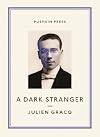
A Dark Stranger
by Julien Gracq
On This Page
Description
From the moment he arrives at an elegant seaside hotel with his lover, Allan unsettles and obsesses the other guests. Elusive, equivocal, beautiful, he lives, gambles, swims and dances with a strange fierceness that they find intoxicating. Soon he even haunts their dreams. One by one, each guest is fatally drawn to Allan. And, as the hazy August heat fades and summer comes to an end, they gravitate towards self-destruction. Rich, lushly poetic, A Dark Stranger is a dreamlike portrayal of show more lives lived on the edge of the abyss. Pushkin Collection editions feature a spare, elegant series style and superior, durable components. The Collection is typeset in Monotype Baskerville, litho-printed on Munken Premium White Paper and notch-bound by the independently owned printer TJ International in Padstow. The covers, with French flaps, are printed on Colorplan Pristine White Paper. Both paper and cover board are acid-free and Forest Stewardship Council (FSC) certified. show lessTags
Recommendations

























Member Recommendations
by edwinbcn
Member Reviews
It’s always a throw of the dice to choose a book purely on the basis of an attractive binding. It didn’t go well with [b:Una vita|174296|Una vita|Italo Svevo|https://images.gr-assets.com/books/1397771032s/174296.jpg|168361]. ‘A Dark Stranger’ is better than that, but still doesn’t live up to its beautiful Pushkin Press cover. Given the similarity in setting (hotel), theme (hotel-based interpersonal melodrama), and publisher (Pushkin), I was expecting something akin to [a:Stefan Zweig|25573|Stefan Zweig|https://images.gr-assets.com/authors/1190140738p2/25573.jpg]. Gracq, it turns out, is a very different sort of writer. His characters spend their holiday time becoming obsessed with each other for no apparent reason, brooding show more about mortality, and having maddeningly oblique conversations. I theorised at various points that the five main characters were spies, were all sleeping with each other, or were spirits trapped in purgatory. A case could be made for each, I believe. Nothing much happens except beach walks, golf, and a bit of dancing until the last twenty or so pages, yet there is a pervasive sense of doom and angst. A striking aspect of this is its timelessness. There are no markers to situate the narrative more specifically than the first half of the twentieth century. The main characters’ pre-holiday lives are mentioned only rarely. Are they are staying at a Hotel California-esque supernatural establishment? Quite possibly.
It took me much longer than I expected to finish this book, mostly because I found the dialogue almost insufferably pretentious in its allusiveness. The sheer inability of characters to say anything remotely clearly was positively awe-inspiring. I could have enjoyed it had there been some inklings of humour. The florid, metaphorical style worked much better in descriptive passages, though. An example of dialogue:
They are discussing a picnic that Irene organised. Yes, a picnic. An example of description:
Amid this flood of unironic hyper-gothic Romanticism, the single moment of self-awareness from Gerard the narrator was perhaps my favourite part of the whole book:
This seemed like the central theme of the book to me: hotel guests creating an artificial web of drama and intrigue because their holidays are deathly boring. Only French writers produce novels about this heavy duty ennui; it’s heading in the direction of Camus’ [b:The Stranger|49552|The Stranger|Albert Camus|https://images.gr-assets.com/books/1349927872s/49552.jpg|3324344]. The effort required to read ‘A Dark Stranger’ was akin to wading through treacle, yet it was not without rewards. Also, the translator’s note was sensibly placed at the end, which I appreciate. show less
It took me much longer than I expected to finish this book, mostly because I found the dialogue almost insufferably pretentious in its allusiveness. The sheer inability of characters to say anything remotely clearly was positively awe-inspiring. I could have enjoyed it had there been some inklings of humour. The florid, metaphorical style worked much better in descriptive passages, though. An example of dialogue:
"Maybe. So let’s assume Irene is an intrepid experimenter, not even afraid that there might an explosion. You’ll agree that’s exactly how we make discoveries."
Something in his voice made me think he was applying this last expression to himself in particular.
"My dear Henri, what some people call an innocent taste for experiments, others have sometimes called ‘tempting fate’. The Church doesn’t have a great liking for alchemists. Although what did they do if not investigate basic attractions? What a lovely temptation, so straightforward! Mix fire and water, salt and sulphur. That’s how you cheerfully cast out demons. Yet I’m sure what guided them was just an unbridled appetite for universal friendship."
"All these polite chemical metaphors of yours make Irene sound like some kind of procurer, You’re being pretty harsh, Gerard."
"But don’t you think that one way or another everyone would like to be a procurer. Putting two substances, two people together and seeing if they explode or mix. It’s quite natural."
"And perhaps perverse."
"Nature is perverse! The human race is perverse! Luckily. It’s how things get done. It’s how people meet, and every opportunity, everything new comes from that. How could things and individuals make contact, enrich each other, without perverting them, without diverting them from the safe, well-trodden path, without new ideas? Whether that’s the work of the devil or not, agree on everything else. The devil is a diversion - he’s always oblique."
For a moment Henri was lost in thought.
They are discussing a picnic that Irene organised. Yes, a picnic. An example of description:
He turned back to the darkened room. A moonbeam slipped across the glowing parquet floor like a piece of silk. Somewhere in the darkness a clock ticked away the seconds. The extraordinary stillness of the moon sucked the life out of this dark sombre room through the windows, as an embalmer drains a skull through the nostrils, replacing the warm breath of life with pure icy ether - effortlessly merging the empty room with the dark grottos of the enchanted garden.
Amid this flood of unironic hyper-gothic Romanticism, the single moment of self-awareness from Gerard the narrator was perhaps my favourite part of the whole book:
It’s amazing to think just how far you can involve someone in a situation, even the most repellent, the most thankless, just by persuading them of the decisive importance of their participation could have. Personal advantage probably counts for little in motivating people - but their ever-alert dramatic instinct, now there’s a motive that virtually never fails to respond to an appeal. Perhaps people are always vaguely dreaming of giving a star performance some day or other.
This seemed like the central theme of the book to me: hotel guests creating an artificial web of drama and intrigue because their holidays are deathly boring. Only French writers produce novels about this heavy duty ennui; it’s heading in the direction of Camus’ [b:The Stranger|49552|The Stranger|Albert Camus|https://images.gr-assets.com/books/1349927872s/49552.jpg|3324344]. The effort required to read ‘A Dark Stranger’ was akin to wading through treacle, yet it was not without rewards. Also, the translator’s note was sensibly placed at the end, which I appreciate. show less
I can easily see why some readers might find this book frustrating: The plot is inconspicuous, the characters are shown as psychological forces rather than as distinct personalities, the dialogue is unrealistic--in fact, the characters for the most part write and speak all in the same voice--and the style demands a very leisurely reading.
It's the style that overwhelmed me--Gracq's writing is the richest I've encountered. As a rule I've little patience with detailed descriptive and metaphorical prose, and Gracq's is certainly that. But perhaps because the overall effect seems the detailing of a dream, or a reverie, or imaginings from a just-awakening doze rather than of the quotidian world, I was drawn into the book and lingered with it. show more Even when Gracq is recounting his characters' ideas and opinions it's with the same lush and oblique style. For an idea of it, this is from the book's second paragraph, describing a seaside resort in late autumn:
'Soon the great maritime grisaille will restore this whole scene to primary colours--here and there a subtle pigmentation takes hold, puddle by puddle--salt blanches the surface of walls, turns metal railings a jarring red. . . a sudden, unexpected encroachment pervades this little town, harsh and grey like the salt and the coral, with the vague traces of a fire gone cold, of a dried-up tidal wave.'
I'm embarrassed that it took me so long to get around to reading Gracq; I'll certainly be reading more of him. show less
It's the style that overwhelmed me--Gracq's writing is the richest I've encountered. As a rule I've little patience with detailed descriptive and metaphorical prose, and Gracq's is certainly that. But perhaps because the overall effect seems the detailing of a dream, or a reverie, or imaginings from a just-awakening doze rather than of the quotidian world, I was drawn into the book and lingered with it. show more Even when Gracq is recounting his characters' ideas and opinions it's with the same lush and oblique style. For an idea of it, this is from the book's second paragraph, describing a seaside resort in late autumn:
'Soon the great maritime grisaille will restore this whole scene to primary colours--here and there a subtle pigmentation takes hold, puddle by puddle--salt blanches the surface of walls, turns metal railings a jarring red. . . a sudden, unexpected encroachment pervades this little town, harsh and grey like the salt and the coral, with the vague traces of a fire gone cold, of a dried-up tidal wave.'
I'm embarrassed that it took me so long to get around to reading Gracq; I'll certainly be reading more of him. show less
Une citation :« Lu ces jours-ci la Vie de Rancé de Chateaubriand, livre étonnant, abruptement griffonné, je veux dire tracé de l’ongle négligent, fabuleux, du griffon, du monstre au coup de patte d’éclair qu’est l’écrivain-né »
Tout est dans tout et inversement comme Jean aimait à dire.
Tout est dans tout et inversement comme Jean aimait à dire.
Ratings
Members
- Recently Added By
Author Information

47+ Works 2,455 Members
Some Editions
Awards and Honors
Series
Belongs to Publisher Series
Common Knowledge
- Canonical title
- A Dark Stranger
- Original title
- Un beau ténébreux
- Original publication date
- 1945 (French) (French); 2009 (English) (English)
- Important places
- Brittany, France
- Epigraph
- They that have the power hurt and will do none,
That do not do the thing they most do show,
Who, moving others, are themselves as stone,
Unmoved, cold, and to temptation slow;
They rightly do inherit heaven's grac... (show all)es,
And husband nature's riches from expense;
They are the lords and owners of their faces,
Others but stewards of their excellence...
Sonnet XCIV William Shakespeare - Dedication
- For Roger Veillé
- First words
- During these fleeting, drifting days of late autumn I recall with special fondness the paths on that little beach at the close of the season, suddenly strangely overwhelmed by silence.
J'évoque, dans ces journées glissantes, fuyantes, de l'arrière-automne, avec une prédilection particulière les avenues de cette petit palge, dans le déclin de la saison soudain singulièrement envahies par le silence. - Last words
- (Click to show. Warning: May contain spoilers.)De nouveau il entendit la porte s'ouvrir, et, calme, du fond de la chambre, il vit venir à lui sa dernière heure.
Classifications
Statistics
- Members
- 166
- Popularity
- 195,364
- Reviews
- 3
- Rating
- (3.94)
- Languages
- English, French, German, Japanese
- Media
- Paper, Ebook
- ISBNs
- 10
- ASINs
- 5