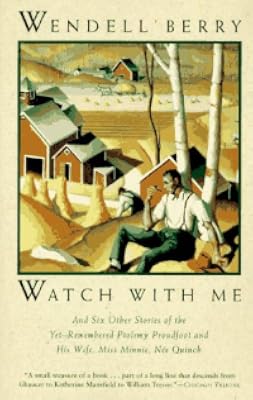
Watch With Me and Six Other Stories of the Yet-Remembered Ptolemy Proudfoot and His Wife, Miss Minnie, Née Quinch
by Wendell Berry
Port William Membership
On This Page
Description
This volume of six linked stories and the novella from which the book derives its title is set in Port William from 1908 to the Second World War. Here Wendell Berry introduces two of his more indelible and poignant characters, Ptolemy Proudfoot and his wife Miss Minnie, remarkable for the comic and affectionate range that, with the mastery of this consummate storyteller working at the height of his powers, here approaches the Shakespearean. Tol Proudfoot is huge, outsized, in the tradition show more of the mythic. The three-hundred-pound farmer, personally imposing and unkempt, is also the most graceful of presences, reserved and gallant toward his tiny wife, the ninety-pound schoolteacher. Their contrasts are humorous, of course, and recall the tall tales of rural Americana. In the novella Watch with Me, we are given a story of such depth, breadth, and importance it earns being listed as one of the most important short stories written in the American language during the twentieth century. show lessTags
Recommendations





























Member Reviews
Summary: Six short stories and the title novella centered around the Port William resident, Tol Proudfoot and his wife, Miss Minnie and their life on a rural farm, part of the membership of a rural community.
This one had me at the title, both for its length, and the “yet-remembered” part. For Ptolemy “Tol” Proudfoot was a memorable man–a big man of 300 pounds who seemed to be a-bursting out of his clothes, which looked disheveled within minutes of him donning them. He carefully farmed 98 acres, just enough and not two acres more. He was a good judge of horses and all livestock, as well as a good judge of people. Miss Minnie Quinch Proudfoot was as diminutive as Tol was large, but just as impressive. This book of short stories show more and a novella trace their life together and the lives they touched from the time they began to court until a few years before death parted them.
The first story introduces both of them and tells how Miss Minnie, who had had eyes for him as he for her, consented to let Tol see her home after the Harvest Festival. “A Half-Pint of Old Darling” renders the amusing story of how Miss Minnie, a local temperance movement leader, got pie-eyed drunk on some Old Darling whiskey Tol had bought for his new calves. “The Lost Bet” recounts the time Tol had the last laugh with a store owner who belittled him. Tol was great with livestock and could drive a horse with aplomb, but struggled mightily with his new Model A. “Nearly to the Fair” recounts their attempt to be driven by Elton Penn to the state fair, never quite getting there.
Tol and Miss Minnie never had children and the hospitality they showed to a homeless father and son during the height of the Depression showed the unspoken heartache between them. As the father and son are leaving, Tol half-jokingly says to the man, “We could use a boy like that.” After they left “Tol put on a clean shirt and his jacket, and cap and gloves. Miss Minnie began to clear the table. For the rest of that day, they did not look at one another.” With an economy of words, Berry expresses the bond between them, the diligence of their daily lives, and the unspoken ache they both felt. The last of the short stories recalls a riotous incident from childhood when the family was gathered at Old Ant’ny Proudfoot’s and the boys managed to dump both a cat and a dog down the chimney resulting in all hell breaking loose with the company. Told a few years before his passing with tears of laughter running down his face, “It was Tol’s benediction, as I grew to know, on that expectancy of good and surprising things that had kept Lester’s eyes, and Tol’s too, wide open for so long.”
“Watch With Me,” the final novella is another incident, from 1916, of those “good and surprising things.” Thacker “Nightlife” Hample was prone to spells. Prevented from preaching at the revival at Goforth Church, he comes by Tol’s place, spies an old shotgun that had been loaded to kill a snake, takes it and walks deliberately away, mouthing threats to kill himself. Tol and his nephew Sam and several others follow as a distance, as Nightlife walks on, oblivious of them while they are far from oblivious to the danger of the shotgun. They follow a day and a night, losing him in the woods only to have him come to the fire where they had fallen asleep, uttering Jesus’ words “Couldn’t you stay awake? Couldn’t you stay awake?” He then leaves, taking them in a big circle back to Tol’s workshop. It’s a fine story of human fidelity and frailty–of friends who drop their work to watch their “teched” community member, not sure what they can do, but realizing they needed to be there, even at risk to themselves. That’s what it was to be a “member” of this community.
This is a wonderful collection I never knew existed, introducing me to an older member of Port William. The fine writing says just enough to suggest the things Berry wants us to see–the wonder of marital fidelity with all its flaws, the attentive care to land and crops, and animals, and people that makes for a healthy place, and the laughable incongruities of life. We witness the gentle respect people show for one another’s fallibilities, where people are protected from the worst versions of themselves, offering them space for redemption and growth. Berry makes us long for what was in this fictional town, and what could be in ours. He gently poses the question of us of what it may be to be the Tol, the Miss Minnie to others. We miss what Berry is saying if we only long for the world around us to be like these people and fail to hear the invitation to be like them ourselves. show less
This one had me at the title, both for its length, and the “yet-remembered” part. For Ptolemy “Tol” Proudfoot was a memorable man–a big man of 300 pounds who seemed to be a-bursting out of his clothes, which looked disheveled within minutes of him donning them. He carefully farmed 98 acres, just enough and not two acres more. He was a good judge of horses and all livestock, as well as a good judge of people. Miss Minnie Quinch Proudfoot was as diminutive as Tol was large, but just as impressive. This book of short stories show more and a novella trace their life together and the lives they touched from the time they began to court until a few years before death parted them.
The first story introduces both of them and tells how Miss Minnie, who had had eyes for him as he for her, consented to let Tol see her home after the Harvest Festival. “A Half-Pint of Old Darling” renders the amusing story of how Miss Minnie, a local temperance movement leader, got pie-eyed drunk on some Old Darling whiskey Tol had bought for his new calves. “The Lost Bet” recounts the time Tol had the last laugh with a store owner who belittled him. Tol was great with livestock and could drive a horse with aplomb, but struggled mightily with his new Model A. “Nearly to the Fair” recounts their attempt to be driven by Elton Penn to the state fair, never quite getting there.
Tol and Miss Minnie never had children and the hospitality they showed to a homeless father and son during the height of the Depression showed the unspoken heartache between them. As the father and son are leaving, Tol half-jokingly says to the man, “We could use a boy like that.” After they left “Tol put on a clean shirt and his jacket, and cap and gloves. Miss Minnie began to clear the table. For the rest of that day, they did not look at one another.” With an economy of words, Berry expresses the bond between them, the diligence of their daily lives, and the unspoken ache they both felt. The last of the short stories recalls a riotous incident from childhood when the family was gathered at Old Ant’ny Proudfoot’s and the boys managed to dump both a cat and a dog down the chimney resulting in all hell breaking loose with the company. Told a few years before his passing with tears of laughter running down his face, “It was Tol’s benediction, as I grew to know, on that expectancy of good and surprising things that had kept Lester’s eyes, and Tol’s too, wide open for so long.”
“Watch With Me,” the final novella is another incident, from 1916, of those “good and surprising things.” Thacker “Nightlife” Hample was prone to spells. Prevented from preaching at the revival at Goforth Church, he comes by Tol’s place, spies an old shotgun that had been loaded to kill a snake, takes it and walks deliberately away, mouthing threats to kill himself. Tol and his nephew Sam and several others follow as a distance, as Nightlife walks on, oblivious of them while they are far from oblivious to the danger of the shotgun. They follow a day and a night, losing him in the woods only to have him come to the fire where they had fallen asleep, uttering Jesus’ words “Couldn’t you stay awake? Couldn’t you stay awake?” He then leaves, taking them in a big circle back to Tol’s workshop. It’s a fine story of human fidelity and frailty–of friends who drop their work to watch their “teched” community member, not sure what they can do, but realizing they needed to be there, even at risk to themselves. That’s what it was to be a “member” of this community.
This is a wonderful collection I never knew existed, introducing me to an older member of Port William. The fine writing says just enough to suggest the things Berry wants us to see–the wonder of marital fidelity with all its flaws, the attentive care to land and crops, and animals, and people that makes for a healthy place, and the laughable incongruities of life. We witness the gentle respect people show for one another’s fallibilities, where people are protected from the worst versions of themselves, offering them space for redemption and growth. Berry makes us long for what was in this fictional town, and what could be in ours. He gently poses the question of us of what it may be to be the Tol, the Miss Minnie to others. We miss what Berry is saying if we only long for the world around us to be like these people and fail to hear the invitation to be like them ourselves. show less
Ratings
Members
- Recently Added By
Lists

Indigenous Peoples: Nonfiction & Fiction
50 works; 1 member
Author Information

160+ Works 24,792 Members
Wendell Berry The prolific poet, novelist, and essayist Wendell Berry is a fifth-generation native of north central Kentucky. Berry taught at Stanford University; traveled to Italy and France on a Guggenheim Fellowship; and taught at New York University and the University of Kentucky, Lexington, before moving to Henry County. Berry owns and show more operates Lanes Landing Farm, a small, hilly piece of property on the Kentucky River. He embraced full-time farming as a career, using horses and organic methods to tend the land. Harmony with nature in general, and the farming tradition in particular, is a central theme of Berry's diverse work. As a poet, Berry gained popularity within the literary community. Collected Poems, 1957-1982, was particularly well-received. Novels and short stories set in Port William, a fictional town paralleling his real-life home town of Port Royal further established his literary reputation. The Memory of Old Jack, Berry's third novel, received Chicago's Friends of American Writers Award for 1975. Berry reached his broadest audience and attained his greatest popular acclaim through his essays. The Unsettling of America: Culture and Agriculture is a springboard for contemporary environmental concerns. In his life as well as his art, Berry has advocated a responsible, contextual relationship with individuals in a local, agrarian economy. (Bowker Author Biography) show less
Series

Work Relationships
Is contained in
Common Knowledge
- Canonical title
- Watch With Me and Six Other Stories of the Yet-Remembered Ptolemy Proudfoot and His Wife, Miss Minnie, Née Quinch
- Original publication date
- 1994
- People/Characters
- Ptolemy Proudfoot; Minnie Quinch; Burley Coulter
Classifications
Statistics
- Members
- 191
- Popularity
- 171,488
- Reviews
- 1
- Rating
- (4.19)
- Languages
- English
- Media
- Paper, Ebook
- ISBNs
- 5
- ASINs
- 2