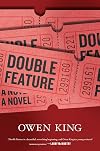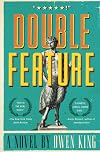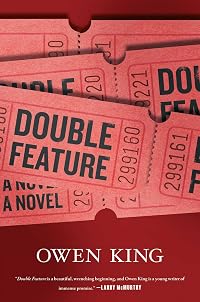
Double Feature
by Owen King
On This Page
Description
A young man comes to terms with his life in the process and aftermath of making his first film, in particular with his relationships with family, friends, lovers, and adversaries.Tags
Recommendations







Member Reviews
I can picture it on the big screen…
I’m nothing so pretentious as a cinephile; I’m a movie-lover. So, I think, is debut novelist Owen King. But the young protagonist of Double Feature, Sam Dolan, is very much a cinephile and a freshly-minted graduate of film school. As the non-linear narrative opens, Sam is about to start filming the script that was his college thesis. The first third of the novel involves the shooting of this low-budget, indie feature film and the aftermath of that film’s creation. It affects Sam’s life in long-lasting and unexpected ways. Beyond this, Double Feature is about Sam’s complicated relationship with his father, Booth, a deeply flawed and aging B-movie actor. One passage:
“The story was show more undoubtedly an exaggeration if not an outright fabrication. Booth had been in the business of cheap entertainment for so long that he had gone native. In his telling, everything was a sensation, a shock, a crisis, a betrayal, amazing bad luck, or an unforeseeable confluence. When Sam was younger, his father had let him down. Now that Sam was older, his earlier self’s stupidity mortified him: how could he have expected anything else from a man who relished any opportunity to tell strangers that his infant son looked like a leper? Booth’s fallaciousness was right there all the time, as inherent as the nose on his face.”
It’s bold—Bold I say!—when you’re Stephen King’s son, to publish a debut about a young artist with major daddy issues. Readers tend to read into these things. But I can’t honestly say that I believe Mr. King is working through any issues of his own. Still, he may have some insights into being the child of a celebrity that most of us don’t.
I mentioned above that the novel is non-linear. It moves in time from the opening when Sam is in his early-twenties, back to his parents’ courtship decades earlier, forward to the altered life of Sam’s early thirties, and many points in between. I’m a big fan of this type of story-telling when it’s done right. It’s an interesting way to make revelations, often with answers coming before questions are even asked. Mr. King did manage this device well, for instance, eventually supplying the additional information on Sam’s mother that as a reader I actively craved.
As you can see from the quote above, his use of language is sophisticated. This is not the type of macabre commercial fiction that his father and brother trade in. This is a satirical dramedy, and yes, it’s definitely funny, though not generally in a laugh-out-loud way. Both the characters and the events of the novel have a heightened quality about them, not exactly mirroring real-life, but intentionally so. King has created a fantastic and entertaining assortment of supporting characters. This is one case, however, where I don’t feel that the novel’s jacket copy does them justice or really describes the story accurately. What can you say? No one wants to be guilty of spoilers.
Double Feature is an accomplished debut, but I do have a few criticisms. I felt that both the novel’s beginning and ending were especially strong, but things slumped a bit in the tale’s middle. Further, there are plot developments that occur that are so unbelievably obvious to the reader that it’s hard to credit that Sam can’t see the big picture as easily as we can. It’s true that when you’re living in the moment, these things generally aren’t as obvious, but it still stretched my credulity.
That said, the novel’s plotting was especially impressive. King juggles quite a few literary threads and manages to bring his story full circle in a notably satisfying manner. It’s truly difficult not to develop affection for this loony cast of characters. And one more treat… Do you stay to the very end of films’ credits like I do? Sometimes there’s an “Easter egg” at the very end. This may be the first time I’ve seen a literary Easter egg after a novel’s acknowledgements, but it’s awesome. It’s the perfect way to end this tribute to the magic of movies. show less
I’m nothing so pretentious as a cinephile; I’m a movie-lover. So, I think, is debut novelist Owen King. But the young protagonist of Double Feature, Sam Dolan, is very much a cinephile and a freshly-minted graduate of film school. As the non-linear narrative opens, Sam is about to start filming the script that was his college thesis. The first third of the novel involves the shooting of this low-budget, indie feature film and the aftermath of that film’s creation. It affects Sam’s life in long-lasting and unexpected ways. Beyond this, Double Feature is about Sam’s complicated relationship with his father, Booth, a deeply flawed and aging B-movie actor. One passage:
“The story was show more undoubtedly an exaggeration if not an outright fabrication. Booth had been in the business of cheap entertainment for so long that he had gone native. In his telling, everything was a sensation, a shock, a crisis, a betrayal, amazing bad luck, or an unforeseeable confluence. When Sam was younger, his father had let him down. Now that Sam was older, his earlier self’s stupidity mortified him: how could he have expected anything else from a man who relished any opportunity to tell strangers that his infant son looked like a leper? Booth’s fallaciousness was right there all the time, as inherent as the nose on his face.”
It’s bold—Bold I say!—when you’re Stephen King’s son, to publish a debut about a young artist with major daddy issues. Readers tend to read into these things. But I can’t honestly say that I believe Mr. King is working through any issues of his own. Still, he may have some insights into being the child of a celebrity that most of us don’t.
I mentioned above that the novel is non-linear. It moves in time from the opening when Sam is in his early-twenties, back to his parents’ courtship decades earlier, forward to the altered life of Sam’s early thirties, and many points in between. I’m a big fan of this type of story-telling when it’s done right. It’s an interesting way to make revelations, often with answers coming before questions are even asked. Mr. King did manage this device well, for instance, eventually supplying the additional information on Sam’s mother that as a reader I actively craved.
As you can see from the quote above, his use of language is sophisticated. This is not the type of macabre commercial fiction that his father and brother trade in. This is a satirical dramedy, and yes, it’s definitely funny, though not generally in a laugh-out-loud way. Both the characters and the events of the novel have a heightened quality about them, not exactly mirroring real-life, but intentionally so. King has created a fantastic and entertaining assortment of supporting characters. This is one case, however, where I don’t feel that the novel’s jacket copy does them justice or really describes the story accurately. What can you say? No one wants to be guilty of spoilers.
Double Feature is an accomplished debut, but I do have a few criticisms. I felt that both the novel’s beginning and ending were especially strong, but things slumped a bit in the tale’s middle. Further, there are plot developments that occur that are so unbelievably obvious to the reader that it’s hard to credit that Sam can’t see the big picture as easily as we can. It’s true that when you’re living in the moment, these things generally aren’t as obvious, but it still stretched my credulity.
That said, the novel’s plotting was especially impressive. King juggles quite a few literary threads and manages to bring his story full circle in a notably satisfying manner. It’s truly difficult not to develop affection for this loony cast of characters. And one more treat… Do you stay to the very end of films’ credits like I do? Sometimes there’s an “Easter egg” at the very end. This may be the first time I’ve seen a literary Easter egg after a novel’s acknowledgements, but it’s awesome. It’s the perfect way to end this tribute to the magic of movies. show less
Ok, Owen King, I see what you did there. You made Sam's life mirror his film, with his own life going off the rails & becoming something uncomfortably close to mental illness for a good chunk of time. Then you resolved his decade-long issues in one long weekend, like the characters of Who We Are were supposed to resolve 4 years in a day. And that's clever.
You wrote a complete novel - complete with missing scenes, a budget for the fictional novel, an interview with the fictional father - with a lot of imagination & humor, encompassing a lot of themes. It was an ambitious undertaking, & not half-bad.
But there WERE some things left incomplete, or maybe they just weren't enough. Like Sam himself. It took me a long time to care about Sam - show more all the way up to his realizing what Brooks had done to his film. And you had me there: I cared, I really wanted to know what came next for him. But then you lost me. It was depressing enough that his talents were wasted on being a weddingographer; realizing that he was such a prick that he didn't deserve much more than that was a disappointment. Nothing feels real at that point: married Polly & her jock husband are caricatures; a NYC woman in her 30s willing to chase down a guy who literally fled from her is NOT real; a guy in his 30s who will stand on an old man to flee out a bathroom window shouldn't even exist in anyone's imagination. If this were a farce, all is fair. But it's not.
I've heard that you insist this father-son relationship is not at all autobiographical. I don't know anyone in the King family, or anyone who can claim to know any Kings, so I have no reason to doubt that. Except this: your father claimed that he didn't realize he was writing books that were making connections to each other, that were building a whole world with a long history. So maybe you're writing some things you don't realize, too. That's okay, & not really my business, unless the reason your story is incomplete is because your understanding of what you're writing is, too. If that's the case, then I just ask that you figure it out, for the sake of the next book.
Because I really want to like you, on your own merits. As debut novels go, this was ambitious, & successful enough. So I will read the next one. I can live with imperfect characters - they're only human, right? I just want to be happier for the main character when he's at a party that brings his whole 30 years together in a touching way than I was for Sam. That's all. show less
You wrote a complete novel - complete with missing scenes, a budget for the fictional novel, an interview with the fictional father - with a lot of imagination & humor, encompassing a lot of themes. It was an ambitious undertaking, & not half-bad.
But there WERE some things left incomplete, or maybe they just weren't enough. Like Sam himself. It took me a long time to care about Sam - show more all the way up to his realizing what Brooks had done to his film. And you had me there: I cared, I really wanted to know what came next for him. But then you lost me. It was depressing enough that his talents were wasted on being a weddingographer; realizing that he was such a prick that he didn't deserve much more than that was a disappointment. Nothing feels real at that point: married Polly & her jock husband are caricatures; a NYC woman in her 30s willing to chase down a guy who literally fled from her is NOT real; a guy in his 30s who will stand on an old man to flee out a bathroom window shouldn't even exist in anyone's imagination. If this were a farce, all is fair. But it's not.
I've heard that you insist this father-son relationship is not at all autobiographical. I don't know anyone in the King family, or anyone who can claim to know any Kings, so I have no reason to doubt that. Except this: your father claimed that he didn't realize he was writing books that were making connections to each other, that were building a whole world with a long history. So maybe you're writing some things you don't realize, too. That's okay, & not really my business, unless the reason your story is incomplete is because your understanding of what you're writing is, too. If that's the case, then I just ask that you figure it out, for the sake of the next book.
Because I really want to like you, on your own merits. As debut novels go, this was ambitious, & successful enough. So I will read the next one. I can live with imperfect characters - they're only human, right? I just want to be happier for the main character when he's at a party that brings his whole 30 years together in a touching way than I was for Sam. That's all. show less
Going to be honest here, I didn't expect to like this. Yes, it's the OTHER (read: non-Joe Hill) son of Stephen King and it was pushed as a "hilarious" novel. Okay, it's not hilarious. But it is, among other things, amusing, touching, smile-inducing, poignant, meandering and frustrating. At times I felt it was closer to J.K. Rowling's A Casual Vacancy than anything. But bottom line? I quite enjoyed it.
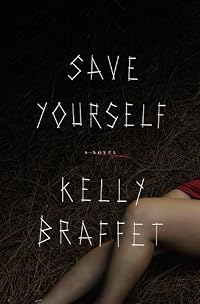
So this author is surrounded by writers in his real life. His wife Kelly Braffet is an author I have read and liked, his Brother Joe Hill's books have been fantastic, his mother Tabitha King is an author, and then of course there is his father Stephen King. So the fact that Owen King decided to be a writer, is really no surprise. What was a surprise was how boring this book was. If you are going to write a book with quirky eccentric characters and a less than conventional storyline like a John Irving, or Wally Lamb book the writing has to be interesting, and pull the reader in from the start. This book has all kinds of creative writing gimmicks- a paragraph that lasts for multiple pages, a plot line within a plot line within a plot show more line, etc, the problem for me was I didn't care about anyone in the book. I felt like there was an inside story I was not privy to, like an inside joke, and I was looking in but would never be made part of the group. Yes the author can write, but for me the subject and the characters were just one dimensional and not at all interesting. show less
A heavy drama about a pretentious, kind of spoiled, young man trying to make an independent movie more or less about his life, representing the resentment that an egomaniacal and strange father has carved in him, and the early death of his morher. The movie was never finished because one of our hero's bigger investors, a traumatized and quirky man, destroyed the main recordings to make one of those "so bad that it's good" films. That shame for making that film follows him throughout the book, the same as his umbrage for being so hapless. Being incapable of maintaining a good relationship with a woman, having an affair with an ex-girlfriend, having to deal with other quirky weirdoes, and a little sister from another mother having the show more same problems as him, and coming into his life, makes for a pretty strong novel. Better than anything his dad ever wrote. I must warn whoever is reading this: NOTHING HAPPENS in this book. It's one of those dramas where characters somewhat grow and learn to accept things as they are at the end. show less
Owen King's pacing, the back and forth of the story between episodes that formed the narrator's directorial career, his father's own somewhat more successful career, I thoroughly enjoyed all of it.
When it begins to dawn on Sam that his film has been destroyed by Brooks I felt the visceral tug at the guts and as the stakes ratcheted up, even though you *knew* what was going to happen (and you do, now, now that you've read this... spoiler!), you knew it wasn't going to end well. But, like a socket wrench, the magnitude of the problem, the sheer loss Sam's going to experience, and you with him, it gets worse, then a little worse, then worse still until something breaks and we get catapulted to 1969 and Booth's nascent career.
It's a pretty show more full book, full of characters, some of whom echo a little more realistically, some of whom (like Booth at his most bombastic, but fully in keeping with his character, or the Internet listicle celeb roommate of Sam's) don't. Like I said, I really enjoyed the pacing and the shifting gears between one story and the next, one perspective and the next, particularly Sam's mother, Allie's story. While the early section is fraught with tension regarding the ultimate fate of Sam's film, the remaining sections, the long weekend sections, still roil with their own little sub-dramas and I had a good time riding out the rest of the story with these folks. show less
When it begins to dawn on Sam that his film has been destroyed by Brooks I felt the visceral tug at the guts and as the stakes ratcheted up, even though you *knew* what was going to happen (and you do, now, now that you've read this... spoiler!), you knew it wasn't going to end well. But, like a socket wrench, the magnitude of the problem, the sheer loss Sam's going to experience, and you with him, it gets worse, then a little worse, then worse still until something breaks and we get catapulted to 1969 and Booth's nascent career.
It's a pretty show more full book, full of characters, some of whom echo a little more realistically, some of whom (like Booth at his most bombastic, but fully in keeping with his character, or the Internet listicle celeb roommate of Sam's) don't. Like I said, I really enjoyed the pacing and the shifting gears between one story and the next, one perspective and the next, particularly Sam's mother, Allie's story. While the early section is fraught with tension regarding the ultimate fate of Sam's film, the remaining sections, the long weekend sections, still roil with their own little sub-dramas and I had a good time riding out the rest of the story with these folks. show less
So this author is surrounded by writers in his real life. His wife Kelly Braffet is an author I have read and liked, his Brother Joe Hill's books have been fantastic, his mother Tabitha King is an author, and then of course there is his father Stephen King. So the fact that Owen King decided to be a writer, is really no surprise. What was a surprise was how boring this book was. If you are going to write a book with quirky eccentric characters and a less than conventional storyline like a John Irving, or Wally Lamb book the writing has to be interesting, and pull the reader in from the start. This book has all kinds of creative writing gimmicks- a paragraph that lasts for multiple pages, a plot line within a plot line within a plot show more line, etc, the problem for me was I didn't care about anyone in the book. I felt like there was an inside story I was not privy to, like an inside joke, and I was looking in but would never be made part of the group. Yes the author can write, but for me the subject and the characters were just one dimensional and not at all interesting. show less
Members
- Recently Added By
Lists

Books Read in 2023
5,638 works; 147 members
Author Information

13+ Works 5,263 Members
Some Editions
Common Knowledge
- Canonical title
- Double Feature
Classifications
Statistics
- Members
- 241
- Popularity
- 135,238
- Reviews
- 13
- Rating
- (3.43)
- Languages
- English
- Media
- Paper, Audiobook, Ebook
- ISBNs
- 9
- UPCs
- 1
- ASINs
- 2