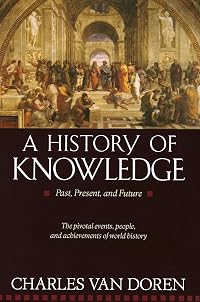
A History of Knowledge: Past, Present, and Future
by Charles Van Doren
On This Page
Description
Here is a compendium of everything that humankind has thought, invented, created, considered, and perfected from the beginning of civilization into the twenty-first century. A History of Knowledge covers not only all the great theories and discoveries of the human race, but also explores the social conditions, political climates, and individual men and women of genius that brought ideas to fruition throughout history. --from publisher description.Tags
Recommendations


















Member Reviews
Normally I would have written this off early in the book. 25 year old book written by a white American male who considers those three attributes to be the marks of culture. The world need only become more like white American males to perfect itself. However, the reason I have this book is that 5 years ago my son was assigned it as a textbook! And the further I got into the book, the more I read his opinions (that he considers to be knowledge) about the then present on into the future, the more horrified I became.
His comment on one major challenge the world was facing when he wrote was "It is not pleasant to have to mention such a possibility. Let us therefore assume it will not happen."
A lot of his 'facts' and 'knowledge' are show more dangerous because he can't tell the difference between his own opinions and reality.
As far as his ideas about the future go, they are the proof that this book is way over its use-by-date.
I can't believe this is still in print. show less
His comment on one major challenge the world was facing when he wrote was "It is not pleasant to have to mention such a possibility. Let us therefore assume it will not happen."
A lot of his 'facts' and 'knowledge' are show more dangerous because he can't tell the difference between his own opinions and reality.
As far as his ideas about the future go, they are the proof that this book is way over its use-by-date.
I can't believe this is still in print. show less
Though I genuinely enjoyed the book, I feel obliged to highlight couple of glaring factual mistakes I detected. They both deal with Russia and as a Russian I could not pass them unnoticed. The Russo-Japanese War was started by Japan with a surprising attack. The author states opposite.
Next, he confuses Belorussians (literally "White Russians") with White Guards, who fought Reds in the Russian Civil War and had mostly nothing in common with these people, apart from sounding alike to a certain degree. To me it sounds liek a hilarious, pun-like joke, but for many foreign readers out there, who are not familiar with the topic it may serve as a misleading information.
Next, he confuses Belorussians (literally "White Russians") with White Guards, who fought Reds in the Russian Civil War and had mostly nothing in common with these people, apart from sounding alike to a certain degree. To me it sounds liek a hilarious, pun-like joke, but for many foreign readers out there, who are not familiar with the topic it may serve as a misleading information.
An overview of human knowledge that, despite its relative conciseness, manages to serve as a source of inspiration for additional reading and rereading. If nothing else, this is a reference work well worth consulting for ideas on the salient features of the centuries' worth of advances in human knowledge.
While slightly fusty by modern 'literary non-fiction' standards, this book has been a beginner history/philosophy student stand-by for a long time. Not the type of book you read from cover to cover in one sitting, but worth having on the shelf for reference value
While "history" books cannot elide the grim determinism of the past upon the present, few historians are as express about the links between our present and the present, and how our present is already fixing the future.
The author was an editor of Encyclopaedia Brtiannica for 20 years.
The book is divided into 15 chapters. That division is explained in the outline of the book presented in the "Author to Reader" section.
1. Wisdom of Ancients
2. Greek Explosion
3. What Romans Knew
4. Light in the Dark Ages
5. Middle Ages: Great Experiment.
6. Reborn in the Renaissance.
7. Europe Reaches Out.
8. Invention of Scientific Method.
9. Age of Revolutions
10. Nineteeth Century: Prelude
11. World in 1914
12. Twentieth C.: Triumph of Democracy
13. Twentieth C: show more Science and Technology
14. Twentieth C: Art and Media
15. Next Hundred Years show less
The author was an editor of Encyclopaedia Brtiannica for 20 years.
The book is divided into 15 chapters. That division is explained in the outline of the book presented in the "Author to Reader" section.
1. Wisdom of Ancients
2. Greek Explosion
3. What Romans Knew
4. Light in the Dark Ages
5. Middle Ages: Great Experiment.
6. Reborn in the Renaissance.
7. Europe Reaches Out.
8. Invention of Scientific Method.
9. Age of Revolutions
10. Nineteeth Century: Prelude
11. World in 1914
12. Twentieth C.: Triumph of Democracy
13. Twentieth C: show more Science and Technology
14. Twentieth C: Art and Media
15. Next Hundred Years show less
Visionary text combining the literature and history of all ages to propose what we should do in the future.
Members
- Recently Added By
Lists

Will Durant's 100 Books: An Update
46 works; 4 members

Bibliotherapy: Family and Personal Social Issues
174 works; 5 members

Shaykh Hamza's Book Recommendations
439 works; 3 members
Author Information

19+ Works 11,232 Members
Charles Lincoln Van Doren was born in Manhattan, New York on February 12, 1926. During World War II, he served with the Army Air Forces. He received a bachelor's degree from St. John's College and a master's degree in mathematics from Columbia University in 1949. After studies at Cambridge University in England and the Sorbonne in Paris, he show more started teaching English at Columbia in 1955 and received a doctorate in literature there in 1959. From November 28, 1956 to March 11, 1957, he appeared on the NBC quiz show Twenty-One. He won a total of $129,000. He appeared on the cover of Time magazine and signed a $150,000 contract to appear on NBC shows for three years. As rumors and skepticism over TV quiz shows being fixed arose, he insisted that he had not taken part in any deceptions. However, on November 2, 1959, he told congressional investigators that the shows had all been fixed, that he had been given questions and answers in advance, and that he had been coached to make the performances more dramatic. He lost his job at Columbia, NBC canceled his contract, and he pleaded guilty to second-degree perjury and received a suspended sentence. He became an editor and a writer. He took a job with Encyclopaedia Britannica and eventually became a vice president in charge of the editorial department. He retired in 1982. He wrote several books including The Joy of Reading and A History of Knowledge. He died on April 9, 2019 at the age of 93. (Bowker Author Biography) show less
Some Editions
Common Knowledge
- Original title
- A History of Knowledge: Past, Present, and Future
- Original publication date
- 1991
- Dedication
- To
Gerry, Liz, Sally and John - First words
- BY THE TIME written history began, some fifty centuries ago, mankind had learned much more than our primitive ancestors knew.
- Original language
- English
Classifications
- Genres
- History, Nonfiction, General Nonfiction, Philosophy, Science & Nature, Religion & Spirituality
- DDC/MDS
- 001 — Computer science, information & general works Computer science, knowledge & systems Knowledge and learning in general
- LCC
- AZ221 .V36 — General Works History of scholarship and learning. The humanities History of scholarship and learning. The humanities History
- BISAC
Statistics
- Members
- 1,511
- Popularity
- 15,377
- Reviews
- 8
- Rating
- (3.65)
- Languages
- 6 — English, German, Italian, Polish, Portuguese, Spanish
- Media
- Paper, Ebook
- ISBNs
- 19
- ASINs
- 4