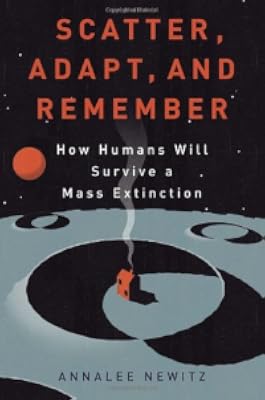
Scatter, Adapt, and Remember: How Humans Will Survive a Mass Extinction
by Annalee Newitz
On This Page
Description
In its 4.5 billion–year history, life on Earth has been almost erased at least half a dozen times: shattered by asteroid impacts, entombed in ice, smothered by methane, and torn apart by unfathomably powerful megavolcanoes. And we know that another global disaster is eventually headed our way. Can we survive it? How?As a species, Homo sapiens is at a crossroads. Study of our planet’s turbulent past suggests that we are overdue for a catastrophic disaster, whether caused by nature or by show more human interference.
It’s a frightening prospect, as each of the Earth’s past major disasters—from meteor strikes to bombardment by cosmic radiation—resulted in a mass extinction, where more than 75 percent of the planet’s species died out. But in Scatter, Adapt, and Remember, Annalee Newitz, science journalist and editor of the science Web site io9.com explains that although global disaster is all but inevitable, our chances of long-term species survival are better than ever. Life on Earth has come close to annihilation—humans have, more than once, narrowly avoided extinction just
during the last million years—but every single time a few creatures survived, evolving to adapt to the harshest of conditions.
This brilliantly speculative work of popular science focuses on humanity’s long history of dodging the bullet, as well as on new threats that we may face in years to come. Most important, it explores how scientific breakthroughs today will help us avoid disasters tomorrow. From simulating tsunamis to studying central Turkey’s ancient underground cities; from cultivating cyanobacteria for “living cities” to designing space elevators to make space colonies cost-effective; from using math to stop pandemics to studying the remarkable survival strategies of gray whales, scientists and researchers the world over are discovering the keys to long-term resilience and learning how humans can choose life over death.
Newitz’s remarkable and fascinating journey through the science of mass extinctions is a powerful argument about human ingenuity and our ability to change. In a world populated by doomsday preppers and media commentators obsessively forecasting our demise, Scatter, Adapt, and Remember is a compelling voice of hope. It leads us away from apocalyptic thinking into a future where we live to build a better world—on this planet and perhaps on others. Readers of this book will be equipped scientifically, intellectually, and emotionally to face whatever the future holds. show less
Tags
Recommendations









Member Recommendations
Physics of the Future: How Science Will Shape Human Destiny and Our Daily Lives by the Year 2100 by Michio Kaku
CGlanovsky Both books take a survey of cutting edge science & technology in various fields and extrapolate on how these advancements might effect life in the future.
Member Reviews
Love post-apocalypse fiction? Here’s apocalyptic science made utterly fascinating and relatively hopeful--
How can humanity survive life-annihilating disasters like global warming, cyclical ice ages, cosmic radiation, mega-volcanoes, rampaging pathogens, and asteroid strikes? After talking with scientists, engineers, philosophers, historians, technicians and--as she puts it--sundry brainiacs, Annalee Newitz has a few suggestions. Since I inexplicably love novels, movies, and TV shows set in post-apocalyptic times I found her book utterly fascinating.
Scatter, Adapt, and Remember covers a vast territory of time, from the earliest days of life on Earth until a million years in the future. The first section, A History of Mass Extinctions, show more describes times when life was almost snuffed out completely, only to reemerge adapted for new conditions. Often these almost end-times were brought on by external forces, but it turns out we aren’t the first species to pollute our own environment--that would be the oxygen spewing cyanobacteria (or blue-green algae). Oxygen was poisonous to the life forms of early Earth and most of them died off when it began to fill the atmosphere, but the change set our planet on a trajectory that gave rise to the world as we know it.
The second section of the book, We Almost Didn’t Make It, covers times when starvation or plague killed vast numbers of people. Lessons From Survivors draws its conclusions from many different life forms that have survived mass death, not just humans. Sections titled How to Build a Death-Proof City, which suggests possibilities like underground communities, urban agriculture, and bioplastic buildings, and The Million Year View, which has space colonies among its ideas, conclude the book.
Some of the information is necessarily speculative, but science is exciting in Newitz’s hands. It’s a hopeful book, drawing ideas for the future from the many times life forms on Earth have managed to sneak past the ultimate grim reaper. show less
How can humanity survive life-annihilating disasters like global warming, cyclical ice ages, cosmic radiation, mega-volcanoes, rampaging pathogens, and asteroid strikes? After talking with scientists, engineers, philosophers, historians, technicians and--as she puts it--sundry brainiacs, Annalee Newitz has a few suggestions. Since I inexplicably love novels, movies, and TV shows set in post-apocalyptic times I found her book utterly fascinating.
Scatter, Adapt, and Remember covers a vast territory of time, from the earliest days of life on Earth until a million years in the future. The first section, A History of Mass Extinctions, show more describes times when life was almost snuffed out completely, only to reemerge adapted for new conditions. Often these almost end-times were brought on by external forces, but it turns out we aren’t the first species to pollute our own environment--that would be the oxygen spewing cyanobacteria (or blue-green algae). Oxygen was poisonous to the life forms of early Earth and most of them died off when it began to fill the atmosphere, but the change set our planet on a trajectory that gave rise to the world as we know it.
The second section of the book, We Almost Didn’t Make It, covers times when starvation or plague killed vast numbers of people. Lessons From Survivors draws its conclusions from many different life forms that have survived mass death, not just humans. Sections titled How to Build a Death-Proof City, which suggests possibilities like underground communities, urban agriculture, and bioplastic buildings, and The Million Year View, which has space colonies among its ideas, conclude the book.
Some of the information is necessarily speculative, but science is exciting in Newitz’s hands. It’s a hopeful book, drawing ideas for the future from the many times life forms on Earth have managed to sneak past the ultimate grim reaper. show less
This was an impulse buy at the bookstore. The title and blurb promised me exactly the sort of book I was looking for at that moment: an optimistic account of how humanity will realize its destiny as starseed. This book didn't exactly deliver on that, but it did deliver a fair amount of interesting information along the way.
The book is divided into five parts, but thematically, I think it's really three: 1) A history of mass-extinctions and crisis points. 2) Stories of how life itself, and later, humanity, survived these bottlenecks and crises. 3) Science and developments happening right now that may help us through our current age of extinction and global warming.
Some of Newitz's choices never seem fully justified. The book seems to show more exist in a muddled grey space between "my personal journey from despair to hope over the ultimate fate of humanity" and "an academic treatise on the possibilities of the continued existence of the human race." For instance, as an example of the survival of a particular human culture through multiple crises, she uses the Jewish diaspora. Which may be fully legitimate, but an academic text would have either discussed more examples or made a better case for why we're discussing this one in particular rather than giving the feeling that this is the case we're discussing because Newitz is Jewish and she knew the most about this one.
Lest you think I'm just being Anti-Semetic, Newitz also promises to plumb the world of science fiction for ideas of how humanity will survive. But this exploration is limited solely to the works of Octavia Butler. Now, I love Octavia Butler. She is hands-down one of my favorite writers and I referenced her idea of Earthseed or starseed in the beginning of this review. But really, why only Butler? The choice is never explained.
So mostly, the parts of the book I most enjoyed were those describing current science that may lend to our survival and imagining the future. There was some great stuff on living buildings (seriously, some Slonczewski references would have been great here!), and interesting discussion of the still theoretical space elevator, and the rarely made acknowledgement that humans are continuously evolving, and that even without genetic engineering or uploading ourselves into computers, should we survive, the humans of a million years from now will look radically different.
So, this wasn't exactly the book I was looking for. But that book would probably have been agonizingly long. This book was still a step in the right direction. show less
The book is divided into five parts, but thematically, I think it's really three: 1) A history of mass-extinctions and crisis points. 2) Stories of how life itself, and later, humanity, survived these bottlenecks and crises. 3) Science and developments happening right now that may help us through our current age of extinction and global warming.
Some of Newitz's choices never seem fully justified. The book seems to show more exist in a muddled grey space between "my personal journey from despair to hope over the ultimate fate of humanity" and "an academic treatise on the possibilities of the continued existence of the human race." For instance, as an example of the survival of a particular human culture through multiple crises, she uses the Jewish diaspora. Which may be fully legitimate, but an academic text would have either discussed more examples or made a better case for why we're discussing this one in particular rather than giving the feeling that this is the case we're discussing because Newitz is Jewish and she knew the most about this one.
Lest you think I'm just being Anti-Semetic, Newitz also promises to plumb the world of science fiction for ideas of how humanity will survive. But this exploration is limited solely to the works of Octavia Butler. Now, I love Octavia Butler. She is hands-down one of my favorite writers and I referenced her idea of Earthseed or starseed in the beginning of this review. But really, why only Butler? The choice is never explained.
So mostly, the parts of the book I most enjoyed were those describing current science that may lend to our survival and imagining the future. There was some great stuff on living buildings (seriously, some Slonczewski references would have been great here!), and interesting discussion of the still theoretical space elevator, and the rarely made acknowledgement that humans are continuously evolving, and that even without genetic engineering or uploading ourselves into computers, should we survive, the humans of a million years from now will look radically different.
So, this wasn't exactly the book I was looking for. But that book would probably have been agonizingly long. This book was still a step in the right direction. show less
I was rather hoping for kind of an updating of Isaac Asimov’s A Choice of Catastrophes, a survey of all the things that could wipe out humanity and how humans could prepare to survive them.
There’s a lot to like in this book. Newitz reminds us there were more mass extinctions in Earth’s history than just those two publicity hogs, the Permian and K-T. And even the dinosaur extinction may not be as simple as a big space rock smacking the Yucatan. She nicely sums up state of the current Neanderthal debate. Did we kill them? And, if they did leave us some of their genes, was it rape or a peaceful merging of cultures? Though she accepts the idea of harmful anthropogenic global warming, Newitz reminds us we don’t have to shut down show more industrial civilization to mitigate it. She also reminds us that’s also not a path without plenty of technical, scientific, and political complications. But she also knows that environmentalists like the famous Bill McKibbin have chosen an arbitrary state of nature to preserve and fixate on. Finally, I can’t hate any book that touches on so many interests of mine: geology, the Black Death, and science fiction.
However, I think anybody who even pays just casual attention to science journalism is going to find this an overpriced book with a fair amount of padding and digressions.
The padding? The history of cyanobacteria on Earth and the migratory patterns of the gray whale are interesting, but it would have been nice if Newitz would have used examples from human history to illustrate the survival strategies of adaptation and remembering. The engineering of cities to withstand earthquakes and tsunamis is certainly interesting and a worthy goal, but neither type of disaster threatens the extinction of our species.
The digressions? While the ability to grow food in a city, particularly an underground city, is quite indispensable in the event of a supervolcano or that deadly duo from space, a gamma ray burst or asteroid strike, the section on San Francisco as the “City of Tomorrow” comes off as naïve (and native) boosterism by Newitz for a city, in other eyes, full of moral preeners escaping, in their green zone, the problems they cause or aggravate elsewhere.
The book is, Newitz admits at one point, an argument for why man needs to move into space. I agree with that goal, and, in that regard, I was glad to see an update on the progress to build space elevators, but the argument could have been shorter (and cheaper) or more detailed. Often, the book leaves the connections between some parts less than clear and further reinforces the impression of some chapters maybe starting their life as articles on Newitz’s IO9 website.
I also liked the bizarre visions of literally organic city buildings though the problem of gene exchange and evolution thwarting our designs is barely touched on. There is also a section on radical attempts to capture solar energy via organic photosynthetic methods rather than silicon photovoltaics. Logically, that sort of runs in opposition to the urban utopians we meet who somehow think, with all this cheap, future energy, we will want to live the life of local famers.
The book does conclude logically, though, with a look at transhumanism – the promise and pitfalls and complications of changing the human condition by changing our bodies and brains. However, for me, Newitz’s final analogy of our transhuman descendents regarding us fondly as we do our pre-Neanderthal ancestor, seems an emotionally unconvincing conclusion to her story. I feel more emotional kinship with a German Shepard than Australopithecus I’m afraid.
But, if you are familiar with no more than two or three of the topics covered here, then you probably won’t mind this wandering book and just look on it as a fascinating grab bag of articles show less
There’s a lot to like in this book. Newitz reminds us there were more mass extinctions in Earth’s history than just those two publicity hogs, the Permian and K-T. And even the dinosaur extinction may not be as simple as a big space rock smacking the Yucatan. She nicely sums up state of the current Neanderthal debate. Did we kill them? And, if they did leave us some of their genes, was it rape or a peaceful merging of cultures? Though she accepts the idea of harmful anthropogenic global warming, Newitz reminds us we don’t have to shut down show more industrial civilization to mitigate it. She also reminds us that’s also not a path without plenty of technical, scientific, and political complications. But she also knows that environmentalists like the famous Bill McKibbin have chosen an arbitrary state of nature to preserve and fixate on. Finally, I can’t hate any book that touches on so many interests of mine: geology, the Black Death, and science fiction.
However, I think anybody who even pays just casual attention to science journalism is going to find this an overpriced book with a fair amount of padding and digressions.
The padding? The history of cyanobacteria on Earth and the migratory patterns of the gray whale are interesting, but it would have been nice if Newitz would have used examples from human history to illustrate the survival strategies of adaptation and remembering. The engineering of cities to withstand earthquakes and tsunamis is certainly interesting and a worthy goal, but neither type of disaster threatens the extinction of our species.
The digressions? While the ability to grow food in a city, particularly an underground city, is quite indispensable in the event of a supervolcano or that deadly duo from space, a gamma ray burst or asteroid strike, the section on San Francisco as the “City of Tomorrow” comes off as naïve (and native) boosterism by Newitz for a city, in other eyes, full of moral preeners escaping, in their green zone, the problems they cause or aggravate elsewhere.
The book is, Newitz admits at one point, an argument for why man needs to move into space. I agree with that goal, and, in that regard, I was glad to see an update on the progress to build space elevators, but the argument could have been shorter (and cheaper) or more detailed. Often, the book leaves the connections between some parts less than clear and further reinforces the impression of some chapters maybe starting their life as articles on Newitz’s IO9 website.
I also liked the bizarre visions of literally organic city buildings though the problem of gene exchange and evolution thwarting our designs is barely touched on. There is also a section on radical attempts to capture solar energy via organic photosynthetic methods rather than silicon photovoltaics. Logically, that sort of runs in opposition to the urban utopians we meet who somehow think, with all this cheap, future energy, we will want to live the life of local famers.
The book does conclude logically, though, with a look at transhumanism – the promise and pitfalls and complications of changing the human condition by changing our bodies and brains. However, for me, Newitz’s final analogy of our transhuman descendents regarding us fondly as we do our pre-Neanderthal ancestor, seems an emotionally unconvincing conclusion to her story. I feel more emotional kinship with a German Shepard than Australopithecus I’m afraid.
But, if you are familiar with no more than two or three of the topics covered here, then you probably won’t mind this wandering book and just look on it as a fascinating grab bag of articles show less
I picked this up in heavy anticipation because I've already read two of her SF novels. I thought to myself, HEY! We're going to get some cool speculation and have it backed up by science... right?
Ah, well, a bit. At the end.
Instead, we mainly focus on well-established extinction events from the past, a slightly optimistic, slightly rose-tinted outlook at life on geological scales, and the basic insistence that extinction happens over a great scale of time. Colony collapses are recoverable, mostly, over the long-run. Roger. That's pretty much standard science, but it has been used to argue both sides of the pessimistic fence in many different venues. I simplify, but let me be honest: these subjects are handled with more detail and show more slightly better writing in places such as [b:The Sixth Extinction: An Unnatural History|17910054|The Sixth Extinction An Unnatural History|Elizabeth Kolbert|https://i.gr-assets.com/images/S/compressed.photo.goodreads.com/books/1372677697l/17910054._SY75_.jpg|25095506] and Yuval Noah Harari's [b:of Sapiens: A Brief History of Mankind by Yuval Noah Harari: An Unofficial Summary and Analysis|27972572|of Sapiens A Brief History of Mankind by Yuval Noah Harari An Unofficial Summary and Analysis|SpeedReader Summaries|https://i.gr-assets.com/images/S/compressed.photo.goodreads.com/books/1448513819l/27972572._SY75_.jpg|47976637] and [b:Homo Deus: A History of Tomorrow|31138556|Homo Deus A History of Tomorrow|Yuval Noah Harari|https://i.gr-assets.com/images/S/compressed.photo.goodreads.com/books/1468760805l/31138556._SY75_.jpg|45087110]. There are quite a few books that have a slightly more comprehensive optimistic outlook to offset the more alarmist (such as Sixth Extinction.)
I can understand why so much of this particular book needed to ground itself in past collapses in order to set the stage for coping strategies, but how it worked out here was kinda strange. Most were background stuff with old-hat science and the rest was just a small taste of the truly juicy bits.
If I was a little more cussed about it, I'd recommend reading Cixin Liu's Remembrance of Earth's Past trilogy, starting with [b:The Three-Body Problem|20518872|The Three-Body Problem (Remembrance of Earth’s Past #1)|Liu Cixin|https://i.gr-assets.com/images/S/compressed.photo.goodreads.com/books/1415428227l/20518872._SY75_.jpg|25696480] for some really juicy survival mechanisms. :) show less
Ah, well, a bit. At the end.
Instead, we mainly focus on well-established extinction events from the past, a slightly optimistic, slightly rose-tinted outlook at life on geological scales, and the basic insistence that extinction happens over a great scale of time. Colony collapses are recoverable, mostly, over the long-run. Roger. That's pretty much standard science, but it has been used to argue both sides of the pessimistic fence in many different venues. I simplify, but let me be honest: these subjects are handled with more detail and show more slightly better writing in places such as [b:The Sixth Extinction: An Unnatural History|17910054|The Sixth Extinction An Unnatural History|Elizabeth Kolbert|https://i.gr-assets.com/images/S/compressed.photo.goodreads.com/books/1372677697l/17910054._SY75_.jpg|25095506] and Yuval Noah Harari's [b:of Sapiens: A Brief History of Mankind by Yuval Noah Harari: An Unofficial Summary and Analysis|27972572|of Sapiens A Brief History of Mankind by Yuval Noah Harari An Unofficial Summary and Analysis|SpeedReader Summaries|https://i.gr-assets.com/images/S/compressed.photo.goodreads.com/books/1448513819l/27972572._SY75_.jpg|47976637] and [b:Homo Deus: A History of Tomorrow|31138556|Homo Deus A History of Tomorrow|Yuval Noah Harari|https://i.gr-assets.com/images/S/compressed.photo.goodreads.com/books/1468760805l/31138556._SY75_.jpg|45087110]. There are quite a few books that have a slightly more comprehensive optimistic outlook to offset the more alarmist (such as Sixth Extinction.)
I can understand why so much of this particular book needed to ground itself in past collapses in order to set the stage for coping strategies, but how it worked out here was kinda strange. Most were background stuff with old-hat science and the rest was just a small taste of the truly juicy bits.
If I was a little more cussed about it, I'd recommend reading Cixin Liu's Remembrance of Earth's Past trilogy, starting with [b:The Three-Body Problem|20518872|The Three-Body Problem (Remembrance of Earth’s Past #1)|Liu Cixin|https://i.gr-assets.com/images/S/compressed.photo.goodreads.com/books/1415428227l/20518872._SY75_.jpg|25696480] for some really juicy survival mechanisms. :) show less
This is a really frustrating read. I want to like the book; but at the same time I am disinclined to recommend it. The writing is decent with some exceptions -- the most obvious, Newitz has this pressing need to repeat herself. Other places I find myself questioning this book and the author:
pg 158 - why would WOMEN be the regulated gender? Is this Weisman's thought or Newitz's? If Newitz, she seems to fall into the trap of “present thinking” instead of “future thinking.” If Weisman, it annoys me that a man continues to insist that women should be regulated…or that we are the “easier” gender.
Pg 164 - how does NYC define itself as “being at odds” with the US?
Pg 165 - “commuter buses” - she never mentions the work show more time benefit to the companies. I'm not sure how altruistic the companies really are…or the employees, either.
Pg 181 - CIA has no US authority, right? Wouldn't that be the first reason? If the CIA is involved, it is consultation or foreign country data gathering, right?
Pg 182 - ILINet…how is reporting possible with HIPAA?
Pg 199 - “suburban sprawl” will happen vertically in urban areas if we build underground. I don't see how building down is any different than building out with regard to “sprawl.”
Pg 206 - Layzer has a very idealized (unrealistic?) view of a future city. Who will tend the crops & animals? What abt money? Cars? No way will the general pop give up cars for bikes willingly. Her pie-in-the-sky “utopia” really offends me for some reason.
Pg 208 - “tweaked cellular material” Why doesn't she just call it what it is? GMO.
Overall, I'm not really impressed with the book. The ultimate solution Newitz offers is to scatter into space. Well, that's great. Except we are nowhere near ready for space travel.
I get that this is speculative science; but the book leaves me feeling ambivalent about the topic and the author. show less
pg 158 - why would WOMEN be the regulated gender? Is this Weisman's thought or Newitz's? If Newitz, she seems to fall into the trap of “present thinking” instead of “future thinking.” If Weisman, it annoys me that a man continues to insist that women should be regulated…or that we are the “easier” gender.
Pg 164 - how does NYC define itself as “being at odds” with the US?
Pg 165 - “commuter buses” - she never mentions the work show more time benefit to the companies. I'm not sure how altruistic the companies really are…or the employees, either.
Pg 181 - CIA has no US authority, right? Wouldn't that be the first reason? If the CIA is involved, it is consultation or foreign country data gathering, right?
Pg 182 - ILINet…how is reporting possible with HIPAA?
Pg 199 - “suburban sprawl” will happen vertically in urban areas if we build underground. I don't see how building down is any different than building out with regard to “sprawl.”
Pg 206 - Layzer has a very idealized (unrealistic?) view of a future city. Who will tend the crops & animals? What abt money? Cars? No way will the general pop give up cars for bikes willingly. Her pie-in-the-sky “utopia” really offends me for some reason.
Pg 208 - “tweaked cellular material” Why doesn't she just call it what it is? GMO.
Overall, I'm not really impressed with the book. The ultimate solution Newitz offers is to scatter into space. Well, that's great. Except we are nowhere near ready for space travel.
I get that this is speculative science; but the book leaves me feeling ambivalent about the topic and the author. show less
Very accessible; briskly paced. Well written.
I am lucky that I read Vernor Vinge's A FIRE UPON THE DEEP just prior. As a result, the concept of the earth breaking through the damaging cosmic rays of the Milky Way's planar field every 65 million years was easy to envision/grasp.
I am lucky that I read Vernor Vinge's A FIRE UPON THE DEEP just prior. As a result, the concept of the earth breaking through the damaging cosmic rays of the Milky Way's planar field every 65 million years was easy to envision/grasp.
Written and edited for a pop audience presumed to be interested also In science fiction, virtual-reallty games, and disaster movies, this book Is ultimately too glib. There are promising openings — whale migration as it might Illuminate human nomadism. for example. But they aren't followed up. Instead. the author gee-whizzes Into space travel and human-ET hybrldIsm. There's plenty of scatter In her Method, and maybe too much Adapt as she drifts into the next topic, whatever it might he. I wish there were more here for me to Remember.
Members
- Recently Added By
Published Reviews
ThingScore 100
Newitz is a fantastic science writer for the general reader, and she doesn't forget to include some purely speculative and sci-fi-sounding options: living without bodies (the "singularity") or spreading out across the solar system.
added by KelMunger
Lists

The Hermenautic Bookshelf
111 works; 6 members
Author Information

23+ Works 6,095 Members
Annalee Newitz, who writes for the New York Times and New Scientist, is the founder of io9 and the former editor-in-chief of Gizmodo. They are the author of Scatter, Adapt, and Remember and the novels Autonomous and The Future of Another Timeline. They live in San Francisco.
Awards and Honors
Awards
Distinctions
Common Knowledge
- Original publication date
- 2013
- People/Characters
- Annalee Newitz; Richard Leakey; Geoffrey Chaucer; Richard II; Thomas Malthus; Harry Ostrer (show all 16); Jane Jacobs; Himadri Pakrasi; Cynthia Lo; Octavia E. Butler; Simon Driscoll; Amy Mainzer; Nick Bostrom; Mae Jemison; Nathalie Cabrol; Richard Rhodes
- Important places
- Earth
- Important events
- Oxygen Apocalypse; Snowball Earth; Ordovician-Silurian Extinction; Late Devonian Extinction; End Permian Extinction; Triassic-Jurassic Extinction (show all 7); Cretaceous-Tertiary Extinction
- Epigraph
- Utopian speculations . . . must come back into fashion.
They are a way of affirming faith in the possibility of solving
problems that seem at the moment insoluble. Today
even the survival of humanity is a utopian hop... (show all)e.
- Norman O. Brown, from Life Against Death - Dedication
- To Charlie for the words
To Chris for the sounds
To Jesse for the stars
To Charlie for the words
To Chris for the sounds
To Jesse for the stars - First words
- Introduction: Are We All Going to Die?
Humanity is at a crossroads.
The first time I saw the prairies of Saskatchewan, it was midwinter.
1: THE APOCALYPSE THAT BROUGHT US TO LIFE
If you think that humans are destroying the planet in a way that's historically unprecedented, you're suffering from a species-level delusion of grandeur. We're not even... (show all) the first creatures to pollute the Earth so much that other creatures go extinct. Weirdly, it turns out that's a good thing. - Last words
- (Click to show. Warning: May contain spoilers.)As long as we keep exploring, humanity is going to survive.
- Blurbers
- Mann, Charles C.; Wilson, Daniel H.; Doctorow, Corey; Clegg, Brian; Robinson, Kim Stanley; Mnookin, Seth
Classifications
Statistics
- Members
- 457
- Popularity
- 67,166
- Reviews
- 19
- Rating
- (3.27)
- Languages
- Chinese, English
- Media
- Paper, Audiobook, Ebook
- ISBNs
- 10
- ASINs
- 4