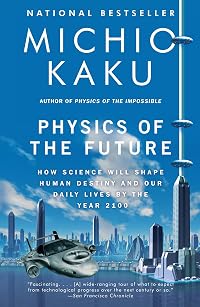
Physics of the Future: How Science Will Shape Human Destiny and Our Daily Lives by the Year 2100
by Michio Kaku
On This Page
Description
The "New York Times"-bestselling author of "Physics of the Impossible" offers a stunning and provocative vision of the future, and explains how science will shape human destiny and everyone's daily life by the year 2100.Tags
Recommendations
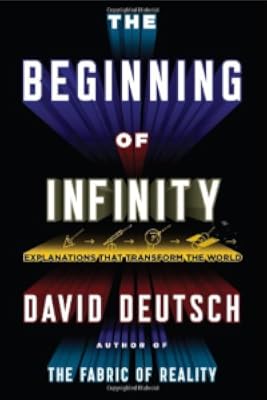
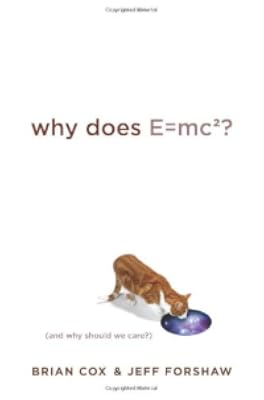
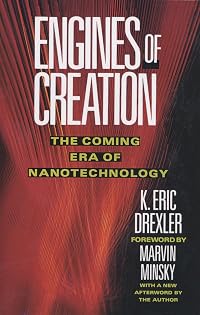

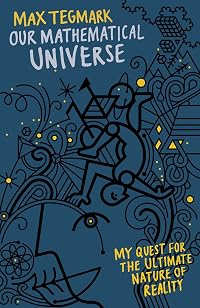
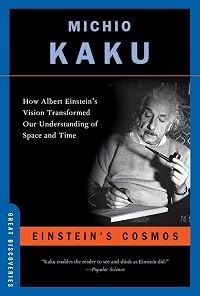
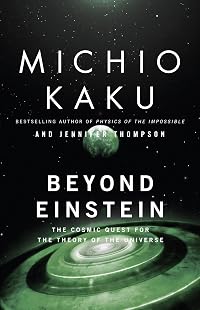
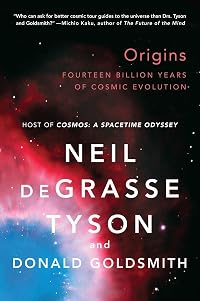
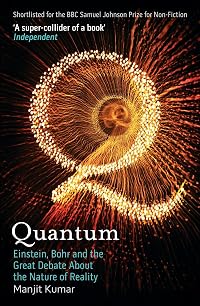
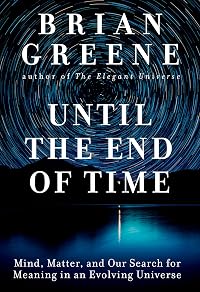
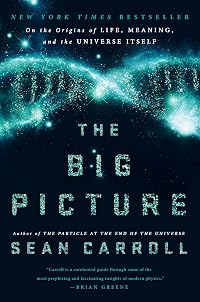
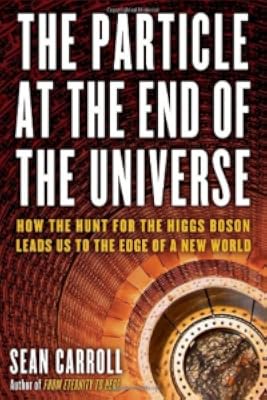
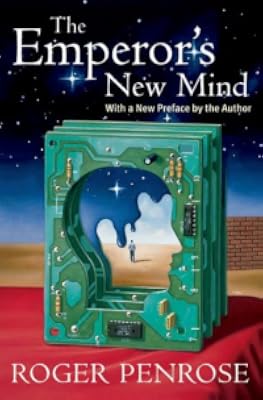

Member Recommendations
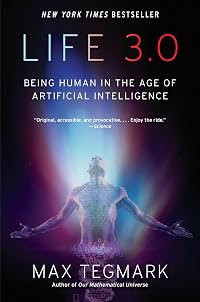
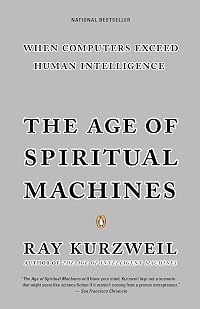
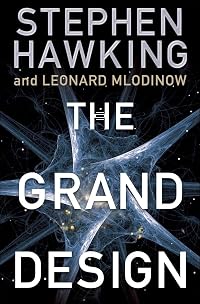
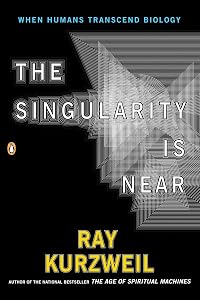
CGlanovsky Both books take a survey of cutting edge science & technology in various fields and extrapolate on how these advancements might effect life in the future.
Member Reviews
The book starts out great, with a good intro promising a science-based approach by an actual scientist, as opposed to the vast majority of popular writing on the subject by self-anointed "futurists" who often lack a grasp of the underlying science beneath their prognostications. Unfortunately, after the first chapter it quickly devolves into the same standard wiz-bang technology focus prevalent in every corporate press release, with barely a mention of fundamental science until much later.
Throughout the early chapters, Kaku makes the mistake of evaluating the validity of future predictions for a technology trend on the success/failure of past predictions. But just because someone was right/wrong in 1990 about where we'd be by 2010 show more doesn't mean that a linear extrapolation in valid to predict what's likely to happen by 2030. Exponential curves flatten, and seemingly flat lines sometimes explode exponentially. A lot of the conclusions he reaches seem to based more on whim and feeling than on actual data or actual insight into the field, whether he's talking about CPU speed, haptic feedback, or the workplace. Instead, he should be acting like a scientist and evaluating the current state, the physical constraints, and go from there.
And it gets a lot worse in the later chapters as he tackles the socioeconomic, political, and personal implications of the forecasted technology trends, subjects far removed from his areas of expertise, ending with an insipid and uninspired snapshot of what life will be like 100 years hence.
The book is further plagued by lots of hyperbolic language, describing advanced technology as "magical" or as giving us "the power of gods". And for a book about the future published in 2011, a lot of the "contemporary" examples seem many years out of date, such as Pentium chips, CD-ROM, videotape. There are a bunch of examples of future tech from popular sci-fi, but bizarrely most are either from Star Trek or Back to the Future. Both 20+ years old at the time of writing. Dude, read a f*cking book!
Worst of all, over half the content is describing 2000's tech, seemingly based on the author's participation in various TV productions,
with just a short discussion tacked on at the end of each section with some vague speculation about the next 100 years. While this in itself wouldn't be so bad as it potentially sets a baseline for understanding the underlying science (e.g. can't build a space elevator if we don't have a strong enough material to construct it with), by treating each area as a separate topic he fails to take into account the inevitable synergies and interactions. So his vision of the future is one in which smaller and smarter smartphones are incorporated into contact lenses and sensors are built into our clothing (thus providing fully immersive virtual environments), but he still envisions hanging display screens on our walls, commuting to work in an office, and driving to department stores for shopping. Whether or not one believes in the Singularity happening any time soon, it's pretty obvious that the envisioned radical advancements in AI, nanotechnology, genetic engineering, mind-machine interfaces, materials science, robotics, power production/delivery, etc. will reinforce each other and have profound effects on our societies and daily lives. show less
Throughout the early chapters, Kaku makes the mistake of evaluating the validity of future predictions for a technology trend on the success/failure of past predictions. But just because someone was right/wrong in 1990 about where we'd be by 2010 show more doesn't mean that a linear extrapolation in valid to predict what's likely to happen by 2030. Exponential curves flatten, and seemingly flat lines sometimes explode exponentially. A lot of the conclusions he reaches seem to based more on whim and feeling than on actual data or actual insight into the field, whether he's talking about CPU speed, haptic feedback, or the workplace. Instead, he should be acting like a scientist and evaluating the current state, the physical constraints, and go from there.
And it gets a lot worse in the later chapters as he tackles the socioeconomic, political, and personal implications of the forecasted technology trends, subjects far removed from his areas of expertise, ending with an insipid and uninspired snapshot of what life will be like 100 years hence.
The book is further plagued by lots of hyperbolic language, describing advanced technology as "magical" or as giving us "the power of gods". And for a book about the future published in 2011, a lot of the "contemporary" examples seem many years out of date, such as Pentium chips, CD-ROM, videotape. There are a bunch of examples of future tech from popular sci-fi, but bizarrely most are either from Star Trek or Back to the Future. Both 20+ years old at the time of writing. Dude, read a f*cking book!
Worst of all, over half the content is describing 2000's tech, seemingly based on the author's participation in various TV productions,
with just a short discussion tacked on at the end of each section with some vague speculation about the next 100 years. While this in itself wouldn't be so bad as it potentially sets a baseline for understanding the underlying science (e.g. can't build a space elevator if we don't have a strong enough material to construct it with), by treating each area as a separate topic he fails to take into account the inevitable synergies and interactions. So his vision of the future is one in which smaller and smarter smartphones are incorporated into contact lenses and sensors are built into our clothing (thus providing fully immersive virtual environments), but he still envisions hanging display screens on our walls, commuting to work in an office, and driving to department stores for shopping. Whether or not one believes in the Singularity happening any time soon, it's pretty obvious that the envisioned radical advancements in AI, nanotechnology, genetic engineering, mind-machine interfaces, materials science, robotics, power production/delivery, etc. will reinforce each other and have profound effects on our societies and daily lives. show less
Are super powers, sentient robots, and flying cars in our future? According to Michio Kaku’s latest book, the answers to that question is probably; not any time soon; and at least floating cars almost definitely. In this book, Kaku makes predictions about what the next 100 years of science will bring and how that science will effect our daily lives. He makes these predictions based on both extensive interviews with scientists doing cutting edge research and his own experience as a researcher.
Ever since I read Kaku’s Hyperspace I have been astonished and impressed by his ability to explain complex physics concepts to a general audience. In this book, he applies that ability to other fields as well. Looking at his discussion of my show more field, bioinformatics, I found that his descriptions were very simplified, but still accurate and contained information I’d be excited to have the general public know. Reading about fields that I’m not familiar with, I appreciated the simplification and found his discussions enjoyable and easy to follow. The constant connections between this science and our future quality of life in particular made the science interesting through relevancy. Kaku does a great job conveying his own excitement too, about not only potential applications but also the basic science.
The overall organization was very well done, with one topic leading into the next and sometimes referring to each other so that concepts began to feel familiar. Throughout the book and again at the end, Kaku also draws our attention to the fascinating ethical implications of cutting edge science. He also makes incredible predictions about where that science will go. For both of those reasons, I would highly recommend this book to scientists as well as any non-scientists who’d like to be better informed (which in my opinion, should really be everyone, since that’s who this science is going to affect!). But for scientists in particular, it’s important to always remember three things: the social implications of your work; the ethical implications of your work; and the big dreams we should all be striving for in order to make our daily lives better. This book does a great job bringing home all of those points.
This review first published on Doing Dewey. show less
Ever since I read Kaku’s Hyperspace I have been astonished and impressed by his ability to explain complex physics concepts to a general audience. In this book, he applies that ability to other fields as well. Looking at his discussion of my show more field, bioinformatics, I found that his descriptions were very simplified, but still accurate and contained information I’d be excited to have the general public know. Reading about fields that I’m not familiar with, I appreciated the simplification and found his discussions enjoyable and easy to follow. The constant connections between this science and our future quality of life in particular made the science interesting through relevancy. Kaku does a great job conveying his own excitement too, about not only potential applications but also the basic science.
The overall organization was very well done, with one topic leading into the next and sometimes referring to each other so that concepts began to feel familiar. Throughout the book and again at the end, Kaku also draws our attention to the fascinating ethical implications of cutting edge science. He also makes incredible predictions about where that science will go. For both of those reasons, I would highly recommend this book to scientists as well as any non-scientists who’d like to be better informed (which in my opinion, should really be everyone, since that’s who this science is going to affect!). But for scientists in particular, it’s important to always remember three things: the social implications of your work; the ethical implications of your work; and the big dreams we should all be striving for in order to make our daily lives better. This book does a great job bringing home all of those points.
This review first published on Doing Dewey. show less
Theoretical physicist and science writer, Michio Kaku, provides a futuristic view with the aid of 300 scientists of the next 100 years in the fields of medicine, computer, artificial intelligence, nanotechnology, energy, and space travel. The predictions in each of area of study are presented for the near future and 50 years and 100 years out. Of course, the further removed from the present, the more uncertain the accuracy of the predictions. I enjoyed the book until his political views colored his science and technology views for the future.
Michio Kaku is, in my opinion, our most entertaining science popularizer right now. He's a theoretical physicist and a science fiction fan, and the result is he's not afraid to imagine and project what might be, as well as talking knowledgeably about what we do know and can do now, on the cutting edge of science and technology.
In this book, he looks at what we can expect in technology in manufacturing, information technology, medicine, and transportation, in the near, medium, and more distant future. Said that way, it doesn't sound too exciting, but three-d printers, nano-technology, self-driving cars, and the ability to slow or reverse the aging process offer possibilities as amazing to us as airplanes and space travel would have been show more to 18th century Europeans. Programmable matter, able to transform into any number of different tools and objects at the press of a button, might turn out to be one of the more mundane developments.
Kaku breaks his text up into broad subject areas, including artificial intelligence, medicine, transportation, and space travel, and then gives us near-term, medium-term, and "by 2100 or beyond" projections of what we can expect. He has a clear, direct, conversational style, and never talks down to his readers, but assumes anyone can understand the essential points if they're explained clearly.
Recommended.
I borrowed this book from the library. show less
In this book, he looks at what we can expect in technology in manufacturing, information technology, medicine, and transportation, in the near, medium, and more distant future. Said that way, it doesn't sound too exciting, but three-d printers, nano-technology, self-driving cars, and the ability to slow or reverse the aging process offer possibilities as amazing to us as airplanes and space travel would have been show more to 18th century Europeans. Programmable matter, able to transform into any number of different tools and objects at the press of a button, might turn out to be one of the more mundane developments.
Kaku breaks his text up into broad subject areas, including artificial intelligence, medicine, transportation, and space travel, and then gives us near-term, medium-term, and "by 2100 or beyond" projections of what we can expect. He has a clear, direct, conversational style, and never talks down to his readers, but assumes anyone can understand the essential points if they're explained clearly.
Recommended.
I borrowed this book from the library. show less
Celebrity physicist Michio Kaku channels his inner seer and attempts to predict scientific and cultural advancements over the next 88 years. He starts out regaling us with failed predictions a century ago...the pace of technological advancement turned out far greater than 19th century minds could have ever conceived. Kaku takes a look at the current state of astronomy, computing, robotics, transportation and more and begins with assessment of today's state of the art. Current developments are easily extrapolated to the next quarter century, beyond that, it gets a little more difficult. Kaku posits scientific goals -- true AI; near immortality; visiting other solar systems -- and discusses how we might get there from here. Some of this show more technology faces cultural hurdles -- particularly by religious nutjobs who feel man is reaching over their skis. This too he believes will be overcome -- I'm not entirely certain. Stem cell research, for example, nearly died on the vine during GWB's eight year reign of ignorance.
Beneficiaries of some of the most incredible technology -- such as ultra-longevity, will likely be the province of the wealthy in the coming century. Personally, I think the human race needs to establish an off-planet presence elsewhere before life-extending technology makes ecological sense. Planetary population is estimated to level off at 11 billion -- should the species manage zero population growth at that point, then we should talk about living indefinitely. Kaku's contention is that there is no natural reason we couldn't live indefinitely if we could just manage all of the external factors that cause aging. Nano-bots and other treatments can help in this regard.
When it comes to computers and robotics, established theories make prediction a little more plausible. Moore's law, where computing power doubles every 18 months, will level off once we're talking about circuitry on an atomic level. Still, around mid-century, AI could be developed that meets then exceeds the human mind. Being a media creature, Kaku compares this with the Terminator scenario, and thinks we'll be able to manage it without creating the harbingers of our own doom. At least he doesn't predict we will master time and be able to travel outside the present.
Nanobots play a large role in the future. Not only do they fix what ails us, but the could be spammed out into space at near-light speed, containing some basic instructions that allow them to start manufacturing larger, more useful structures, once they land at a destination. Millions could be sent to compensate for the low success rate.
Sadly, some of the more interesting predictions are beyond my lifetime (the longevity ones won't happen soon enough to benefit me). Eighty eight years from now, some pundit will have some fun at Kaku's expense ala Nostrodamus. The most interesting part of the book was his discussion od the current state of the art -- there's some pretty interesting developments going on that fail to garner media attention. The future is so bright, I'll have to wear shades. show less
Beneficiaries of some of the most incredible technology -- such as ultra-longevity, will likely be the province of the wealthy in the coming century. Personally, I think the human race needs to establish an off-planet presence elsewhere before life-extending technology makes ecological sense. Planetary population is estimated to level off at 11 billion -- should the species manage zero population growth at that point, then we should talk about living indefinitely. Kaku's contention is that there is no natural reason we couldn't live indefinitely if we could just manage all of the external factors that cause aging. Nano-bots and other treatments can help in this regard.
When it comes to computers and robotics, established theories make prediction a little more plausible. Moore's law, where computing power doubles every 18 months, will level off once we're talking about circuitry on an atomic level. Still, around mid-century, AI could be developed that meets then exceeds the human mind. Being a media creature, Kaku compares this with the Terminator scenario, and thinks we'll be able to manage it without creating the harbingers of our own doom. At least he doesn't predict we will master time and be able to travel outside the present.
Nanobots play a large role in the future. Not only do they fix what ails us, but the could be spammed out into space at near-light speed, containing some basic instructions that allow them to start manufacturing larger, more useful structures, once they land at a destination. Millions could be sent to compensate for the low success rate.
Sadly, some of the more interesting predictions are beyond my lifetime (the longevity ones won't happen soon enough to benefit me). Eighty eight years from now, some pundit will have some fun at Kaku's expense ala Nostrodamus. The most interesting part of the book was his discussion od the current state of the art -- there's some pretty interesting developments going on that fail to garner media attention. The future is so bright, I'll have to wear shades. show less
Some of the stuff seems a bit starry eyed, but hey, he's the physics prof. Plus, everything is postulated on sound research and precedents. Strangely, it all seemed most plausible toe me when he conjectures "A day in the life" 2100. I wonder how much of this I will live to see? And my children?
Robots, AI, nanotechnology, energy, superconductivity... The list of projected future achievements speculated about in this book is impressive. I look forward to seeing some of these things. An effective cure for aging perhaps is most appealing, since I'm beginning to feel the effects of this universally fatal ailment. But one thing that pervades this book is the (probably unintentional) implication that these these will come, inevitably. It's only a matter of time. I'm not saying they won't, it's just that scientific and technological advances don't just happen. People make them happen, and people can also fail to make them happen in any number of ways. The future may be a strange and wonderful place, but we have to work to get there. show more
Still, despite an overuse of sage, bumper sticker quotes, I found the book informative. I recommend it for readers with an interest in science and future tech. show less
Still, despite an overuse of sage, bumper sticker quotes, I found the book informative. I recommend it for readers with an interest in science and future tech. show less
Members
- Recently Added By
Lists

A Brilliant List of Science Books for People Who Want Their Minds Blown
16 works; 3 members

Speculative non-fiction
25 works; 2 members
Author Information

39+ Works 15,119 Members
Michio Kaku was born January 24, 1947 in San Jose California. Kaku attended Cubberley High School in Palo Alto in the early 1960s and played first board on their chess team. At the National Science Fair in Albuquerque, New Mexico, he attracted the attention of physicist Edward Teller, who took Kaku as a protégé, awarding him the Hertz show more Engineering Scholarship. Kaku graduated summa cum laude from Harvard University with a B.S. degree in 1968 and was first in his physics class. He attended the Berkeley Radiation Laboratory at the University of California, Berkeley and received a Ph.D. in 1972 and held a lectureship at Princeton University in 1973. During the Vietnam War, Kaku completed his U.S. Army basic training at Fort Benning, Georgia and his advanced infantry training at Fort Lewis, Washington. Kaku currently holds the Henry Semat Chair and Professorship in theoretical physics and a joint appointment at City College of New York, and the Graduate Center of the City University of New York, where he has lectured for more than 30 years. He is engaged in defining the "Theory of Everything", which seeks to unify the four fundamental forces of the universe: the strong nuclear force, the weak nuclear force, gravity and electromagnetism. He was a visiting professor at the Institute for Advanced Study in Princeton, and New York University. He is a Fellow of the American Physical Society. He is listed in Who's Who in Science and Engineering, and American Men and Women of Science. He has published research articles on string theory from 1969 to 2000. In 1974, along with Prof. K. Kikkawa, he wrote the first paper on string field theory, now a major branch of string theory, which summarizes each of the five string theories into a single equation. In addition to his work on string field theory, he also authored some of the first papers on multi-loop amplitudes in string theory. Kaku is the author of several doctoral textbooks on string theory and quantum field theory and has published 170 articles in journals covering topics such as superstring theory, supergravity, supersymmetry, and hadronic physics. He is also author of the popular science books: Visions, Hyperspace, Einstein's Cosmos, Parallel Worlds, The Future of the Mind, and The Future of Humanity: Terraforming Mars, Interstellar Travel, Immortality, and Our Destiny Beyond. (Bowker Author Biography) show less
Some Editions
Awards and Honors
Awards
Common Knowledge
- Canonical title
- Physics of the Future: How Science Will Shape Human Destiny and Our Daily Lives by the Year 2100
- Original title
- Physics of the Future: How Science Will Shape Human Destiny and Our Daily Lives by the Year 2100
- Original publication date
- 2011
- Dedication
- To my loving wife, Shizue, and miy daughters, Michelle and Alyson
- First words
- When I was a child, two experiences helped to shape the person I am today and spawned two passions that have helped to define my entire life.
- Last words
- (Click to show. Warning: May contain spoilers.)Mahatma Gandhi once wrote:
The Roots of Violence:
Wealth without work,
Pleasure without conscience,
Knowledge without character,
Commerce without morality,
Science without humanity,
Worship without sacrifice,
Politics without principles.
Classifications
Statistics
- Members
- 1,694
- Popularity
- 13,151
- Reviews
- 33
- Rating
- (3.63)
- Languages
- 16 — Czech, Dutch, English, Estonian, French, German, Hungarian, Italian, Polish, Portuguese, Russian, Serbian, Spanish, Turkish, Ukrainian, Vietnamese
- Media
- Paper, Audiobook, Ebook
- ISBNs
- 45
- ASINs
- 14