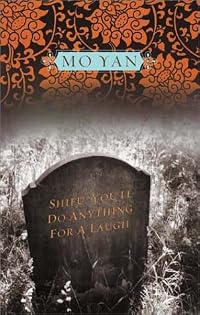
Shifu, You'll Do Anything for a Laugh
by Mo Yan
On This Page
Description
Mo Yan, China's most critically acclaimed author, has changed the face of his country's contemporary literature with such daring and masterly novels as Red Sorghum, The Garlic Ballads, and The Republic of Wine. In this collection of eight astonishing stories--the title story of which has been adapted to film by the award-winning director of Red Sorghum Zhang Yimou--Mo Yan shows why he is also China's leading writer of short fiction. His passion for writing shaped by his own experience of show more almost unimaginable poverty as a child, Mo Yan uses his talent to expose the harsh abuses of an oppressive society. In these stories he writes of those who suffer, physically and spiritually, under its yoke: the newly unemployed factory worker who hits upon an ingenious financial opportunity; two former lovers revisiting their passion fleetingly before returning to their spouses; young couples willing to pay for a place to share their love in private; the abandoned baby brought home by a soldier to his unsympathetic wife; the impoverished child who must subsist on a diet of iron and steel; the young bride willing to go to any length to escape an odious, arranged marriage. Never didactic, Mo's fiction ranges from tragedy to wicked satire, rage to whimsy, magical fable to harsh realism, from impassioned pleas on behalf of struggling workers to paeans to romantic love. show lessTags
Recommendations



Member Reviews
The introduction gave useful context about the author's background and the themes that interest him. It also gave me the term "scar literature" which he defines as "personal accounts of the horrors of the Cultural Revolution". The author disclaims affiliation with any particular 'literary fad" but the horrors and the drudgery of Chinese history are still very present in these stories - along with various elements of something like magical realism that make it difficult to always be sure what's happening.
I liked many of the stories up to the endings, which often came abruptly and/or with a strange focus as seen from my narrative expectations. Sometimes it felt like it was meant to be a punchline but if it was making a point I couldn't show more tell what it was, and I was left feeling I was missing something (either about the meaning or about the structure). show less
I liked many of the stories up to the endings, which often came abruptly and/or with a strange focus as seen from my narrative expectations. Sometimes it felt like it was meant to be a punchline but if it was making a point I couldn't show more tell what it was, and I was left feeling I was missing something (either about the meaning or about the structure). show less
Written by one of the most recent recipients of the Nobel Prize for Literature, this collection is an entertaining mix of phantom and reality, socio-political concern and the day-to-day business of life. The stories and characters are all enchantingly believable, even when and where they leave reality behind in favor of something more speculative, often achieving in the process a frightening version of magical realism. There's no doubt in my mind that the stories here will haunt me for some time, and draw me back to re-read and pass on the journeys to other readers.
On a side note, I haven't the faintest idea why the work is regularly labeled as a novel online--it is a collection of short stories, not interconnected by anything but the show more occasional theme. Regardless, this is absolutely recommended. show less
On a side note, I haven't the faintest idea why the work is regularly labeled as a novel online--it is a collection of short stories, not interconnected by anything but the show more occasional theme. Regardless, this is absolutely recommended. show less
This is a collection of short stories (some longer) by the amazing Mo Yan. After first reading Red Sorghum, which is one of the most riveting, visceral, most affecting novels I have ever read, his other work seems quite different. For one thing, as in The Republic of Wine (see my review), he is very funny. At the same time, his writing reflects the realities of Chinese life for the past fifty or sixty years. Some of these stories might seem a bit incomplete or be less than appreciated by readers who don't have some understanding of modern Chinese history, the rise of the Communist Party, and all that implies. My rating of 3 1/2 stars isn't meant as negative, however; I just have to place this book in context with his others. I enjoyed show more every story, whether it was one of the more realistic ones or one of the two he says are basically fables. I also enjoyed his introduction, which seems to be a mixture of autobiographic fact and fancy. Some may be annoyed with his self-estimation of his writing ability, but the originality in this and his other works backs up his boast. Whether you fall in love with a particular story here or not, you must agree that it is original and good reading. Most of the stories are really about dealing with change, and that is something we can all identify with. show less
These stories are surreal but full of earthy details of the landscapes and people of Gaomi Township, a semifictional version of the author's home. They're slapsticky, tragic, muckraking, and always humane. I look forward to reading more from Mo Yan.
Abrupt and Fantastical Stories
While I've read numerous Chinese writers in the past, I have never read a collection of short stories. Mo Yan's "Shifu, You'll Do Anything for a Laugh" collects a handful of his stories from the '80s and '90s. They are interesting enough but they are very quick, very abrupt, and have very little context.
The longest story is "Shifu, You'll Do Anything for a Laugh." It is an enjoyable parable about a exemplary machinist who starts a bordello of sorts after his factory is closed. Other stories include "Iron Child," about an abandoned child who meets a spirit. The two of them roam the countryside eating iron during the Great Leap Forward. In "Soaring," a bride grows wings and flies away the day of her wedding. show more The comparisons to Kafka are valid because several of these stories include such fantastical situations. However, to understand the stories the reader should understand the historical contexts in which they were written.
Unfortunately, the stories all end very quickly, often dispensing with the descriptions and resolutions that other contemporary Chinese writers use. Nevertheless, these stories are all quick reads and enjoyable in their own right. show less
While I've read numerous Chinese writers in the past, I have never read a collection of short stories. Mo Yan's "Shifu, You'll Do Anything for a Laugh" collects a handful of his stories from the '80s and '90s. They are interesting enough but they are very quick, very abrupt, and have very little context.
The longest story is "Shifu, You'll Do Anything for a Laugh." It is an enjoyable parable about a exemplary machinist who starts a bordello of sorts after his factory is closed. Other stories include "Iron Child," about an abandoned child who meets a spirit. The two of them roam the countryside eating iron during the Great Leap Forward. In "Soaring," a bride grows wings and flies away the day of her wedding. show more The comparisons to Kafka are valid because several of these stories include such fantastical situations. However, to understand the stories the reader should understand the historical contexts in which they were written.
Unfortunately, the stories all end very quickly, often dispensing with the descriptions and resolutions that other contemporary Chinese writers use. Nevertheless, these stories are all quick reads and enjoyable in their own right. show less
I enjoyed this book and it was an interesting view into chinese cultural paradigm. The stories did not always hold my attention but the writing was excellent and for the stories that did hold my attemtion i suspect i'll be thinking of the message of the story and visualized moments - for a long time. Good literary experience.
This collection of short stories by Mo Yan contains a wide variety of of themes and serves as a great introduction to Mo Yan for those not already familiar with him. There are eight stories total but in this review I’ll focus on my favorite three: “Shifu, You’ll Do Anything For a Laugh,” “Soaring,” and “Abandoned Child.”
“Shifu, You’ll Do Anything For a Laugh” is about Ding shifu, who’s been working for the same factory for years and is mere days away from his retirement when the company decides to let go of most of their workers. The title “shifu,” is given to people who are a master of their trade, or just as a way to show respect to someone who has been working for a long time. With no hope of getting his show more due pension, Ding shifu has to find a new way to support his family and falls into despair. He gets a business idea when he spends an afternoon watching young couples in the park sneak off into the woods to get close. He builds a shack which he charges these young couples to use and makes a killing at it, at least until a couple comes along months later who enter the shack and then become deathly quiet. Convinced the couple has committed double suicide, Ding shifu runs around town trying to figure out what he should do. When he finally brings a police officer to the scene, they find no one in the shack. In this realistically bleak and yet humorous story the reader is left wondering what forces of nature had stepped in and brought an end to Ding shifu’s less than honorable business. Were they ghosts? Did the couple play a joke on Ding shifu for making money off of young love?
In “Soaring,” a newly wedded bride gets a look at her new groom and takes off flying– literally. The entire town gives chase, trying to coax her down as she gets further and further away from her new home. Even her own family gets involved and begs her to accept her marriage or she’ll ruin the marriage for her mute brother which was so hard to set up and is contingent upon the poor girl’s marriage. Nothing affects the flying bridge, who eventually ends up sitting in a tree with the entire crowd watching her. Finally she is shot down and killed with a bow and arrow, and the groom laments the loss of his beautiful bride. Again humor mixes with a stark portrayal of truth about how powerless bridges are in their arranged marriages.
The last story of the collection is “Abandoned Child,” which describes the terrible effects the one child policy has specifically on those who live in the rural parts of China who still cling to the belief that male children are more valuable than female. The main character finds a baby girl abandoned in a sunflower field and brings her home. His family is devastated and angry because he already has one child, a girl, and all of their hopes were for him to produce a second, male, child. He goes to the local government which suggests he go around and ask widows/widowers if they would take in the child, but he finds that these families also only want boys. Meanwhile the government official mentions that if the rescuer keeps the child, he’ll have to pay the fine for having more than one child. The story ends with the fate of the little girl unclear and the main character disgusted by the people of his hometown. This story is devoid of the humor of the previous two but the narrator of the story has a disillusioned, desperate tone that will stay with you long after you finish reading. show less
“Shifu, You’ll Do Anything For a Laugh” is about Ding shifu, who’s been working for the same factory for years and is mere days away from his retirement when the company decides to let go of most of their workers. The title “shifu,” is given to people who are a master of their trade, or just as a way to show respect to someone who has been working for a long time. With no hope of getting his show more due pension, Ding shifu has to find a new way to support his family and falls into despair. He gets a business idea when he spends an afternoon watching young couples in the park sneak off into the woods to get close. He builds a shack which he charges these young couples to use and makes a killing at it, at least until a couple comes along months later who enter the shack and then become deathly quiet. Convinced the couple has committed double suicide, Ding shifu runs around town trying to figure out what he should do. When he finally brings a police officer to the scene, they find no one in the shack. In this realistically bleak and yet humorous story the reader is left wondering what forces of nature had stepped in and brought an end to Ding shifu’s less than honorable business. Were they ghosts? Did the couple play a joke on Ding shifu for making money off of young love?
In “Soaring,” a newly wedded bride gets a look at her new groom and takes off flying– literally. The entire town gives chase, trying to coax her down as she gets further and further away from her new home. Even her own family gets involved and begs her to accept her marriage or she’ll ruin the marriage for her mute brother which was so hard to set up and is contingent upon the poor girl’s marriage. Nothing affects the flying bridge, who eventually ends up sitting in a tree with the entire crowd watching her. Finally she is shot down and killed with a bow and arrow, and the groom laments the loss of his beautiful bride. Again humor mixes with a stark portrayal of truth about how powerless bridges are in their arranged marriages.
The last story of the collection is “Abandoned Child,” which describes the terrible effects the one child policy has specifically on those who live in the rural parts of China who still cling to the belief that male children are more valuable than female. The main character finds a baby girl abandoned in a sunflower field and brings her home. His family is devastated and angry because he already has one child, a girl, and all of their hopes were for him to produce a second, male, child. He goes to the local government which suggests he go around and ask widows/widowers if they would take in the child, but he finds that these families also only want boys. Meanwhile the government official mentions that if the rescuer keeps the child, he’ll have to pay the fine for having more than one child. The story ends with the fate of the little girl unclear and the main character disgusted by the people of his hometown. This story is devoid of the humor of the previous two but the narrator of the story has a disillusioned, desperate tone that will stay with you long after you finish reading. show less
Members
- Recently Added By
Talk Discussions
Past Discussions
Shifu, You'll Do Anything for a Laugh - discussion in Read Mo Yan (April 2013)
Author Information

115+ Works 4,881 Members
Mo Yan is the pseudonym of Guan Moye, who was born in Gaomi, Shandong Province, China on March 5, 1955. He became a teenager during the Cultural Revolution, leaving school to work first on a farm and then in a cottonseed oil factory. He started writing while he was serving in the People's Liberation Army. His first short story was published in show more 1981. His works include Life and Death Are Wearing Me Out, Red Sorghum, The Garlic Ballads, Big Breasts and Wide Hips, The Republic of Wine, and Sandalwood Death. He received the 2012 Nobel Prize in Literature. (Bowker Author Biography) show less
Some Editions
Awards and Honors
Common Knowledge
- Canonical title*
- Alles voor een glimlach
- Alternate titles*
- Shifu, you'll do anything for a laugh
*Some information comes from Common Knowledge in other languages. Click "Edit" for more information.
Classifications
- Genres
- Fiction and Literature, General Fiction
- DDC/MDS
- 895.1 — Literature & rhetoric Literatures of other languages Literatures of East and Southeast Asia Chinese
- LCC
- PL2886 .S513 — Language and Literature Languages and literatures of Eastern Asia, Africa, Oceania Languages of Eastern Asia, Africa, Oceania Chinese language and literature Chinese literature Individual authors and works
- BISAC
Statistics
- Members
- 275
- Popularity
- 116,765
- Reviews
- 14
- Rating
- (3.51)
- Languages
- 5 — Chinese, Dutch, English, French, Spanish
- Media
- Paper, Ebook
- ISBNs
- 17
- ASINs
- 5