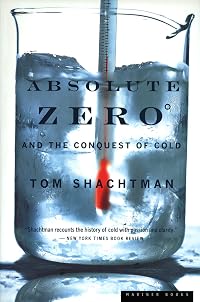
Absolute Zero and the Conquest of Cold
by Tom Shachtman
On This Page
Description
In a sweeping yet marvelously concise history, Tom Shachtman ushers us into a world in which scientists tease apart the all-important secrets of cold. Readers take an extraordinary trip, starting in the 1600s with an alchemist's air conditioning of Westminster Abbey and scientists' creation of thermometers. Later, while entrepreneurs sold Walden Pond ice to tropical countries -- packed in "high-tech" sawdust -- researchers pursued absolute zero and interpreted their work as romantically as show more did adventurers to remote regions. Today, playing with ultracold temperatures is one of the hottest frontiers in physics, with scientists creating useful particles Einstein only dreamed of. Tom Shachtman shares a great scientific adventure story and its characters' rich lives in a book that has won a grant from the prestigious Alfred P. Sloan Foundation. Absolute Zero is for everyone who loves history and science history stories, who's eager to explore Nobel Prize-winning physics today, or who has ever sighed with pleasure on encountering air conditioning. show lessTags
Recommendations














Member Reviews
Absolute Zero is a fascinating popular history of research into cold, from Francis Bacon through the present day, with a climax around the liquification of helium by Dutch physicist Heike Kamerlingh Onnes. Popular in the sense that Shachtman avoids equations and a historical perspective, this book is comprehensive and enjoyable.
As Shachtman notes, cold presents an unusual negation of phenomenon for early physicists. Unlike light, sound, motion, or heat, cold is an absence. Francis Bacon, the proto-experimentalist, died of pneumonia after an impromptu test to see if snow could preserve chicken (yes), and after that the study of cold languished for centuries, a mere adjunct to the more important measurement of temperature.
The dominant show more caloric theory of the 18th century was intuitively satisfying, but its invocation of a ineffable and non-existent heat bearing fluid model the emerging technology of steam engines, or the mechanical production of cold by gas expansion. As physicists experimented with cold, they proved that gases could transform to new phases of matter at low temperatures and above atmospheric pressure. Carbon dioxide, nitrogen, oxygen, hydrogen, and finally helium were all liquified.
Onnes was the first to liquify helium, and the first to note the astonish property of low temperature superconductivity in mercury and a host of other substances, as well as the superfluid behavior of liquid helium. Low temperatures proved an experimental bridge between classical physics and the new quantum physics, where at low temperatures macro-scale objects that could be manipulated in the lab exhibited properties only explainable by quantum effects.
Today, commercial refrigeration and air conditioning are so commonplace as to be entirely unremarkable, but cold was once cutting edge, and this book captures the romance of the quest for absolute zero. show less
As Shachtman notes, cold presents an unusual negation of phenomenon for early physicists. Unlike light, sound, motion, or heat, cold is an absence. Francis Bacon, the proto-experimentalist, died of pneumonia after an impromptu test to see if snow could preserve chicken (yes), and after that the study of cold languished for centuries, a mere adjunct to the more important measurement of temperature.
The dominant show more caloric theory of the 18th century was intuitively satisfying, but its invocation of a ineffable and non-existent heat bearing fluid model the emerging technology of steam engines, or the mechanical production of cold by gas expansion. As physicists experimented with cold, they proved that gases could transform to new phases of matter at low temperatures and above atmospheric pressure. Carbon dioxide, nitrogen, oxygen, hydrogen, and finally helium were all liquified.
Onnes was the first to liquify helium, and the first to note the astonish property of low temperature superconductivity in mercury and a host of other substances, as well as the superfluid behavior of liquid helium. Low temperatures proved an experimental bridge between classical physics and the new quantum physics, where at low temperatures macro-scale objects that could be manipulated in the lab exhibited properties only explainable by quantum effects.
Today, commercial refrigeration and air conditioning are so commonplace as to be entirely unremarkable, but cold was once cutting edge, and this book captures the romance of the quest for absolute zero. show less
As a history of the scientific pursuit of ultra low temperatures, "Absolute Zero" is a fairly decent narrative for the general reader. The author stays away from formulas, detailed technical descriptions or diagrams of any sort. The book is really more about the people involved and their relationships with each other; there's a lot of backstabbing in the scientific world! The book however doesn't go fair beyond that. The author does throw in a bit of history of the commercial aspects of cold, like the ice sellers of the nineteenth century and the rise of air conditioning and the flash freezing of food, but these seem to be added as some padding for the book and only whet the appetite. I would recommend this book only for those who wish show more to gain some insight on the history but aren't looking for much in the way of science. show less
A pretty interesting look at the science behind heat, or, more notably the absence thereof. I found it very interesting how long it took for people to truly understand what heat is.
Bonus points for naming an alumni of my alma mater and name dropping RPI, although I found it funny that the author referred to it as "Rensselaer Polytech," which nobody in the universe calls the school.
At times the book dragged, but the last chapter was really interesting. I work with liquid nitrogen and liquid helium all the time so I understand how important liquid gases are. Would have enjoyed hearing more about how scientists are achieving extreme low temperatures, but that was completely missing.
Bonus points for naming an alumni of my alma mater and name dropping RPI, although I found it funny that the author referred to it as "Rensselaer Polytech," which nobody in the universe calls the school.
At times the book dragged, but the last chapter was really interesting. I work with liquid nitrogen and liquid helium all the time so I understand how important liquid gases are. Would have enjoyed hearing more about how scientists are achieving extreme low temperatures, but that was completely missing.
Ratings
Members
- Recently Added By
Lists

Houghton Mifflin Harcourt
45 works; 1 member

In Our Time books
4,934 works; 2 members
Author Information

40 Works 2,755 Members
Tom Shachtman has written twenty-five books, including the best-selling "The Gilded Leaf" (with Patrick Reynolds), as well as documentaries for all of the major television networks. (Bowker Author Biography)
Some Editions
Series
Belongs to Publisher Series
Common Knowledge
- Original publication date
- 1999
- People/Characters
- Anders Celsius; Gabriel Daniel Fahrenheit; William Thomson (1st Baron Kelvin)
- Dedication
- For Mel Berger
- First words
- King James I of England and Scotland chose a very warm day in the summer of 1620 for Cornelis Drebbel's newest demonstration and decreed that it be held in the Great Hall of Westminster Abbey.
- Last words
- (Click to show. Warning: May contain spoilers.)If the present direction and volume of research are any guide, a large proportion of tomorrow's discoveries about the composition of matter and the nature of the universe, will be made in the vicinity of absolute zero and will be based on our mastery and manipulation of the cold.
- Publisher's editor
- van Dam, Laura
- Blurbers
- Bishop, Jerry E.; Washburn, Bradford; Lightman, Alan
Classifications
Statistics
- Members
- 199
- Popularity
- 164,554
- Reviews
- 3
- Rating
- (3.48)
- Languages
- English, German, Hungarian, Italian
- Media
- Paper, Ebook
- ISBNs
- 7
- UPCs
- 2
- ASINs
- 3