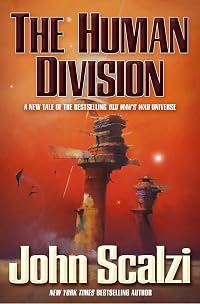
The Human Division
by John Scalzi
Old Man's War (5), The Human Division (Collections and Selections — 1-13 collected)
On This Page
Description
B Team leader Lieutenant Harry Wilson counters hostile alien forces, angry humans and unpredictable elements from the universe in order to protect the interests of the Colonial Union.Tags
Recommendations






Member Reviews
I understand that John Scalzi, when discussing the next book in his Old Man's War series with his publisher, put forth the idea of distributing THE HUMAN DIVISION in a serial format. The thought behind the change was for the publisher to break into the short story market, and it would hopefully garner the series more fans as well. Now that those novellas are together as one novel, all I can say is that I am not a fan.
I don't think this is Mr. Scalzi's fault. He was only doing what was asked of him. Individually, the novellas are good. They tell interesting stories within their confines, expanding the Old Man's War world when possible, and providing clarification of certain details when not. The problem arises when they are together. show more
Reading one after the other, or reading them as smaller parts of a whole novel, makes it impossible to understand the timeline. Some of the stories overlap, while others occur months in advance or after the other short stories. While they all connect to the overarching story about an unknown entity or entities seeking to dismantle the Colonial Union, there is nothing truly cohesive about these short stories that allows you to see the full picture of what was occurring. While this does place you in the same context as Harry Wilson, it is still annoying.
Making the lack of cohesion even worse is the fact that the villain remains unknown throughout each novella. We have no idea if it is a group of alien species or just one, or what the true motive is. We don't even know if there is a villain because there are no direct threats until the very end. It is all speculation and supposition.
We never receive a single answer either. The last novella concludes with a threat, but without any answers regarding the operators behind the threat or their motives. It is a frustrating place to end any story. It is also unusual for Mr. Scalzi, as he usually excels at tying up certain plot points and keeping the resolution open-ended, allowing for future stories.
I still enjoy the world of Old Man's War, so THE HUMAN DIVISION is not a total loss. It's just that I prefer a full novel instead of loosely connected novellas. Had Mr. Scalzi experimented with the format earlier in the series, I might be more accepting of the serial publishing. After four full novels, though, it is too disruptive to the narrative flow. show less
I don't think this is Mr. Scalzi's fault. He was only doing what was asked of him. Individually, the novellas are good. They tell interesting stories within their confines, expanding the Old Man's War world when possible, and providing clarification of certain details when not. The problem arises when they are together. show more
Reading one after the other, or reading them as smaller parts of a whole novel, makes it impossible to understand the timeline. Some of the stories overlap, while others occur months in advance or after the other short stories. While they all connect to the overarching story about an unknown entity or entities seeking to dismantle the Colonial Union, there is nothing truly cohesive about these short stories that allows you to see the full picture of what was occurring. While this does place you in the same context as Harry Wilson, it is still annoying.
Making the lack of cohesion even worse is the fact that the villain remains unknown throughout each novella. We have no idea if it is a group of alien species or just one, or what the true motive is. We don't even know if there is a villain because there are no direct threats until the very end. It is all speculation and supposition.
We never receive a single answer either. The last novella concludes with a threat, but without any answers regarding the operators behind the threat or their motives. It is a frustrating place to end any story. It is also unusual for Mr. Scalzi, as he usually excels at tying up certain plot points and keeping the resolution open-ended, allowing for future stories.
I still enjoy the world of Old Man's War, so THE HUMAN DIVISION is not a total loss. It's just that I prefer a full novel instead of loosely connected novellas. Had Mr. Scalzi experimented with the format earlier in the series, I might be more accepting of the serial publishing. After four full novels, though, it is too disruptive to the narrative flow. show less
This book is actually a collection of serial episodes that were initially released online. I didn't read them when they were released as I was taking a break from Scalzi. I'm glad that I waited for them to be bundled together as that works better for me. While each story is self-contained, strung together they apply to a larger storyline: Who is behind the effort to destroy the Colonial Union's efforts to reunite with Earth and get along with its neighbors? Unfortunately, the answer to that question isn't in this book.
The stories are primarily about the work of the "B Team", a diplomat, her retinue, the ship's captain and crew, and their CDF technical liaison, Lt. Harry Wilson. If you read Old Man's War, he was one of John Perry's show more buddies. During their adventures, they discover evidence of the larger storyline, but as they try to piece together the clues or climb out of the trap about to spring on them, they always seem to be a step or two behind their adversary.
A few other stories served as background for the reader, but were always relevant to the main storyline. These tended to be darker, a juxtaposition to the B Team's typical "we've stepped in it now" attitude in the face of adversity.
I have to say that I've missed the effortless way that Scalzi can carry a story and develop characters with dialogue. Humor is a big part of that. Good-natured snarky pokes at their jobs or the situations that they're in makes them relatable and thus endearing to this reader. But there's a lot of heart as well. The main characters are good people forced to work in difficult situations with lives at stake, theirs or others. If you're in it up to your neck, there's no time for whining. You just have to do your job and hope that it all works out in the end. When the shit hit the fan in the climactic episode, I couldn't help but care about who made it out alive. And that's an important lesson for all writers, if you want people to come back and read your stories, you'd better give them some characters to root for.
4.25 stars show less
The stories are primarily about the work of the "B Team", a diplomat, her retinue, the ship's captain and crew, and their CDF technical liaison, Lt. Harry Wilson. If you read Old Man's War, he was one of John Perry's show more buddies. During their adventures, they discover evidence of the larger storyline, but as they try to piece together the clues or climb out of the trap about to spring on them, they always seem to be a step or two behind their adversary.
A few other stories served as background for the reader, but were always relevant to the main storyline. These tended to be darker, a juxtaposition to the B Team's typical "we've stepped in it now" attitude in the face of adversity.
I have to say that I've missed the effortless way that Scalzi can carry a story and develop characters with dialogue. Humor is a big part of that. Good-natured snarky pokes at their jobs or the situations that they're in makes them relatable and thus endearing to this reader. But there's a lot of heart as well. The main characters are good people forced to work in difficult situations with lives at stake, theirs or others. If you're in it up to your neck, there's no time for whining. You just have to do your job and hope that it all works out in the end. When the shit hit the fan in the climactic episode, I couldn't help but care about who made it out alive. And that's an important lesson for all writers, if you want people to come back and read your stories, you'd better give them some characters to root for.
4.25 stars show less
This is not a novel.
This is a serial: a series of short, reasonably self contained stories that contribute more or less vaguely to a story arc. It's very much like one season of an ongoing television show, and has the same not-very-much of an ending possessed by seasons that are not Final Seasons.
I normally dislike Scalzi, and I particularly didn't care for the Old Man's War books. But I really enjoyed reading this! It felt like good old fashioned science fiction, with interesting characters, interesting science, reasonable aliens, believable political intrigue, funny comments, and people who by and large did the Decent Thing, without prompting, even at significant personal or institutional cost. There are clearly villainous baddies in show more the book, but they largely operate from behind the scenes. There's also a fair helping of in-group allusions to other SF, which adds to the fun.
I was very surprised that I enjoyed this book! I conclude that this is the perfect format for Scalzi: short, self-contained stories where he never has to actually write a complete ending. He should just keep writing serials. show less
This is a serial: a series of short, reasonably self contained stories that contribute more or less vaguely to a story arc. It's very much like one season of an ongoing television show, and has the same not-very-much of an ending possessed by seasons that are not Final Seasons.
I normally dislike Scalzi, and I particularly didn't care for the Old Man's War books. But I really enjoyed reading this! It felt like good old fashioned science fiction, with interesting characters, interesting science, reasonable aliens, believable political intrigue, funny comments, and people who by and large did the Decent Thing, without prompting, even at significant personal or institutional cost. There are clearly villainous baddies in show more the book, but they largely operate from behind the scenes. There's also a fair helping of in-group allusions to other SF, which adds to the fun.
I was very surprised that I enjoyed this book! I conclude that this is the perfect format for Scalzi: short, self-contained stories where he never has to actually write a complete ending. He should just keep writing serials. show less
A series of vignettes showcasing the solutions those in the "human division", that is, the Colonial Union's diplomatic corps, have used in negotiations with aliens. Interestingly, other stories in this collection focus on quite another dipolomat, Hafte Sorvalh, an officer of The Conclave, who is very fond of churros. (I really, really love Sorvalh). Other characters of note are Harry Wilson, who will tell it like it is; Danielle Lowen, daughter of the US Secretary of State; and Hart Schmidt who seems like a bumbly lackey, until he really, really isn't. Great fun.
A fun read. I'm fond of Scalzi's sense of humor, his characters run a line of patter that put one in the mind of Bogart and Bacall, or Powell and Loy. If the rating seems low it's because this really doesn't work as a novel, it's a collection of short stories and the seams show. But I'd watch the heck out of a Netflix series adaptation. (Instead of grimdark wannabe sci-fi noir like Altered Carbon.)
I admit I stopped reading the series for years after I realized that this installment was a serialized novel. I just stopped. I wanted full novels and I got pissy.
Well, fortunately, I got over it. Mostly because I have friends in buddy reads who made me feel guilty as hell. But even more, I have a lot of fond memories for the series as a whole and I think I may have been plain WRONG.
Yeah. So. Eating crow now.
These are a bunch of great short stories here that don't feel all the connected at first but wind up being very connected, indeed. All the events take place after the Colonies and Earth part company, and while not all characters follow along within these thirteen stories, a few do. Wilson, for one, was someone I was always very show more happy to see. Even if he does like to electrocute dogs. :) That one was very funny.
And while a lot of these had the light Scalzi humor I've grown to love, not all were light. Some were very sad. All of them were very interesting.
Not all novelists can write short stories, but Scalzi is pretty fantastic at it... He's able to make tight tales that are perfectly standalone that also tie in perfectly to make a complete work that, read together, feels like a complete novel with thirteen chapters. Color me impressed.
I'm fully back on track to read the rest of this series and I'm hitting myself for taking so long.
This universe is fascinating. show less
Well, fortunately, I got over it. Mostly because I have friends in buddy reads who made me feel guilty as hell. But even more, I have a lot of fond memories for the series as a whole and I think I may have been plain WRONG.
Yeah. So. Eating crow now.
These are a bunch of great short stories here that don't feel all the connected at first but wind up being very connected, indeed. All the events take place after the Colonies and Earth part company, and while not all characters follow along within these thirteen stories, a few do. Wilson, for one, was someone I was always very show more happy to see. Even if he does like to electrocute dogs. :) That one was very funny.
And while a lot of these had the light Scalzi humor I've grown to love, not all were light. Some were very sad. All of them were very interesting.
Not all novelists can write short stories, but Scalzi is pretty fantastic at it... He's able to make tight tales that are perfectly standalone that also tie in perfectly to make a complete work that, read together, feels like a complete novel with thirteen chapters. Color me impressed.
I'm fully back on track to read the rest of this series and I'm hitting myself for taking so long.
This universe is fascinating. show less
John Scalzi seems determined to set himself a challenge with his latest entry in the "Old Man's War" series: tell several stories in a series of stand-alone parts that nonetheless can be brought together into a larger narrative. Though this can seem a writerly stunt, Scalzi pulls it off successfully. His stores tell of the fallout from John Perry's decision to end Earth's enforced isolation at the end of The Last Colony. with the Earth now denying the Colonial Union the steady stream of recruits necessary for them to wage their constant wars for interstellar turf, the CU is forced to dust off their underused tool of diplomacy in an effort to salvage the situation.
Scalzi develops events primarily (though not exclusively) from the show more perspective of Harry Wilson (one of the "Old Farts" from the first novel) and the team of diplomats to which he is often attached. Theirs is hardly a string of unbroken successes, as they are constantly challenged by a shadowy conspiracy determined to foment discord between the Colonial Union and the Earth, as well as between the CU and the alien alliance known as the Conclave. Here Scalzi demonstrates that he can make political intrigue every bit as exciting as futuristic combat, an achievement enhanced further by the nature of his self-imposed format. It all makes for an impressive work and a worthy contribution to his series, one that demonstrates how much of his tale remains to be written. show less
Scalzi develops events primarily (though not exclusively) from the show more perspective of Harry Wilson (one of the "Old Farts" from the first novel) and the team of diplomats to which he is often attached. Theirs is hardly a string of unbroken successes, as they are constantly challenged by a shadowy conspiracy determined to foment discord between the Colonial Union and the Earth, as well as between the CU and the alien alliance known as the Conclave. Here Scalzi demonstrates that he can make political intrigue every bit as exciting as futuristic combat, an achievement enhanced further by the nature of his self-imposed format. It all makes for an impressive work and a worthy contribution to his series, one that demonstrates how much of his tale remains to be written. show less
Members
- Recently Added By
Published Reviews
ThingScore 100
Entertainingly exemplifying the maxim that "All diplomacy is a continuation of war by other means," The Human Division is the type of intelligently crafted and inventive military-political science fiction that reminds us that though we might be able to pinpoint a genre's takeoff point, nobody can predict how far it it will fly.
added by jimroberts
Lists

Best Science Fiction Novels
816 works; 430 members

Top Five Books of 2013
1,562 works; 721 members

Books read in 2015
213 works; 5 members

Books Read in 2016
4,666 works; 197 members

Next in Series
85 works; 1 member

Books Read in 2022
5,226 works; 112 members

Books Read in 2023
5,638 works; 147 members

Books Read in 2025
4,128 works; 98 members
Author Information

135+ Works 67,959 Members
John Michael Scalzi was born May 10, 1969 in California. He attended the University of Chicago. During his 1989 -1990 school year he was the editor-in-chief of The Chicago Maroon. After graduating in 1991, Scalzi took a job as the film critic for the Fresno Bee newspaper, eventually also becoming a humor columnist. In 1996 he was hired as the show more in-house writer and editor at America Online. When he was laid off in 1998, he decided to become a full-time freelance writer and author. His first published novel was Old Man's War. His other works include Agent to the Stars, The Ghosts Brigades, The Androids Team, The Sagan Diary, The Last Colony, and Redshirts: A Novel with Three Codas. In 2014 his title, Locked In, made The New York Times Best Seller List. (Bowker Author Biography) show less
Some Editions
Series


Belongs to Publisher Series
Work Relationships
Is contained in
Contains
Common Knowledge
- Canonical title
- The Human Division
- Original title
- The Human Division
- Original publication date
- 2013-05-14
- People/Characters
- Harry Wilson; Hart Schmidt; Abumwe; Danielle Lowen; Hafte Sorvalh
- Dedication
- To Yanni Kuznia and Brian Decker, for their love and friendship.
To John Harris, in admiration, and in appreciation for his art work for this novel and for all the Old Man's War books. Thank you for your visions. - First words
- Ambassador Sara Blair knew that when the captain of the Polk had invited her to the bridge to view the skip to the Danavar system, protocol strongly suggested that she turn down the invitation.
- Last words
- (Click to show. Warning: May contain spoilers.)She smiled at her friend and then took a bite.
- Publisher's editor
- Nielsen Hayden, Patrick
- Blurbers
- Doctorow, Cory; Hill, Joe; Rubin, Jamie Todd; Di Filippo, Paul
Classifications
Statistics
- Members
- 1,933
- Popularity
- 11,054
- Reviews
- 68
- Rating
- (3.92)
- Languages
- 6 — English, Estonian, French, German, Portuguese, Spanish
- Media
- Paper, Audiobook, Ebook
- ISBNs
- 22
- ASINs
- 11