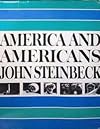
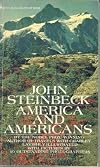
America and Americans
by John Steinbeck
On This Page
Tags
Recommendations



























Member Recommendations
Member Reviews
" ... we seem to be in a state of turmoil all the time, both physically and mentally. We are able to believe that our government is weak, stupid, overbearing, dishonest and inefficient, and at the same time we are deeply convinced that it is the best government in the world, ... (page 29)
Fans of Steinbeck's novels know that he was an astute observer of the individual psyche. In America and Americans, a collection of nine lengthy opinionated essays and American landscape photos, he attempts to analyze the collective American psyche by trying to answer some very interesting questions: How did our history make us who we are as a people? How did the actual physical landscape of America impact our ancestors and us? How did our eventual show more prosperity as a country affect us? What are our dreams for the future? What do our aspirations say about us? He handles all these questions with his typical tact and humor, but in no way does he ever sugarcoat the truth as he sees it.
No stone is left unturned here. Steinbeck seems to have a lot to say about a variety of subjects. He tackles politics, child rearing, and the problem of having too much leisure time. He writes passionately about the connection between criminal behavior and its sometime root, drug abuse. "Where need for money is the mother of the violence, the reason is again sad and sick and destructive, this time self-destructive, the need for drugs to abolish consciousness or stimulants to give shape and substance to a schizoid twin, hallucinatory aids in the creation of another world to take the place of this hated one. This too is a kind of murder ... another kind of murder of the self ... (page 142)" So much of what Steinbeck writes here, some 40 plus years ago, seems so apropos for today that it's downright eery: "... Americans have a love for the President that goes beyond loyalty or party nationality; he is ours, and we exercise the right to destroy him."
This is not a fawning love letter to the land of the free, home of the brave. It is a brutally honest look from one of its accomplished authors who chose not to see it through rose-colored glasses but with clear sight. The love and pride Steinbeck had for his country is clear though. It's almost as if he loved his adolescent country with a fatherly type of love. Steinbeck, who would pass away two years later after this book was published, seems to be calling it home for a family meeting to impart his wisdom and blessing. "If I inspect my people and study them and criticize them, I must love them if I have any self-love, since I can never be separate from them and can be no more objective about them than I am about myself. I am not young, and yet I wonder about tomorrow. How much more, then, must my wonder be about the tomorrow of my people, a young people. Perhaps my questioning is compounded of some fear, more hope, and great confidence."
I would highly recommend this coffee table book, not only for the history and insight Steinbeck imparts on a variety of topics, but also for the wonderful photography included. show less
Fans of Steinbeck's novels know that he was an astute observer of the individual psyche. In America and Americans, a collection of nine lengthy opinionated essays and American landscape photos, he attempts to analyze the collective American psyche by trying to answer some very interesting questions: How did our history make us who we are as a people? How did the actual physical landscape of America impact our ancestors and us? How did our eventual show more prosperity as a country affect us? What are our dreams for the future? What do our aspirations say about us? He handles all these questions with his typical tact and humor, but in no way does he ever sugarcoat the truth as he sees it.
No stone is left unturned here. Steinbeck seems to have a lot to say about a variety of subjects. He tackles politics, child rearing, and the problem of having too much leisure time. He writes passionately about the connection between criminal behavior and its sometime root, drug abuse. "Where need for money is the mother of the violence, the reason is again sad and sick and destructive, this time self-destructive, the need for drugs to abolish consciousness or stimulants to give shape and substance to a schizoid twin, hallucinatory aids in the creation of another world to take the place of this hated one. This too is a kind of murder ... another kind of murder of the self ... (page 142)" So much of what Steinbeck writes here, some 40 plus years ago, seems so apropos for today that it's downright eery: "... Americans have a love for the President that goes beyond loyalty or party nationality; he is ours, and we exercise the right to destroy him."
This is not a fawning love letter to the land of the free, home of the brave. It is a brutally honest look from one of its accomplished authors who chose not to see it through rose-colored glasses but with clear sight. The love and pride Steinbeck had for his country is clear though. It's almost as if he loved his adolescent country with a fatherly type of love. Steinbeck, who would pass away two years later after this book was published, seems to be calling it home for a family meeting to impart his wisdom and blessing. "If I inspect my people and study them and criticize them, I must love them if I have any self-love, since I can never be separate from them and can be no more objective about them than I am about myself. I am not young, and yet I wonder about tomorrow. How much more, then, must my wonder be about the tomorrow of my people, a young people. Perhaps my questioning is compounded of some fear, more hope, and great confidence."
I would highly recommend this coffee table book, not only for the history and insight Steinbeck imparts on a variety of topics, but also for the wonderful photography included. show less
What happens when a gifted writer, skilled in observation, turns his gaze to America and Americans? The pictures are nice, but there is much of interest in this book written in the 1960s. The teacher in me cannot resist. I wouldn't impose the entire book on a student, but there are selections that would be relevant in American history, American literature, sociology, and theology. Personally, I think this would make a great read aloud to share with students, but likely to be omitted in favor of Steinbeck's better known works.
This is essentially an American travelogue by John Steinbeck, encompassing his own opinions and those of the Americans he met in his journey across the country, along with photographs by 55 photographers, including Ansel Adams, Henri Cartier-Bresson, and Alfred Eisenstaedt. This is a good sourcebook for helping to understand the melting pot at a time in our history when it was beginning to come to a boil.
This a must read for high school students in their social studies, english, or history classes. Steinbeck's writing style earned him the Nobel and Pulitzer prizes, and it is no different in this opinionated travelogue, where his opionions just happen to coincide with mine.
Unsparingly, though with humor, affection and his own matcheless vein of anecdote, John Steinbeck describes America as he sees it: with its natural wealth, its moral and political shortcomings; with a gallery of Aemrican types--heroes, eccentric, Indians, teen-agers, misguided parents, old people; with the paradoxes of America's history and the promise of its future.
Ratings
Members
- Recently Added By
Author Information

486+ Works 207,757 Members
In recent years Steinbeck has been elevated to a more prominent status among American writers of his generation. If not quite at the world-class artistic level of a Hemingway or a Faulkner, he is nonetheless read very widely throughout the world by readers of all ages who consider him one of the most "American" of writers. Born in Salinas County, show more California on February 27, 1902, Steinbeck was of German-Irish parentage. After four years as a special student at Stanford University, he went to New York, where he worked as a reporter and as a hod carrier. Returning to California, he devoted himself to writing, with little success; his first three books sold fewer than 3,000 copies. Tortilla Flat (1935), dealing with the paisanos, California Mexicans whose ancestors settled in the country 200 years ago, established his reputation. In Dubious Battle (1936), a labor novel of a strike and strike-breaking, won the gold medal of the Commonwealth Club of California. Of Mice and Men (1937), a long short story that turns upon a melodramatic incident in the tragic friendship of two farm hands, written almost entirely in dialogue, was an experiment and was dramatized in the year of its publication, winning the New York Drama Critics Circle Award. It brought him fame. Out of a series of articles that he wrote about the transient labor camps in California came the inspiration for his greatest book, The Grapes of Wrath (1939), the odyssey of the Joad family, dispossessed of their farm in the Dust Bowl and seeking a new home, only to be driven on from camp to camp. The fiction is punctuated at intervals by the author's voice explaining this new sociological problem of homelessness, unemployment, and displacement. As the American novel "of the season, probably the year, possibly the decade," it won the Pulitzer Prize in 1940. It roused America and won a broad readership by the unusual simplicity and tenderness with which Steinbeck treated social questions. Even today, The Grapes of Wrath remains alive as a vivid account of believable human characters seen in symbolic and universal terms as well as in geographically and historically specific ones. Ma Joad is one of the most memorable characters in twentieth-century American fiction. It is her courage that sustains the family. Steinbeck's best and most ambitious novel after The Grapes of Wrath is East of Eden (1952), a saga of two American families in California from before the Civil War through World War I. Cannery Row (1945), The Wayward Bus (1947), and Sweet Thursday (1955) are lighter works that find Steinbeck returning to the lighthearted tone of Tortilla Flat as he recounts picaresque adventures of modern-day picaros. The Winter of Our Discontent (1961) struck some reviewers as being appropriately titled because of its despairing treatment of humanity's fall from grace in a wasteland world where money is king. Steinbeck also wrote important nonfiction, including Russian Journal (1948) in collaboration with the photographer Robert Capa; Once There Was a War (1958) and America and Americans (1966), which features pictures by 55 leading photographers and a 70-page essay by Steinbeck. His interest in marine biology led to two books primarily about sea life, Sea of Cortez (1941) (with Edward F. Ricketts) and The Log from the Sea of Cortez (1951). Travels with Charley (1962) is an engaging account of his journey of rediscovery of America, which took him through approximately 40 states. Steinbeck was married three times and died in New York City on December 20, 1968 of heart disease and congestive heart failure. He was 66, and had been a life-long smoker. (Bowker Author Biography) show less
Work Relationships
Is contained in
Common Knowledge
- Canonical title*
- Amerikka ja amerikkalaiset
- Original title
- America and Americans
- Original publication date
- 1966
- First words
- Foreword: In text and pictures, this is a book of opinions, unashamed and individual.
- Last words
- (Click to show. Warning: May contain spoilers.)We have never sat still for long; we have never been content with a place, a building - or with ourselves.
- Disambiguation notice
- Do not combine with the anthology "America and Americans and Selected Nonfiction".
*Some information comes from Common Knowledge in other languages. Click "Edit" for more information.
Classifications
Statistics
- Members
- 267
- Popularity
- 122,108
- Reviews
- 5
- Rating
- (3.74)
- Languages
- 7 — Czech, English, Finnish, German, Italian, Japanese, Portuguese
- Media
- Paper, Audiobook
- ISBNs
- 5
- ASINs
- 11