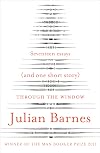
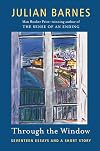
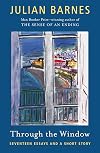
Through the Window: Seventeen Essays and a Short Story (Vintage International)
by Julian Barnes
On This Page
Description
In these seventeen essays (plus a short story and a special preface), Julian Barnes examines the British, French, and American writers who have shaped his own writing, as well as the cross-currents and overlappings of their different cultures.Tags
Recommendations





Member Recommendations


Member Reviews
I still buy books faster than I can read them. But again, this feels completely normal: how weird it would be to have around you only as many books as you have time to read in the rest of your life.
That bibliophilia shows in this collection of 17 essays (most previously published in the Guardian or New York Review of Books), where Barnes examines some of his favorite writers’ attachments to various countries and some various countries’ attachments to certain writers.
I especially enjoyed getting acquainted with Penelope Fitzgerald, reading about John Updike and the Rabbit books, and Barnes’s comparison of Joan Didion’s and Joyce Carol Oates’s memoirs of grief. He writes that Oates converted her deceased husband’s garden of show more annual plants into perennials, and draws the metaphor that it’s “…the problem confronting the widow: how to survive that first year, how to turn into a perennial.”
It’s the most accessible and entertaining literary criticism I’ve read -- interesting even about writers that I have little knowledge or interest in.
(Review based on an advance reading copy provided by the publisher.) show less
That bibliophilia shows in this collection of 17 essays (most previously published in the Guardian or New York Review of Books), where Barnes examines some of his favorite writers’ attachments to various countries and some various countries’ attachments to certain writers.
I especially enjoyed getting acquainted with Penelope Fitzgerald, reading about John Updike and the Rabbit books, and Barnes’s comparison of Joan Didion’s and Joyce Carol Oates’s memoirs of grief. He writes that Oates converted her deceased husband’s garden of show more annual plants into perennials, and draws the metaphor that it’s “…the problem confronting the widow: how to survive that first year, how to turn into a perennial.”
It’s the most accessible and entertaining literary criticism I’ve read -- interesting even about writers that I have little knowledge or interest in.
(Review based on an advance reading copy provided by the publisher.) show less
The one lesson I can best take away from some of my recent readings is that I should let things simmer for a while before giving a rating. The usual Julie-knee-jerk reaction hasn't been working well, as is evidenced by this one. When I closed the book on it last night, I thought, that was a very good book; yet when I came to pen these lines this morning, I had to say, that was an exceptionally good book -- from which I took away many important things, not the least of which is how to read differently. So, overnight, it soared from 4 to 5 stars, hitting its zenith while working its sinuous way deep into my psyche while I slept.
I knew Barnes was my-kind-of-writer by his opening sentence: I have lived in books, for books, by and with show more books; That's all I needed to read before I settled that I was his-kind-of-reader. In the most understated fashion, the preface is an ode to the written word -- an absolutely exquisite long paragraph of affirmations of bookdom, bookhood, bookness. And so the epode comes:
The American writer and dilettante Logan Pearsall Smith once said: "Some people think that life is the thing, but I prefer reading." When I first came across this, I thought it witty; now I find it -- as I do many aphorisms -- a slick untruth. Life and reading are not separate activities. The distinction is false (as it is when Yeats imagines the writer's choice between 'perfection of the life, or of the work'). When you read a great book you don't escape from life, you plunge deeper into it. There may be a superficial escape -- into different countries, mores, speech patterns -- but what you are essentially doing is furthering your understanding of life's subtleties, paradoxes, joys, pains, and truths. Reading and life are not separate but symbiotic. And for this self-discovery, there is and remains one perfect symbol: the printed book.
With such an auspicious start, I was horrified that his first essay should be on the perceptiveness of Penelope Fitzgerald. I groaned inwardly and thought I just might skip that one. (Admittedly, the only P Fitz I've read is Offshore, but that was seemingly enough to scar me for life, and which I put in my execrable list here on GR.) What a surprise to find that P Fitz is not at all who I thought her to be, based on my one reading experience. (I will not comment further on the humour, or irony, of that statement.)
Quite apart from her writing, Fitzgerald sounds like the kind of woman I would have liked to have had over for tea, discussing all manner of things; and in the end, she sounds so much more perceptive about life than I could have ever imagined. In effect, she is my-kind-writer, judging by Barnes's essay. Why did I hate her so much? Did I have my blinkers on that day? Was it an anti-P-Fitz kind of day? ... for certainly, I have those. Just like Eeyore, I have my anti days, in which everything is bleak and everything is execrable.
I pride myself on being perceptive and open minded about the books I read, but it seems not quite as much as I thought. [And of course, we all know what happens when pride comes into the picture. You tend to fall and twist your ankle on the cobblestones.] Since Barnes could presumably read my mind on the idea of 'bookdom', in his preface, I gave him the benefit of acquired knowledge and determined that I should give P Fitz another try. From his point of view, she is positively delightful. I'll have to find out how I could have been so wrong.
My mental re-alignment made this book a joy to get through. It's almost like he knew P Fitz would be my stumbling block; as if he were saying, If I can get through to her on this one, the rest is smooth sailing. And it was. For I connected with him absolutely on Clough and Orwell; on FMF and Kipling; on the art of translation and on Wharton and Updike. Others I didn't know like Fénéon and Moore. Chamfort is tangential and Houllebecq doesn't interest me in the least, but that's only a minor digression. And I recognized, just like Barnes did, the importance and magic of Hemingway's shorter fiction.
Throughout these essays, I was recognizing the touchstones of my life, and measuring them against what Barnes was saying. I was realizing that Barnes was quite a perceptive reader, and writer, much like the afore-mentioned P Fitz, whom I had avoided for no other reason than perhaps it was an Eeyore kind of reading day.
After reading The Sense of an Ending for instance, I had avoided him even though, quite unlike P Fitz's rating of execrable, I had given him four glowing stars for his novel. What I had found problematic with his work was that it said nothing -- absolutely nothing -- to me, but that he wrote beautifully. What was the value in that? So, I gave him 4 happy stars and went merrily on my way, not thinking about him again.
But it turns out that Barnes has indeed a lot to say:
Novels are like cities: some are organised and laid out with the colour-coded clarity of public transport maps, with each chapter marking a progress from one station to the next, until all the characters have been successully carried to their thematic terminus. Others, the subtler, wiser ones, offer no such immediately readable route maps. Instead of a journey through the city, they throw you into the city itself, and life itself: you are expected to find your own way. ... Such novels are not difficult to read, since they are so filled with detail and incident and the movement of life, but they are sometimes diffiuclt to work out. This is because the absentee author has the confidence to presume that the reader might be as subtle and intelligent as [she] is.
Perhaps I have been too used to reading those novels with the "readable routes". (One of my favourite souvenirs from my travels still remains the colourful London Tube map from the early 90s, for its depiction of transportation-nirvana.) Perhaps I'm not used to immersing myself in the "little nothings" of such novels, which in the end are the "little nothings" which make up the bigger part of life.
I'm not being coy or saying I don't understand those novels, and gee-whiz what a dunderhead I am; I'm simply saying that too often, I dismiss them with an almost contrived stubbornness, because they are too simple in presentation. There is that pride sneaking in again, that says, "Pshaw, I already know this. And someone has written an entire novel about it. Well, what a waste of time that was." When I should be saying ... Ah, stop for a moment, and listen to your heart beat. The rhythm is beautiful. Its simplicity is obvious ... but my god, isn't it magnificent?"
All this and more can be gleaned, through Mr. Barnes's window. show less
I knew Barnes was my-kind-of-writer by his opening sentence: I have lived in books, for books, by and with show more books; That's all I needed to read before I settled that I was his-kind-of-reader. In the most understated fashion, the preface is an ode to the written word -- an absolutely exquisite long paragraph of affirmations of bookdom, bookhood, bookness. And so the epode comes:
The American writer and dilettante Logan Pearsall Smith once said: "Some people think that life is the thing, but I prefer reading." When I first came across this, I thought it witty; now I find it -- as I do many aphorisms -- a slick untruth. Life and reading are not separate activities. The distinction is false (as it is when Yeats imagines the writer's choice between 'perfection of the life, or of the work'). When you read a great book you don't escape from life, you plunge deeper into it. There may be a superficial escape -- into different countries, mores, speech patterns -- but what you are essentially doing is furthering your understanding of life's subtleties, paradoxes, joys, pains, and truths. Reading and life are not separate but symbiotic. And for this self-discovery, there is and remains one perfect symbol: the printed book.
With such an auspicious start, I was horrified that his first essay should be on the perceptiveness of Penelope Fitzgerald. I groaned inwardly and thought I just might skip that one. (Admittedly, the only P Fitz I've read is Offshore, but that was seemingly enough to scar me for life, and which I put in my execrable list here on GR.) What a surprise to find that P Fitz is not at all who I thought her to be, based on my one reading experience. (I will not comment further on the humour, or irony, of that statement.)
Quite apart from her writing, Fitzgerald sounds like the kind of woman I would have liked to have had over for tea, discussing all manner of things; and in the end, she sounds so much more perceptive about life than I could have ever imagined. In effect, she is my-kind-writer, judging by Barnes's essay. Why did I hate her so much? Did I have my blinkers on that day? Was it an anti-P-Fitz kind of day? ... for certainly, I have those. Just like Eeyore, I have my anti days, in which everything is bleak and everything is execrable.
I pride myself on being perceptive and open minded about the books I read, but it seems not quite as much as I thought. [And of course, we all know what happens when pride comes into the picture. You tend to fall and twist your ankle on the cobblestones.] Since Barnes could presumably read my mind on the idea of 'bookdom', in his preface, I gave him the benefit of acquired knowledge and determined that I should give P Fitz another try. From his point of view, she is positively delightful. I'll have to find out how I could have been so wrong.
My mental re-alignment made this book a joy to get through. It's almost like he knew P Fitz would be my stumbling block; as if he were saying, If I can get through to her on this one, the rest is smooth sailing. And it was. For I connected with him absolutely on Clough and Orwell; on FMF and Kipling; on the art of translation and on Wharton and Updike. Others I didn't know like Fénéon and Moore. Chamfort is tangential and Houllebecq doesn't interest me in the least, but that's only a minor digression. And I recognized, just like Barnes did, the importance and magic of Hemingway's shorter fiction.
Throughout these essays, I was recognizing the touchstones of my life, and measuring them against what Barnes was saying. I was realizing that Barnes was quite a perceptive reader, and writer, much like the afore-mentioned P Fitz, whom I had avoided for no other reason than perhaps it was an Eeyore kind of reading day.
After reading The Sense of an Ending for instance, I had avoided him even though, quite unlike P Fitz's rating of execrable, I had given him four glowing stars for his novel. What I had found problematic with his work was that it said nothing -- absolutely nothing -- to me, but that he wrote beautifully. What was the value in that? So, I gave him 4 happy stars and went merrily on my way, not thinking about him again.
But it turns out that Barnes has indeed a lot to say:
Novels are like cities: some are organised and laid out with the colour-coded clarity of public transport maps, with each chapter marking a progress from one station to the next, until all the characters have been successully carried to their thematic terminus. Others, the subtler, wiser ones, offer no such immediately readable route maps. Instead of a journey through the city, they throw you into the city itself, and life itself: you are expected to find your own way. ... Such novels are not difficult to read, since they are so filled with detail and incident and the movement of life, but they are sometimes diffiuclt to work out. This is because the absentee author has the confidence to presume that the reader might be as subtle and intelligent as [she] is.
Perhaps I have been too used to reading those novels with the "readable routes". (One of my favourite souvenirs from my travels still remains the colourful London Tube map from the early 90s, for its depiction of transportation-nirvana.) Perhaps I'm not used to immersing myself in the "little nothings" of such novels, which in the end are the "little nothings" which make up the bigger part of life.
I'm not being coy or saying I don't understand those novels, and gee-whiz what a dunderhead I am; I'm simply saying that too often, I dismiss them with an almost contrived stubbornness, because they are too simple in presentation. There is that pride sneaking in again, that says, "Pshaw, I already know this. And someone has written an entire novel about it. Well, what a waste of time that was." When I should be saying ... Ah, stop for a moment, and listen to your heart beat. The rhythm is beautiful. Its simplicity is obvious ... but my god, isn't it magnificent?"
All this and more can be gleaned, through Mr. Barnes's window. show less
Any collection of occasional pieces—book reviews, profiles, essays, even short stories—will have some ups and downs, even for an accomplished, erudite writer like Julian Barnes. So it will not be too surprising to learn that the one non-occasional piece of writing in this collection—the preface essay “A Life With Books”—is perhaps the most delightful. There we see the young Julian Barnes and his growing love of books. It is a passion that has followed him his whole life. And though it might sometimes be the case that he has more love for books than for literature, he has enough of the latter (usually) to share with us.
Barnes is very good when he likes an author. He very much likes Penelope Fitzgerald and he very much likes show more Ford Maddox Ford (there are three essays on Ford in this collection). For such authors he takes pains to draw us to what are salient aspects of their writing for him. He enthuses. And he generally succeeds in encouraging the reader to want to go out and read the books in question sooner rather than later.
For authors that Barnes does not really like, or whose efforts he finds to be lacking, he can be stiff, donnish, unforgiving. That same donnish persona pervades the essays here that resuscitate figures out of the, now dim, yesteryears of (usually French) literary history. They are informative, sometimes insightful, often arch, and, rather like British toast, very dry. They have the habit of reminding the reader just how little depth or breadth must have typified the reader’s education. Which is not really all that much fun. Neither inviting nor accommodating. You may have the distinct hope, while reading, that this tutor will not be marking your final exam.
The short story included in the collection is entitled “Homage to Hemingway”. It patterns itself after a late Hemingway short story, presenting itself in three parts, each a reflection or refraction of the others. In each an unnamed tutor of a creative writing class works through some prepared platitudes, always careful to drop in an anecdote or two, as well as a reference to Hemingway. Curiously, the story conveys a very similar atmosphere to that of the essays: formal, if not entirely formulaic; emotionally distant; full of self-concern; and a touch sad.
A hearty recommendation then for the preface and the delightfully enthusiastic essay on Penelope Fitzgerald, but otherwise, meh. show less
Barnes is very good when he likes an author. He very much likes Penelope Fitzgerald and he very much likes show more Ford Maddox Ford (there are three essays on Ford in this collection). For such authors he takes pains to draw us to what are salient aspects of their writing for him. He enthuses. And he generally succeeds in encouraging the reader to want to go out and read the books in question sooner rather than later.
For authors that Barnes does not really like, or whose efforts he finds to be lacking, he can be stiff, donnish, unforgiving. That same donnish persona pervades the essays here that resuscitate figures out of the, now dim, yesteryears of (usually French) literary history. They are informative, sometimes insightful, often arch, and, rather like British toast, very dry. They have the habit of reminding the reader just how little depth or breadth must have typified the reader’s education. Which is not really all that much fun. Neither inviting nor accommodating. You may have the distinct hope, while reading, that this tutor will not be marking your final exam.
The short story included in the collection is entitled “Homage to Hemingway”. It patterns itself after a late Hemingway short story, presenting itself in three parts, each a reflection or refraction of the others. In each an unnamed tutor of a creative writing class works through some prepared platitudes, always careful to drop in an anecdote or two, as well as a reference to Hemingway. Curiously, the story conveys a very similar atmosphere to that of the essays: formal, if not entirely formulaic; emotionally distant; full of self-concern; and a touch sad.
A hearty recommendation then for the preface and the delightfully enthusiastic essay on Penelope Fitzgerald, but otherwise, meh. show less
Lurid post-it notes jostle pink-yellow-red-blue-green post-it flags at the page edges. I think only the five-star ones merit this number of flags. And — (sigh) — Barnes’s essays on writers and their books has bumped up my TBR count. At least I can re-use the post-it flags for those new ones.
Preface: A Life with Books (5*) — This eleven-page essay was one of my favourites. I love reading about other people’s love affairs with books, about how and what they read as children, what ensared them, about how they grew up in their reading tastes, about their influences and favourite authors.
He starts with, ”I have lived in books, for books, by and with books; in recent years, I have been fortunate enough to be able to live from show more books. And it was through books that I first realized there were other worlds beyond my own; first imagined what it might be like to be another person; first encountered that deeply intimate bond made when a writer’s voice gets inside a reader’s head.”
His book world began to expand at age 17, when he got to choose his book for a school prize. He chose Ulysses: “I can still see the disapproving face of the Lord Mayor as his protectively gloved hand passed over to me this notoriously filthy novel.”
He describes his phase of being a “furious book-hunter, driving to the market towns and cathedral cities of England in my Morris Traveller and loading it with books bought at a rate which far exceeded any possible reading speed.” He collected first editions, complete sets, and just random books to justify otherwise fruitless expeditions.
"The dividing line between books I liked, books I thought I would like, books I hoped I would like, and books I didn't like now but thought I might at some future date was rarely distinct."
Barnes still buys books faster than he can read them, and his defense is one of my favourite quotes in the book: “But this feels completely normal: how weird it would be to have around you only as many books as you have time to read in the rest of your life.”
Indeed.
Most of the essays were previously published in Guardian, NYRB, LRB, New Yorker, or as forewords. About half of them are related to french authors or to France.
It was fascinating to read "Translating Madame Bovary", in which he discusses the Lydia Davis translation in the context of her predecessors, especially since I am (still!) reading her translation of Proust’s “The Way by Swann’s”. He is politely disapproving of her work, describing it as a “linguistically careful version, in the modern style, rendered into an unobtrusively American English.” Ouch.
Davis says that past translations “that are written with some flair and some life to them are not at all that close to the original; the ones that are more faithful may be kind of clunky.” Barnes comments that “This is the paradox and bind of translation. If to be ‘faithful’ is to be ‘clunky’, then it is also to be unfaithful because Flaubert was not a ‘clunky’ writer. He moves between registers; he cuts into the lyric with the prosaic; but this is language whose every sentence, word, syllable has been tested aloud again and again.” I so wish I knew French…
He admires Penelope Fitzgerald’s work. They are examples of the subtler wiser type of novel, in which the “structure and purpose may not be immediately apparent…Nor do such novels move mechanically; they stray, they pause, they lollop, as life does, except with a greater purpose and hidden structure.”
“George Orwell and the Fucking Elephant” is about class, ideologies, Being a Great Writer, and moral ambiguities. He reports, via Orwell’s biographer Bernard Crick, on a restaurant meeting between Crick and Orwell’s widow Sonia. “Crick dared to doubt the utter truthfulness of one of Orwell’s most celebrated pieces of reportage, ‘Shooting an Elephant’. Sonia ‘screamed’ at him across the table, ‘Of course he shot a fucking elephant. He said he did. Why do you always doubt his fucking word!’ Crick had discovered that in fact no one had been killed by the elephant, although Orwell did kill the elephant, angering the owners and resulting in a form of disgraceful internal exile.
He writes a graceful literary eulogy of John Updike, and is particularly fond of the Rabbit books, calling Rabbit at Rest “the greatest post-war American novel.” This makes me want to re-read them again, twenty years later.
Three of the essays were about Ford Maddox Ford. In “Ford’s the Good Soldier” he gives a master class in literary criticism. He discusses the opening sentence…’This is the saddest story I have ever heard.“, and at the end of the paragraph provides this most memorable description: “And if the second verb of the first sentence of the book is unreliable — if it gives a creak under the foot as we put our weight on it— then we must be prepared to treat every line as warily; we must prowl soft-footed through the text, alive for every board’s moan and plaint.” Love it. Wonderful.
The last belongs to Mr. Barnes:
“Nothing can replace the exact, complicated, subtle communion between absent author and entranced, present reader.” show less
Preface: A Life with Books (5*) — This eleven-page essay was one of my favourites. I love reading about other people’s love affairs with books, about how and what they read as children, what ensared them, about how they grew up in their reading tastes, about their influences and favourite authors.
He starts with, ”I have lived in books, for books, by and with books; in recent years, I have been fortunate enough to be able to live from show more books. And it was through books that I first realized there were other worlds beyond my own; first imagined what it might be like to be another person; first encountered that deeply intimate bond made when a writer’s voice gets inside a reader’s head.”
His book world began to expand at age 17, when he got to choose his book for a school prize. He chose Ulysses: “I can still see the disapproving face of the Lord Mayor as his protectively gloved hand passed over to me this notoriously filthy novel.”
He describes his phase of being a “furious book-hunter, driving to the market towns and cathedral cities of England in my Morris Traveller and loading it with books bought at a rate which far exceeded any possible reading speed.” He collected first editions, complete sets, and just random books to justify otherwise fruitless expeditions.
"The dividing line between books I liked, books I thought I would like, books I hoped I would like, and books I didn't like now but thought I might at some future date was rarely distinct."
Barnes still buys books faster than he can read them, and his defense is one of my favourite quotes in the book: “But this feels completely normal: how weird it would be to have around you only as many books as you have time to read in the rest of your life.”
Indeed.
Most of the essays were previously published in Guardian, NYRB, LRB, New Yorker, or as forewords. About half of them are related to french authors or to France.
It was fascinating to read "Translating Madame Bovary", in which he discusses the Lydia Davis translation in the context of her predecessors, especially since I am (still!) reading her translation of Proust’s “The Way by Swann’s”. He is politely disapproving of her work, describing it as a “linguistically careful version, in the modern style, rendered into an unobtrusively American English.” Ouch.
Davis says that past translations “that are written with some flair and some life to them are not at all that close to the original; the ones that are more faithful may be kind of clunky.” Barnes comments that “This is the paradox and bind of translation. If to be ‘faithful’ is to be ‘clunky’, then it is also to be unfaithful because Flaubert was not a ‘clunky’ writer. He moves between registers; he cuts into the lyric with the prosaic; but this is language whose every sentence, word, syllable has been tested aloud again and again.” I so wish I knew French…
He admires Penelope Fitzgerald’s work. They are examples of the subtler wiser type of novel, in which the “structure and purpose may not be immediately apparent…Nor do such novels move mechanically; they stray, they pause, they lollop, as life does, except with a greater purpose and hidden structure.”
“George Orwell and the Fucking Elephant” is about class, ideologies, Being a Great Writer, and moral ambiguities. He reports, via Orwell’s biographer Bernard Crick, on a restaurant meeting between Crick and Orwell’s widow Sonia. “Crick dared to doubt the utter truthfulness of one of Orwell’s most celebrated pieces of reportage, ‘Shooting an Elephant’. Sonia ‘screamed’ at him across the table, ‘Of course he shot a fucking elephant. He said he did. Why do you always doubt his fucking word!’ Crick had discovered that in fact no one had been killed by the elephant, although Orwell did kill the elephant, angering the owners and resulting in a form of disgraceful internal exile.
He writes a graceful literary eulogy of John Updike, and is particularly fond of the Rabbit books, calling Rabbit at Rest “the greatest post-war American novel.” This makes me want to re-read them again, twenty years later.
Three of the essays were about Ford Maddox Ford. In “Ford’s the Good Soldier” he gives a master class in literary criticism. He discusses the opening sentence…’This is the saddest story I have ever heard.“, and at the end of the paragraph provides this most memorable description: “And if the second verb of the first sentence of the book is unreliable — if it gives a creak under the foot as we put our weight on it— then we must be prepared to treat every line as warily; we must prowl soft-footed through the text, alive for every board’s moan and plaint.” Love it. Wonderful.
The last belongs to Mr. Barnes:
“Nothing can replace the exact, complicated, subtle communion between absent author and entranced, present reader.” show less
Lurid post-it notes jostle pink-yellow-red-blue-green post-it flags at the page edges. I think only the five-star ones merit this number of flags. And — (sigh) — Barnes’s essays on writers and their books has bumped up my TBR count. At least I can re-use the post-it flags for those new ones.
Preface: A Life with Books (5*) — This eleven-page essay was one of my favourites. I love reading about other people’s love affairs with books, about how and what they read as children, what ensared them, about how they grew up in their reading tastes, about their influences and favourite authors.
He starts with, ”I have lived in books, for books, by and with books; in recent years, I have been fortunate enough to be able to live from show more books. And it was through books that I first realized there were other worlds beyond my own; first imagined what it might be like to be another person; first encountered that deeply intimate bond made when a writer’s voice gets inside a reader’s head.”
His book world began to expand at age 17, when he got to choose his book for a school prize. He chose Ulysses: “I can still see the disapproving face of the Lord Mayor as his protectively gloved hand passed over to me this notoriously filthy novel.”
He describes his phase of being a “furious book-hunter, driving to the market towns and cathedral cities of England in my Morris Traveller and loading it with books bought at a rate which far exceeded any possible reading speed.” He collected first editions, complete sets, and just random books to justify otherwise fruitless expeditions.
"The dividing line between books I liked, books I thought I would like, books I hoped I would like, and books I didn't like now but thought I might at some future date was rarely distinct."
Barnes still buys books faster than he can read them, and his defense is one of my favourite quotes in the book: “But this feels completely normal: how weird it would be to have around you only as many books as you have time to read in the rest of your life.”
Indeed.
Most of the essays were previously published in Guardian, NYRB, LRB, New Yorker, or as forewords. About half of them are related to french authors or to France.
It was fascinating to read "Translating Madame Bovary", in which he discusses the Lydia Davis translation in the context of her predecessors, especially since I am (still!) reading her translation of Proust’s “The Way by Swann’s”. He is politely disapproving of her work, describing it as a “linguistically careful version, in the modern style, rendered into an unobtrusively American English.” Ouch.
Davis says that past translations “that are written with some flair and some life to them are not at all that close to the original; the ones that are more faithful may be kind of clunky.” Barnes comments that “This is the paradox and bind of translation. If to be ‘faithful’ is to be ‘clunky’, then it is also to be unfaithful because Flaubert was not a ‘clunky’ writer. He moves between registers; he cuts into the lyric with the prosaic; but this is language whose every sentence, word, syllable has been tested aloud again and again.” I so wish I knew French…
He admires Penelope Fitzgerald’s work. They are examples of the subtler wiser type of novel, in which the “structure and purpose may not be immediately apparent…Nor do such novels move mechanically; they stray, they pause, they lollop, as life does, except with a greater purpose and hidden structure.”
“George Orwell and the Fucking Elephant” is about class, ideologies, Being a Great Writer, and moral ambiguities. He reports, via Orwell’s biographer Bernard Crick, on a restaurant meeting between Crick and Orwell’s widow Sonia. “Crick dared to doubt the utter truthfulness of one of Orwell’s most celebrated pieces of reportage, ‘Shooting an Elephant’. Sonia ‘screamed’ at him across the table, ‘Of course he shot a fucking elephant. He said he did. Why do you always doubt his fucking word!’ Crick had discovered that in fact no one had been killed by the elephant, although Orwell did kill the elephant, angering the owners and resulting in a form of disgraceful internal exile.
He writes a graceful literary eulogy of John Updike, and is particularly fond of the Rabbit books, calling Rabbit at Rest “the greatest post-war American novel.” This makes me want to re-read them again, twenty years later.
Three of the essays were about Ford Maddox Ford. In “Ford’s the Good Soldier” he gives a master class in literary criticism. He discusses the opening sentence…’This is the saddest story I have ever heard.“, and at the end of the paragraph provides this most memorable description: “And if the second verb of the first sentence of the book is unreliable — if it gives a creak under the foot as we put our weight on it— then we must be prepared to treat every line as warily; we must prowl soft-footed through the text, alive for every board’s moan and plaint.” Love it. Wonderful.
The last belongs to Mr. Barnes:
“Nothing can replace the exact, complicated, subtle communion between absent author and entranced, present reader.” show less
Preface: A Life with Books (5*) — This eleven-page essay was one of my favourites. I love reading about other people’s love affairs with books, about how and what they read as children, what ensared them, about how they grew up in their reading tastes, about their influences and favourite authors.
He starts with, ”I have lived in books, for books, by and with books; in recent years, I have been fortunate enough to be able to live from show more books. And it was through books that I first realized there were other worlds beyond my own; first imagined what it might be like to be another person; first encountered that deeply intimate bond made when a writer’s voice gets inside a reader’s head.”
His book world began to expand at age 17, when he got to choose his book for a school prize. He chose Ulysses: “I can still see the disapproving face of the Lord Mayor as his protectively gloved hand passed over to me this notoriously filthy novel.”
He describes his phase of being a “furious book-hunter, driving to the market towns and cathedral cities of England in my Morris Traveller and loading it with books bought at a rate which far exceeded any possible reading speed.” He collected first editions, complete sets, and just random books to justify otherwise fruitless expeditions.
"The dividing line between books I liked, books I thought I would like, books I hoped I would like, and books I didn't like now but thought I might at some future date was rarely distinct."
Barnes still buys books faster than he can read them, and his defense is one of my favourite quotes in the book: “But this feels completely normal: how weird it would be to have around you only as many books as you have time to read in the rest of your life.”
Indeed.
Most of the essays were previously published in Guardian, NYRB, LRB, New Yorker, or as forewords. About half of them are related to french authors or to France.
It was fascinating to read "Translating Madame Bovary", in which he discusses the Lydia Davis translation in the context of her predecessors, especially since I am (still!) reading her translation of Proust’s “The Way by Swann’s”. He is politely disapproving of her work, describing it as a “linguistically careful version, in the modern style, rendered into an unobtrusively American English.” Ouch.
Davis says that past translations “that are written with some flair and some life to them are not at all that close to the original; the ones that are more faithful may be kind of clunky.” Barnes comments that “This is the paradox and bind of translation. If to be ‘faithful’ is to be ‘clunky’, then it is also to be unfaithful because Flaubert was not a ‘clunky’ writer. He moves between registers; he cuts into the lyric with the prosaic; but this is language whose every sentence, word, syllable has been tested aloud again and again.” I so wish I knew French…
He admires Penelope Fitzgerald’s work. They are examples of the subtler wiser type of novel, in which the “structure and purpose may not be immediately apparent…Nor do such novels move mechanically; they stray, they pause, they lollop, as life does, except with a greater purpose and hidden structure.”
“George Orwell and the Fucking Elephant” is about class, ideologies, Being a Great Writer, and moral ambiguities. He reports, via Orwell’s biographer Bernard Crick, on a restaurant meeting between Crick and Orwell’s widow Sonia. “Crick dared to doubt the utter truthfulness of one of Orwell’s most celebrated pieces of reportage, ‘Shooting an Elephant’. Sonia ‘screamed’ at him across the table, ‘Of course he shot a fucking elephant. He said he did. Why do you always doubt his fucking word!’ Crick had discovered that in fact no one had been killed by the elephant, although Orwell did kill the elephant, angering the owners and resulting in a form of disgraceful internal exile.
He writes a graceful literary eulogy of John Updike, and is particularly fond of the Rabbit books, calling Rabbit at Rest “the greatest post-war American novel.” This makes me want to re-read them again, twenty years later.
Three of the essays were about Ford Maddox Ford. In “Ford’s the Good Soldier” he gives a master class in literary criticism. He discusses the opening sentence…’This is the saddest story I have ever heard.“, and at the end of the paragraph provides this most memorable description: “And if the second verb of the first sentence of the book is unreliable — if it gives a creak under the foot as we put our weight on it— then we must be prepared to treat every line as warily; we must prowl soft-footed through the text, alive for every board’s moan and plaint.” Love it. Wonderful.
The last belongs to Mr. Barnes:
“Nothing can replace the exact, complicated, subtle communion between absent author and entranced, present reader.” show less
Julian Barnes won the Man Booker Prize in 2011 for his book The Sense of an Ending which has sparked a huge increase in this man’s popularity. To follow up (cash in) on the buzz the release of Through the Window followed soon after, which holds Seventeen Essays (and a Short Story) on the books and authors that have meant the most to him over his career.
I remember reading Julian Barnes’ essay A Life with Books, which really was just a look at his reading history and I absolutely loved it. So I was eager to read this collection to learn more about this wonderful author. What I found was this collection was very dry and this made it difficult to read. Barnes is a very intelligent man and he flexed his intellectual muscles to the point show more where it back very difficult to read for a pseudo intellectual like me.
While I found it interesting to read this author’s thoughts on Penelope Fitzgerald, Hemingway, Kipling, Madame Bovary, Ford Madox Ford and George Orwell I tend to think Barnes wasn’t connecting to the reader like he did with his novels or the essay A Life with Books. It felt more like reading an academic essay more than just someone’s passion for these authors and books.
This is a difficult collection to get through, but people interested in learning more about Julian Barnes or these topics might find something in this book for them. I read this book as soon as I finished Ramona Koval’s By the Book, A Reader’s Guide to Life so it was difficult to go from a book with so much passion for reading to something so dry.
This review originally appeared on my blog; http://literary-exploration.com/2013/03/09/book-review-through-the-window/ show less
I remember reading Julian Barnes’ essay A Life with Books, which really was just a look at his reading history and I absolutely loved it. So I was eager to read this collection to learn more about this wonderful author. What I found was this collection was very dry and this made it difficult to read. Barnes is a very intelligent man and he flexed his intellectual muscles to the point show more where it back very difficult to read for a pseudo intellectual like me.
While I found it interesting to read this author’s thoughts on Penelope Fitzgerald, Hemingway, Kipling, Madame Bovary, Ford Madox Ford and George Orwell I tend to think Barnes wasn’t connecting to the reader like he did with his novels or the essay A Life with Books. It felt more like reading an academic essay more than just someone’s passion for these authors and books.
This is a difficult collection to get through, but people interested in learning more about Julian Barnes or these topics might find something in this book for them. I read this book as soon as I finished Ramona Koval’s By the Book, A Reader’s Guide to Life so it was difficult to go from a book with so much passion for reading to something so dry.
This review originally appeared on my blog; http://literary-exploration.com/2013/03/09/book-review-through-the-window/ show less
"The most misspent day in any life is the one when you've failed to laugh." - Chamfort
Yesterday I first cracked the cover of this in Frankfort Airport, enjoying espresso as I gazed about at the number of beer drinkers at 9 a.m. on a Sunday. As Julian Barnes notes early, his family didn't go to church but they did go to the library. Finally succumbing to slumber, I crashed without finishing Barnes' second examination of Ford Maddox Ford. Replenished, I awoke today before dawn and was off wandering New Belgrade. Pleasantly winded, I returned and read for a hour in a churchyard waiting for the currency exchange to open. Kipling and France were blended in pair of masterful pieces while I waited. It is now nearly noon here and the author show more closed the collection with a multifaceted reflections on Updike and literary grieving. My own life appears ripe and expanded at the present. show less
Yesterday I first cracked the cover of this in Frankfort Airport, enjoying espresso as I gazed about at the number of beer drinkers at 9 a.m. on a Sunday. As Julian Barnes notes early, his family didn't go to church but they did go to the library. Finally succumbing to slumber, I crashed without finishing Barnes' second examination of Ford Maddox Ford. Replenished, I awoke today before dawn and was off wandering New Belgrade. Pleasantly winded, I returned and read for a hour in a churchyard waiting for the currency exchange to open. Kipling and France were blended in pair of masterful pieces while I waited. It is now nearly noon here and the author show more closed the collection with a multifaceted reflections on Updike and literary grieving. My own life appears ripe and expanded at the present. show less
Members
- Recently Added By
Author Information

89+ Works 43,013 Members
Julian Barnes was born in Leicester, England, on January 19, 1946. He received a degree in modern languages from Magdalen College, Oxford University in 1968. He has held jobs as a lexicographer for the Oxford English Dictionary, a reviewer and literary editor for the New Statesmen and the New Review, and a television critic. He has written show more numerous works of fiction including Arthur and George, Pulse: Stories, The Noise of Time, and England, England. He received the Somerset Maugham Award in 1980 for Metroland, the Geoffrey Faber Memorial Prize in 1985 and a Prix Medicis in 1986 for Flaubert's Parrot, and the Man Booker Prize in 2011 for The Sense of an Ending. He also writes non-fiction works including Letters from London, The Pedant in the Kitchen, and Nothing to Be Frightened Of. He received the Shakespeare Prize by the FVS Foundation in 1993, the Austrian State Prize for European Literature in 2004, and the David Cohen Prize for Literature in 2011. He writes detective novels under the pseudonym Dan Kavanaugh. His works under this name include Duffy, Fiddle City, Putting the Boot In, and Going to the Dogs. (Bowker Author Biography) show less
Some Editions
Series
Belongs to Publisher Series
Work Relationships
Contains
Common Knowledge
- Original title
- Through the window : seventeen essays (and one short story) (and one short story)
- Original publication date
- 2012
- Dedication
- For Pat
- First words
- A Sempé cartoon set in a second-hand bookshop.
- Quotations
- Grief dislocates both space and time. The grief-stricken find themselves in a new geography, where other people's maps are only ever approximate. Time also ceases to be reliable.
The perfect translator must be a writer able to subsume himself or herself into the greater writer's text and identity.... Some translations need as long as the book itself took to write, a few even longer.
The general trend of translation over the last century and more has been away from smoothness and towards authenticity, away from a reorganising interpretativeness which aims for the flow of English prose, towards a close-rea... (show all)ding fidelity which seeks to echo the original language.
Flaubert said that a line of prose should be as rhythmical, sonorous and unchangeable as a line of poetry. - Original language
- English
Classifications
Statistics
- Members
- 278
- Popularity
- 115,684
- Reviews
- 13
- Rating
- (3.74)
- Languages
- Dutch, English, French, German
- Media
- Paper, Audiobook, Ebook
- ISBNs
- 18
- ASINs
- 7