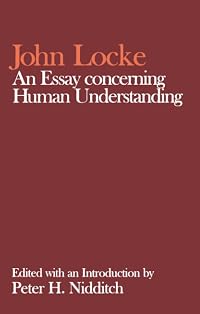
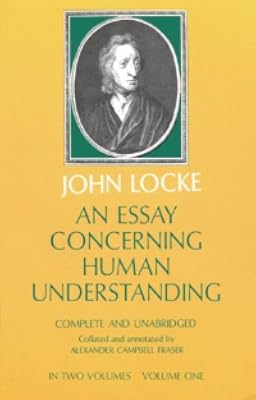
An Essay Concerning Human Understanding
by John Locke
On This Page
Description
Notes and Introduction by Mark G. Spencer, Brock University, OntarioJohn Locke (1632-1704) was perhaps the most influential English writer of his time. HisEssay concerning Human Understanding(1690) and Two Treatises of Government(1690) weighed heavily on the history of ideas in the eighteenth century, and Locke's works are often rightly presented as foundations of the Age of Enlightenment. Both the Essayand the Second Treatise(by far the more influential of the Two Treatises) were widely show more read by Locke's contemporaries and near contemporaries. His eighteenth-century readers included philosophers, historians and political theorists, but also community and political leaders, engaged laypersons, and others eager to participate in the expanding print culture of the era. His epistemological message that the mind at birth was a blank slate, waiting to be filled, complemented his political message that human beings were free and equal and had the right to create and direct the governments under which they lived. Today, Locke continues to be an accessible author. He provides food for thought to university professors and their students, but has no less to offer the general reader who is eager to enjoy the classics of world literature. show lessTags
Recommendations



Member Reviews
I remember taking a course in "Early Modern" philosophy in the spring quarter of my freshman year of college. I was dealing with late nights because of my first "love," and ... yeah, it was spring and the course took place in the afternoon. The instructor was smart but not a dynamo, so it would have been easy to just fall asleep.
I didn't though. I found the material exciting. We primarily covered the British Empiricists (and others -- it's tough to remember at this 45 year distance) + Immanuel Kant. We read some of Locke's stuff in an anthology titled, if I recall correctly, The Empiricists, and I swear I can remember the editor making noise about how Locke was rambling, repetitive, and nowhere near the more elegant level of Berkeley or show more Hume. Nevertheless, there were bits of what we got from Locke that really intrigued me.
Decades later, I picked up and made my way through Locke's Essay Concerning Human Understanding, his major work on epistemology, etc. I think there's a lot to be said FOR Locke's style. It may not be to everyone's taste, it doesn't charge around like a bucking bronco, but there is both a grace and an inexorable-ness to his prose that I quite like. And he has a sense of humor.
Locke simply keeps plunging reasonably on. I don't agree with him everywhere, but he's just so comprehensive and good-natured that ... well, I can understand why this is considered a major work. It was well worth my time, and if I live long enough, I will read it again. show less
I didn't though. I found the material exciting. We primarily covered the British Empiricists (and others -- it's tough to remember at this 45 year distance) + Immanuel Kant. We read some of Locke's stuff in an anthology titled, if I recall correctly, The Empiricists, and I swear I can remember the editor making noise about how Locke was rambling, repetitive, and nowhere near the more elegant level of Berkeley or show more Hume. Nevertheless, there were bits of what we got from Locke that really intrigued me.
Decades later, I picked up and made my way through Locke's Essay Concerning Human Understanding, his major work on epistemology, etc. I think there's a lot to be said FOR Locke's style. It may not be to everyone's taste, it doesn't charge around like a bucking bronco, but there is both a grace and an inexorable-ness to his prose that I quite like. And he has a sense of humor.
Locke simply keeps plunging reasonably on. I don't agree with him everywhere, but he's just so comprehensive and good-natured that ... well, I can understand why this is considered a major work. It was well worth my time, and if I live long enough, I will read it again. show less
I see I gave book three of the Essay five-and-a-half stars when I read it on its own, which I hope shows that I do see the insightful and innovative side of this magnum opus, because I think I'm about to come across more negative about it than I mean to.
Why?? Well, so there is a cute thing Locke says near the beginning that serves not only as life maxim but also as oblique and presumably unintentional commentary on his own work: "It is of great use to the sailor to know the length of his line, though he cannot with it fathom all the depths of the ocean. It is well he knows that it is long enough to reach the bottom, at such places as are necessary to direct his voyage, and caution him against running upon shoals that may ruin him." show more Locke goes further to say that is our job here in the Essay too and we shouldn't expect to know it all, but dude ... I feel so incorrigibly modern for saying this, but stop trying to know it all then! You can't be a fox and a hedgehog at the same time! Or if you're going to be a psychologist, then psychologize, but stop talking about sailors and ropes and not needing to know it all if you're about to spend six hundred pages anatomizing our ideas of things and the operations of the human mind. This is not a cheery, speculative, line-trawling kind of book--it is a System, and how you feel about reading the thing instead of a two paragraph summary in A History of Western Philosophy or your psych text or something will depend a lot on how you feel about prolix, ponderous systematicity.
For me, I am getting old and sad and this old sailor didn't need Locke to prove that cultural relativism exists or that it doesn't make sense to argue that ideas are innate if kids still have to learn them. I know it was noble service. I'm even prepared to imagine that you invented the present-day model of the self, because if not you, then who? But did you have to do it at such length, and then mock us by being all "I know I repeat myself, but enhhh, fuckit"?
One good way to deal with this issue is to read this as a treasure hunt for epigrams, which will result in a rich sense of the process whereby the gentleman of the Enlightenment gathers the low-hanging fruit of the understanding. Sometimes it is perverse--like, the kind of perversity that takes "manna" as the go-to example of the perception of the qualities of substances--manna is sweet, manna is white, shove your manna up your manna hole. But sometimes it's kind of neat--if the sun melts wax is that quality in the sun or the wax? Sunny-dock, grass-chewing stuff. Overall I'm sort of 49% no on that stuff (I challenge anyone to remove a part of space from space. Now!); but what it distracts from is that he's discussing infinity/eternity and categoricity/gradience and free will in sophisticated ways and sometimes talks about what it would be like if we had microscope eyes, and that stuff I am like 57% yes on, even when it's done Locke style.
One funny thing is the way he tries to be universalist and then tumbles into the rabbit hole of differences in perception and the only thing he can do to deal with it is turn to language--the weird ways we put words together, they ways they trick and slied, the "double conformity" of words to our ideas and the ideas of others, and the funny little social compact called language that we try to salvage meaning with. The "connection of ideas," a concept with import beyond its days. (Probably this would be a weird review of Locke if it didn't also mention the tabula rasa in that capacity.) There is annoying Christian contusions about epistemology--"here is a thing that makes sense but oh the one exception is God." And much of this is near-impenetrable and seemingly trivial when penetrated. Is that a founder effect, like it seems obvious NOW, or am I just a whiner? At least it's not Leibniz. show less
Why?? Well, so there is a cute thing Locke says near the beginning that serves not only as life maxim but also as oblique and presumably unintentional commentary on his own work: "It is of great use to the sailor to know the length of his line, though he cannot with it fathom all the depths of the ocean. It is well he knows that it is long enough to reach the bottom, at such places as are necessary to direct his voyage, and caution him against running upon shoals that may ruin him." show more Locke goes further to say that is our job here in the Essay too and we shouldn't expect to know it all, but dude ... I feel so incorrigibly modern for saying this, but stop trying to know it all then! You can't be a fox and a hedgehog at the same time! Or if you're going to be a psychologist, then psychologize, but stop talking about sailors and ropes and not needing to know it all if you're about to spend six hundred pages anatomizing our ideas of things and the operations of the human mind. This is not a cheery, speculative, line-trawling kind of book--it is a System, and how you feel about reading the thing instead of a two paragraph summary in A History of Western Philosophy or your psych text or something will depend a lot on how you feel about prolix, ponderous systematicity.
For me, I am getting old and sad and this old sailor didn't need Locke to prove that cultural relativism exists or that it doesn't make sense to argue that ideas are innate if kids still have to learn them. I know it was noble service. I'm even prepared to imagine that you invented the present-day model of the self, because if not you, then who? But did you have to do it at such length, and then mock us by being all "I know I repeat myself, but enhhh, fuckit"?
One good way to deal with this issue is to read this as a treasure hunt for epigrams, which will result in a rich sense of the process whereby the gentleman of the Enlightenment gathers the low-hanging fruit of the understanding. Sometimes it is perverse--like, the kind of perversity that takes "manna" as the go-to example of the perception of the qualities of substances--manna is sweet, manna is white, shove your manna up your manna hole. But sometimes it's kind of neat--if the sun melts wax is that quality in the sun or the wax? Sunny-dock, grass-chewing stuff. Overall I'm sort of 49% no on that stuff (I challenge anyone to remove a part of space from space. Now!); but what it distracts from is that he's discussing infinity/eternity and categoricity/gradience and free will in sophisticated ways and sometimes talks about what it would be like if we had microscope eyes, and that stuff I am like 57% yes on, even when it's done Locke style.
One funny thing is the way he tries to be universalist and then tumbles into the rabbit hole of differences in perception and the only thing he can do to deal with it is turn to language--the weird ways we put words together, they ways they trick and slied, the "double conformity" of words to our ideas and the ideas of others, and the funny little social compact called language that we try to salvage meaning with. The "connection of ideas," a concept with import beyond its days. (Probably this would be a weird review of Locke if it didn't also mention the tabula rasa in that capacity.) There is annoying Christian contusions about epistemology--"here is a thing that makes sense but oh the one exception is God." And much of this is near-impenetrable and seemingly trivial when penetrated. Is that a founder effect, like it seems obvious NOW, or am I just a whiner? At least it's not Leibniz. show less
This treatise published in 1689 was listed in Good Reading's "100 Significant Books." It's a work of epistemology--the branch of philosophy that examines knowledge. Rejecting Descartes' argument of innate principles, Locke argues that humans at birth are a blank slate written on by experience.
Locke argues that innate ideas can't exist since by their nature they'd be universal, and there is no knowledge everyone agrees upon. I'm not sure given human nature I agree. I know that as different as human cultures and individuals might be, there are some constants, and even linguists think that's reflected in the structure of language. Many scientists and philosophers seem to try to argue for one single cause for things. I see no reason to show more believe identity and ideas couldn't come from both a hard-wired human nature and experience--that is, both nature and nurture. It's not that I disagree that what knowledge we have can only come from the senses and the use of reason to interpret it. That makes sense to me--but that doesn't mean I find Locke's particular line of argument completely convincing.
And particularly because epistemology lies at the root of philosophy, it has consequences for ethics and politics. Locke is associated with the libertarian principles of the American Revolution. Thomas Jefferson cribbed much of the American Declaration of Independence from Locke's Two Treatises of Government. If humans are blank slates to be written on, in one way that can be very heartening and optimistic--a chance to make the world anew. But it also tempts people into totalitarian schemes, thinking humans can be twisted into whatever shapes they will.
I have other doubts about Locke's arguments. If we only know things by experience, and there are no universals, how can Locke argue in Book II that it is a "certain and evident truth" that there is a God? But then even in the dedication and "Epistle" to the reader there seemed to be a nervousness that the entire thrust of his argument is atheist. Methinks here Locke was not being intellectually honest or at least not intellectually consistent--and given the intolerance of his times I hardly blame him. Moreover I really don't see the usefulness of dividing ideas and things into simple and complex, primary and secondary qualities. But the importance of the ideas in this essay I do not doubt. And despite the difficulties of the subject, I found Locke fairly lucid--it probably helped I was exposed to excerpts from this essay before in school. I don't know that I'd call it enjoyable reading, and I think this could be more succinct (even Locke admits that in his opening remarks.) But reading it is useful to know to understand not just the subjects it touches upon, but its influence on history. show less
Locke argues that innate ideas can't exist since by their nature they'd be universal, and there is no knowledge everyone agrees upon. I'm not sure given human nature I agree. I know that as different as human cultures and individuals might be, there are some constants, and even linguists think that's reflected in the structure of language. Many scientists and philosophers seem to try to argue for one single cause for things. I see no reason to show more believe identity and ideas couldn't come from both a hard-wired human nature and experience--that is, both nature and nurture. It's not that I disagree that what knowledge we have can only come from the senses and the use of reason to interpret it. That makes sense to me--but that doesn't mean I find Locke's particular line of argument completely convincing.
And particularly because epistemology lies at the root of philosophy, it has consequences for ethics and politics. Locke is associated with the libertarian principles of the American Revolution. Thomas Jefferson cribbed much of the American Declaration of Independence from Locke's Two Treatises of Government. If humans are blank slates to be written on, in one way that can be very heartening and optimistic--a chance to make the world anew. But it also tempts people into totalitarian schemes, thinking humans can be twisted into whatever shapes they will.
I have other doubts about Locke's arguments. If we only know things by experience, and there are no universals, how can Locke argue in Book II that it is a "certain and evident truth" that there is a God? But then even in the dedication and "Epistle" to the reader there seemed to be a nervousness that the entire thrust of his argument is atheist. Methinks here Locke was not being intellectually honest or at least not intellectually consistent--and given the intolerance of his times I hardly blame him. Moreover I really don't see the usefulness of dividing ideas and things into simple and complex, primary and secondary qualities. But the importance of the ideas in this essay I do not doubt. And despite the difficulties of the subject, I found Locke fairly lucid--it probably helped I was exposed to excerpts from this essay before in school. I don't know that I'd call it enjoyable reading, and I think this could be more succinct (even Locke admits that in his opening remarks.) But reading it is useful to know to understand not just the subjects it touches upon, but its influence on history. show less
The year of 1689 saw two publications that would make John Locke influential force in political discussions for the next four plus centuries, but a third publication would set the stage for a new school of modern philosophy. An Essay Concerning Human Understanding in which Locke argues against that the mind is born with innate ideas and is instead a blank slate that knowledge is gained through experience.
The work is divided into four books: Book I focuses on Locke’s main thesis in opposing the principle of innate ideas, Book II presents Locke’s argument that every idea is derived from experience either by sensation or reflection, Book III focuses on words and how man uses unique sounds to signify ideas then relate them to others, show more and Book IV focuses on knowledge in general—that it can be thought of as the sum of ideas and perceptions—and if there can be a limit to human knowledge. Over the 635 pages, Locke’s reasoning while thorough also verged on bloated arguments that would have diluted the overall piece. Of the entire essay, Book IV had the most interesting material as Locke focused on various issues but the one that stood out the most was his look into the existence of God and of Faith and Reason.
An Essay Concerning Human Understanding is a thoughtful yet nearly bloated piece in which John Locke puts forth his thoughts on how we gain knowledge and how we should use it. show less
The work is divided into four books: Book I focuses on Locke’s main thesis in opposing the principle of innate ideas, Book II presents Locke’s argument that every idea is derived from experience either by sensation or reflection, Book III focuses on words and how man uses unique sounds to signify ideas then relate them to others, show more and Book IV focuses on knowledge in general—that it can be thought of as the sum of ideas and perceptions—and if there can be a limit to human knowledge. Over the 635 pages, Locke’s reasoning while thorough also verged on bloated arguments that would have diluted the overall piece. Of the entire essay, Book IV had the most interesting material as Locke focused on various issues but the one that stood out the most was his look into the existence of God and of Faith and Reason.
An Essay Concerning Human Understanding is a thoughtful yet nearly bloated piece in which John Locke puts forth his thoughts on how we gain knowledge and how we should use it. show less
It was of John Locke's philosophy that Bertrand Russell famously wrote: No one has yet succeeded in inventing a philosophy at once credible and self- consistent. Locke aimed at credibility, and achieved it at the expense of consistency.
Nowhere is Locke's empiricism more inconsistent than in his ideas about God. According to Locke, the only knowledge we can have with any certainty is the knowledge of our own existence; and the knowledge of the existence of God.
This second assertion is at odds with the whole push and thrust of his empiricism, however. The Essay itself provides the arguments and methods to refute this assertion. The Essay exists in a state of tension between asserting certain knowledge of the existence of God, and show more providing arguments to disprove that assertion. Book 4 of the Essay may with justice be regarded as a classic example of the mess thinkers get into when they try to reconcile reason with the unreasonable.
Let's first look at what Locke asserts about our knowledge of God, and then look at how The Essay Concerning Human Understanding provides the arguments with which to refute the existence of God...
Read more on The Lectern show less
Nowhere is Locke's empiricism more inconsistent than in his ideas about God. According to Locke, the only knowledge we can have with any certainty is the knowledge of our own existence; and the knowledge of the existence of God.
This second assertion is at odds with the whole push and thrust of his empiricism, however. The Essay itself provides the arguments and methods to refute this assertion. The Essay exists in a state of tension between asserting certain knowledge of the existence of God, and show more providing arguments to disprove that assertion. Book 4 of the Essay may with justice be regarded as a classic example of the mess thinkers get into when they try to reconcile reason with the unreasonable.
Let's first look at what Locke asserts about our knowledge of God, and then look at how The Essay Concerning Human Understanding provides the arguments with which to refute the existence of God...
Read more on The Lectern show less
This book was overlong and I am glad to be finished with it. Locke has a tendency to iterate and reiterate points and "proofs" ad nauseam. He also has a tendency to discourse on things that are not altogether relevant to the topic at hand; while this might be acceptable now and then, Locke does it to an extreme that is taxing on the reader's attention and patience. This book, if it weren't for the redundancies and lack of focus, would be a far more acceptable length. That being said, it was not as tiresome as I thought it would be. He does make some interesting points and his exploration of topics are often adequately thorough, although I did not always agree with his arguments. His "tabula rasa" is the obvious first point of contention show more for me. While I agree that the mind lacks fully formed ideas, to compare it to a blank canvas or blank notepad is an incredibly poor analogy. A pad of paper doesn't comprehend the words written on it. The human mind, from birth, has some capability towards semeiotic dynamism that is not only lacking in lifeless media, but also lacking in other lifeforms on this planet. Some very complex preset condition must be responsible for this. While Locke allows the mind some instinctual capability from birth, he allows it no preset ideas. I think that Jung, and others before and after him, did a fairly good job of proving the validity of archetypal (a word found in Locke interestingly enough) notions being very basic within human generation. I do intend to read Leibniz's response to this book because I know he was against the foregoing theory. Some other things did catch my attention while reading this book as well; one was the phrase "pursuit of happiness" that is found and explored in a section of this work. One can't help thinking that it was this section that inspired the framers of the Declaration of Independence to use that phrase. What I found interesting though is that essential to Locke's discussion is the notion that not all pursuits really make for happiness but one must be discerning and choose to relinquish false avenues in that pursuit. Too bad many Americans do not know the context of the phrase "pursuit of happiness" that was originally intended by Locke.
The last hundred pages were probably the most interesting for me. I wound up marking whole paragraphs in the chapter devoted to enthusiasm. Also, his discussions regarding intuitive knowledge I agreed with in large part, although my definition of intuitive knowledge is slightly more broad.
While Locke was a professing Christian, this work, along with others, contributed to the growing tide of deism in England. Some of his points were utilized by deists subsequently, and are still used by atheists. I did agree with his discussion regarding faith and reason to a large extent, but I think some of his arguments regarding the role of reason and faith are not as clear cut as he sets out here. Many of the roles he delegates to reason puts far too much stock in it's ability to always know definitively and a priori how it can work as a foil to faith/revelation.
It is easy to see the influence this work had on philosophers subsequently. It almost certainly was an influence on Kant. I doubt I will be rereading this anytime soon. It was worth reading once and noting the more interesting portions for future reference. show less
The last hundred pages were probably the most interesting for me. I wound up marking whole paragraphs in the chapter devoted to enthusiasm. Also, his discussions regarding intuitive knowledge I agreed with in large part, although my definition of intuitive knowledge is slightly more broad.
While Locke was a professing Christian, this work, along with others, contributed to the growing tide of deism in England. Some of his points were utilized by deists subsequently, and are still used by atheists. I did agree with his discussion regarding faith and reason to a large extent, but I think some of his arguments regarding the role of reason and faith are not as clear cut as he sets out here. Many of the roles he delegates to reason puts far too much stock in it's ability to always know definitively and a priori how it can work as a foil to faith/revelation.
It is easy to see the influence this work had on philosophers subsequently. It almost certainly was an influence on Kant. I doubt I will be rereading this anytime soon. It was worth reading once and noting the more interesting portions for future reference. show less
I also agree with him. Innate idea does not exist. without some memory with DNA> >
Members
- Recently Added By
Lists

100 Books to Read in a Lifetime (That Are Older Than 200 Years)
415 works; 175 members

Filosofía - Clásicos
217 works; 1 member

Well-Educated Mind
150 works; 3 members

Sonlight Books
1,487 works; 25 members

CCE 100 Great Books List
145 works; 8 members

The Great Courses: The Great Ideas of Psychology
61 works; 1 member

How to Read a Book's Recommended Reading List
309 works; 10 members

Greatest Books, allegedly
484 works; 9 members

Books Read in 2023
5,547 works; 145 members

Books Referenced by Izetbegovic's Islam Between East and West
233 works; 2 members

Philosophy, Politics and Economics
61 works; 1 member

Books Read in 2010
631 works; 11 members
My List
302 works; 1 member
Author Information

276+ Works 14,693 Members
John Locke's works of political and social philosophy, written in the 17th century, have strongly influenced intellectuals ever since - including the founders of the United States of America. Born in 1632 in Wrington, England, Locke studied at Christ Church, Oxford, where he earned his B.A. and M.A. degrees in the late 1650's. He also studied show more medicine and earned a medical license. His studies led to an interest in contemporary philosophers influenced by science, such as Rene Descartes. Locke read widely among them while teaching at Christ Church over the next few years. In 1667, Locke became personal physician and adviser to Anthony Ashley Cooper, who later was appointed Earl of Shaftesbury. Through Shaftesbury's patronage, Locke earned some government posts and entered London's intellectual circles, all the while writing philosophy. He was one of the best-known European thinkers of his time when he died in 1704. In An Essay Concerning Human Understanding (1690), Locke established the philosophy of empiricism, which holds that the mind at birth is a blank tablet. Experience, Locke believed, would engrave itself upon the tablet as one grew. He felt humans should create theories according to experience and test them with experiments. This philosophy helped establish the scientific method. Locke codified the principals of liberalism in "Two Treatises of Government" (1690). He emphasized that the state must preserve its citizens' natural rights to life, liberty and property. When the state does not, Locke argued, citizens are justified in rebelling. His view of liberalism comprised limited government, featuring elected representation and legislative checks and balances. While a Christian, Locke believed in absolute separation of church and state, and he urged toleration of those whose religious views differed from the majorities. (Bowker Author Biography) show less
Some Editions
Awards and Honors
Series
Belongs to Publisher Series
Work Relationships
Is contained in
Has as a student's study guide
Common Knowledge
- Original title
- An Essay Concerning Humane Understanding
- Original publication date
- 1689; 1690
- People/Characters
- Locke, John, 1632-1704
- First words
- Since it is the understanding that sets man above the rest of sensible beings, and gives him all the advantage and dominion which he has over them; it is certainly a subject, even for its nobleness, worth our labour to inquir... (show all)e into.
- Last words
- (Click to show. Warning: May contain spoilers.)All which three, viz., things, as they are in themselves knowable; actions as they depend on us, in order to happiness; and the right use of signs in order to knowledge, being toto coelo different, they seemed to me to be the three great provinces of the intellectual world, wholly separate and distinct one from another.
- Original language
- English
- Canonical LCC
- B1290
Classifications
Statistics
- Members
- 2,913
- Popularity
- 6,171
- Reviews
- 14
- Rating
- (3.72)
- Languages
- 11 — Czech, English, French, German, Greek, Hungarian, Italian, Lithuanian, Portuguese, Spanish, Turkish
- Media
- Paper, Audiobook, Ebook
- ISBNs
- 101
- ASINs
- 58