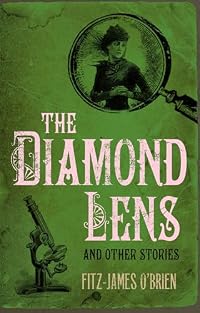
The Diamond Lens and Other Stories
by Fitz James O'Brien
On This Page
Description
An absorbing and haunting collection of early science fiction tales by an Irish-American author Fitz-James O'Brien capitalized on the success of his predecessors Edgar Allan Poe and Mary Shelley in writing disturbing stories with demented protagonists, and this collection of three tales shows his mastery of the macabre. "The Diamond Lens" tells of a lone scientist's discovery of a microcosmic world within a drop of water, and his growing obsession with the beautiful Animula, a fair maiden show more within this world which he can see but never enter. His uncompromising pursuit of knowledge at any cost foreshadows the mad scientist familiar to readers in a multitude of works. In "What Was It?" an invisible man is discovered by residents of a boarding house. The residents' capture and investigation of the creature blends the fantastic with the scientific as they seek rational explanations for this extraordinary phenomenon. "The Wondersmith" is a macabre tale of an embittered toymaker who seeks revenge upon the society that has persecuted him by creating demonic mannequins and imbuing them with life in order to slaughter the masses—a fantastic melodrama in which the cunning Wondersmith is offset by the unassuming and unlikely hero Solon the hunchback, in love with the villain's daughter. show lessTags
Member Reviews
Hesperus Press, dedicated to reviving forgotten authors and stories, has recently published this collection of three stories by Irish-American author Fitz-James O'Brien -- The Diamond Lens and Other Stories. Written in 1858 and 1859, these science fiction and horror tales have a unique feel of derangement and madness to them. Fans of Poe and of classic horror films will find something to enjoy in them. Even O'Brien's short life reads like an improbable story.
As I was reading The Diamond Lens, I couldn't help but mentally cast Vincent Price as the microscopist who will go to any lengths to further his craft and discover something nobody has yet seen. The story read like the script of an old Roger Corman film and I found myself laughing show more out loud in disbelief at the insanity of it. The influence of Poe was definitely felt in the unreliable first-person narration. The only drawback was the passing racism in the story as our narrator expounds on the qualities of his Jewish neighbor.
The Wondersmith is a different kettle of fish altogether as it falls squarely in the realm of horror and is also a big ball of racism. With both passing remarks denigrating Jews and Italians and actual racist themes regarding gypsies and the physically handicapped, this story was a bit harder to stomach. With malicious wooden mannikins, brought to life by a fortune teller who has collected evil souls in a black bottle, who are meant to murder Christian children on New Years' Day, this seems more like a story that was meant to enforce the stereotypes of the time. The introduction mentions this story as a possible precursor to the modern robot tale but I'm not sure it should be given so much weight. I can only hope that some of its original readers were put off by the over-the-top gypsy stereotypes.
What Was It? is labeled as "A Mystery" when it is actually one of the first invisibility stories. It is a bit of a rollercoaster ride as our narrator is also an opium smoker and, for a while, one isn't quite sure if his invisible attacker is real. Once the "mystery" is solved, the remainder of the story is strangely straightforward. It left me feeling a bit sad for the fate of the unknown creature.
I think this collection has its strengths and weaknesses and, though a bit distasteful, also has its place as early science fiction and horror.
http://webereading.com/2012/06/new-release-diamond-lens-and-other.html show less
As I was reading The Diamond Lens, I couldn't help but mentally cast Vincent Price as the microscopist who will go to any lengths to further his craft and discover something nobody has yet seen. The story read like the script of an old Roger Corman film and I found myself laughing show more out loud in disbelief at the insanity of it. The influence of Poe was definitely felt in the unreliable first-person narration. The only drawback was the passing racism in the story as our narrator expounds on the qualities of his Jewish neighbor.
The Wondersmith is a different kettle of fish altogether as it falls squarely in the realm of horror and is also a big ball of racism. With both passing remarks denigrating Jews and Italians and actual racist themes regarding gypsies and the physically handicapped, this story was a bit harder to stomach. With malicious wooden mannikins, brought to life by a fortune teller who has collected evil souls in a black bottle, who are meant to murder Christian children on New Years' Day, this seems more like a story that was meant to enforce the stereotypes of the time. The introduction mentions this story as a possible precursor to the modern robot tale but I'm not sure it should be given so much weight. I can only hope that some of its original readers were put off by the over-the-top gypsy stereotypes.
What Was It? is labeled as "A Mystery" when it is actually one of the first invisibility stories. It is a bit of a rollercoaster ride as our narrator is also an opium smoker and, for a while, one isn't quite sure if his invisible attacker is real. Once the "mystery" is solved, the remainder of the story is strangely straightforward. It left me feeling a bit sad for the fate of the unknown creature.
I think this collection has its strengths and weaknesses and, though a bit distasteful, also has its place as early science fiction and horror.
http://webereading.com/2012/06/new-release-diamond-lens-and-other.html show less
Ratings
Members
- Recently Added By
Author Information

56+ Works 373 Members
Work Relationships
Common Knowledge
- Disambiguation notice
- The Hesperus Press edition of The Diamond Lens and Other Stories collects "The Diamond Lens," "The Wondersmith," and "What Was It? A Mystery." Please do not combine with books collecting different stories.
Classifications
- Genres
- Fiction and Literature, Science Fiction, General Fiction, Horror
- DDC/MDS
- 813.3 — Literature & rhetoric American literature in English American fiction in English Middle 19th Century 1830-1861
- LCC
- PS2485 .D5 — Language and Literature American literature American literature Individual authors 19th century
- BISAC
Statistics
- Members
- 13
- Popularity
- 1,762,554
- Reviews
- 1
- Rating
- (3.17)
- Languages
- English
- Media
- Paper
- ISBNs
- 3