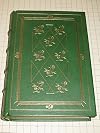
In This Our Life
by Ellen Glasgow
On This Page
Description
This early work by Ellen Glasgow is both expensive and hard to find in its first edition. It is a fictional story of two sisters and their trials and tribulations in love and life. This is a fascinating work and it eventually became a Hollywood movie starring Bette Davies.Tags
Recommendations













Member Reviews
My first Ellen Glasgow, of which I was very unsure at the outset, but which ended up leaving me bowled over. Parts of it went exactly where I expected, but there was a major twist that I had not expected, and that one told me everything about who these characters really were.
It was a very hard look at one family and how they affected one another, their struggles for happiness against the odds, and the different ways they brought on or dealt with suffering. What looked like a side story in the beginning of the novel became a major element, and it was this that propelled it from a mediocre look at these people to a work of worth and substance. I’d deem Ellen Glasgow as clever indeed.
Published in 1941, Glasgow also paints an show more excruciatingly vivid picture of the complicated race relations of the time. If I have ever encountered a realistic picture of how double-sided and confusing the Southern relationship between blacks and whites could be, I found it here. Asa Timberlake is not Atticus Finch, but he is a man of conscious who feels genuine love and respect for the women who have served his family for generations and is unwilling to discount a black life as if it had no value. The attitudes of the others around him are often disgustingly apathetic if not downright evil.
There is every kind of human emotion portrayed in these pages: greed, lust, mendacity, betrayal, self-sacrifice, resentment, and destructive indulgence. There are characters you cannot help despising, some you cannot help wishing better things for, and some who are too small and mean to even merit your concern. Mostly you root for escape for those who deserve it, but how does one escape a family, or a society, or a time such as this? Would you believe the hope that seems to loom is the beginning of a World War that will rock the foundations? The characters do not know, but we do, that this world is about to change...and not a moment too soon. show less
It was a very hard look at one family and how they affected one another, their struggles for happiness against the odds, and the different ways they brought on or dealt with suffering. What looked like a side story in the beginning of the novel became a major element, and it was this that propelled it from a mediocre look at these people to a work of worth and substance. I’d deem Ellen Glasgow as clever indeed.
Published in 1941, Glasgow also paints an show more excruciatingly vivid picture of the complicated race relations of the time. If I have ever encountered a realistic picture of how double-sided and confusing the Southern relationship between blacks and whites could be, I found it here. Asa Timberlake is not Atticus Finch, but he is a man of conscious who feels genuine love and respect for the women who have served his family for generations and is unwilling to discount a black life as if it had no value. The attitudes of the others around him are often disgustingly apathetic if not downright evil.
There is every kind of human emotion portrayed in these pages: greed, lust, mendacity, betrayal, self-sacrifice, resentment, and destructive indulgence. There are characters you cannot help despising, some you cannot help wishing better things for, and some who are too small and mean to even merit your concern. Mostly you root for escape for those who deserve it, but how does one escape a family, or a society, or a time such as this? Would you believe the hope that seems to loom is the beginning of a World War that will rock the foundations? The characters do not know, but we do, that this world is about to change...and not a moment too soon. show less
In This Our Life is one of the last Pulitzers I had left to read. It’s taken me this long because the book is out of print and there aren’t a ton of copies available. Really, this is not surprising given how utterly boring the book is.
There’s both a lot going on in the story and also not much of anything. I really just couldn’t muster two licks of giving a shit about these privileged, whiny characters. They did seem to be even more bored with their own lives than I was, which is saying something because god damn was I bored with them.
Each of the characters had their own internal struggles, most of which revolved around reconciling what one wants to do with what one must or should do. Certainly not a new theme, but one that is show more interesting and universal enough. That is, if you are at all interested in the characters.
Really what best demonstrates my experience with this book is when I realized there were about 20 pages missing from the middle of the book and apparently nothing of import happened in those pages, because it picked up pretty much in the same place it was before the pages went missing.
Obviously, I would not recommend this book. show less
There’s both a lot going on in the story and also not much of anything. I really just couldn’t muster two licks of giving a shit about these privileged, whiny characters. They did seem to be even more bored with their own lives than I was, which is saying something because god damn was I bored with them.
Each of the characters had their own internal struggles, most of which revolved around reconciling what one wants to do with what one must or should do. Certainly not a new theme, but one that is show more interesting and universal enough. That is, if you are at all interested in the characters.
Really what best demonstrates my experience with this book is when I realized there were about 20 pages missing from the middle of the book and apparently nothing of import happened in those pages, because it picked up pretty much in the same place it was before the pages went missing.
Obviously, I would not recommend this book. show less
Asa is the long-suffering husband of Lavinia. He never loved her and is financially dependent on her wealthy uncle, William. Asa has two young daughters, Stanley and Roy (I never figured out why they have male names). Roy is married to Peter and Stanley is engaged to Craig. Stanley breaks her engagement with Peter and elopes with her sister's husband. Roy and Craig strike up a relationship and talk about getting married. Peter eventually commits suicide and Craig confesses he still loves Stanley but wants Roy to "rescue" him from her. All Asa wants is his daughters to be happy. He relates to and loves Roy to pieces unlike his feelings toward Stanley.
It's a story of the generational contrasts of the attitudes about marriage and the show more commitment to relationships. I found the plot drawn-out and repetitive. A middle-of-the-road Pulitzer. show less
It's a story of the generational contrasts of the attitudes about marriage and the show more commitment to relationships. I found the plot drawn-out and repetitive. A middle-of-the-road Pulitzer. show less
550. In This Our Life by Ellen Glasgow (read 12 Aug 1958) (Pulitzer fiction prize for 1942) I was reading the books which won the Pulitzer prize for fiction, and this won for 1942, so I read it. I did no post-reading note and I had quit keeping a diary so what I thought of it is, sadly, lost to history.
Ratings
Members
- Recently Added By
Lists

Pulitzer Prize Winners for Fiction
102 works; 54 members
Author Information

40+ Works 1,403 Members
Ellen Anderson Gholson Glasgow (April 22, 1873 -November 21, 1945) was an American novelist who portrayed the changing world of the contemporary south. Glasgow was born in Richmond, Virginia, of a mother who traced her ancestry to the Cavalier settlers of Tidewater Virginia and a father who descended from the Scotch-Irish of the Shenandoah Valley. show more She was a writer whose divided background helps explain her ability to combine romantic sensibility with tough-minded realism. For the Virginia Edition of her works, published by Scribner in 1938 and now out of print, she chose 12 of her 18 novels and divided them into two main groups. What she called "novels of character and comedies of manners" consist of five works: The Battle-Ground (1902); The Deliverance (1904); They Stooped to Folly (1929); Virginia (1913); and Barren Ground (1925). The remaining seven novels she grouped under the heading "social history in the form of fiction." Covering almost 100 years of life in the Old Dominion, they are perhaps better read in historical sequence rather than the order in which they were originally published: The Miller of Old Church (1911); The Romantic Comedians (1926); The Voice of the People (1900); The Romance of a Plain Man (1909); Life and Gabriella (1916); The Sheltered Life (1932); and Vein of Iron (1935). The new prefaces that she wrote for each volume of the Virginia Edition form a valuable record of her literary growth and a treatise on novel writing that compares favorably with the prefaces that Henry James wrote for the New York Edition of his works. With the addition of an introduction to the one novel she published subsequently, the Pulitzer Prize-winning In This Our Life (1941), these prefaces were brought together and published as A Certain Measure (1943). The Woman Within (1954), her own story of her inner life, parallels her fiction in its account of a courageous woman who refused to become a victim of the outmoded codes of chivalry and male domination that characterized the Old South of her heritage. She remains a transitional figure of considerable importance in the literary history of America. (Bowker Author Biography) show less
Awards and Honors
Awards
Work Relationships
Has the adaptation
Common Knowledge
- Canonical title
- In This Our Life
- Original title
- In This Our Life
- Original publication date
- 1941
- Related movies
- In This Our Life (1942 | IMDb)
- Epigraph
- Your creeds are dead, your rites are dead,
Your social order too!
Where tarries he, the Power who said:
"See, I make all things new?" - First words
- The street was darkened by a smoky sunset, and light had not yet come on in the lamps near the empty house.
- Last words
- (Click to show. Warning: May contain spoilers.)Still ahead, and within sight, but just out of reach, and always a little farther away, fading, but not ever disappearing, was freedom.
Classifications
Statistics
- Members
- 204
- Popularity
- 159,456
- Reviews
- 4
- Rating
- (3.30)
- Languages
- English, Italian
- Media
- Paper, Ebook
- ISBNs
- 6
- ASINs
- 12