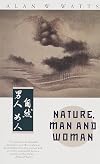
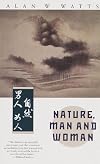
Nature, Man and Woman
by Alan W. Watts
On This Page
Description
A poetic examination of nature, humanity and spirituality by pioneering Zen scholar Alan Watts. To be forever looking beyond is to remain blind to what is here. In this engaging and enduring work, pioneering Zen scholar Alan Watts examines humanity's place in the natural world and the spirit's connection to the body. Drawing on the precepts of Taoism, Watts offers an alternative vision of our place in the universe that will revolutionise the way you think, feel and live.Tags
Recommendations
























Member Reviews
The human animal, can justly be described as a tangle of non-sense, and that certainly seems so whilst observing anyone. Alan W. Watts takes his vast knowledge of world theologies, and an intensely introspective philosophy that reveals Man's alienation from nature, Woman, and himself.
Maybe the most dense of Watts' books. Beautiful ideas. Need to reread.
From the back-cover blurb:
"Mr. Watts discusses the origins of [human] alienation from nature in Christianity and Western thought, contrasted with the Chinese philosophy of the Tao and its vision of nature as an organic whole in which man is fully included and feels at home."
According to "Eastern Philosophy" or "Mysticism," the root of the alienation is not Christianity or Western thought, but instead the conscious, or "rational," mind. And it doesn't reject mind as being "unnatural".
That's why China and all the other Eastern countries in which Buddhism, and Taoism, etc., are practiced are utopias, while the West is a broken down ghetto suffused with anxiety over losing one's material goods.
"Mr. Watts discusses the origins of [human] alienation from nature in Christianity and Western thought, contrasted with the Chinese philosophy of the Tao and its vision of nature as an organic whole in which man is fully included and feels at home."
According to "Eastern Philosophy" or "Mysticism," the root of the alienation is not Christianity or Western thought, but instead the conscious, or "rational," mind. And it doesn't reject mind as being "unnatural".
That's why China and all the other Eastern countries in which Buddhism, and Taoism, etc., are practiced are utopias, while the West is a broken down ghetto suffused with anxiety over losing one's material goods.
Ratings
Members
- Recently Added By
Published Reviews
Book was dedicated to Jean Burden as Alan tells us on page 297 of his biography. In the footnote of " In My Own. Way,"he refers to the " dedicatory poem." This poem is written for Jean Burden, an important poetic voice from that era.
added by sndymorn
Lists

Used books to buy next
565 works; 1 member
Author Information

224+ Works 17,201 Members
Alan Watts (1915-1973) was a renowned lecturer and the author of nearly thirty books, including The Way of Zen and The Book. Born in Chislehurst, England, he moved to the United States in 1938 and began Zen training in New York. He received a master's degree in theology from Seabury-Western Theological Seminary and served as an Episcopal priest show more before leaving the ministry in 1950 to move to California, where he joined the faculty of the American Academy of Asian Studies (now the California Institute of Integral Studies). show less
Common Knowledge
- Original publication date
- 1958
Classifications
- Genres
- Nonfiction, Religion & Spirituality, Philosophy, General Nonfiction
- DDC/MDS
- 200.1 — Religion The Bible & Christianity Religion Systems, scientific principles, psychology of religion, philosophy and religion
- LCC
- BL51 .W3713 — Philosophy, Psychology and Religion Religions. Mythology. Rationalism Religions. Mythology. Rationalism Philosophy of religion. Psychology of religion. Religion
- BISAC
Statistics
- Members
- 613
- Popularity
- 47,553
- Reviews
- 3
- Rating
- (4.08)
- Languages
- English, French, German, Latin
- Media
- Paper, Audiobook, Ebook
- ISBNs
- 12
- ASINs
- 15