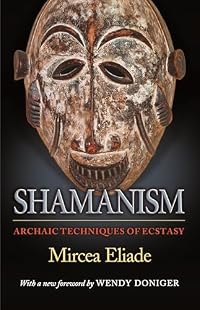
Shamanism: Archaic Techniques of Ecstasy
by Mircéa Eliade
On This Page
Description
First published in 1951, this book soon became the standard work in the study of this mysterious and fascinating phenomenon. Writing as the founder of the modern study of the history of religion, Romanian--scholar Mircea Eliade (1907-1986) surveys the practice of Shamanism over two and a half millennia of human history, moving from the Shamanic traditions of Siberia and Central Asia--where Shamanism was first observed--to North and South America, Indonesia, Tibet, China, and beyond. In this show more authoritative survey, Eliade illuminates the magico-religious life of societies that give primacy of place to the figure of the Shaman--at once magician and medicine man, healer and miracle-doer, priest, mystic, and poet. Synthesizing the approaches of psychology, sociology, and ethnology, this work will remain for years to come the reference book of choice for those intrigued by this practice. show lessTags
Recommendations







































Member Recommendations

by anonymous user
Member Reviews
This is the definitive account of Shamanism, and a feat of aggregating world knowledge along the lines of Joseph Campbell and Fraser, although more scholarly (and probably accurate). While it might be tough sledding, it is the worth the expenditure .Not only are we given the importance of the three cosmic zones but also the Shamanistic approaches to navigating them. We are also told about the Center of the World, the path of navigation but most fascinating to me was the almost universal concern among all humans with how to recall the souls of the dead. And in each of these Eliade can very thoroughly track their particular manifestations in societies throughout the world, though his starting place is Siberia. The other linking premise is show more that the journey of the Shaman is different from possession, it is something that must be learned and there is, inevitably, an initiation though there is some variety culturally between those who have inherited the gift of the spirit language and those who were called. As the title says, ecstasy is the key differentiator between the shaman and the witch, magician or fakir. If this subject interests you, this is the mother lode. Look no further. show less
A brilliant reference book on the inner practices and history of the same ...
Very well researched, well indexed, well footnoted.
Our current culture may have some technological advantages yet has to play catch-up to what has gone before, and this book is a great start to that.
When preceding cultures are ignored due to the current narratives then we miss out in the overall scheme of history.
This book fills the gaps in role of expanding understandings in Conscious-Conscious-ness in so many ways.
Very well researched, well indexed, well footnoted.
Our current culture may have some technological advantages yet has to play catch-up to what has gone before, and this book is a great start to that.
When preceding cultures are ignored due to the current narratives then we miss out in the overall scheme of history.
This book fills the gaps in role of expanding understandings in Conscious-Conscious-ness in so many ways.
A brilliant reference book on the inner practices and history of the same ...
Very well researched, well indexed, well footnoted.
Our current culture may have some technological advantages yet has to play catch-up to what has gone before, and this book is a great start to that.
When preceding cultures are ignored due to the current narratives then we miss out in the overall scheme of history.
This book fills the gaps in role of expanding understandings in Conscious-Conscious-ness in so many ways.
Very well researched, well indexed, well footnoted.
Our current culture may have some technological advantages yet has to play catch-up to what has gone before, and this book is a great start to that.
When preceding cultures are ignored due to the current narratives then we miss out in the overall scheme of history.
This book fills the gaps in role of expanding understandings in Conscious-Conscious-ness in so many ways.
First published in 1951, Shamanism soon became the standard work in the study of this mysterious and fascinating phenomenon. Writing as the founder of the modern study of the history of religion, Romanian émigré--scholar Mircea Eliade (1907-1986) surveys the practice of Shamanism over two and a half millennia of human history, moving from the Shamanic traditions of Siberia and Central Asia--where Shamanism was first observed--to North and South America, Indonesia, Tibet, China, and beyond. In this authoritative survey, Eliade illuminates the magico-religious life of societies that give primacy of place to the figure of the Shaman--at once magician and medicine man, healer and miracle-doer, priest, mystic, and poet. Synthesizing the show more approaches of psychology, sociology, and ethnology, Shamanism will remain for years to come the reference book of choice for those intrigued by this practice.
"synopsis" may belong to another edition of this title. show less
"synopsis" may belong to another edition of this title. show less
The first work to treat shamanism in a comprehensive, scholarly way.
The foundational work on shamanism now available as a Princeton Classics paperback
Shamanism is an essential work on the study of this mysterious and fascinating phenomenon. The founder of the modern study of the history of religion, Mircea Eliade surveys the tradition through two and a half millennia of human history, moving from the shamanic traditions of Siberia and Central Asia—where shamanism was first observed—to North and South America, Indonesia, Tibet, China, and beyond. In this authoritative survey, Eliade illuminates the magico-religious life of societies that give primacy of place to the figure of the shaman—at once magician and medicine man, healer and miracle-doer, priest, mystic, and poet. Synthesizing the approaches show more of psychology, sociology, and ethnology, Shamanism remains the reference book of choice for those interested in this practice.
Source: Princeton University Press, 2020 Edition show less
Shamanism is an essential work on the study of this mysterious and fascinating phenomenon. The founder of the modern study of the history of religion, Mircea Eliade surveys the tradition through two and a half millennia of human history, moving from the shamanic traditions of Siberia and Central Asia—where shamanism was first observed—to North and South America, Indonesia, Tibet, China, and beyond. In this authoritative survey, Eliade illuminates the magico-religious life of societies that give primacy of place to the figure of the shaman—at once magician and medicine man, healer and miracle-doer, priest, mystic, and poet. Synthesizing the approaches show more of psychology, sociology, and ethnology, Shamanism remains the reference book of choice for those interested in this practice.
Source: Princeton University Press, 2020 Edition show less
ability to travel in spirit world for knowledge and locating lost spirits, etc. core of shamanism, use of drugs and dance sign of decadence, shares techniques and lore with other types of magical practitioners
Members
- Recently Added By
Lists

Jordan B. Peterson's Recommended Books
104 works; 5 members

Nonordinary States of Consciousness
184 works; 6 members

Books in the Bibliography of The Mind in the Cave by David Lewis-Williams
257 works; 1 member

Books in the Bibliography of The Illusion of Conscious Will by Daniel Wegne
273 works; 1 member
Author Information

386+ Works 17,033 Members
Born in Bucharest, Rumania, Mircea Eliade studied at the University of Bucharest and, from 1928 to 1932, at the University of Calcutta with Surendranath Dasgupta. After taking his doctorate in 1933 with a dissertation on yoga, he taught at the University of Bucharest and, after the war, at the Sorbonne in Paris. From 1957, Eliade was a professor show more of the history of religions at the University of Chicago. He was at the same time a writer of fiction, known and appreciated especially in Western Europe, where several of his novels and volumes of short stories appeared in French, German, Spanish, and Portuguese. Two Tales of the Occult "to relate some yogic techniques, and particularly yogic folklore, to a series of events narrated in the genre of a mystery story." Both Nights of Serampore and The Secret of Dr. Honigberger evoke the mythical geography and time of India. Mythology, fantasy, and autobiography are skillfully combined in Eliade's tales. (Bowker Author Biography) show less
Some Editions
Series
Belongs to Publisher Series
Common Knowledge
- Canonical title
- Shamanism: Archaic Techniques of Ecstasy
- Original title
- Le chamanisme et les techniques archaïques de l'extase
- Original publication date
- 1951 (French) (French); 1957 (German) (German); 1964 (English) (English)
- First words
- Since the beginning of the century, ethnologists have fallen into the habit of using the terms "shaman," "medicine man," "sorcerer," and "magician" interchangeably to designate certain individuals possessing magico-religious ... (show all)powers and found in all "primitive" societies.
- Last words
- (Click to show. Warning: May contain spoilers.)What a magnificent book remains to be written on the ecstatic "sources" of epic and lyric poetry, on the prehistory of dramatic spectacles, and, in general, on the fabulous worlds discovered, explored, and described by the ancient shamans. . . .
- Original language
- French
Classifications
- Genres
- Anthropology, Religion & Spirituality, Nonfiction, General Nonfiction, History
- DDC/MDS
- 201.44 — Religion The Bible & Christianity Religious mythology, general classes of religion, interreligious relations and attitudes, social theology General classes of religion Shamanism
- LCC
- BL2370 .S5 .E413 — Philosophy, Psychology and Religion Religions. Mythology. Rationalism Religions. Mythology. Rationalism History and principles of religions Asian. Oriental
- BISAC
Statistics
- Members
- 1,304
- Popularity
- 18,469
- Reviews
- 17
- Rating
- (4.01)
- Languages
- 13 — Czech, English, Estonian, French, German, Hungarian, Italian, Norwegian (Bokmål), Polish, Portuguese, Romanian, Spanish, Turkish
- Media
- Paper, Ebook
- ISBNs
- 32
- ASINs
- 17