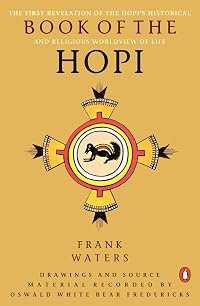
Book of the Hopi
by Frank Waters
On This Page
Description
The secrets of the Hopi "road of life" revealed for the first time in written form In this strange and wonderful book, thirty elders of the ancient Hopi tribe of Northern Arizona--a people who regard themselves as the first inhabitants of America--freely reveal the Hopi worldview for the first time in written form. The Hopi kept this view a secret for countless centuries, and anthropologists have long struggled to understand it. Now they record their myths and legends, and the meaning of show more their religious rituals and ceremonies as a gift to future generations. Here is a reassertion of a rhythm of life we have disastrously tried to ignore and instincts we have tragically repressed, and a reminder that we must attune ourselves to the need for inner change if we are to avert a cataclysmic rupture between our minds and hearts. show lessTags
Recommendations






































Member Reviews
This book is one of the classics of anthropological research. It is one of the few complete resources you will find on the Hopi mythologies, including how that mythology leads to the lives they live today. From that standpoint, it is one of the best books in its field.
However, the book suffers from two major flaws. (Flaws that have resulted in many detractors in the past.) The first is that the author seems to impose a Judeo-Christian mythos over the stories he has heard. The origin stories and the “Great White Brother” concept (one that does indeed run through many other tribe’s stories) seem to have a spin on them, as if the author wants us to see just how closely these align to our beliefs. The second is that the author has show more definitely lost his objectivity. Of course he sides with the Hopis in any story involving the Navajos. But he even goes so far as to side with different Hopi villages when their stories or beliefs may diverge.
But that only means what is told here needs to be taken with a grain of salt. The mere fact that the author may have lost his researcher’s objectivity does not take away from the fact that this is an incredible collection that pulls together so much of what makes the Hopis the unique tribe they are. And, though the author tries too hard to make the point, it is apparent that the Hopi have been a part of the greater expanse of tribes that have lived in the Americas far into the past.
At times it is dry and scholarly. Other times the author repeats himself. And other times there are just too many details. But read past the author’s inability to pull his own preconceived notion out of the narrative, and you will find an intriguing mythology that few people are lucky enough to share. show less
However, the book suffers from two major flaws. (Flaws that have resulted in many detractors in the past.) The first is that the author seems to impose a Judeo-Christian mythos over the stories he has heard. The origin stories and the “Great White Brother” concept (one that does indeed run through many other tribe’s stories) seem to have a spin on them, as if the author wants us to see just how closely these align to our beliefs. The second is that the author has show more definitely lost his objectivity. Of course he sides with the Hopis in any story involving the Navajos. But he even goes so far as to side with different Hopi villages when their stories or beliefs may diverge.
But that only means what is told here needs to be taken with a grain of salt. The mere fact that the author may have lost his researcher’s objectivity does not take away from the fact that this is an incredible collection that pulls together so much of what makes the Hopis the unique tribe they are. And, though the author tries too hard to make the point, it is apparent that the Hopi have been a part of the greater expanse of tribes that have lived in the Americas far into the past.
At times it is dry and scholarly. Other times the author repeats himself. And other times there are just too many details. But read past the author’s inability to pull his own preconceived notion out of the narrative, and you will find an intriguing mythology that few people are lucky enough to share. show less
I read this as a teenager, and the world view of the Hopi's affected me deeply enough at the time to consider running away from home. It was probably one of the major catalyst's to me to think about other cultures in a way that wasn't presented to us in the western world at the time via the media. (which was typically racist and demeaning).
Nothing to do with baskets. Classic and popular book about Hopi culture, religion and history by Frank Waters. Somewhat disputed by anthropologists of the day. Entertaining and inspiring and no doubt popular among the 1970s remnant of 1960s culture.
1. In this "strange and wonderful book," some thirty elders of the ancient Hopi tribe of Northern Arizona freely reveal for the first time in written form the Hopi world-view of life. The Hopis have kept this view a secret for countless generations, and this book was made possible only as a result of their desire to record for future generations the principles of their "Road of Life." The breaking of the Hopi silence is significant and fascinating because for the first time anthropologists, ethnologists, and everyone interested in the field of Indian study have been given rich material showing the Hopi legends, the meaning of their religious rituals and ceremonies, and the beauty of a conception of life within the natural world that is show more completely untouched by materialistic worlds Source: GoodReads
2. "Only a person as deeply steeped in Hopi mysticism as the Hopis themselves could have produced this volume. Mr. Waters and Mr. Fredericks have approached the task of combining Hopi art, history, tradition, myth, folklore, and ceremonialism with dignity and authority.... Deserves to be part of the library of any student of the American Southwest."
SOURCE: American Anthropologist show less
2. "Only a person as deeply steeped in Hopi mysticism as the Hopis themselves could have produced this volume. Mr. Waters and Mr. Fredericks have approached the task of combining Hopi art, history, tradition, myth, folklore, and ceremonialism with dignity and authority.... Deserves to be part of the library of any student of the American Southwest."
SOURCE: American Anthropologist show less
The US should try to emulate the Hopi.
History and culture of the Hopi Indians
Recommended by my native American friend as an excellent source for understanding the historical and religious views of the ancestral puebloans.
Members
- Recently Added By
Author Information

31+ Works 2,271 Members
Frank Waters was born in July 1902 in Colorado Springs, Colorado. He is an author of novels and historical works about the American Southwest. His first novel after college was entitled Fever Pitch (1930). He then wrote a series of autobiographical novels beginning with The Wild Earth's Nobility (1935). In 1936, Waters left L.A. and moved back and show more forth between Colorado and New Mexico, continuing to write and completing a biography of W. S. Stratton, Midas of the Rockies. When World War II broke out, Waters moved to Washington, D.C. to work for the Office of the Coordinator of Inter-American Affairs. There, he performed the duties of a propaganda analyst and chief content officer. Waters' masterpiece, The Man Who Killed the Deer, was published in 1942. In 1953, Waters was awarded the Taos Artists Award for Notable Achievement in the Art of Writing. Waters also held positions as information consultant for Los Alamos Scientific Laboratory, New Mexico. He established the Frank Waters Foundation in 1993 which is a nonprofit organization with the goal of promoting the arts, specifically those in the spirit of the creativity of Frank Waters. The members of the FWF operate under the motto "Sheltering the creative spirit", by providing a retreat for artists to live and work among the Sangre de Cristo Mountains. Frank Waters died at his home in Arroyo Seco on June 3, 1995. (Bowker Author Biography) show less
All Editions
Common Knowledge
- Original publication date
- 1963
- Important places
- Arizona, USA; New Mexico, USA; Colorado, USA; Utah, USA; Tibet; Grand Canyon National Park, Arizona, USA (show all 10); Arctic Regions; San Francisco Peaks, Arizona, USA; Mexico; Aztec Empire
- Important events
- Saquasohuh; Railroads; Florentine Codex
- Epigraph
- There is no such thing as a little country. The greatness of a people is no more determined by their number than the greatness of a man is determined by his height. —Victor Hugo
- First words
- Introduction
This is a strange and wonderful book.
Foreword
Laurens Van Der Post, gifted writer and perceptive student of humanity, has deplored the loss to our society of the whole natural language of the spirit, with the result that we no longer have a certain basic sens... (show all)e of proportion.
The first world was Tokpela (Endless Space). - Quotations
- There is no such thing as a little country.
- Last words
- (Click to show. Warning: May contain spoilers.)It is an effort on the part of a small nation that could well be emulated by greater nations in the shrinking time before this one small planet extends its pattern of unity or disunity to still more planets in outer space—a prelude to another Emergence to another stage of evolutionary development along our common and continuing Road of Life
Classifications
- Genres
- Anthropology, Nonfiction, History, Religion & Spirituality, General Nonfiction
- DDC/MDS
- 970.00497 — History & geography History of North America History of North America North America Ethnic and National Groups Native Americans
- LCC
- E99 .H7 .W3 — History of the United States America Indians of North America Indian tribes and cultures
- BISAC
Statistics
- Members
- 1,044
- Popularity
- 24,770
- Reviews
- 9
- Rating
- (3.64)
- Languages
- 5 — English, French, German, Japanese, Spanish
- Media
- Paper, Ebook
- ISBNs
- 13
- ASINs
- 14