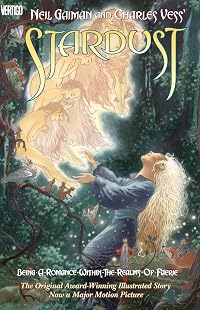
On This Page
Description
In a Victorian-era tale of magic and romance, young Tristran Thorn falls in love with the town beauty and must go on an incredible coming-of-age journey in order to capture her heart. Living in the small countryside town of Wall, one night Tristran vows to his beloved to retrieve a fallen star that they witnessed crashing down from the heavens. Now, to gain his love's hand, he must leave behind his home and embark on a journey that will define the meaning of true love. Told through show more breathtaking painted illustrations, this fairy tale for adults is a true masterpiece in storytelling. show lessTags
Recommendations



Member Recommendations
Member Reviews
The more I read of Gaiman, the more convinced I am that he is the logical successor to Ray Bradbury.
Both Bradbury and Gaiman have such a loving touch with their characters, that it just shines through the marks on the page to become something real, something you know and understand intuitively in your own mind.
And like Bradbury, there are times when the reader can tell when they fell a bit too much in love with certain characters or story elements and stay with them a touch too long, as Gaiman did here.
Regardless, like the Sandman series, like [b:The Ocean at the End of the Lane|15783514|The Ocean at the End of the Lane|Neil show more Gaiman|https://i.gr-assets.com/images/S/compressed.photo.goodreads.com/books/1497098563l/15783514._SY75_.jpg|21500681], like [b:The Graveyard Book|2213661|The Graveyard Book|Neil Gaiman|https://i.gr-assets.com/images/S/compressed.photo.goodreads.com/books/1531295292l/2213661._SY75_.jpg|2219449], and like so much of Gaiman's other work, this is simply magical, endearing, and an absolute pleasure to read.
Nobody else is doing what Gaiman does. show less
Both Bradbury and Gaiman have such a loving touch with their characters, that it just shines through the marks on the page to become something real, something you know and understand intuitively in your own mind.
And like Bradbury, there are times when the reader can tell when they fell a bit too much in love with certain characters or story elements and stay with them a touch too long, as Gaiman did here.
Regardless, like the Sandman series, like [b:The Ocean at the End of the Lane|15783514|The Ocean at the End of the Lane|Neil show more Gaiman|https://i.gr-assets.com/images/S/compressed.photo.goodreads.com/books/1497098563l/15783514._SY75_.jpg|21500681], like [b:The Graveyard Book|2213661|The Graveyard Book|Neil Gaiman|https://i.gr-assets.com/images/S/compressed.photo.goodreads.com/books/1531295292l/2213661._SY75_.jpg|2219449], and like so much of Gaiman's other work, this is simply magical, endearing, and an absolute pleasure to read.
Nobody else is doing what Gaiman does. show less
Young Tristran Thorn (who's birth is maybe not as...aboveboard...as Victorian society would like) is desperately in love with Victoria Forester. He screws up his courage one night to ask her to kiss him or marry him or just--something! He is met with laughter. In desperation, he offers to slay dragons and bring back treasures for her, each adventure more outlandish than the last. Finally, as they see a shooting star, he offers to bring back the fallen star for her.
She accepts.
And so Tristran goes over the Wall for which his village is named and into Fairyland.
Tristran is woefully unprepared for what he finds there, but he's an adaptable boy. Maybe suspiciously adaptable? He finds the star and sets off with her toward home and Victoria. show more That's right--her. In fairyland, the stars are beautiful young women. Tristran's particular star is named Yvaine, and she is unwilling to help him on his quest for true love. Other, more sinister, people are looking for her as well, and many an adventure and near-miss follow.
I have loved this book since I first read it when it was a new book at my local library. I had to have my own copy, and this has to be at least the third or fourth time I've re-read it.
I love the adventure and the unexpected romance, the ghosts of Stormhold, the desperate witch, the humor, the quirky inhabitants of Fairy, and the way that wishes granted rarely turn out as we expect. Tristran grows so much as a character. He goes from a shallow boy whose head is turned by a beautiful face, to a man who places others' happiness before his own. He follows Gaiman's own [b:Instructions|7023148|Instructions|Neil Gaiman|http://photo.goodreads.com/books/1301656636s/7023148.jpg|7269944] about offering aid or accepting help as the situation dictates and finds that things usually turn out for the best that way.
Part of me wishes that Gaiman would go back and fill in some of Tristran's adventures that are only hinted at in the epilogue. Who can resist a story that is summed up with, "Have been unavoidably detained by the world." Intriguing, right? I want to know where he's been in the world and what he's seen. But the rest of me thinks that this book is just perfect the way it is and I don't want it to become a story that is ruined by later installments.
This was my first time reading the Charles Vess edition. Oh my goodness. It is gorgeous. I personally wouldn't really call it a graphic novel. That, to me, implies panels and dialog bubbles. This was more of an illustrated novel. I adore Vess's artwork. His detailed paintings are a delight to pore over. I was fortunate to meet him at an artist signing when his collection, [b:Drawing Down the Moon|741951|Drawing Down the Moon The Art of Charles Vess |Charles Vess|http://photo.goodreads.com/books/1277039786s/741951.jpg|728116], was published. He was very nice and I loved hearing him talk about his work. He talked a little about this book, and pointed out some details that I might have rushed over in my eagerness to read the story. Since I knew to look out for the details, I took my time and enjoyed each illustration as its own piece of art. (Hint: look for Gaiman himself in the first fairy market scene. You can take it from there.)
I love this story, and Vess' illustrations just increased my love for it. I highly recommend it. show less
She accepts.
And so Tristran goes over the Wall for which his village is named and into Fairyland.
Tristran is woefully unprepared for what he finds there, but he's an adaptable boy. Maybe suspiciously adaptable? He finds the star and sets off with her toward home and Victoria. show more That's right--her. In fairyland, the stars are beautiful young women. Tristran's particular star is named Yvaine, and she is unwilling to help him on his quest for true love. Other, more sinister, people are looking for her as well, and many an adventure and near-miss follow.
I have loved this book since I first read it when it was a new book at my local library. I had to have my own copy, and this has to be at least the third or fourth time I've re-read it.
I love the adventure and the unexpected romance, the ghosts of Stormhold, the desperate witch, the humor, the quirky inhabitants of Fairy, and the way that wishes granted rarely turn out as we expect. Tristran grows so much as a character. He goes from a shallow boy whose head is turned by a beautiful face, to a man who places others' happiness before his own. He follows Gaiman's own [b:Instructions|7023148|Instructions|Neil Gaiman|http://photo.goodreads.com/books/1301656636s/7023148.jpg|7269944] about offering aid or accepting help as the situation dictates and finds that things usually turn out for the best that way.
Part of me wishes that Gaiman would go back and fill in some of Tristran's adventures that are only hinted at in the epilogue. Who can resist a story that is summed up with, "Have been unavoidably detained by the world." Intriguing, right? I want to know where he's been in the world and what he's seen. But the rest of me thinks that this book is just perfect the way it is and I don't want it to become a story that is ruined by later installments.
This was my first time reading the Charles Vess edition. Oh my goodness. It is gorgeous. I personally wouldn't really call it a graphic novel. That, to me, implies panels and dialog bubbles. This was more of an illustrated novel. I adore Vess's artwork. His detailed paintings are a delight to pore over. I was fortunate to meet him at an artist signing when his collection, [b:Drawing Down the Moon|741951|Drawing Down the Moon The Art of Charles Vess |Charles Vess|http://photo.goodreads.com/books/1277039786s/741951.jpg|728116], was published. He was very nice and I loved hearing him talk about his work. He talked a little about this book, and pointed out some details that I might have rushed over in my eagerness to read the story. Since I knew to look out for the details, I took my time and enjoyed each illustration as its own piece of art. (Hint: look for Gaiman himself in the first fairy market scene. You can take it from there.)
I love this story, and Vess' illustrations just increased my love for it. I highly recommend it. show less
Having read the novel and watched the film versions of this story many times I was not surprised at all by the multiple plot twists, but I still found the graphic novel to be quite charming. Gaiman's prose is typically elegant (if slightly more terse than the novel due to space constraints) and is complemented well by Vess' illustrations. Together the two make up one wonderful story that could really only be improved by an overall lengthening; we all want more of Tristran's and Yvaine's adventures after all!
One of my favorites, now. I saw the movie and thought it was wonderfully fun (very like the Princess Bride in tone and scope) and whimsical, so I thought I'd buy the book and read it. Though the movie and book diverge on several major plot points, I think the movie certainly captured the spirit of the Gaiman/Vess novel. Books are always better to readers, and Stardust is no exception to that rule. I spent a few, lovely hours curled up reading about Tristran and Yvaine, laughing, loving Gaiman's careful prose (so unusual in the Fantasy genre) and philosophical wisdom. Here is a man who has, himself, read much and suffered much. His writing gets beyond plot and seeks to illuminate what makes us human: desire for love, sex, adventure, fear show more of aging, fear of death, and loss. I'm on my way to the bookstore to stock up on Gaiman's works--I've clearly been avoiding him for too long. show less
One of Neil Gaiman's recurring themes that works so well in his hands is the art and significance of storytelling. The Sandman followed Morpheus, the embodiment of "dream," to that ever elusive place, full of baffling realms our imaginations take us to, and the threshold of inspiration for those who tell stories. Stardust follows a vein of thought within this realm of dreams (Faerie, to be precise), and although it reads at times like a parody of classic western fairy-tale lore, overall it proves to be a celebration, a tribute, and a whole new legend worthy of Gaiman's authorship.
Beyond it's intentionally cliche (but in such a delicate way..) coming of age theme, the story takes unexpected and original turns every new chapter, tipping show more its hat to formulas of similar stories, but in the end striving to blaze its own path, even if the author shows a bit of pretention in the process. Just as the narrative threatened to lose this reader's interest with uncharacteristically long bits of meticulous description, the story's originality and charm allow it to recover nicely and deliver some of its delicious doses of unreality.
The illustrations are often beautiful companions to the story, incurring a sort of childish wonder at whimsical venues and characters, while sometimes delivering shocking images to emphasize moments in the story that would have scared the shit out of you as a child (well, me anyway..). This is the next step in maturity for those of us who were captivated and elevated by fantasy as young readers, listeners, observers of tales which challenge the depth of our imaginations, but do not insult our intelligence. show less
Beyond it's intentionally cliche (but in such a delicate way..) coming of age theme, the story takes unexpected and original turns every new chapter, tipping show more its hat to formulas of similar stories, but in the end striving to blaze its own path, even if the author shows a bit of pretention in the process. Just as the narrative threatened to lose this reader's interest with uncharacteristically long bits of meticulous description, the story's originality and charm allow it to recover nicely and deliver some of its delicious doses of unreality.
The illustrations are often beautiful companions to the story, incurring a sort of childish wonder at whimsical venues and characters, while sometimes delivering shocking images to emphasize moments in the story that would have scared the shit out of you as a child (well, me anyway..). This is the next step in maturity for those of us who were captivated and elevated by fantasy as young readers, listeners, observers of tales which challenge the depth of our imaginations, but do not insult our intelligence. show less
This edition of "Stardust" was the first I've read & truly loved of Gaiman's works. It touched the child in me & got me interested in the fantasy genre once more. What's more it's graced with Charles Vess's exquisite 175 illustrations -- delicate, colorful, ethereal, and full of little details and shadowy corners. He captures every shred of the magic that Gaiman's words are able to conjure, and a little bit more than that.
What is intriguing is the proposition that some time ago, mortal men & faerie creatures are involved in commerce, even though it's only every 9 years. An apt description of the Faerie Market: (There were wonders for sale, and marvels, and miracles; there were things undreamed-of and objects unimagined)
"Bottled dreams, show more a shilling a bottle!"
"Coats of night! Coats of twilight! Coats of dusk!"
"Swords of fortune! Wands of power! Rings of Eternity!"
Now, if you're mortal, would you pass up the opportunity to go & visit such a wonderful place? Never mind the caution of old, of not indulging in any faerie food & drink. I absolutely devoured the whole page spread of Vess' illustration of the Faerie Market....think of all the possibilities that could occur at such a place (reminiscent of the Floating Market as mentioned in Gaiman's "Neverwhere").
We met the slave girl in disguise who falls in love with the simple Dunstan (helped along with the gift of finding one's Heart's Desire by members of the Fellowship of the Castle). I laughed out loud at her sharp tongue, when she chastised Dunstan's imitation of a little owl's hoot as a signal of his arrival: "That is nothing like a little owl. If my ears were stopped up with twigs perhaps I'd imagine an eagle owl. But it's not a little owl." :)
One cannot help but cringe at what men would do in order to seize power to rule a kingdom, in this case, the Power of Stormhold. I thought that Primus would gain that right to rule, but ahh, be wary of those who are more cunning than you are.
The Three Ladies who are the Lilim can be traced back to old folklore; I don't know how they kept themselves sane having that mirror which reflects a warped version of their personal reality or longing (I can't decide which). In the end, I felt sorry for the oldest of the Lilim, knowing that her sisters await her return with cruel punishment:
Yvaine realized that she felt nothing but pity for the creature who had wanted her dead, so she said, "Could it be that the heart that you seek is no longer my own? I have given my heart to another."
"The boy? The one in the inn? With the unicorn?"
"Yes."
"Your boy will break it, or waste it, or lose it. They all do."
"Nonetheless, he has my heart."
When you read the book you don't realize how big a role the little hairy man plays in Tristran's life, but with Vess' illustrations, you see him popping up everywhere, slyly hidden. The two become fast friends when Tristran first entered Faerie, the former instructing him on the best way to deal with the locals & how not to give away his goal since others are also seeking the fallen star for their own purpose. I particularly liked how the hairy creature gave Tristran the candle-wax to aid him in finding the star ("Can I get there by candlelight? There and back again.")
You find yourself feeling for the characters, no matter the way they were introduced to the story. I rather felt that the unicorn deserved better, since I was appalled by the violent way its life ended. The captain of the ship Free Ship Perdita proved that ships can be airborne, on a lightning-hunting expedition & can later dock on a huge tree with other skyships. You should see Vess' illustration of this.
But the most romantic is of course the colored painting of Tristran & Yvaine realizing that they truly care for each other: (They kissed for the first time then in the cold spring rain; and neither one of them knew that it was raining). And the saddest, is the last illustration of Yvaine who stares "upward into the dark sky and watches, with sad yes, the slow dance of the infinite stars.")
Book Details:
Title Stardust: Being A Romance Within the Realms of Faerie (signed copy)
Author Neil Gaiman & Charles Vess
Reviewed By Purplycookie show less
What is intriguing is the proposition that some time ago, mortal men & faerie creatures are involved in commerce, even though it's only every 9 years. An apt description of the Faerie Market: (There were wonders for sale, and marvels, and miracles; there were things undreamed-of and objects unimagined)
"Bottled dreams, show more a shilling a bottle!"
"Coats of night! Coats of twilight! Coats of dusk!"
"Swords of fortune! Wands of power! Rings of Eternity!"
Now, if you're mortal, would you pass up the opportunity to go & visit such a wonderful place? Never mind the caution of old, of not indulging in any faerie food & drink. I absolutely devoured the whole page spread of Vess' illustration of the Faerie Market....think of all the possibilities that could occur at such a place (reminiscent of the Floating Market as mentioned in Gaiman's "Neverwhere").
We met the slave girl in disguise who falls in love with the simple Dunstan (helped along with the gift of finding one's Heart's Desire by members of the Fellowship of the Castle). I laughed out loud at her sharp tongue, when she chastised Dunstan's imitation of a little owl's hoot as a signal of his arrival: "That is nothing like a little owl. If my ears were stopped up with twigs perhaps I'd imagine an eagle owl. But it's not a little owl." :)
One cannot help but cringe at what men would do in order to seize power to rule a kingdom, in this case, the Power of Stormhold. I thought that Primus would gain that right to rule, but ahh, be wary of those who are more cunning than you are.
The Three Ladies who are the Lilim can be traced back to old folklore; I don't know how they kept themselves sane having that mirror which reflects a warped version of their personal reality or longing (I can't decide which). In the end, I felt sorry for the oldest of the Lilim, knowing that her sisters await her return with cruel punishment:
Yvaine realized that she felt nothing but pity for the creature who had wanted her dead, so she said, "Could it be that the heart that you seek is no longer my own? I have given my heart to another."
"The boy? The one in the inn? With the unicorn?"
"Yes."
"Your boy will break it, or waste it, or lose it. They all do."
"Nonetheless, he has my heart."
When you read the book you don't realize how big a role the little hairy man plays in Tristran's life, but with Vess' illustrations, you see him popping up everywhere, slyly hidden. The two become fast friends when Tristran first entered Faerie, the former instructing him on the best way to deal with the locals & how not to give away his goal since others are also seeking the fallen star for their own purpose. I particularly liked how the hairy creature gave Tristran the candle-wax to aid him in finding the star ("Can I get there by candlelight? There and back again.")
You find yourself feeling for the characters, no matter the way they were introduced to the story. I rather felt that the unicorn deserved better, since I was appalled by the violent way its life ended. The captain of the ship Free Ship Perdita proved that ships can be airborne, on a lightning-hunting expedition & can later dock on a huge tree with other skyships. You should see Vess' illustration of this.
But the most romantic is of course the colored painting of Tristran & Yvaine realizing that they truly care for each other: (They kissed for the first time then in the cold spring rain; and neither one of them knew that it was raining). And the saddest, is the last illustration of Yvaine who stares "upward into the dark sky and watches, with sad yes, the slow dance of the infinite stars.")
Book Details:
Title Stardust: Being A Romance Within the Realms of Faerie (signed copy)
Author Neil Gaiman & Charles Vess
Reviewed By Purplycookie show less
***read for the Stay at Home Reading Rush 2020***
Read for the prompt: Read a book with a house on the cover. And the prompt : Read a book in the same room the whole time
The movie Stardust was an unexpected delight. At the time i didn't know it was based upon a book. So I interested after learning that tidbit. Problem was that I heard the book was so different from the movie and not that good? But when I saw this edition I couldn't stop myself from buying it.
It's different for sure but I really enjoyed it! The art really enhanced the story so I don't know if I would enjoy it as much without it. It is quirky and fun. Very meandering and absolutely got me in the mindset of reading a fairytale.
Read for the prompt: Read a book with a house on the cover. And the prompt : Read a book in the same room the whole time
The movie Stardust was an unexpected delight. At the time i didn't know it was based upon a book. So I interested after learning that tidbit. Problem was that I heard the book was so different from the movie and not that good? But when I saw this edition I couldn't stop myself from buying it.
It's different for sure but I really enjoyed it! The art really enhanced the story so I don't know if I would enjoy it as much without it. It is quirky and fun. Very meandering and absolutely got me in the mindset of reading a fairytale.
Members
- Recently Added By
Lists

Prose Fiction Recommendations Based On WATCHMEN
10 works; 1 member

Favorite Coming of Age Novels.
164 works; 51 members
Top-Rated Books on LibraryThing
272 works; 117 members
Author Information

846+ Works 450,416 Members
Neil Gaiman was born in Portchester, England on November 10, 1960. He worked as a journalist and freelance writer for a time, before deciding to try his hand at comic books. Some of his work has appeared in publications such as Time Out, The Sunday Times, Punch, and The Observer. His first comic endeavor was the graphic novel series The Sandman. show more The series has won every major industry award including nine Will Eisner Comic Industry Awards, three Harvey Awards, and the 1991 World Fantasy Award for best short story, making it the first comic ever to win a literary award. He writes both children and adult books. His adult books include The Ocean at the End of the Lane, which won a British National Book Awards, and the Locus Award for Best Fantasy Novel for 2014; Stardust, which won the Mythopoeic Award as best novel for adults in 1999; American Gods, which won the Hugo, Nebula, Bram Stoker, SFX, and Locus awards; Anansi Boys; Trigger Warning: Short Fictions and Disturbances; and The View from the Cheap Seats: Selected Nonfiction, which is a New York Times Bestseller. His children's books include The Day I Swapped My Dad for Two Goldfish; Coraline, which won the Elizabeth Burr/Worzalla, the BSFA, the Hugo, the Nebula, and the Bram Stoker awards; The Wolves in the Walls; Odd and the Frost Giants; The Graveyard Book, which won the Newbery Award in 2009 and The Sandman: Overture which won the 2016 Hugo Awards Best Graphic Story. (Bowker Author Biography) show less

Series

Belongs to Publisher Series
Work Relationships
Contains
Has the adaptation
Common Knowledge
- Canonical title
- Stardust [Graphic]
- Alternate titles
- Neil Gaiman and Charles Vess' Stardust: Being a Romance Within the Realms of Faerie; Stardust [Illustrated Book]; Stardust: being a romance within the realms of faerie
- Original publication date
- 1997 (serialized) (serialized); 1998 (book format) (book format)
- Related movies
- Stardust (2007 | IMDb)
- Original language
- English
- Disambiguation notice
- This is the book Illustrated by Charles Vess, firstly published by Vertigo. Please don't combine it with the prose only version of the book.
Classifications
Statistics
- Members
- 2,409
- Popularity
- 8,143
- Reviews
- 56
- Rating
- (4.31)
- Languages
- 5 — English, German, Italian, Portuguese, Spanish
- Media
- Paper, Ebook
- ISBNs
- 15
- UPCs
- 1
- ASINs
- 9