On This Page
Description
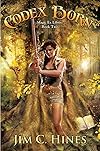
Five hundred years ago, Johannes Gutenberg discovered the art of libriomancy, allowing him to reach into books to create things from their pages. Gutenberg's power brought him many enemies, and some of those enemies have waited centuries for revenge. Revenge which begins with the brutal slaughter of a wendigo in the northern Michigan town of Tamarack, a long-established werewolf territory. Libriomancer Isaac Vainio is part of Die Zwelf Portenære, better known as the Porters, the show more organization founded by Gutenberg to protect the world from magical threats. Isaac is called in to investigate the killing, along with Porter psychiatrist Nidhi Shah and his dryad bodyguard and lover, Lena Greenwood. Born decades ago from the pages of a pulp fantasy novel, Lena was created to be the ultimate fantasy woman, strong and deadly, but shaped by the needs and desires of her companions. Her powers are unique, and Gutenberg's enemies hope to use those powers for themselves. But their plan could unleash a far darker evi l... show lessTags
Recommendations


Member Reviews
A great follow up to Libriomancer with bonus Even More Lena!
I liked how Hines expanded this universe's ideas about libriomancy with things like ebooks, multiple readings by the same person, and magazines. I especially liked using poetry to create moods and feelings.
I realize this is Isaac's story, and I do like him quite a bit, but this book gave me Lena, what she was, what she could have been, and who she wants to be. Considering she's a fantasy creature pulled from a book and designed to change with her lover's desires, this is a huge step for her, and it's fantastic.
The next book can't come soon enough. After reading the ending, I'm ready for it.
I liked how Hines expanded this universe's ideas about libriomancy with things like ebooks, multiple readings by the same person, and magazines. I especially liked using poetry to create moods and feelings.
I realize this is Isaac's story, and I do like him quite a bit, but this book gave me Lena, what she was, what she could have been, and who she wants to be. Considering she's a fantasy creature pulled from a book and designed to change with her lover's desires, this is a huge step for her, and it's fantastic.
The next book can't come soon enough. After reading the ending, I'm ready for it.
Isaac, Lena and Nidhi are developing their new relationship – but hardly have the chance to do so on peace before being called into the field again.
There’s been some murdered Wendigo – and Wendigo are pretty hard to kill.
But throw in some strange, lethal metal insects, creations of a dead Libriomancer and his far less fun father.
An ancient order of Chinese mages who have a severe beef with Gutenburg’s followers – and made extra uncomfortable by them maybe being right
Then throw in the Devourers, dryads and a dragon and there’s certainly a lot to handle; all confused further by Gutenburg’s secrets and that nagging question as to whether or not they’re actually on the right side.
I love the very concept of this world. The show more idea of pulling things out of books – and now e-readers – and both the wonder and the complexity that can come with that. I love the geeky shout outs to so many books I’ve read and loved. I love just how much the love of reading and the power of it and this genre which we adore so much is all just worshipped in this series.
And things have got complicated – wonderfully, gloriously complicated. We have an enemy – who everyone hates, even his allies and rightly so. Then we have an enemy who Isaac kind of feels sympathetic towards with lots of recognition of past injustice. Then we have Gutenburg who may be their ally and super powerful and he may have some extremely good reasons for his decisions – but he’s still done a whole lot of evil, he’s still keeping a whole lot of secrets and Isaac still doesn’t trust, despite working for him. And under all that you have the big nasty monsters that may try to eat everyone.
It’s wonderfully complex.
And part of that complexity is the complexity of the characters (while still giving us someone who is evil and we can hate without having to be complicated about it – because that’s fun too). The entire history of the Libriomancers is a fascinating one that’s been really well developed. I love the dispensing of the idea that Gutenburg is the first Libriomancer – the Chinese have been printing long before him and already had their own variety. At first it seemed like a simple case of Gutenburg attacking, slaughtering and stealing from the Students of Bi Sheng. But then lots of nuance get added:
Are we judging someone based on what they did 500 years ago? With attitudes, standards and thought processes that were prevalent at the time?
Gutenburg was involved in a war – not only did the Students of Bi Sheng fight him but multiples forces were trying to destroy him while he established his power – he saw it as a fight for survival.
And, of course, Gutenburg’s organisation did end up bringing order and peace to the magical world – albeit in a Pax Romana fashion.
I like how all of these are raised without in any way justifying or excusing what Gutenburg did or that it was wrong – even having Gutenburg admit it. The nuance is there for human complexity, not dismissal. And Isaac still acts against Gutenburg’s express wishes, especially when it comes to continuing what he started; and receives tacit support from Pallas and the other Libriomancers as well
The same applies to Gutenburg keeping secrets – it’s annoying and patronising and it could harm the Libriomancers – but at the same time why does a 500 year old with centuries of study and mastery over someone under 30 all his secrets and knowledge? Isn’t it reasonable for him not to trust or rely on people that much weaker and younger? And don’t the Libriomancers already trust him to lock books? Except, of course, that secrecy is equally used to cover up his nefarious deeds, build his legend and head off any challenge and criticism.
But then there’s the very nature of the Libriomancers – intelligent, brilliant, imaginative people who are caught up in and absorbed by books. People with infinite curiosity, massive imaginations and a slight inclination to poke things while asking “what if…”. I love them, it’s an absolutely awesome portrayal but equally adds credence to why Gutenburg may want to keep some things from them because they WILL poke at it.
In addition to all this human world building, I love nuts and bolts of the world – how so much thought has gone into making everything work. Like the body temperatures of the Wendigo (and a wonderful acknowledgement of where Wendigo come from) or how using magic to travel at super speeds means you risk friction burns from the air, or werewolves shifting in their clothes and being in agony because denim just doesn’t rip that easily and it’s the last thing you want constricting over your swelling nether regions.
I also love how a lot of the world building – the new ways of using magic Isaac is learning, the nature of the Devourer and a lot more doesn’t have a simple answer. Some things are theories – hotly debated theories – which is excellently realistic. Why should they know all the rules of magic? That’d be like us knowing every law of physics – real life doesn’t work that way.
Read More show less
There’s been some murdered Wendigo – and Wendigo are pretty hard to kill.
But throw in some strange, lethal metal insects, creations of a dead Libriomancer and his far less fun father.
An ancient order of Chinese mages who have a severe beef with Gutenburg’s followers – and made extra uncomfortable by them maybe being right
Then throw in the Devourers, dryads and a dragon and there’s certainly a lot to handle; all confused further by Gutenburg’s secrets and that nagging question as to whether or not they’re actually on the right side.
I love the very concept of this world. The show more idea of pulling things out of books – and now e-readers – and both the wonder and the complexity that can come with that. I love the geeky shout outs to so many books I’ve read and loved. I love just how much the love of reading and the power of it and this genre which we adore so much is all just worshipped in this series.
And things have got complicated – wonderfully, gloriously complicated. We have an enemy – who everyone hates, even his allies and rightly so. Then we have an enemy who Isaac kind of feels sympathetic towards with lots of recognition of past injustice. Then we have Gutenburg who may be their ally and super powerful and he may have some extremely good reasons for his decisions – but he’s still done a whole lot of evil, he’s still keeping a whole lot of secrets and Isaac still doesn’t trust, despite working for him. And under all that you have the big nasty monsters that may try to eat everyone.
It’s wonderfully complex.
And part of that complexity is the complexity of the characters (while still giving us someone who is evil and we can hate without having to be complicated about it – because that’s fun too). The entire history of the Libriomancers is a fascinating one that’s been really well developed. I love the dispensing of the idea that Gutenburg is the first Libriomancer – the Chinese have been printing long before him and already had their own variety. At first it seemed like a simple case of Gutenburg attacking, slaughtering and stealing from the Students of Bi Sheng. But then lots of nuance get added:
Are we judging someone based on what they did 500 years ago? With attitudes, standards and thought processes that were prevalent at the time?
Gutenburg was involved in a war – not only did the Students of Bi Sheng fight him but multiples forces were trying to destroy him while he established his power – he saw it as a fight for survival.
And, of course, Gutenburg’s organisation did end up bringing order and peace to the magical world – albeit in a Pax Romana fashion.
I like how all of these are raised without in any way justifying or excusing what Gutenburg did or that it was wrong – even having Gutenburg admit it. The nuance is there for human complexity, not dismissal. And Isaac still acts against Gutenburg’s express wishes, especially when it comes to continuing what he started; and receives tacit support from Pallas and the other Libriomancers as well
The same applies to Gutenburg keeping secrets – it’s annoying and patronising and it could harm the Libriomancers – but at the same time why does a 500 year old with centuries of study and mastery over someone under 30 all his secrets and knowledge? Isn’t it reasonable for him not to trust or rely on people that much weaker and younger? And don’t the Libriomancers already trust him to lock books? Except, of course, that secrecy is equally used to cover up his nefarious deeds, build his legend and head off any challenge and criticism.
But then there’s the very nature of the Libriomancers – intelligent, brilliant, imaginative people who are caught up in and absorbed by books. People with infinite curiosity, massive imaginations and a slight inclination to poke things while asking “what if…”. I love them, it’s an absolutely awesome portrayal but equally adds credence to why Gutenburg may want to keep some things from them because they WILL poke at it.
In addition to all this human world building, I love nuts and bolts of the world – how so much thought has gone into making everything work. Like the body temperatures of the Wendigo (and a wonderful acknowledgement of where Wendigo come from) or how using magic to travel at super speeds means you risk friction burns from the air, or werewolves shifting in their clothes and being in agony because denim just doesn’t rip that easily and it’s the last thing you want constricting over your swelling nether regions.
I also love how a lot of the world building – the new ways of using magic Isaac is learning, the nature of the Devourer and a lot more doesn’t have a simple answer. Some things are theories – hotly debated theories – which is excellently realistic. Why should they know all the rules of magic? That’d be like us knowing every law of physics – real life doesn’t work that way.
Read More show less
“My name is Isaac Vainio,” I said. “You smashed my library. Prepare to die.”
This time around, the stakes are higher. We learn a bit more about the history of magic in the world and Libriomancy in particular, including a way that doesn't require Gutenberg's presses to come into being, which isn't something I had even considered. On top of that, we get some technomancy, more looks at the big nasties that live in books, and a big magical showdown.
Characterwise, I like seeing how Isaac is growing, both in power and in confidence. His relationships with Lena, with Nidhi, and with Gunteberg are all fascinating in different ways.
“You don’t believe in the risks. Not to you. You think you’re too clever, just like every othershow more
Porter who ended up destroying themselves.”
We also get a lot more about Lena, which is a plus. She's a fascinating character, given her somewhat artificial origin, but entirely 'real' nature. This book takes the kind of unfortunate way that her needs were described in the first book and explores them much more deeply, both in the modern day with Isaac and Nidhi and in flashbacks when she was first 'born'. It's still an uncomfortable story line at times, but I think it's dealt with in a much better manner in Codex Born.
Worldbuildingwise, we get a few more magical beasties (werewolves and wendigos oh my) and constructs (a colony of metal bugs that can grow and evolve, very cool). Along with that, we can finally answer a question I had from the first book (given that I read these on my Kindle): how does Libriomancy work with ebooks?
On the other hand, this only feels sort of related to the first book. We have the same world, most of the same characters, but the big bads (at least at first) seem to have shifted gears. The final battle feels a bit abrupt, even if it is pretty epic.
Overall, worth the follow up. I look forward to seeing where this goes next.
‘If you really want to kill a libriomancer, hook a bomb up to a big red button and tell him not to press it.’show less
3.75 stars
This is book 2 in a series. Isaac is a librarian, but also a “libriomancer”. That means he can pull items out of books and use them, often magically. There are a group of libriomancers who call themselves Porters, lead by Gutenberg himself. When a wendigo is found by a couple of werewolves, murdered, Isaac and one of the local werewolves go to investigate, along with the help of Isaac’s dryad girlfriend, Lena, and Lena’s other love/girlfriend, Nidhi (also a psychiatrist) go to help find out what happened. This becomes bigger and bigger and ends in a bit of a “war” with magical metal insects, a ghost army, a vindictive father wanting to learn magic, the Chinese equivalent of libriomancers (though many of them have show more been dead for years, or trapped in books).
There is almost too much fantasy for me in this, but at the same time, I quite enjoyed it. I liked the dryad, Lena, and I love Isaac’s pet: a “fire-spider”, Smudge. I also love that Isaac is a librarian. The beginning of each chapter gives us Lena’s background. It was in italics and I often tend to skim parts like that, but I actually did pay attention to this story, as well. show less
This is book 2 in a series. Isaac is a librarian, but also a “libriomancer”. That means he can pull items out of books and use them, often magically. There are a group of libriomancers who call themselves Porters, lead by Gutenberg himself. When a wendigo is found by a couple of werewolves, murdered, Isaac and one of the local werewolves go to investigate, along with the help of Isaac’s dryad girlfriend, Lena, and Lena’s other love/girlfriend, Nidhi (also a psychiatrist) go to help find out what happened. This becomes bigger and bigger and ends in a bit of a “war” with magical metal insects, a ghost army, a vindictive father wanting to learn magic, the Chinese equivalent of libriomancers (though many of them have show more been dead for years, or trapped in books).
There is almost too much fantasy for me in this, but at the same time, I quite enjoyed it. I liked the dryad, Lena, and I love Isaac’s pet: a “fire-spider”, Smudge. I also love that Isaac is a librarian. The beginning of each chapter gives us Lena’s background. It was in italics and I often tend to skim parts like that, but I actually did pay attention to this story, as well. show less
Isaac has settled into his new role as a researcher trying to determine the source of the dark magic that lurks inside books and threatens to destroy the world. However, when a wendigo is found murder and Isaac is asked to help investigate it reveals a larger conspiracy that threatens everyone Isaac cares about.
As the second book in the Magic Ex Libris series, this book suffers a bit in comparison with the first volume. It's full of action and plenty of references to delight any book nerd (particularly SFF readers) but the darker plot means this book doesn't feel quite as fun as the first volume. That said, it sets up a development for the larger conflict that has me willing to pick up the next volume. A solid read but not quite as show more sparkling as I'd hoped. show less
As the second book in the Magic Ex Libris series, this book suffers a bit in comparison with the first volume. It's full of action and plenty of references to delight any book nerd (particularly SFF readers) but the darker plot means this book doesn't feel quite as fun as the first volume. That said, it sets up a development for the larger conflict that has me willing to pick up the next volume. A solid read but not quite as show more sparkling as I'd hoped. show less
Once again I was thoroughly taken in by the skillful world building in this series. This volume occurs about two months after the first, and focus very much on Lena. The idea that a person with no magic could not only take over most of the Porters' secret knowledge and then become one of the most formidable adversaries (besting even the automatons) was a bit of a stretch, but what can you do. If the close detail of the plotting is not flawless, the author nonetheless tells a gripping tale full of characters we actually care about.
Two and a half stars
All I can think of is the Goblin King in Labyrinth: “Such a pity.” Creative ideas, a streamlined plot, a love of books–all are fabulous ideas, and all undermined by cumbersome execution. I really want to like this series–I like Jim Hines‘ public persona, I really do--particularly his willingness to be an advocate against rape and rape culture. I haven’t yet read his Goblin King series, but I suspect his strength might be in the YA genre (as well as non-fiction, given his blogging and journalism), because barring a detailed sex scene, this would be satisfactory young adult fare. As an adult genre book, I was too bothered by a lack of polish and sophistication to enjoy it.
**************************
The rest show more of my review is pure crankiness, followed by bitter cover analysis. Because Goodreads will delete it if someone gets their undies in a bunch, I keep my full reviews at Wordpress and Booklikes:
http://clsiewert.wordpress.com/2014/04/07/codex-born-by-jim-c-hines/
http://carols.booklikes.com/post/849864/codex-born-by-jim-hines show less
All I can think of is the Goblin King in Labyrinth: “Such a pity.” Creative ideas, a streamlined plot, a love of books–all are fabulous ideas, and all undermined by cumbersome execution. I really want to like this series–I like Jim Hines‘ public persona, I really do--particularly his willingness to be an advocate against rape and rape culture. I haven’t yet read his Goblin King series, but I suspect his strength might be in the YA genre (as well as non-fiction, given his blogging and journalism), because barring a detailed sex scene, this would be satisfactory young adult fare. As an adult genre book, I was too bothered by a lack of polish and sophistication to enjoy it.
**************************
The rest show more of my review is pure crankiness, followed by bitter cover analysis. Because Goodreads will delete it if someone gets their undies in a bunch, I keep my full reviews at Wordpress and Booklikes:
http://clsiewert.wordpress.com/2014/04/07/codex-born-by-jim-c-hines/
http://carols.booklikes.com/post/849864/codex-born-by-jim-hines show less
Members
- Recently Added By
Lists

Wishlist
48 works; 1 member
Talk Discussions
Past Discussions
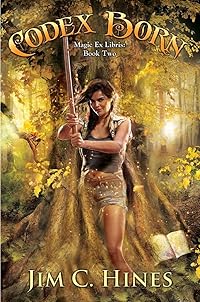
Codex Born in Good Show Sir! — bad science fiction and fantasy covers (February 2025)
Author Information


Jim C. Hines is a LibraryThing Author, an author who lists their personal library on LibraryThing.
Some Editions
Awards and Honors
Distinctions
Series

Belongs to Publisher Series
Common Knowledge
- Canonical title
- Codex Born
- Original title
- Codex Born
- Original publication date
- 2013-08-06
- People/Characters
- Isaac Vainio; Lena Greenwood; Nidhi Shah; Gutenberg, Johannes, 1394/99-ca. 1468; August Harrison
- Important places
- Michigan, USA
- Epigraph
- "Gutenberg's invention, while having given to some national freedom, brought slavery to others. It became the founder and protector of human liberty, and yet it made despotism possible where formerly it was impossible."
- Dedication
- To Amy, Skylar, and Jamie.
Thank you for putting up with me through another one. - First words
- People say love changes a person. They have no idea.
- Last words
- (Click to show. Warning: May contain spoilers.)And beyond that mask, a legion of the dead, waiting to follow.
- Publisher's editor
- Gilbert, Sheila
Classifications
Statistics
- Members
- 613
- Popularity
- 47,721
- Reviews
- 34
- Rating
- (3.80)
- Languages
- English, French, German, Korean
- Media
- Paper, Audiobook, Ebook
- ISBNs
- 10
- ASINs
- 7