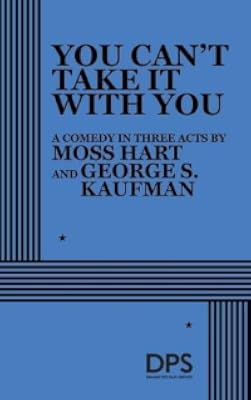
You Can't Take It With You
by Moss Hart, George S. Kaufman
On This Page
Description
At first the Sycamores seem mad, but it is not long before we realize that if they are mad, the rest of the world is madder. In contrast to these delightful people are the unhappy Kirbys. The plot shows how Tony, attractive young son of the Kirbys, falls in love with Alice Sycamore and brings his parents to dine at the Sycamore home on the wrong evening. The shock sustained by the Kirbys, who are invited to eat cheap food, shows Alice that marriage with Tony is out of the question. The show more Sycamores, however, though sympathetic to Alice, find it hard to realize her point of view. Meantime, Tony, who knows the Sycamores are right and his own people wrong, will not give her up, and in the end Mr. Kirby is converted to the happy madness of the Sycamores, particularly since he happens in during a visit by an ex-Grand Duchess, earning her living as a waitress. No mention has as yet been made of the strange activities of certain members of the household engaged in the manufacture of fireworks; nor of the printing press set up in the parlor; nor of Rheba the maid and her friend Donald; nor of Grandpa's interview with the tax collector when he tells him he doesn't believe in the income tax. -- from publisher. show lessTags
Recommendations













Member Reviews
A very funny, absorbing play. More like the screenplay of a sitcom or something, which makes it quite an entertaining read.
A very funny, absorbing play. More like the screenplay of a sitcom or something, which makes it quite an entertaining read.
I honestly wasn't really into it for the first act, and a bit into the second. But it was the impromptu dinner scene that really hooked me. From then on I loved it, the third act especially as I thought it wrapped up really nicely.
https://nwhyte.livejournal.com/2951226.html
The drunk actress Gay Wellington (and another comic turn, the Grand Duchess Olga) were among the cuts made by Riskin as he adapted the play for the screen. Kirby's background is much less developed in the play - the whole subplot involving property transactions, and the character of Mr Poppins, are inserted by Riskin into the film. The Vanderhofs have pet snakes rather than a raven. (Though I'm glad to say that the kitten is original.)
The guts of it are all the same as the film, and one can see why the play won a Pulitzer as an uplifting tonic in depressing times. It's a bit more misogynistic (as I said, two extra female characters who are only there as figures of fun, and Mrs Kirby gets a show more harder time) and more racist (Donald gets treated worse). There is a hilarious sequence during the Kirbys' disastrous visit to the Vanderhof household, where Penny gets the Kirbys to play a word association game:
[start]
KIRBY. Will you go on, Mrs. Sycamore? What was the next word?
PENNY. (Reluctantly.) Honeymoon.
KIRBY. Oh, yes. And what was Mrs. Kirby's answer ?
PENNY. Ah—"Honeymoon—dull."
KIRBY. (Murderously calm.) Did you say—dull?
MRS. KIRBY. What I meant, Anthony, was that Hot Springs was not very gay that season. All those old people sitting on the porch all afternoon, and—nothing to do at night. (Realizes she has gone too far.)
KIRBY. That was not your reaction at the time, as I recall it.
TONY. (Crosses in a step.) Father, this is only a game.
KIRBY. A very illuminating game. Go on, Mrs. Sycamore!
PENNY. (Brightly, having taken a look ahead.) This one's all right, Mr. Kirby. "Sex—Wall Street."
KIRBY. Wall Street? What do you mean by that, Miriam?
MRS. KIRBY. (Nervously.) I don't know what I meant, Anthony. Nothing.
KIRBY. But you most have meant something, Miriam, or you wouldn't have put it down.
MRS. KIRBY. It was just the first thing that came into my head, that's all.
KIRBY. But what does it mean ? Sex—Wall Street.
MRS. KIRBY. (Annoyed.) Oh, I don't know what it means, Anthony. It's just that you're always talking about Wall Street, even when (She catches herself.) I don't know what I meant.. . . Would you mind terribly, Alice, if we didn't stay for dinner? (Rises. GRANDPA and KOLENKHOV rise. Also ESSIE, ED and PAUL.) I'm afraid this game has given me a headache.
[end]
I can see how what plays well on Broadway might not always survive to Hollywood. show less
The drunk actress Gay Wellington (and another comic turn, the Grand Duchess Olga) were among the cuts made by Riskin as he adapted the play for the screen. Kirby's background is much less developed in the play - the whole subplot involving property transactions, and the character of Mr Poppins, are inserted by Riskin into the film. The Vanderhofs have pet snakes rather than a raven. (Though I'm glad to say that the kitten is original.)
The guts of it are all the same as the film, and one can see why the play won a Pulitzer as an uplifting tonic in depressing times. It's a bit more misogynistic (as I said, two extra female characters who are only there as figures of fun, and Mrs Kirby gets a show more harder time) and more racist (Donald gets treated worse). There is a hilarious sequence during the Kirbys' disastrous visit to the Vanderhof household, where Penny gets the Kirbys to play a word association game:
[start]
KIRBY. Will you go on, Mrs. Sycamore? What was the next word?
PENNY. (Reluctantly.) Honeymoon.
KIRBY. Oh, yes. And what was Mrs. Kirby's answer ?
PENNY. Ah—"Honeymoon—dull."
KIRBY. (Murderously calm.) Did you say—dull?
MRS. KIRBY. What I meant, Anthony, was that Hot Springs was not very gay that season. All those old people sitting on the porch all afternoon, and—nothing to do at night. (Realizes she has gone too far.)
KIRBY. That was not your reaction at the time, as I recall it.
TONY. (Crosses in a step.) Father, this is only a game.
KIRBY. A very illuminating game. Go on, Mrs. Sycamore!
PENNY. (Brightly, having taken a look ahead.) This one's all right, Mr. Kirby. "Sex—Wall Street."
KIRBY. Wall Street? What do you mean by that, Miriam?
MRS. KIRBY. (Nervously.) I don't know what I meant, Anthony. Nothing.
KIRBY. But you most have meant something, Miriam, or you wouldn't have put it down.
MRS. KIRBY. It was just the first thing that came into my head, that's all.
KIRBY. But what does it mean ? Sex—Wall Street.
MRS. KIRBY. (Annoyed.) Oh, I don't know what it means, Anthony. It's just that you're always talking about Wall Street, even when (She catches herself.) I don't know what I meant.. . . Would you mind terribly, Alice, if we didn't stay for dinner? (Rises. GRANDPA and KOLENKHOV rise. Also ESSIE, ED and PAUL.) I'm afraid this game has given me a headache.
[end]
I can see how what plays well on Broadway might not always survive to Hollywood. show less
Best play ever.
This was the first play I helped with at my high school!
Did not age well
Members
- Recently Added By
Lists

Plays I Like
230 works; 31 members

Jewish Books
367 works; 24 members

Read the book and saw the movie
1,170 works; 195 members

Books You Read During High School (For School)
301 works; 52 members

In or About the 1930s
198 works; 27 members

1930s
262 works; 5 members

Books Read in 2004
212 works; 7 members
1:28 p.m.'s 350 Stage Plays Challenge
94 works; 3 members
Essential/Recognized Stage Plays
115 works; 4 members

Next Plays / 2025
352 works; 1 member

Next Plays to Watch
50 works; 1 member
Author Information

28+ Works 2,156 Members

59+ Works 2,247 Members
Kaufman, was born in Pittsburgh, attended law school for two years, failed as a business person, and became a humorist for Franklin P. Adams's column before joining the New York Times, whose drama editor he became in the 1920s. Kaufman was sole author of one long play and two one-act plays, including the popular The Butter and Egg Man (1926), but show more he collaborated on more than 25 plays, most importantly with Moss Hart, but also with Marc Connelly, Edna Ferber, and others, including Ring Lardner and John P. Marquand. These plays range from the hilarious madness of Cocoanuts (1929) and Animal Crackers (1928), two Marx Brothers shows that Kaufman worked on, to the comic pathos of Stage Door (1936) (with Edna Ferber). Commenting on why he did not write true satire, Kaufman said, "Satire is what closes Saturday night." Kaufman, Morris Ryskind, and Ira Gershwin won the Pulitzer Prize for drama for Of Thee I Sing (1932) and Kaufman and Hart for You Can't Take It with You (1937). (Bowker Author Biography) show less
Awards and Honors
Awards
Work Relationships
Is contained in
Has the adaptation
Has as a student's study guide
Common Knowledge
- Canonical title
- You Can't Take It With You
- Original title
- You Can't Take It With You
- Original publication date
- 1936 (performed) (performed); 1937 (printed) (printed)
- Related movies
- You Can't Take It with You (1938 | IMDb); Great Performances: You Can't Take It with You (1984 | IMDb)
- First words
- "My that kitchen is hot."
- Last words
- (Click to show. Warning: May contain spoilers.)And a very good thing, too.
Classifications
Statistics
- Members
- 568
- Popularity
- 52,255
- Reviews
- 9
- Rating
- (3.77)
- Languages
- English
- Media
- Paper
- ISBNs
- 4
- ASINs
- 7