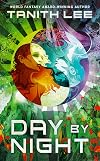
Day by Night
by Tanith Lee
On This Page
Description
This repackaged edition of a classic sci-fi tale from a master storyteller explores a planet of great contrasts, one side in perpetual light, the other in darkness. Vel Thaidis is a figment of Vitra's imagination. In a city with no sunlight, Vitra crafts dreams to entertain the masses. She enjoys a decadent life with the nobility while the lower class work and rot. Vitra's dreams are a mirror image of her life. Vel has a brother like her, knows a man like the one Vitra desires. Even the show more machines that take care of them, that no one remembers how to fix, are the same. Except in Vitra's dreams, no one can fix the machines when they slowly die, while they never break down in reality. Vitra will never fear being stuck in the dark with no machines to create light. Until she is. Vitra's dreams and reality are merging. She feels pushed into a corner, with no solution but the one her dreams have given her. In the end, Vitra may not have as much free will as she believes--and her dreams may be more real than she knows. show lessTags
Recommendations





















Member Reviews
This the 19th novel/collection I've read from Tanith Lee. After reading The Lords of Darkness trilogy, I decided I had to collect and read everything she wrote. Unfortunately, out of that 19 I've got 4 1-star and 4 2-star books (vs only 3 5-star and 4 4-star). This one barely made it to 3-stars. It got better in the last 3rd, but was kind of a slog for the first two thirds.
The idea was definitely original, she paints a stark dystopian landscape, and the final "reveal" wasn't what I thought it would be, but it still often felt dated and not very exciting.
The idea was definitely original, she paints a stark dystopian landscape, and the final "reveal" wasn't what I thought it would be, but it still often felt dated and not very exciting.
My experience with Tanith Lee’s novels is rather hit and miss, and I’m afraid this one falls into the latter category. Only my love of some of her other works kept me reading until the end - to be ultimately disappointed.
This is actually two stories; in one the vapid Vitra is a Fabulast who lives on the dark side of the planet, and she is writing a story about the spoiled Vel Thaidis who lives on the light side of the planet. Or is it a story? After a crime is committed in each world, the stories strangely take on a life of their own – which is explained in the last chapter.
Definitely not Lee’s best work, but you can see shadows of concepts explored more fully in other books, like the spoiled teens from Don’t Bite The Sun show more and the evil (almost incestuous) twins of The Silver Metal Lover. She hints at the eroticism that is an integral part of her other works, but never delivers. show less
This is actually two stories; in one the vapid Vitra is a Fabulast who lives on the dark side of the planet, and she is writing a story about the spoiled Vel Thaidis who lives on the light side of the planet. Or is it a story? After a crime is committed in each world, the stories strangely take on a life of their own – which is explained in the last chapter.
Definitely not Lee’s best work, but you can see shadows of concepts explored more fully in other books, like the spoiled teens from Don’t Bite The Sun show more and the evil (almost incestuous) twins of The Silver Metal Lover. She hints at the eroticism that is an integral part of her other works, but never delivers. show less
This novel consists of a number of story threads, layered, and with characters who have counterparts in other threads. Initially, the sunward side of a planet which has a fixed rotation in relation to its sun is shown, from the viewpoint of decadent aristocrats who depend upon an underclass that lives in a decayed area called the Slumopolis. Then the focus switches in the second part of the first chapter to another set of decadent aristocrats, living on the dark side which is cold but has a higher technology, who have apparently created the first habitation as the setting of a fantasy which is used to lull the underclass, who labour and live in poverty and squalor to support the upper classes.
Each chapter then has the same structure, show more showing first the sunward side and then the darkside, with the parallel stories of characters in each who frame a fellow aristocrat for murder, out of spite and envy, resulting in that person - in the sunward side, a woman, in the darkside, a man who has used his command of technology to actually help the underclass out of guilt at their plight - being banished to the respective enclave of the underclass where they are expected, one way or another, to have a short life expectancy.
It isn't as straightforward as that, however, but I won't give more away. However, the format of having characters who supposedly were not real, though I did start to wonder given the viewpoint used, did mean I had less engagement with them. There are quite a few twists towards the end, and a big one at the very end, but I wasn't keen on that one in particular, and overall didn't really enjoy the book, hence an OK 2 star rating. show less
Each chapter then has the same structure, show more showing first the sunward side and then the darkside, with the parallel stories of characters in each who frame a fellow aristocrat for murder, out of spite and envy, resulting in that person - in the sunward side, a woman, in the darkside, a man who has used his command of technology to actually help the underclass out of guilt at their plight - being banished to the respective enclave of the underclass where they are expected, one way or another, to have a short life expectancy.
It isn't as straightforward as that, however, but I won't give more away. However, the format of having characters who supposedly were not real, though I did start to wonder given the viewpoint used, did mean I had less engagement with them. There are quite a few twists towards the end, and a big one at the very end, but I wasn't keen on that one in particular, and overall didn't really enjoy the book, hence an OK 2 star rating. show less
Ratings
Members
- Recently Added By
Author Information

322+ Works 29,854 Members
Tanith Lee, September 19, 1947 - May 24, 2015 Tanith Lee was born on September 19, 1947 in London, England, the daughter of ballroom dancers. She attended various primary schools and had a variety of jobs, from file clerk and assistant librarian to shop assistant and waitress. Lee attended an art college for one year, but felt she would be better show more writing her ideas than painting them. Her first professional sale was "Eustace," a 90 page vignette which appeared in The Ninth Pan Book of Horror Stories in 1968. While Lee was working as an assistant librarian, she wrote a children's story that was accepted for publication. Others of her stories were also bought but never published. In 1971, Macmillan published "The Dragon Hoard," another children's book, which was followed by "Animal Castle" and "Princess Hynchatti and Other Stories" in 1972. Lee was looking for a British publisher for her book "The Birthgrave," but was denied at every House she went. She then wrote to American publisher DAW, known for it's fantasy and horror selections, who immediately accepted her manuscript and published the book in 1975. Thus began a partnership between the two that lasted till 1989 and resulted in 28 books. After the publication of her third book by DAW, Lee quit her job and became a full-time freelance writer. Lee has been nominated for the World Fantasy Award, the August Derleth Award and the Nebula. She has had more than 40 novels published, along with over 200 short stories. Lee died peacefully in her sleep after a long illness on May 24, 2015. (Bowker Author Biography) show less
Some Editions
Series
Belongs to Publisher Series
DAW Book Collectors (408)
Common Knowledge
- Original publication date
- 1980
- Dedication
- To Bernard Lee, my Father,
who generously gave me a planet, and all its problems. - First words
- Half a staed below the palace of Hirz, the formal gardens gradually smoothed themselves into the curve of the lake shore.
Classifications
Statistics
- Members
- 220
- Popularity
- 148,169
- Reviews
- 4
- Rating
- (3.67)
- Languages
- Dutch, English, French, German
- Media
- Paper, Ebook
- ISBNs
- 7
- ASINs
- 4