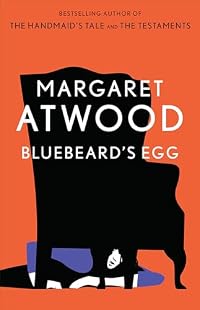
Bluebeard's Egg and Other Stories
by Margaret Atwood
On This Page
Description
With the publication of the best-selling The Handmaid's Tale in 1986, Margaret Atwood's place in North American letters was reconfirmed. Poet, short story writer, and novelist. With Bluebeard's Egg, her second short story collection, Atwood covers a dramatic range of storytelling, her scope encompassing the many moods of her characters, from the desolate to the hilarious. The stories are set in the 1940s, 1950s, and 1980s and concern themselves with relationships of various sorts. There is show more the bond between a political activist and his kidnapped cat, a woman and her dead psychiatrist, a potter and the group of poets who live with her and mythologize her, an artist and the strange men she picks up to use as models. There is a man who finds himself surrounded by women who are literally shrinking, and a woman whose life is dominated by a fear of nuclear warfare, there are telling relationships among parents and children. By turns humorous and warm, stark and frightening, Bluebeard's Egg explores and illuminates both the outer world in which we all live and the inner world that each of us creates. show lessTags
Recommendations








Member Reviews
"The life she's led up to now seems to her entirely crazed. How did she end up in this madhouse? By putting one foot in front of the other ..." Quite a few stories of this collection present women stranded in their middle age, trying to understand what happened. These are the best of the collection, full of unforgettable lines and observations and presented with a type of humour all of the author's own: "Her only discoverable ambition as a child was to be able to fly, and much of her later life has been spent in various attempts to take off."
From this collection, my favourites are Atwood's (or the child narrator) stories of a youth spent in northern Ontario. Although it couldn't have always been fun, there is freedom and abandon in nature not found in the city. These are contrasted with the adult stories of ambiguous and complicated relationships that seem wanting in satisfaction.
Atwood has a beautiful, vibrant style, and these stories have not aged one bit.
Atwood has a beautiful, vibrant style, and these stories have not aged one bit.
Beautifully written, but uneven. The semi-autobiographical tales of a nomadic childhood in post-war Canada that open and close the book are poignant and affecting - subtle, yet heavy with raw emotion and sublime imagery. The rest of the collection - which deals primarily with, (at the time of publication), middle-aged, artsy-yuppie baby-boomers in failing relationships confronting their own mortality - is something of a slog. The characters in these stories - most notably "Uglypuss," and the titular piece - are so selfish, short-sighted and hateful that reading about them borders on excruciating. Perhaps this is the point - one cannot expect all characters to be likable or sympathetic, after all - but in reading these stories, the show more phrase, "first-world problems," continuously comes to mind. Pretentious, self-obsessed, developmentally arrested artists who treat other people like garbage and/or take their partners for granted does not make for especially engaging literature, particularly when said characters are regularly blindsided by the eye-roll inducingly obvious consequences of their own deplorable behavior. This collection is recommendable for the following pieces: "Significant Moments in the Life of My Mother," "Hurricane Hazel," "Betty," and "Unearthing Suite," but overall, it does not rank among Atwood's best. show less
I normally love Margaret Atwood's novels so I was looking forward to this book but I found myself slightly disappointed.
This is a collection of short stories by Atwood, some are autobiographical and I think these were the ones I enjoyed the most.
The rest were well written but often ended abruptly and left me feeling clueless about what that particular story was about. I don't know whether I just don't like the short story format or whether these were too literary for me but I was left feeling like Atwood was trying to make some point that I just wasn't getting.
I felt quite dim which is not a feeling I enjoy!
This is a collection of short stories by Atwood, some are autobiographical and I think these were the ones I enjoyed the most.
The rest were well written but often ended abruptly and left me feeling clueless about what that particular story was about. I don't know whether I just don't like the short story format or whether these were too literary for me but I was left feeling like Atwood was trying to make some point that I just wasn't getting.
I felt quite dim which is not a feeling I enjoy!
A collection of stories about the lives of women -- even the one or two that are from a male POV are really more about women -- and about relationships between men and women or between children and parents. They're mostly the kind of literary stories in which not much actually happens and in which there doesn't even necessarily seem to be a well-defined beginning, middle, and end. The one exception, perhaps, is "Uglypuss," about a woman's attempt to get at a cheating man by way of his cat. As a cat lover, I found that one highly disturbing, and part of me wishes one fewer thing had happened in it, honestly. It's definitely an effective story, though. And, like all of them, it's well written. Atwood's prose isn't showy, but it's smooth show more and beautiful, and full of subtlety. show less
A collection of short stories by Margaret Atwood. Of the twelve, I have listed the ones I found exceptional below. There were a couple of mediocre ones (or perhaps just ones I didn't relate to as well). But, as I usually find with Atwood, the writing was universally superb.
Significant Moments in the Life of My Mother
A woman’s memories of her mother, which struck me as both poignant and true.
“I used to think that my mother, in her earlier days, led a life of sustained hilarity and hair-raising adventure. (That was before I realized that she never put in the long stretches of uneventful time that must have made up much of her life: the stories were just punctuation.)”
Betty
Told from an adolescent point of view, this is the story of show more Betty and Fred, the couple who live in the cottage next door during a beach summer. Betty is sweet, he is charming, and the young girls are crazy for him. What the girl, looking back, reflects on is how Betty was the nice one, but Fred was preferred. She comes to realize that Fred was just like a million others, while Betty was unique.
Bluebeard’s Egg
This becomes a bit of a retelling of a fairytale. The fairytale is one in which Bluebeard’s wives break their promise not to enter a forbidden room and pay by being butchered by him. He is then deceived into believing his final wife is honest and true, when in fact she is only clever. The parallel is the story of Ed and Sally. Ed is also not true or honest, only clever, but the fairytale is reversed, Sally is the victim not the Bluebeard.
The Sin Eater
This is the story of our narrator and her psychiatrist, Joseph. They talk about sin eaters before his death and she dreams of being asked to eat his sins after he unexpectedly dies in an accident that might be a suicide.
“This world is all we have, says Joseph. It’s all you have to work with. It’s not too much for you. You will not be rescued.”
The stories are full of beautiful prose and imagery and Atwood’s moments of proverbial wisdom.
“One of my sons has just reached the shower-and-shave phase, the other one hasn’t, but both of them leave a deposit every time they pass through a room. A sort of bathtub ring of objects–socks, paperback books left face-down and open in the middle, sandwiches with bites taken out of them, and, lately, cigarette butts.”
“The sunrise is not a thing, but only an effect of the light caused by the positions of two astronomical bodies in relation to each other. The sun does not really rise at all, it is the earth that turns. The sunrise is a fraud.” show less
Significant Moments in the Life of My Mother
A woman’s memories of her mother, which struck me as both poignant and true.
“I used to think that my mother, in her earlier days, led a life of sustained hilarity and hair-raising adventure. (That was before I realized that she never put in the long stretches of uneventful time that must have made up much of her life: the stories were just punctuation.)”
Betty
Told from an adolescent point of view, this is the story of show more Betty and Fred, the couple who live in the cottage next door during a beach summer. Betty is sweet, he is charming, and the young girls are crazy for him. What the girl, looking back, reflects on is how Betty was the nice one, but Fred was preferred. She comes to realize that Fred was just like a million others, while Betty was unique.
Bluebeard’s Egg
This becomes a bit of a retelling of a fairytale. The fairytale is one in which Bluebeard’s wives break their promise not to enter a forbidden room and pay by being butchered by him. He is then deceived into believing his final wife is honest and true, when in fact she is only clever. The parallel is the story of Ed and Sally. Ed is also not true or honest, only clever, but the fairytale is reversed, Sally is the victim not the Bluebeard.
The Sin Eater
This is the story of our narrator and her psychiatrist, Joseph. They talk about sin eaters before his death and she dreams of being asked to eat his sins after he unexpectedly dies in an accident that might be a suicide.
“This world is all we have, says Joseph. It’s all you have to work with. It’s not too much for you. You will not be rescued.”
The stories are full of beautiful prose and imagery and Atwood’s moments of proverbial wisdom.
“One of my sons has just reached the shower-and-shave phase, the other one hasn’t, but both of them leave a deposit every time they pass through a room. A sort of bathtub ring of objects–socks, paperback books left face-down and open in the middle, sandwiches with bites taken out of them, and, lately, cigarette butts.”
“The sunrise is not a thing, but only an effect of the light caused by the positions of two astronomical bodies in relation to each other. The sun does not really rise at all, it is the earth that turns. The sunrise is a fraud.” show less
Margaret Atwood is a literary treasure. The flow and poetry of her work is just worlds above most. Bluebeard's Egg is a wonderful collection because it shows that the talent and skill isn't just sequestered to one inspired tail, but that she can recreate magic over and over.
Many of the stories have magic realism. Each has characters that manage to be simultaneously deeply developed and mysterious. Atwood gives the reader windows into each, but keeps some doors locked to give the reader some creative space to make her stories theirs.
Many of the stories have magic realism. Each has characters that manage to be simultaneously deeply developed and mysterious. Atwood gives the reader windows into each, but keeps some doors locked to give the reader some creative space to make her stories theirs.
Members
- Recently Added By
Lists

The Best of Canadian Literature
235 works; 32 members

Literature About Women and Girls
391 works; 39 members
Author Information

282+ Works 198,333 Members
Margaret Atwood was born on November 18, 1939 in Ottawa, Canada. She received a B.A. from Victoria College, University of Toronto in 1961 and an M.A. from Radcliff College in 1962. Her first book of verse, Double Persephone, was published in 1961 and was awarded the E. J. Pratt Medal. She has published numerous books of poetry, novels, story show more collections, critical work, juvenile work, and radio and teleplays. Her works include The Journals of Susanna Moodie, Power Politics, Cat's Eye, The Robber Bride, Morning in the Buried House, the MaddAdam trilogy, and The Heart Goes Last. She has won numerous awards including the Prince of Asturias Award for Literature, the Booker Prize in 2000 for The Blind Assassin, the Giller Prize and the Premio Mondello for Alias Grace, and the Governor General's Award in 1966 for The Circle Game and in 1986 for The Handmaid's Tale, which also won the very first Arthur C. Clarke Award in 1987. She won the PEN Pinter prize in 2016 for her political activism. She was awarded the 2016 PEN Pinter Prize for the outstanding literary merit of her body of work. (Bowker Author Biography) show less
Some Editions
Series
Belongs to Publisher Series
Fischer Taschenbuch (13435)
Work Relationships
Is contained in
Common Knowledge
- Canonical title
- Bluebeard's Egg and Other Stories
- Original title
- Bluebeard's Egg and Other Stories
- Original publication date
- 1983
- Dedication
- For My Parents
- First words
- When my mother was very small, someone gave her a basket of baby chicks for Easter.
- Last words
- (Click to show. Warning: May contain spoilers.)For my mother however, this is something else. For her this dropping - this hard-long, two-fingers-thick, black, hairy dropping - not to put too fine a point on it, this deposit of animal shit - is a miraculous token, a sign of divine grace; as if their mundane, familiar much-patched but at times still-leaking roof has been visited and made momentarily radiant by an unknown but by no means minor god.
- Original language
- English
Classifications
Statistics
- Members
- 2,183
- Popularity
- 9,244
- Reviews
- 15
- Rating
- (3.58)
- Languages
- 9 — Chinese, Czech, English, Finnish, German, Italian, Japanese, Portuguese, Spanish
- Media
- Paper, Audiobook, Ebook
- ISBNs
- 41
- ASINs
- 30