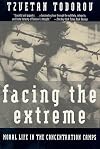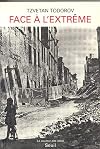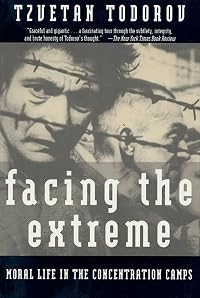
Facing the Extreme: Moral Life in the Concentration Camps
by Tzvetan Todorov
On This Page
Description
An examination of the human capacity for moral life; reconstructs a vivid portrait of those who ran the camps and those who suffered their outrages. Also offers an elequent plea for the recognition of everyday virtues as a basis for contemporary morality.Tags
Recommendations


















Member Reviews
Facing the Extreme is an impressive book: impressive in its ambition, and in the breadth of thinking and observation and analysis by the author. Based on a detailed reading of the literature by camp survivors, mainly Nazi but also Stalinist, Todorov seeks to "use the extreme as an instrument, a sort of magnifying glass that can bring into better focus certain things that in the normal course of human affairs remain blurry". Following Primo Levi, Todorov believes that no human experience, no matter how exceptional, is without meaning and that fundamental values, even if not positive, can be deduced from that experience. Todorov argues that it is possible, "to take the extreme experience of the camps as a basis from which to reflect on show more moral life, not because moral life was superior in the camps but because it was more visible and thus more telling there".
Todorov constructs a typology of virtues and values. The former he divides into heroic, i.e. actions taken on behalf of humanity or nations, actions that are abstract and taken for ideas; ordinary virtues are those that provide their own justification and are taken for the sake of an individual human being. He expands upon three ordinary virtues: caring for individuals, dignity; and the life of the mind. Values are divided those that are vital, i.e. actions required to save one's own life or furthering the individual's well-being, and those that are moral, i.e. actions that pertain to something more precious than life itself, where staying human is more important than staying alive.
Todorov acknowledges that extreme measures can destroy the social contract at its very foundations and human beings are then reduced to animal reactions. But, he argues:
"...what exactly does this observation mean? Does it reflect the fundamental truth about human nature, that morality is but a superficial convention jettisoned at the first opportunity? On the contrary, what it demonstrates is that moral reactions are spontaneous, omnipresent, and eradicable only with the greatest violence."
Todorov disagrees with the popular version of Hobbes's doctrine. He argues that, "except under extreme constraint, human beings are prompted, among other things, to communicate with one another, to help one another, and to distinguish good from evil."
Todorov thinks about the nature of evil and its perpetrators. He agrees with Primo Levi that "Monsters exist, but they are too few in number to be truly dangerous. More dangerous are the common man". He argues that to explain evil on the magnitude of the camps, one must look not to the character of the individual, but to that of the society; the explanation will be political and social, not psychological and individual: "The Germans, the Russians, and all the others who committed these unspeakable crimes are human beings, no different from any others; what sets them apart is the political regime under which they lived". He then goes on to examine the nature of totalitarianism and how it imposes its own morality under which, through habituation and inurement, atrocities were, in fact, seen to be good things.
On the perpetrators, Todorov follows Arendt on the banality of evil, in the sense that this is precisely what made it so dangerous: it was so easy that no exceptional human qualities were required for it to come into being. And, in addition, "For evil to come into being, the actions of a few are not sufficient; it is also necessary that the vast majority stand aside, indifferent; of such behavior, as we know well, we are all of capable". Evil is not accidental; it is always there at hand, ready to manifest itself: "All it needs to emerge is for us to do nothing".
These notes cannot do justice to the breadth of this book and Todorov's cogitations upon nonviolence and resignation, forms of combat, the perils of judgement, and telling, judging, understanding. This is a book that requires serious re-reading and thinking.
The final word to Todorov on why it is important to consider these questions:
"The first duty of the witness is to tell, so that the truth can be established. The task of the judge is to judge, and, in so doing, uphold the principles of justice. But even these things are not enough. Ultimately an effort must be made at all costs to understand. If we are content to tell the event without trying to relate it to other events that have occurred in the past or are taking place now, we turn it into a monument. This is better than ignoring it, of course, but that doesn't mean it's enough. Our memory of the camps should become an instrument that informs our capacity to analyze the present; for this to happen, we must recognize our own image in the caricature reflected back at us by the camps, regardless of how much this mirror deforms and how painful the recognition is. Only then can we tell ourselves that, at least from the viewpoint of humanity, the horrible experience of the camps will not have been in vain, that it contains lessons for us, who think we live in a completely different world. The act of telling events of the past without seeking to understand them and without allowing them to be compared with other events, past and present, amounts to a consecration of the horror. To reject that consecration does not mean we wish to turn this page of history. Instead, it means that we have finally decided to read it."
(Jan/06) show less
Todorov constructs a typology of virtues and values. The former he divides into heroic, i.e. actions taken on behalf of humanity or nations, actions that are abstract and taken for ideas; ordinary virtues are those that provide their own justification and are taken for the sake of an individual human being. He expands upon three ordinary virtues: caring for individuals, dignity; and the life of the mind. Values are divided those that are vital, i.e. actions required to save one's own life or furthering the individual's well-being, and those that are moral, i.e. actions that pertain to something more precious than life itself, where staying human is more important than staying alive.
Todorov acknowledges that extreme measures can destroy the social contract at its very foundations and human beings are then reduced to animal reactions. But, he argues:
"...what exactly does this observation mean? Does it reflect the fundamental truth about human nature, that morality is but a superficial convention jettisoned at the first opportunity? On the contrary, what it demonstrates is that moral reactions are spontaneous, omnipresent, and eradicable only with the greatest violence."
Todorov disagrees with the popular version of Hobbes's doctrine. He argues that, "except under extreme constraint, human beings are prompted, among other things, to communicate with one another, to help one another, and to distinguish good from evil."
Todorov thinks about the nature of evil and its perpetrators. He agrees with Primo Levi that "Monsters exist, but they are too few in number to be truly dangerous. More dangerous are the common man". He argues that to explain evil on the magnitude of the camps, one must look not to the character of the individual, but to that of the society; the explanation will be political and social, not psychological and individual: "The Germans, the Russians, and all the others who committed these unspeakable crimes are human beings, no different from any others; what sets them apart is the political regime under which they lived". He then goes on to examine the nature of totalitarianism and how it imposes its own morality under which, through habituation and inurement, atrocities were, in fact, seen to be good things.
On the perpetrators, Todorov follows Arendt on the banality of evil, in the sense that this is precisely what made it so dangerous: it was so easy that no exceptional human qualities were required for it to come into being. And, in addition, "For evil to come into being, the actions of a few are not sufficient; it is also necessary that the vast majority stand aside, indifferent; of such behavior, as we know well, we are all of capable". Evil is not accidental; it is always there at hand, ready to manifest itself: "All it needs to emerge is for us to do nothing".
These notes cannot do justice to the breadth of this book and Todorov's cogitations upon nonviolence and resignation, forms of combat, the perils of judgement, and telling, judging, understanding. This is a book that requires serious re-reading and thinking.
The final word to Todorov on why it is important to consider these questions:
"The first duty of the witness is to tell, so that the truth can be established. The task of the judge is to judge, and, in so doing, uphold the principles of justice. But even these things are not enough. Ultimately an effort must be made at all costs to understand. If we are content to tell the event without trying to relate it to other events that have occurred in the past or are taking place now, we turn it into a monument. This is better than ignoring it, of course, but that doesn't mean it's enough. Our memory of the camps should become an instrument that informs our capacity to analyze the present; for this to happen, we must recognize our own image in the caricature reflected back at us by the camps, regardless of how much this mirror deforms and how painful the recognition is. Only then can we tell ourselves that, at least from the viewpoint of humanity, the horrible experience of the camps will not have been in vain, that it contains lessons for us, who think we live in a completely different world. The act of telling events of the past without seeking to understand them and without allowing them to be compared with other events, past and present, amounts to a consecration of the horror. To reject that consecration does not mean we wish to turn this page of history. Instead, it means that we have finally decided to read it."
(Jan/06) show less
It is an understatement to call the Nazi and Soviet death camps "outposts of hell on earth", as we know from the testimony of a powerful body of witnesses. Todorov looks inside these camps, and there he finds hope for all humankind, arguing that innumerable instances of heroism, self-sacrifice, and caring show that "moral reactions are spontaneous, omnipresent, and eradicable only with the greatest violence" and that "morality cannot disappear without a radical mutation of the human species". Even in a regime of terror and depersonalisation, the ordinary virtues survived and sometimes even flourished, Todorov maintains. His wide-ranging study bears him out, and it makes for fascinating reading.
First published in early 1999, this show more historical study of the human capacity for compassion focuses on the Nazi concentration camps and the Soviet gulag. Using eyewitness accounts, Todorov creates a portrait of the conduct of those who ran the camps and those who were the victims revealing dignity, care, compassion and solidarity. show less
First published in early 1999, this show more historical study of the human capacity for compassion focuses on the Nazi concentration camps and the Soviet gulag. Using eyewitness accounts, Todorov creates a portrait of the conduct of those who ran the camps and those who were the victims revealing dignity, care, compassion and solidarity. show less
Ratings
Members
- Recently Added By
Author Information

110+ Works 4,194 Members
Tzvetan Todorov was born in Sofia, Bulgaria on March 1, 1939. He did his undergraduate studies at the University of Sofia and then moved to France to pursue postgraduate work. He completed his doctorate at the School for Advanced Studies in the Social Sciences in 1966 and he began teaching at the National Center for Scientific Research in 1968. In show more 1983, he helped found the Center for Arts and Language Research, involving scholars from both institutions. He was a literary theorist and historian. He wrote numerous books including The Fantastic: A Structural Approach to a Literary Genre, The Conquest of America: The Question of the Other, On Human Diversity, Facing the Extreme: Moral Life in the Concentration Camps, A French Tragedy: Scenes of Civil War Summer 1944, The New World Disorder: Reflections of a European, and Fear of the Barbarians: Beyond the Clash of Civilizations. He died of multiple system atrophy, a progressive brain disorder, on February 7, 2017 at the age of 77. (Bowker Author Biography) show less
Some Editions
Common Knowledge
- Canonical title*
- Face à l' extreme
- Original title
- Face à l' extreme
- Original publication date
- 1996
- Important events
- Holocaust; Stalinist Terror
*Some information comes from Common Knowledge in other languages. Click "Edit" for more information.
Classifications
- Genres
- Nonfiction, History, General Nonfiction
- DDC/MDS
- 940.5318 — History & geography History of Europe History of Europe 1918- World War II, 1939-1945 Social, political, economic history; Holocaust Holocaust
- LCC
- D804.3 .T6313 — History of Europe, Asia, Africa and Oceania History (General) World War II (1939-1945)
- BISAC
Statistics
- Members
- 260
- Popularity
- 124,606
- Reviews
- 2
- Rating
- (4.25)
- Languages
- 7 — Czech, English, French, German, Italian, Portuguese (Portugal), Spanish
- Media
- Paper, Ebook
- ISBNs
- 13
- ASINs
- 3