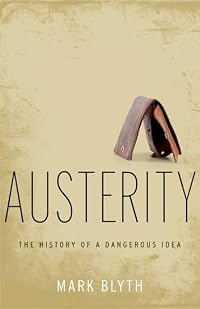
Austerity: The History of a Dangerous Idea
by Mark Blyth
On This Page
Description
Politicians today in both Europe and the United States have succeeded in casting government spending as reckless wastefulness that has made the economy worse. In contrast, they have advanced a policy of draconian budget cuts--austerity--to solve the financial crisis. We are told that we have all lived beyond our means and now need to tighten our belts. This view conveniently forgets where all that debt came from. Not from an orgy of government spending, but as the direct result of bailing show more out, recapitalizing, and adding liquidity to the broken banking system. Through these actions private debt was rechristened as government debt while those responsible for generating it walked away scot free, placing the blame on the state, and the burden on the taxpayer. That burden now takes the form of a global turn to austerity, the policy of reducing domestic wages and prices to restore competitiveness and balance the budget. The problem, according to political economist Mark Blyth, is that austerity is a very dangerous idea. First of all, it doesn't work. As the past four years and countless historical examples from the last 100 years show, while it makes sense for any one state to try and cut its way to growth, it simply cannot work when all states try it simultaneously: all we do is shrink the economy. In the worst case, austerity policies worsened the Great Depression and created the conditions for seizures of power by the forces responsible for the Second World War: the Nazis and the Japanese military establishment. As Blyth amply demonstrates, the arguments for austerity are tenuous and the evidence thin. Rather than expanding growth and opportunity, the repeated revival of this dead economic idea has almost always led to low growth along with increases in wealth and income inequality. Austerity demolishes the conventional wisdom, marshaling an army of facts to demand that we recognize austerity for what it is, and what it costs us. show lessTags
Recommendations
















Member Reviews
My favorite thing about reading occurs when I do not understand a concept. I read a book about it and then, magically, knowledge appears. This is perhaps a clichéd notion, but it still makes me feel good about reading. By no stretch of the imagination will I be able to teach a course in economics after this one, but when I hear radio and news reports of the economic landscape, I should be able to follow them with a little more understanding. Mark Blyth’s Austerity is a book really about three related things: convoluted economic instruments and how their interrelatedness sparked the current global downturn, the history of austerity as a way to alter a country’s financial standing, and how the clarion call for austerity measures in show more economically weak European countries is perhaps the wrong thing to do.
Austerity is the measure by which a country endeavors to tighten its fiscal belt in order to reduce the amount of debt it’s carrying and show to the world that it is trying to become less deficit-heavy. Interestingly, there are two things happening here. One is an actual change in balance sheets in that the government has to decrease actual spending in order not to go into default. The other is a perceived change to induce other countries to trust in the future liquidity and investment possibilities of said austere state. After reading this book, I realized that economics is always a combination of these two forces—the real and the imagined.
Blyth’s history of the current financial crisis is surprisingly easy to read, even though he has to explain things like credit default swaps, mortgage-backed securities, and value at risk analysis. While he clearly has an agenda (and who doesn’t), his explanations have merit. Most of what happened in the real estate crisis had little to do with state spending and government debt. The only hand the government had in the downturn was the omission of rigid and exact regulation on new banking products. When banks bundled together what they thought were low-risk, low-volatility products, they actually created high-risk securities that blow up in their face.
Blyth’s parallel history of the idea of austerity is in many ways not as interesting, We get the standard Locke-Hume-Smith thread that seeks to endow every citizen with the opportunity to amass property and calls for the state to check its own immense power to remove that property from the citizen. The problem comes from the disconnect between lawmakers enacting austerity measures and how that will invariably affect the populace in a disproportionate manner. If everybody has to take a financial hit once measures are in place, it’s those who are lowest on the totem pole who will invariably feel it the most.
This book was astonishing in the amount of information it has to offer. I was fully prepared to be put to sleep by all the economic mumbo-jumbo, but following Blyth’s arguments and polemic against the use of austerity turned out to be quite interesting. The metaphors he uses for modern financial theories and instruments are apt and elegant. While this book will of course have its detractors and bring out age-old political arguments, the history of the idea is certainly worth a look—even if it’s because you’re trying to know thy enemy. show less
Austerity is the measure by which a country endeavors to tighten its fiscal belt in order to reduce the amount of debt it’s carrying and show to the world that it is trying to become less deficit-heavy. Interestingly, there are two things happening here. One is an actual change in balance sheets in that the government has to decrease actual spending in order not to go into default. The other is a perceived change to induce other countries to trust in the future liquidity and investment possibilities of said austere state. After reading this book, I realized that economics is always a combination of these two forces—the real and the imagined.
Blyth’s history of the current financial crisis is surprisingly easy to read, even though he has to explain things like credit default swaps, mortgage-backed securities, and value at risk analysis. While he clearly has an agenda (and who doesn’t), his explanations have merit. Most of what happened in the real estate crisis had little to do with state spending and government debt. The only hand the government had in the downturn was the omission of rigid and exact regulation on new banking products. When banks bundled together what they thought were low-risk, low-volatility products, they actually created high-risk securities that blow up in their face.
Blyth’s parallel history of the idea of austerity is in many ways not as interesting, We get the standard Locke-Hume-Smith thread that seeks to endow every citizen with the opportunity to amass property and calls for the state to check its own immense power to remove that property from the citizen. The problem comes from the disconnect between lawmakers enacting austerity measures and how that will invariably affect the populace in a disproportionate manner. If everybody has to take a financial hit once measures are in place, it’s those who are lowest on the totem pole who will invariably feel it the most.
This book was astonishing in the amount of information it has to offer. I was fully prepared to be put to sleep by all the economic mumbo-jumbo, but following Blyth’s arguments and polemic against the use of austerity turned out to be quite interesting. The metaphors he uses for modern financial theories and instruments are apt and elegant. While this book will of course have its detractors and bring out age-old political arguments, the history of the idea is certainly worth a look—even if it’s because you’re trying to know thy enemy. show less
New Dimensions in Bait ‘n’ Switch
Right off the top, I liked Austerity, because it directed me to a Youtube video of the author giving a five minute summary of the book in his lovely Scottish accent, immersed in complementary animation that he seemed to direct with his hands. A great start, that made me read with his delivery in mind. Fortunately, his writing is as clear, direct and succinct as his speaking, so it made reading Austerity a pleasure. It added immeasurably to the total experience. Something more authors might consider to get into the heads of their readers.
Austerity (the book) seems to be a bunch of Keystone Kops in dark suits, madly running around accomplishing very little. They rationalize, they contradict themselves show more and their policies, they make the same dumb moves over and over, they make up incredible formulas that cannot work even in theory, they take down the economies of the world – and they blame their governments for the mess they leave. The result is bankers continuing to pay themselves obscenely, while governments are saddled with assumed banking debt and the ugly prospect of austerity, as Blyth puts it, that “constitutes the greatest bait and switch in human history.”
Blyth proves repeatedly that austerity is “zombie economics” – no matter how many times it is disproved, it just keeps coming back for more. No amount of mere fact disconfirms a good ideology, he tells us.
He hammers the point that in essentially every national case except maybe Greece, government spending was not behind the current financial collapse. Government was not overspending, not creating inflation, not distorting the economy. It was the bankers doing that, with theories of efficient markets and off the books vehicles. When it blew up, government had to step in, and the private mess became public debt, with bankers walking away whole –again.
Blyth gives vibrant life to the chaos. Unfortunately, what he doesn’t say is that austerity becomes self fulfilling, as people claim the state of the economy is a reflection of the crippling effect of national debt. Faced with this new burden of public-ized bank debt, everyone fears saddling their children with it, and only austerity can reduce the debt. This is doubly unfortunate, because as Blyth proves decisively, austerity actually increases debt, every time and everywhere it is applied.
I disagree with Blyth’s acidic view of the euro. He says it is an “unmitigated disaster for everyone but the Germans,” and spends a lot of space slamming it. But countries are lined up for years forward to get into the euro, because they see how well their neighbors are doing by it. Even now, countries jostle to get on the waiting list. Countries like Estonia and Slovakia have benefited mightily in just a few years; they could not possibly have done as well with their own insignificant currencies. The original euro members have only themselves to blame for running up deficits. Hardly the fault of the euro, though Blyth blames it instead of them. France’s myopic (anti)industrial policy is at least as much to blame for its fiscal woes as anything Societé Generale or BNP did to load up on sovereigns (country bonds). Germany’s greed with its surpluses reminds us of China, only the Germans are the good guys for most of us, so it’s acceptable. Blyth also conveniently and completely omits the out and out fraud of both Italy and Greece in entering the euro in the first place. While he notes that Greece had not generated a surplus in 50 years, he doesn’t relate how it was able to (magically) declare less than 3% deficit in order to qualify for entry. It repeatedly failed to qualify, until the last minute, when it suddenly turned out Greece’s ducks were all in a row after all – a model student. Please. But the powers that be bought it, lock, stock and barrel. The same scenario played out for Italy. And in the intervening years, neither country did anything to reform and legitimize their accession. So fraud is why the euro was “an accident waiting to happen” as much as anything Blyth posits about regulations.
Furthermore, the American dollar is living proof of why the euro will survive and thrive. Despite all the crises, the budget deficits, the trade deficits, the debt, the mismanagement and the uncertainty, the dollar refuses to decline. And this despite the treasury printing possibly nine trillion new dollars to save the banks (which Blyth shows is money down the drain). The dollar has no intrinsic value; it is a fiat instrument, just like the euro. Normally, you could not print so very much money and not have it seriously affect the currency. But if all the major fiat currencies are dealing with these same factors, and they’re all trying to devalue, they will all remain in place relative to each other. At least that’s how it has been working this millennium. It’s a confidence game, not a value play. As long as people believe in the euro, there will be value attached to the euro. And that’s why the discredited concept “austerity” continues to survive. You can’t stop it, much as Blyth wants to, because despite the theory and despite all the evidence, people still believe.
It’s no secret the euro is flawed because of all the constraints it members shackled it with to emulate their wonderful old national systems. That is being undone slowly, with small concessions from Germany and workarounds by the ECB, for example. Eventually, the whole thing will have to rationalized, or this will happen again, and worse, just like financial crises in the US. I don’t think there’s any controversy there. But there’s more than just the euro in economics:
Blyth is hypercritical – of everyone and everything. Independent central banks “spread like a rash all over the face of the planet” is a typical description. Hard to please, it seems, but entertaining in an otherwise dismal science.
Austerity the concept needs no more disproof than the IMF and the “economic hit men” who impose it on every developing country, despite its total failure wherever it is implemented. It’s garden-variety hypocrisy, and it’s global. Contradictions in terms like “expansionary austerity” don’t seem to dull its blade either. It’s a pesky fly you can swat at, but not kill. But Blyth tries. He beats it up, body slams it to the mat repeatedly and clubs it over the head with an (economic) anvil. He meticulously trashes every study that supports it. I particularly appreciated the point that central banks can offset contracting budget cuts by lowering interest rates, but in our situation of near zero rates, there can only be pain from deep cuts. So in case you missed it – austerity the concept never works. Basically, contractions beget contraction, and expansion begets expansions. Everything else is fantasy.
Austerity the book is an expression of great frustration. If it shows one thing, it’s that no economic school or theory works. There is some aspect that fits in every situation, but nothing covers totally or perfectly. They have a hard enough time fitting the past and none of them has a prescription that will work going forward. As JK Galbraith said, the only reason for economic forecasts is to build credibility for astrology.
Unlike austerity the concept, Austerity the book is very rewarding. show less
Right off the top, I liked Austerity, because it directed me to a Youtube video of the author giving a five minute summary of the book in his lovely Scottish accent, immersed in complementary animation that he seemed to direct with his hands. A great start, that made me read with his delivery in mind. Fortunately, his writing is as clear, direct and succinct as his speaking, so it made reading Austerity a pleasure. It added immeasurably to the total experience. Something more authors might consider to get into the heads of their readers.
Austerity (the book) seems to be a bunch of Keystone Kops in dark suits, madly running around accomplishing very little. They rationalize, they contradict themselves show more and their policies, they make the same dumb moves over and over, they make up incredible formulas that cannot work even in theory, they take down the economies of the world – and they blame their governments for the mess they leave. The result is bankers continuing to pay themselves obscenely, while governments are saddled with assumed banking debt and the ugly prospect of austerity, as Blyth puts it, that “constitutes the greatest bait and switch in human history.”
Blyth proves repeatedly that austerity is “zombie economics” – no matter how many times it is disproved, it just keeps coming back for more. No amount of mere fact disconfirms a good ideology, he tells us.
He hammers the point that in essentially every national case except maybe Greece, government spending was not behind the current financial collapse. Government was not overspending, not creating inflation, not distorting the economy. It was the bankers doing that, with theories of efficient markets and off the books vehicles. When it blew up, government had to step in, and the private mess became public debt, with bankers walking away whole –again.
Blyth gives vibrant life to the chaos. Unfortunately, what he doesn’t say is that austerity becomes self fulfilling, as people claim the state of the economy is a reflection of the crippling effect of national debt. Faced with this new burden of public-ized bank debt, everyone fears saddling their children with it, and only austerity can reduce the debt. This is doubly unfortunate, because as Blyth proves decisively, austerity actually increases debt, every time and everywhere it is applied.
I disagree with Blyth’s acidic view of the euro. He says it is an “unmitigated disaster for everyone but the Germans,” and spends a lot of space slamming it. But countries are lined up for years forward to get into the euro, because they see how well their neighbors are doing by it. Even now, countries jostle to get on the waiting list. Countries like Estonia and Slovakia have benefited mightily in just a few years; they could not possibly have done as well with their own insignificant currencies. The original euro members have only themselves to blame for running up deficits. Hardly the fault of the euro, though Blyth blames it instead of them. France’s myopic (anti)industrial policy is at least as much to blame for its fiscal woes as anything Societé Generale or BNP did to load up on sovereigns (country bonds). Germany’s greed with its surpluses reminds us of China, only the Germans are the good guys for most of us, so it’s acceptable. Blyth also conveniently and completely omits the out and out fraud of both Italy and Greece in entering the euro in the first place. While he notes that Greece had not generated a surplus in 50 years, he doesn’t relate how it was able to (magically) declare less than 3% deficit in order to qualify for entry. It repeatedly failed to qualify, until the last minute, when it suddenly turned out Greece’s ducks were all in a row after all – a model student. Please. But the powers that be bought it, lock, stock and barrel. The same scenario played out for Italy. And in the intervening years, neither country did anything to reform and legitimize their accession. So fraud is why the euro was “an accident waiting to happen” as much as anything Blyth posits about regulations.
Furthermore, the American dollar is living proof of why the euro will survive and thrive. Despite all the crises, the budget deficits, the trade deficits, the debt, the mismanagement and the uncertainty, the dollar refuses to decline. And this despite the treasury printing possibly nine trillion new dollars to save the banks (which Blyth shows is money down the drain). The dollar has no intrinsic value; it is a fiat instrument, just like the euro. Normally, you could not print so very much money and not have it seriously affect the currency. But if all the major fiat currencies are dealing with these same factors, and they’re all trying to devalue, they will all remain in place relative to each other. At least that’s how it has been working this millennium. It’s a confidence game, not a value play. As long as people believe in the euro, there will be value attached to the euro. And that’s why the discredited concept “austerity” continues to survive. You can’t stop it, much as Blyth wants to, because despite the theory and despite all the evidence, people still believe.
It’s no secret the euro is flawed because of all the constraints it members shackled it with to emulate their wonderful old national systems. That is being undone slowly, with small concessions from Germany and workarounds by the ECB, for example. Eventually, the whole thing will have to rationalized, or this will happen again, and worse, just like financial crises in the US. I don’t think there’s any controversy there. But there’s more than just the euro in economics:
Blyth is hypercritical – of everyone and everything. Independent central banks “spread like a rash all over the face of the planet” is a typical description. Hard to please, it seems, but entertaining in an otherwise dismal science.
Austerity the concept needs no more disproof than the IMF and the “economic hit men” who impose it on every developing country, despite its total failure wherever it is implemented. It’s garden-variety hypocrisy, and it’s global. Contradictions in terms like “expansionary austerity” don’t seem to dull its blade either. It’s a pesky fly you can swat at, but not kill. But Blyth tries. He beats it up, body slams it to the mat repeatedly and clubs it over the head with an (economic) anvil. He meticulously trashes every study that supports it. I particularly appreciated the point that central banks can offset contracting budget cuts by lowering interest rates, but in our situation of near zero rates, there can only be pain from deep cuts. So in case you missed it – austerity the concept never works. Basically, contractions beget contraction, and expansion begets expansions. Everything else is fantasy.
Austerity the book is an expression of great frustration. If it shows one thing, it’s that no economic school or theory works. There is some aspect that fits in every situation, but nothing covers totally or perfectly. They have a hard enough time fitting the past and none of them has a prescription that will work going forward. As JK Galbraith said, the only reason for economic forecasts is to build credibility for astrology.
Unlike austerity the concept, Austerity the book is very rewarding. show less
This is very much a book of the moment, though this is partly a matter of luck. While Mark Blyth’s book was written in response to the emergence of austerity policies in 2010, its publication was nicely timed with the contemporaneous undermining of the key study by Carmen Reinhart and Kenneth Rogoff which was used to make the case for the necessity of austerity. Though Blyth’s book was written before the revelation of the study’s flaws, his more broader focus on the origins and development of austerity is no less powerful and damming.
Blyth’s book can be broken down into three parts. The first is an explanation of the recent debt crisis that has plagued the global economy. Here Blyth demonstrates that, contrary to much of the show more political rhetoric, this did not originate as a sovereign debt crisis but as a private debt crisis in the banking sector, one that became a sovereign debt crisis in a “bait and switch” as European states (and their taxpayers) absorbed the costs of fixing the problems created by the profligate and unwise lending policies of several European banks. Blyth then turns his attention to the history of the idea of austerity, which he sees as born out of a set of assumptions in classical economic theory that remained overly simplistic and underdeveloped. He concludes the book with an examination of the application of austerity as policy in recent history, showing how the examples of the past offer clear demonstration of its failure of austerity as a solution to economic crisis – and often end up making the problems worse rather than better.
All of this makes for a convincing argument against austerity as a response to economic downturns. Its effectiveness is aided by Blyth’s ability to walk the reader through the recent crises and untangle the underlying causes. While his use of economic jargon can make some of his arguments difficult to follow, overall he provides a clear and direct explanation of economic events. The result is a book that should be read by anyone seeking a better understanding not just of the concept of austerity and its misuse, but of the broader economic crisis we face and what brought us to this point. show less
Blyth’s book can be broken down into three parts. The first is an explanation of the recent debt crisis that has plagued the global economy. Here Blyth demonstrates that, contrary to much of the show more political rhetoric, this did not originate as a sovereign debt crisis but as a private debt crisis in the banking sector, one that became a sovereign debt crisis in a “bait and switch” as European states (and their taxpayers) absorbed the costs of fixing the problems created by the profligate and unwise lending policies of several European banks. Blyth then turns his attention to the history of the idea of austerity, which he sees as born out of a set of assumptions in classical economic theory that remained overly simplistic and underdeveloped. He concludes the book with an examination of the application of austerity as policy in recent history, showing how the examples of the past offer clear demonstration of its failure of austerity as a solution to economic crisis – and often end up making the problems worse rather than better.
All of this makes for a convincing argument against austerity as a response to economic downturns. Its effectiveness is aided by Blyth’s ability to walk the reader through the recent crises and untangle the underlying causes. While his use of economic jargon can make some of his arguments difficult to follow, overall he provides a clear and direct explanation of economic events. The result is a book that should be read by anyone seeking a better understanding not just of the concept of austerity and its misuse, but of the broader economic crisis we face and what brought us to this point. show less
Blyth's treatment of the concept of austerity contributes significantly to our understanding both of economic history and the history of political thought without holding back on advocacy. Austerity fails time after time, Blyth shows. His overview of the origins of austerity in seventeenth- and eighteenth-century Britain, while brief, demonstrates crucially that the policy's moral component is a big part of its resilience. His insistence that ideas about austerity grow out of liberalism's ambivalence about the relationship between state and market is also a useful corrective to those who equate capitalism with unfettered economic freedom. Austerity may be a simple idea that seems rooted in common sense, but it has a complicated history show more that Blyth helpfully offers to reshape current debates among policy wonks and the public alike. Both its "natural" and "intellectual" histories offer a sustained argument that, despite the protestations of self-proclaimed pragmatists, ideas powerfully shape human behavior. One can only hope the book will find a wide audience. show less
 This review was written for LibraryThing Early Reviewers.
Mark Blyth’s Austerity: The History of a Dangerous Idea goes a long way to discredit both the theory and the practice of debt reduction as a means to achieve fiscal recovery in the current economic crisis. Mr Blyth’s book outlines the dubious underpinnings of austerity as an economic theory and looks at the perilous consequences of pursuing austerity in the current economy. His call for abandoning this path is not the only one. Most recently we have seen the influential Reinhart-Rogoff report discredited for using bogus math to reach their conclusions; clearly this is a case of the cart before the horse – facts being tailored to fit the theory. So why do otherwise rational policy-makers seem determined to pursue this discredited show more economic theory? Clearly, there are other factors at work. In the United States, the greatest proponents of the austerity medicine are the same people who have repeatedly ignored facts in favor of beliefs. These are the same people who argue Creationism over Evolution. They are same people who accuse climate change scientists of perpetuating a hoax. They are the same people who spout the latest paranoid fantasy whipped up by the NRA. Their intent has nothing to do with fiscal recovery. Rather they are using the economic crisis to dismantle the social welfare framework begun by Franklin Delano Roosevelt and developed over the last 70 to 80 years to ameliorate the inherent evils of capitalism. In America, this policy is being used to justify a class warfare waged by the capital class (the 1 percenters) against the workers (everyone else). In Europe, despite Andrea Merkel’s claims to the contrary, pushing the austerity agenda seems to be Germany once again attempting to establish their dominance on the continent. Small wonder that France is their opponent in this endeavor. When Germany demands that Eurozone members have to surrender authority to European institutions (controlled by Germany), the overall intent seems clear. Despite the constant rounds of austerity imposed on the countries in Europe, the economic situation there has only gotten worse instead of better. Mark’s book explains why. And now as the effects of “Sequester” filter down through the American economy, we know that we too will see a prolonged worsening of our economy as well. show less
This review was written for LibraryThing Early Reviewers.I learned about this book from my mother, who heard an interview with the author on NPR.
Blyth grew up in Scotland, and is a professor of political economy at Brown. Oxford University Press published this title in 2015.
You may have heard of the concept if you’ve been following current events in Europe. In short, austerity is the curtailment of government spending, often resulting in large cuts to the welfare state and other social expenditures. It is often justified by the aim of reducing government debt, although this claim is almost always fraudulent in practice (if not in intention).
As the subtitle suggests (“The History of a Dangerous Idea”), austerity isn’t just uncomfortable, but could be blamed (indirectly), for such show more inhumane incidents as World War II. Blyth meticulously tracks the history of austerity globally, going back to the roots of the concept with Adam Smith and John Locke, tracing it’s evolution over the past century, and then offering a current-day analysis. If anything, his refutation of research done over the past thirty years in support of austerity is too rigorous, verging on obsessive.
Ultimately, this book is an economic text, and you should be prepared for technical literature (although there isn’t any math in the book) if you’re considering picking up this book.
One refrain in the book is that austerity is an ideology too compelling to be dispelled by a century of misery, destruction, and abject failure. Although Blyth repeatedly admits the inability of facts to have any impact to discredit austerity, he blunders on with a relentlessly fact-based rhetoric throughout the text. The book leaves two vital questions unanswered:
1. If austerity fails to accomplish its stated aims so consistency, what affords it such credence?
2. What ideology of superior ethic and utility has the temerity to unseat austerity?
In the book, Blyth valiantly strives to unpack some of the underlying fundamentals that drive a healthy economy. Such a feat is not to be scoffed at; few academics or economists make it this far, tending to fumble about with mechanisms rather than getting to the pattern level. It is a question that has been driving much of my inquiry for many years now. He does so by illustrating relatively simple maxims, rather than getting into the complex metaphysics underlying the social technology we call money (also a fascinating arena, but less approachable).
I’m disappointed that Blyth is so dismissive of Occupy Wall Street and debt forgiveness solutions. Doesn’t he realize that default and bankruptcy are fundamental mechanisms of any healthy economy? He would do well to learn from the work of Andrew Ross at NYU.
Where is the inquisitive reader to go from here? I’m looking forward to reading histories of Japan and China, as well as Yanis Varoufakis’ two most recent books. Unfortunately, I have yet to encounter a paradigm that encompasses ecological economics while preserving a high quality of living. Currently, the faster our economy churns, the more destruction is borne. And yet, depressions more commonly result in fascist dictatorships than socialist anarchies. How we bridge economic and ecological health is one of the existential mandates of our times, and the more I learn, the further I realize we are from a pragmatic solution. Regenerative economics continues to be elusive. show less
Blyth grew up in Scotland, and is a professor of political economy at Brown. Oxford University Press published this title in 2015.
You may have heard of the concept if you’ve been following current events in Europe. In short, austerity is the curtailment of government spending, often resulting in large cuts to the welfare state and other social expenditures. It is often justified by the aim of reducing government debt, although this claim is almost always fraudulent in practice (if not in intention).
As the subtitle suggests (“The History of a Dangerous Idea”), austerity isn’t just uncomfortable, but could be blamed (indirectly), for such show more inhumane incidents as World War II. Blyth meticulously tracks the history of austerity globally, going back to the roots of the concept with Adam Smith and John Locke, tracing it’s evolution over the past century, and then offering a current-day analysis. If anything, his refutation of research done over the past thirty years in support of austerity is too rigorous, verging on obsessive.
Ultimately, this book is an economic text, and you should be prepared for technical literature (although there isn’t any math in the book) if you’re considering picking up this book.
One refrain in the book is that austerity is an ideology too compelling to be dispelled by a century of misery, destruction, and abject failure. Although Blyth repeatedly admits the inability of facts to have any impact to discredit austerity, he blunders on with a relentlessly fact-based rhetoric throughout the text. The book leaves two vital questions unanswered:
1. If austerity fails to accomplish its stated aims so consistency, what affords it such credence?
2. What ideology of superior ethic and utility has the temerity to unseat austerity?
In the book, Blyth valiantly strives to unpack some of the underlying fundamentals that drive a healthy economy. Such a feat is not to be scoffed at; few academics or economists make it this far, tending to fumble about with mechanisms rather than getting to the pattern level. It is a question that has been driving much of my inquiry for many years now. He does so by illustrating relatively simple maxims, rather than getting into the complex metaphysics underlying the social technology we call money (also a fascinating arena, but less approachable).
I’m disappointed that Blyth is so dismissive of Occupy Wall Street and debt forgiveness solutions. Doesn’t he realize that default and bankruptcy are fundamental mechanisms of any healthy economy? He would do well to learn from the work of Andrew Ross at NYU.
Where is the inquisitive reader to go from here? I’m looking forward to reading histories of Japan and China, as well as Yanis Varoufakis’ two most recent books. Unfortunately, I have yet to encounter a paradigm that encompasses ecological economics while preserving a high quality of living. Currently, the faster our economy churns, the more destruction is borne. And yet, depressions more commonly result in fascist dictatorships than socialist anarchies. How we bridge economic and ecological health is one of the existential mandates of our times, and the more I learn, the further I realize we are from a pragmatic solution. Regenerative economics continues to be elusive. show less
The author argues that nations which are overburdened by debt cannot ease their situation by tightening the belt on public expenditures. Doing so will only produce more unemployment, not improve competitiveness. He discusses the economic crisis of 2009 in the United States and Europe and argues that it was wrong to make ordinary taxpayers bail out profligate banks and suffer austerity programs. He acknowledges that the decision was difficult but writes that it would probably have been better, at least in Europe, to let the banks fail. He takes a few shots at the euro in the process, but the main message is that states should not expect to reduce their indebtedness by cutting spending. The author favors Keynesian stimulation instead.
The show more book is written in a reasonably clear manner. A layman can follow the author's explanation of the causes of the financial crisis fairly well, although he does at times steam ahead a bit too rapidly with acronyms that would only be familiar to economic professionals. In any case, as far as I can tell the author makes a good case against austerity measures. I particularly liked his modern intellectual history of academic scholarship in favour of austerity.
However, I would have liked to read something more about the alternatives. The author acknowledges that Greece was over its head in debt and could probably not have spent its way out of that hole without having debts cancelled, but he doesn't give any practical case studies of moderately indebted countries that would have reduced their indebtedness by following the Keynesian strategies which he advocates as the better alternative. It also would have been nice to obtain some other general conclusion from this argument than simply "austerity is a dangerous idea". It seems clear from the author's analysis of the financial crisis that its main cause was the growth of labyrinthine banking instruments where sane economic caution was lost, and that the solution to that problem should be more bank regulation. But I suppose that's a topic for another book.
All in all, this is a good but somewhat one-sided economic analysis of the 2009 financial crisis and the economic policies that were implement soon afterward. show less
The show more book is written in a reasonably clear manner. A layman can follow the author's explanation of the causes of the financial crisis fairly well, although he does at times steam ahead a bit too rapidly with acronyms that would only be familiar to economic professionals. In any case, as far as I can tell the author makes a good case against austerity measures. I particularly liked his modern intellectual history of academic scholarship in favour of austerity.
However, I would have liked to read something more about the alternatives. The author acknowledges that Greece was over its head in debt and could probably not have spent its way out of that hole without having debts cancelled, but he doesn't give any practical case studies of moderately indebted countries that would have reduced their indebtedness by following the Keynesian strategies which he advocates as the better alternative. It also would have been nice to obtain some other general conclusion from this argument than simply "austerity is a dangerous idea". It seems clear from the author's analysis of the financial crisis that its main cause was the growth of labyrinthine banking instruments where sane economic caution was lost, and that the solution to that problem should be more bank regulation. But I suppose that's a topic for another book.
All in all, this is a good but somewhat one-sided economic analysis of the 2009 financial crisis and the economic policies that were implement soon afterward. show less
Members
- Recently Added By
Published Reviews
ThingScore 100
If you only read one book about the current state of the world’s economy—and the reasons for it—Austerity should be the one. Mark Blyth, a political economist at Brown University, has written a short history of austerity that ought to put a stake through the heart of the idea that we can rescue a recessionary economy by cutting back on government spending.
added by KelMunger
Lists

LT picks: Blue Books
197 works; 44 members
Author Information
10 Works 559 Members
Mark Blyth is Professor of International Political Economy at Brown University.
Common Knowledge
- Canonical title*
- Talouskuri : Vaarallisen opin historia
- Original publication date
- 2012
- Dedication
- For Jules
This book has cost you as many hours as it has cost me, possible more. I really could not have written this without your love and support. Thank you. - First words
- On Friday, August 5, 2011, what used to be the fiscally unthinkable happened.
- Quotations
- . . . the greatest bait-and-switch operation in modern history. What were essentially private-sector debt problems were rechristened as ‘the Debt’ generated by ‘out-of-control’ public spending.
*Some information comes from Common Knowledge in other languages. Click "Edit" for more information.
Classifications
Statistics
- Members
- 433
- Popularity
- 70,742
- Reviews
- 22
- Rating
- (3.91)
- Languages
- 5 — English, Finnish, German, Portuguese (Portugal), Spanish
- Media
- Paper, Audiobook, Ebook
- ISBNs
- 15
- UPCs
- 1
- ASINs
- 5