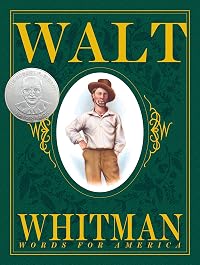
Walt Whitman: Words for America
by Barbara Kerley
On This Page
Description
A biography of the American poet whose compassion led him to nurse soldiers during the Civil War, to give voice to the nation's grief at Lincoln's assassination, and to capture the true American spirit in verse.Tags
Recommendations



Member Reviews
I am a fan of Brian Selznick so I was thrilled to discover that he illustrated Walt Whitman: Words for America. I didn't know much about Walt Whitman's life before reading this book and I was deeply moved by his story. I was especially moved by Whitman's actions during the Civil War, when after searching for his brother, who was wounded in the war, Whitman stayed at the hospital for the duration of the war, tending to the wounded soldiers. The story is well written and the seamless use of Whitman's poetry throughout brings new meaning to verses I'd heard before. The illustrations were incredible and Selznick captured deep emotions in his illustrations. I have not seen many of Selznick's works in color.
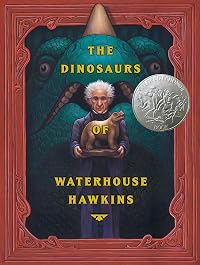
Making Walt Whitman's involvement in and reactions to the American Civil War their focus, Barbara Kerley and Brian Selznick - the same author/illustrator team behind the fabulous The Dinosaurs of Waterhouse Hawkins: An Illuminating History of Mr. Waterhouse Hawkins, Artist and Lecturer - have produced an emotionally involving, and artistically satisfying picture-book about this great American poet. Making judicious use of Whitman's own words, Kerley begins (appropriately enough) with Whitman's youth, and his time as a printer's apprentice, but quickly moves on to his adulthood, the development of his free-wheeling poetic style - so out of step with the literary establishment of the day - and his work as a sort of de facto, unofficial show more nurse in Washington, D.C., during the dark days of the Civil War. The tragic aftermath of the war, and the assassination of Abraham Lincoln - for whom Whitman felt a deep admiration and love - is also covered, with a brief summary of the poet's alter years.
All things considered, I don't know that Walt Whitman: Words for America is really the best biography of this poet for young people, as it has such a specific focus, but as an exploration of Whitman's involvement in the life of the nation - his sense of himself as a sort of everyman, his desire to speak for and to the common man, his love for people of all kinds, and of all regions - it succeeds. The artwork is simply beautiful, and it struck me, as I was looking at it, they'd I'd only really seen Selznick's black-and-white pencil drawings, in works like The Invention of Hugo Cabret and Wonderstruck, so it was good to finally experience his full-color paintings. The two-page on which two Whitmans are facing away from one another - one rushing along a crowded city street, the other running naked along a deserted beach - was particularly appealing, although I really appreciated them all.
In short: this is a wonderful book, very informative and thought-provoking, that will introduce young readers to Whitman and his poetry (I found, after reading it, that I wanted to pick up my Whitman, realizing that it really had been some time), while also treating them to some beautiful illustrations! show less
All things considered, I don't know that Walt Whitman: Words for America is really the best biography of this poet for young people, as it has such a specific focus, but as an exploration of Whitman's involvement in the life of the nation - his sense of himself as a sort of everyman, his desire to speak for and to the common man, his love for people of all kinds, and of all regions - it succeeds. The artwork is simply beautiful, and it struck me, as I was looking at it, they'd I'd only really seen Selznick's black-and-white pencil drawings, in works like The Invention of Hugo Cabret and Wonderstruck, so it was good to finally experience his full-color paintings. The two-page on which two Whitmans are facing away from one another - one rushing along a crowded city street, the other running naked along a deserted beach - was particularly appealing, although I really appreciated them all.
In short: this is a wonderful book, very informative and thought-provoking, that will introduce young readers to Whitman and his poetry (I found, after reading it, that I wanted to pick up my Whitman, realizing that it really had been some time), while also treating them to some beautiful illustrations! show less
"In these ordinary Americans he saw the true spirit of the nation" (5)
Walt Whitman: Words For America is a Sibert Honor Book that chronicles the poet's life with beautiful prose and gorgeous illustrations. Rather than focusing on his entire life, Words For America explores a unique angle and primarily examines Whitman’s perspective and involvement in the Civil War. Aside from "Oh Captain, My Captain", the Civil War is not the first association I make with Whitman, so this was fascinating territory to explore. The book portrays Whitman as an incredibly genuine and caring individual, and I was deeply moved by the stories of his service as a volunteer nurse -- especially the accounts of him remaining bedside to comfort strangers as they show more died.
Throughout the book the author included excerpts of Whitman's poetry. I thought this was an excellent decision. I found myself savoring the lines within the context of what I was reading and making mental notes of which full-length poems I wanted to revisit at a later time (several are conveniently printed in the back of the book). The book is a great introduction to the character of Whitman and really captures, what I believe to be, his true spirit -- an attempt to deeply understand America through the ordinary people that surrounded him.
In regards to aesthetics, the book itself is stunning. The cover features a die-cut center and embossed gold lettering, and each page within is mesmerizing in its own unique way. I really loved how greatly the illustrations varied in size. In the more somber moments of the story the illustrations are small and quiet, and in the less introspective moments they were bold and loud. These decisions really help to guide the pacing and tone of the story.
The back of the book features supplemental mini-biographies on both Whitman and Lincoln, and as mentioned above, a small collection of Whitman's poetry. As a fan of Whitman, I was excited to read this book and was surprised to discover that I actually knew very little about him! The Civil War perspective is a fascinating angle, and it has opened up the doors for new understanding of Whitman’s life and poetry. show less
Walt Whitman: Words For America is a Sibert Honor Book that chronicles the poet's life with beautiful prose and gorgeous illustrations. Rather than focusing on his entire life, Words For America explores a unique angle and primarily examines Whitman’s perspective and involvement in the Civil War. Aside from "Oh Captain, My Captain", the Civil War is not the first association I make with Whitman, so this was fascinating territory to explore. The book portrays Whitman as an incredibly genuine and caring individual, and I was deeply moved by the stories of his service as a volunteer nurse -- especially the accounts of him remaining bedside to comfort strangers as they show more died.
Throughout the book the author included excerpts of Whitman's poetry. I thought this was an excellent decision. I found myself savoring the lines within the context of what I was reading and making mental notes of which full-length poems I wanted to revisit at a later time (several are conveniently printed in the back of the book). The book is a great introduction to the character of Whitman and really captures, what I believe to be, his true spirit -- an attempt to deeply understand America through the ordinary people that surrounded him.
In regards to aesthetics, the book itself is stunning. The cover features a die-cut center and embossed gold lettering, and each page within is mesmerizing in its own unique way. I really loved how greatly the illustrations varied in size. In the more somber moments of the story the illustrations are small and quiet, and in the less introspective moments they were bold and loud. These decisions really help to guide the pacing and tone of the story.
The back of the book features supplemental mini-biographies on both Whitman and Lincoln, and as mentioned above, a small collection of Whitman's poetry. As a fan of Whitman, I was excited to read this book and was surprised to discover that I actually knew very little about him! The Civil War perspective is a fascinating angle, and it has opened up the doors for new understanding of Whitman’s life and poetry. show less
Before reading Walt Whitman, I had never really loved poetry. Of course there were some poems and poets I enjoyed more than others, but I had never experienced poetry the same--before or since--Whitman. The intense imagery and depth of feeling resonated with me as a young reader in high school, and for the first time, poetry felt real and profound.
Walt Whitman: Words of America is a beautiful tribute to Whitman's life and work for children. The illustrations rival Whitman's own approach to detail, and artist Brian Selznick masterfully captures a variety of emotions layered and embedded throughout Whitman's life in pictures. The dynamic layout offers a mix of full-page and smaller illustrations and text, making the book feel more like a show more piece of workable art than a traditional children's picturebook. Lines of Whitman's poetry are occasionally included in the illustrations, making them visual representations of the poetry itself. One of my favorite illustrations is that opposite the title page: the illustrator's rendition of the title in typeset as Whitman might've arranged it as a child, working as a printer's apprentice. It's not particularly profound, but the image is playful since the letters are presented backwards. I appreciate how it sets the tone for the book, letting readers know that this will be visually appealing and intellectually stimulating.
Kerley's text is educational and informative, and I appreciate that she includes several lines of Whitman's poetry (and one of his letters) to illustrate her point and include his text in the biography. However, I feel as though this book is a case in which the illustrations and style are in danger of overshadowing the text. The book's cover is magnificent: deep matte green, set off with gold typeface, decorative scrollwork, and a color illustration of a young Walt Whitman. Selznick's illustrations could arguably stand alone. Although the text is valuable and not in any way lacking in itself, I felt at times that it slows the pace, and I found myself, an avid Whitman fan, often ready to move on to the next topic. Given the picturebook nature of Walt Whitman: Words for America, there is simply just too much text for what I was expecting. Also, to note, Kerley chose to focus on the Civil War as a major event in Whitman's life. Again, there's nothing wrong with this, but I was hoping to read more about Whitman's early life and influences.
As for using this book in the classroom, I'm not sure if I would use it directly. I might include it in a class library and booktalk it during a poetry unit, but depending on time constraints in the classroom, I think the book has too much text to read together as a class. (It took me just under 17 minutes to read the text at a listener-appropriate pace.) Still, I think the imagery and context available in the text offers students a different perspective on the American classic. show less
Walt Whitman: Words of America is a beautiful tribute to Whitman's life and work for children. The illustrations rival Whitman's own approach to detail, and artist Brian Selznick masterfully captures a variety of emotions layered and embedded throughout Whitman's life in pictures. The dynamic layout offers a mix of full-page and smaller illustrations and text, making the book feel more like a show more piece of workable art than a traditional children's picturebook. Lines of Whitman's poetry are occasionally included in the illustrations, making them visual representations of the poetry itself. One of my favorite illustrations is that opposite the title page: the illustrator's rendition of the title in typeset as Whitman might've arranged it as a child, working as a printer's apprentice. It's not particularly profound, but the image is playful since the letters are presented backwards. I appreciate how it sets the tone for the book, letting readers know that this will be visually appealing and intellectually stimulating.
Kerley's text is educational and informative, and I appreciate that she includes several lines of Whitman's poetry (and one of his letters) to illustrate her point and include his text in the biography. However, I feel as though this book is a case in which the illustrations and style are in danger of overshadowing the text. The book's cover is magnificent: deep matte green, set off with gold typeface, decorative scrollwork, and a color illustration of a young Walt Whitman. Selznick's illustrations could arguably stand alone. Although the text is valuable and not in any way lacking in itself, I felt at times that it slows the pace, and I found myself, an avid Whitman fan, often ready to move on to the next topic. Given the picturebook nature of Walt Whitman: Words for America, there is simply just too much text for what I was expecting. Also, to note, Kerley chose to focus on the Civil War as a major event in Whitman's life. Again, there's nothing wrong with this, but I was hoping to read more about Whitman's early life and influences.
As for using this book in the classroom, I'm not sure if I would use it directly. I might include it in a class library and booktalk it during a poetry unit, but depending on time constraints in the classroom, I think the book has too much text to read together as a class. (It took me just under 17 minutes to read the text at a listener-appropriate pace.) Still, I think the imagery and context available in the text offers students a different perspective on the American classic. show less
Walt Whitman: Words for America tells a touching narrative of how Whitman wrote his way through the civil war. The story explains how Whitman traveled all across the country right before the civil war and how he saw the tension brewing. During the war Whitman continued to travel and document what he witnessed along the way. The book tells of how Whitman became close to President Lincoln and how hard it was for him when he heard about Lincoln’s assassination. All in all, this book does a great job of describing Whitman’s motives throughout his entire life, and I think it would be a great picture book for readers who are beginning to learn about poetry/famous poets.
A lenghty story of the early American poet and his life before and during the Civil War. Chock full of tidbits about his early life and motivation for his many writings. With execptionally beautiful illustrations this story is a good read for anyone of any age.
A brilliantly succinct historical account of Walt Whitman's contribution to America. The historical information is detailed and accurate, but keeps a lively pace so that young readers remain engaged. Illustrations support the text, and excerpts from his poetry aew well selected and moving.
Members
- Recently Added By
Lists

Mensa for Kids Excellence in Reading Award Program (Nonfiction)
54 works; 4 members

Robert F. Sibert Informational Book Medal
102 works; 1 member
Author Information

20+ Works 5,151 Members
All Editions
Awards and Honors
Awards
Distinctions
Publishers Weekly Starred Review (October 18 – 2004)
Kirkus Reviews Starred Review (September 15 – 2004)
School Library Journal Starred Review (November 1 – 2004)
Common Knowledge
- Canonical title
- Walt Whitman: Words for America
Classifications
Statistics
- Members
- 399
- Popularity
- 78,016
- Reviews
- 18
- Rating
- (4.39)
- Languages
- English
- Media
- Paper
- ISBNs
- 3
- UPCs
- 1
- ASINs
- 2