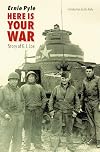
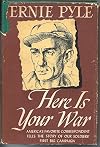
Here Is Your War
by Ernie Pyle
On This Page
Description
A wonderful and enduring tribute to American troops in the Second World War, Here Is Your War is Ernie Pyle's story of the soldiers' first campaign against the enemy in North Africa. With unequaled humanity and insight, Pyle tells how people from a cross-section of America--ranches, inner cities, small mountain farms, and college towns--learned to fight a war. The Allied campaign and ultimate victory in North Africa was built on blood, brave deeds, sacrifice and needless loss, exotic show more vistas, endurance, homesickness, and an unmistakable American sense of humor. It's all here--the suspenseful landing at Oran; the risks taken daily by fighter and bomber pilots; grim, unrelenting combat in the desert and mountains of Tunisia; a ferocious tank battle that ended in defeat for the inexperienced Americans; and the final victory at Tunis. Pyle's keen observations relate the full story of ordinary G.I.s caught up in extraordinary times. show lessTags
Recommendations





















Member Recommendations

Member Reviews
Fascinating, mostly because it doesn't, and doesn't try, to give you an overview. It is, as Pyle frequently states, a worms-eye view of WWII in Africa. Pyle came ashore with the first American landings and stayed with and among the troops for the entire course of the fighting in northern Africa. He wasn't, strictly, embedded - he wandered more or less at will between groups, divisions, encampments, and battles. But he saw the whole thing standing (or ducked down in a foxhole) near the men who did the fighting, and the men and women who supported them behind the lines. The other thing that makes it so good is that these were written as dispatches, and have not been edited (much) to put them into book form. So when we meet someone, we do show more _not_ get an overview of where they end up - no "but his life was to be cut short" or "and by the end of the war he had risen in the ranks" or whatever. That's amazingly refreshing - we get to meet them just as Pyle did, as people "here and now". There's also the oddity (which makes sense, given what he was actually writing) that nearly everyone he meets is identified by full name and address (city at least, sometimes street address). He was writing for the folks at home, and connecting with their family members or friends in the war zone is part of that. He is an optimist, and tends to see the best in everyone and every situation - but he doesn't ignore the darker side of things, just doesn't focus on it (let alone to the exclusion of the brighter side of things, as some war writers do). War is horrific, and funny, and inspiring, and destructive, and all these things at once - and Pyle manages to convey that very well. I want more! There is more - his war dispatches start in England and continue through Africa (this book), Europe, and into the war in the Pacific, though he died there. There are also columns he wrote from before the war, traveling through the US and Canada. I'm going to read them all. show less
Pyle does a superb job of capturing the day to day experience of the common soldier. His anecdotes bring the reality of war to the personal level - whether sad, poignant or humorous. This book should be required reading in ROTC.
Pyle is an amazing writer who really has an affinity with his subject. He'll write about generals, but his real link is with the Air Force fighter crews and the infantry. He makes you feel like you are there. You get the whole picture of war - the boredom, the sacrifice, the anger, the cold, the absolute fear and frustration.
This book is a compilation of articles Pyle wrote about and during the Allied invasion of Africa in 1942 through the defeat of the Axis armies there in mid-1943. Pyle writes from the front much of the time and his perspective is that of the men and women in the ranks--he refers to only two generals in the course of this book, but repeatedly quotes nurses, enlisted men, NCOs and a smattering of lower-ranking officers. It's an engaging, unusual history of the first U.S. ground campaign of World War Two.
Pyle’s writing during the war. Impactful and alive .
Another compilation of Pyle's WWII newspaper columns syndicated by the Scripps-Howard chain. Very, very simple and powerful writing.
He describes in plain words the evennts he sees and the people he meets, and the stories and men work their way right down into you in very short order.
Pyle was a troubled soul, and his life was cut short in the Pacific before the war ended.
Forty of his columns are now online if you'd like a sampling of his stuff: www.journalism.indiana.edu/news/erniepyle/
Scripps-Howard has not forgottten him: www.scripps.com/foundation/programs/pyle/pyle.html
He describes in plain words the evennts he sees and the people he meets, and the stories and men work their way right down into you in very short order.
Pyle was a troubled soul, and his life was cut short in the Pacific before the war ended.
Forty of his columns are now online if you'd like a sampling of his stuff: www.journalism.indiana.edu/news/erniepyle/
Scripps-Howard has not forgottten him: www.scripps.com/foundation/programs/pyle/pyle.html
Ernie Pyle’s stories of the American soldiers’ first campaign against the enemy fought in North Africa. From the landing at Oran to the final victory at Tunis, the author relates the stories of ordinary G.I.s caught up in the war.
Members
- Recently Added By
Lists

Books about World War II
241 works; 22 members

Publisher's Weekly NON-Fiction list - 1912 - 1975
486 works; 4 members
Author Information

19+ Works 2,451 Members
Some Editions
Awards and Honors
Distinctions
Work Relationships
Has the adaptation
Common Knowledge
- Canonical title
- Here Is Your War
- Original publication date
- 1943-10
- People/Characters
- Ernie Pyle; Kay Francis; Martha Raye; Mitzi Mayfair; Carole Landis
- Important places
- North Africa; Oran, Algeria
- Related movies
- Story of G.I. Joe (1945 | IMDb)
- Dedication
- To My Father
- First words
- A trip by troop transport in convoy is a remarkable experience. I came to Africa that way.
- Last words
- (Click to show. Warning: May contain spoilers.)They died and thereby the rest of us can go on and on. When we leave here for the next shore, there is nothing we can do for the ones beneath the wooden crosses, except perhaps to pause and murmur, "Thanks, pal."
- Blurbers
- Kuralt, Charles; Truman, Harry S.; Roosevelt, Eleanor
Classifications
Statistics
- Members
- 696
- Popularity
- 41,050
- Reviews
- 9
- Rating
- (4.18)
- Languages
- English
- Media
- Paper, Ebook
- ISBNs
- 7
- ASINs
- 32