On This Page
Description
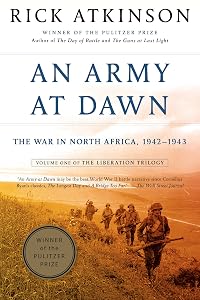
In the first volume of his monumental trilogy about the liberation of Europe in WW II, Pulitzer Prize winner Rick Atkinson tells the riveting story of the war in North Africa. The liberation of Europe and the destruction of the Third Reich is a story of courage and enduring triumph, of calamity and miscalculation. That first year of the Allied war was a pivotal point in American history, the moment when the United States began to act like a great power. Beginning with the daring amphibious show more invasion in November 1942, An Army at Dawn follows the American and British armies as they fight the French in Morocco and Algeria, and then take on the Germans and Italians in Tunisia. Battle by battle, an inexperienced and sometimes poorly led army gradually becomes a superb fighting force. Central to the tale are the extraordinary but fallible commanders who come to dominate the battlefield: Eisenhower, Patton, Bradley, Montgomery, and Rommel. Brilliantly researched, rich with new material and vivid insights, Atkinson's narrative provides the definitive history of the war in North Africa. show lessTags
Recommendations














Member Recommendations


Member Reviews
Atkinson is a beautiful writer, though I was left with questions as to how exactly he knew what the dawn of the day of a WWII battle looked and smelled like—was he prettying up descriptions provided by actual attendees, or inferring from some other source? He spends a lot of time on the physical miseries of war for ordinary soldiers, and emphasizes just how dumb a lot of battles were in purely tactical terms. In North Africa, the Americans started to learn how to fight, but not without lots of mistakes and casualties.
“Memory, too, has transcendent power, even as we swiftly move toward the day when not a single participant remains alive to tell his tale, and the epic of World War II forever slips into national mythology. The author’s task is to authenticate: to warrant that history and memory give integrity to the story, to aver that all this really happened. But the final few steps must be the reader’s. For among mortal powers, only imagination can bring back the dead.”
The first book in the Liberation trilogy provides a riveting account of the Allied landings in North Africa during World War II. Allied troops landed in Algeria and Morocco, overpowered the Vichy French, and fought the Axis forces on the way to Tunisia, the planned launching show more point for the invasion of Italy. It is a detailed description of tactics, strategy, and impact of military operations. It includes profiles of many commanders, including Commander-in-Chief Eisenhower, Alexander, Bradley, Montgomery, Patton, Rommel, and von Arnim.
This is an exceptional work of non-fiction. Atkinson’s writing is outstanding. As I read this book, the descriptions were so vivid that I felt as if a movie were running through my head.
“Not until dusk did the British vanguard reach the col below Longstop’s northwest face. Rain had transformed the Medjerda valley into a vast brown sea too quaggy even for mules. A brace of bullocks was harnessed to pull a few guns forward. Wheeled vehicles bogged down 5,000 yards from the hill. Even tracked carriers could get no closer than Chassart Teffaha, a farm hamlet two miles away. There, in a damp cellar that stank like a slaughterhouse, surgeons worked by candlelight over boys beyond surgeoning; stretcher bearers dumped another load and headed back into the night without even bothering to fold stretchers stiff with blood.”
The author inserts plentiful quotes from journals, correspondences, and official documents to support his conclusions. I appreciated the inclusion of the many maps, photos, and endnotes. We get a “behind the scenes” view of the interpersonal conflicts and military politics among commanders, but it is not just a view from the top. It is also sprinkled with stories of individual soldiers. Atkinson highlights both mistakes and triumphs. “Confusion and error, valor and misdeed marked this first night of green troops in combat.”
North Africa provided a training ground for the previously untested American troops. By the time they reached Tunis, the troops were battle-hardened and ready for the fierce battles to come. It is important to understand the North African campaign in order to get a full picture of the road to the ultimate victory in Europe. I plan to read the final two books in the trilogy. This is history at its finest. I highly recommend it. show less
The first book in the Liberation trilogy provides a riveting account of the Allied landings in North Africa during World War II. Allied troops landed in Algeria and Morocco, overpowered the Vichy French, and fought the Axis forces on the way to Tunisia, the planned launching show more point for the invasion of Italy. It is a detailed description of tactics, strategy, and impact of military operations. It includes profiles of many commanders, including Commander-in-Chief Eisenhower, Alexander, Bradley, Montgomery, Patton, Rommel, and von Arnim.
This is an exceptional work of non-fiction. Atkinson’s writing is outstanding. As I read this book, the descriptions were so vivid that I felt as if a movie were running through my head.
“Not until dusk did the British vanguard reach the col below Longstop’s northwest face. Rain had transformed the Medjerda valley into a vast brown sea too quaggy even for mules. A brace of bullocks was harnessed to pull a few guns forward. Wheeled vehicles bogged down 5,000 yards from the hill. Even tracked carriers could get no closer than Chassart Teffaha, a farm hamlet two miles away. There, in a damp cellar that stank like a slaughterhouse, surgeons worked by candlelight over boys beyond surgeoning; stretcher bearers dumped another load and headed back into the night without even bothering to fold stretchers stiff with blood.”
The author inserts plentiful quotes from journals, correspondences, and official documents to support his conclusions. I appreciated the inclusion of the many maps, photos, and endnotes. We get a “behind the scenes” view of the interpersonal conflicts and military politics among commanders, but it is not just a view from the top. It is also sprinkled with stories of individual soldiers. Atkinson highlights both mistakes and triumphs. “Confusion and error, valor and misdeed marked this first night of green troops in combat.”
North Africa provided a training ground for the previously untested American troops. By the time they reached Tunis, the troops were battle-hardened and ready for the fierce battles to come. It is important to understand the North African campaign in order to get a full picture of the road to the ultimate victory in Europe. I plan to read the final two books in the trilogy. This is history at its finest. I highly recommend it. show less
“Memory, too, has transcendent power, even as we swiftly move toward the day when not a single participant remains alive to tell his tale, and the epic of World War II forever slips into national mythology. The author’s task is to authenticate: to warrant that history and memory give integrity to the story, to aver that all this really happened. But the final few steps must be the reader’s. For among mortal powers, only imagination can bring back the dead.”
The first book in the Liberation trilogy provides a riveting account of the Allied landings in North Africa during World War II. Allied troops landed in Algeria and Morocco, overpowered the Vichy French, and fought the Axis forces on the way to Tunisia, the planned launching show more point for the invasion of Italy. It is a detailed description of tactics, strategy, and impact of military operations. It includes profiles of many commanders, including Commander-in-Chief Eisenhower, Alexander, Bradley, Montgomery, Patton, Rommel, and von Arnim.
This is an exceptional work of non-fiction. Atkinson’s writing is outstanding. As I read this book, the descriptions were so vivid that I felt as if a movie were running through my head.
“Not until dusk did the British vanguard reach the col below Longstop’s northwest face. Rain had transformed the Medjerda valley into a vast brown sea too quaggy even for mules. A brace of bullocks was harnessed to pull a few guns forward. Wheeled vehicles bogged down 5,000 yards from the hill. Even tracked carriers could get no closer than Chassart Teffaha, a farm hamlet two miles away. There, in a damp cellar that stank like a slaughterhouse, surgeons worked by candlelight over boys beyond surgeoning; stretcher bearers dumped another load and headed back into the night without even bothering to fold stretchers stiff with blood.”
The author inserts plentiful quotes from journals, correspondences, and official documents to support his conclusions. I appreciated the inclusion of the many maps, photos, and endnotes. We get a “behind the scenes” view of the interpersonal conflicts and military politics among commanders, but it is not just a view from the top. It is also sprinkled with stories of individual soldiers. Atkinson highlights both mistakes and triumphs. “Confusion and error, valor and misdeed marked this first night of green troops in combat.”
North Africa provided a training ground for the previously untested American troops. By the time they reached Tunis, the troops were battle-hardened and ready for the fierce battles to come. It is important to understand the North African campaign in order to get a full picture of the road to the ultimate victory in Europe. I plan to read the final two books in the trilogy. This is history at its finest. I highly recommend it. show less
The first book in the Liberation trilogy provides a riveting account of the Allied landings in North Africa during World War II. Allied troops landed in Algeria and Morocco, overpowered the Vichy French, and fought the Axis forces on the way to Tunisia, the planned launching show more point for the invasion of Italy. It is a detailed description of tactics, strategy, and impact of military operations. It includes profiles of many commanders, including Commander-in-Chief Eisenhower, Alexander, Bradley, Montgomery, Patton, Rommel, and von Arnim.
This is an exceptional work of non-fiction. Atkinson’s writing is outstanding. As I read this book, the descriptions were so vivid that I felt as if a movie were running through my head.
“Not until dusk did the British vanguard reach the col below Longstop’s northwest face. Rain had transformed the Medjerda valley into a vast brown sea too quaggy even for mules. A brace of bullocks was harnessed to pull a few guns forward. Wheeled vehicles bogged down 5,000 yards from the hill. Even tracked carriers could get no closer than Chassart Teffaha, a farm hamlet two miles away. There, in a damp cellar that stank like a slaughterhouse, surgeons worked by candlelight over boys beyond surgeoning; stretcher bearers dumped another load and headed back into the night without even bothering to fold stretchers stiff with blood.”
The author inserts plentiful quotes from journals, correspondences, and official documents to support his conclusions. I appreciated the inclusion of the many maps, photos, and endnotes. We get a “behind the scenes” view of the interpersonal conflicts and military politics among commanders, but it is not just a view from the top. It is also sprinkled with stories of individual soldiers. Atkinson highlights both mistakes and triumphs. “Confusion and error, valor and misdeed marked this first night of green troops in combat.”
North Africa provided a training ground for the previously untested American troops. By the time they reached Tunis, the troops were battle-hardened and ready for the fierce battles to come. It is important to understand the North African campaign in order to get a full picture of the road to the ultimate victory in Europe. I plan to read the final two books in the trilogy. This is history at its finest. I highly recommend it. show less
Perhaps it is a tautology to say that no commander has ever entered a battle he has won before. Every new battle, every new war demands innovation. Only fools enter war confident they have mastered every contingency. The Allies entered the African campaign of WWII with a lot of preconceptions, but with few soldiers who had been there before. It seems so odd to us today reading that Dwight D. Eisenhower was named Supreme Commander of the Allied force with no experience leading an army into battle. None. Certainly the British generals under him scratched their head at the decision. Eisenhower had been in war before, but not from such lofty heights. In this account of the Allied invasion of North Africa we see Eisenhower make a lot of show more costly mistakes. Still the Allies beat one of the best armies ever assembled led by some of the best generals on the planet. To be fair, many of the Allies' costly mistakes came from a certain newness to the situation, a newness even the British generals took time cluing in to. The US Army may have fought in WWI, but they had never invaded a hostile continent before, nor supplied the soldiers of three nations to do it. They bumbled, they stalled for time, they failed to move in for the kill most of the time. But in Atkinson's great account, what the US soldiers had to learn first was to really hate the enemy. When you really hate the enemy you kill with abandon. Bernard Montgomery hated the enemy. His 8th British Army fought Rommel's army in their schoolhouse and pushed him back. And what the Allies had to learn was to trust and learn from each other, and to learn from their foes. Once the Americans, British, and French buried their differences and worked together, they found the secret sauce. As General George Patton said to his soldiers, " Once you look across at what was once the face of your best friend and see a gooey mess, you'll know what to do." (I paraphrase.) show less
I was introduced to this book through my Pulitzer Prize reading group. It was very well researched as it covered the United States' fighting in North Africa during World War II. I have been fascinated by the Army, Navy, Air Force and Marines since I was a kid. I always knew I would enlist when I turned 18. It was a difficult decision to decide on which branch but I settled on the Army in 1997. I served two years and learned that, at least in the areas that I was trained and worked, which was supply logistics, no matter what I was always a lean green killing machine first. It appeared to me that the Army was like a game of Telephone gone awry. Each level gets their orders from above and by the time it gets to the bottom, there is show more disarray. This book essentially told the same story. It sounded to me like some commanders had a cohesive plan but many did not. I've lost quite a few friends/fellow soldiers to recent wars and I wish there was a solid strategy behind their deaths. As I listened to all of the book's battles on audiobook, I was saddened that it felt like we sent men in without a solid plan for returning. I wish we could learn from our mistakes and not place men in positions of power who gleam glory by massive death tolls rather than strategy. show less
This is top-of-the-line military history. I'm very much looking forward to reading the next two volumes. I was very impressed with the first two (so far) of the three volumes of Ian Toll's history of World War II in the Pacific, and this is arguably even better, which is a high bar indeed. The author's willingness to detail both the good and the bad of "war and battle management" and the idiosyncrasies of the commanders at multiple levels was especially welcome. This volume emphasizes how poorly the Allies approached the first major part of the war against Hitler and Mussolini, but the author also explains well how the reader could expect those shortcomings to eventually serve to educate and improve upon what would follow.
Absolutely fabulous history of the Allies operations in North Africa in 1942-43. It portrays the difficulties/animosities/distrust between the Allies, along with the successes of those countries’ militaries, while trying to wrest control of, and expel Germany and Italy from, North Africa.
There is a ton of interesting information here about the difficulties, and eventual successes, the Allies had in establishing cohesive action by the different Departments (Army, Navy, Air Force) – that is, trying to coordinate the different actions by the divisions to have the most effective actions against the German and Italian militaries. It is clear that the Allies suffered both unnecessary loss of life, and overall defeats, on the battlefield show more precisely because actions taken were often unique to each military department, and sometimes, to each of the Allies.
There is also a huge amount of personal information about the officers of each military and how they interacted. A somewhat longer read but written well and rewarding overall. I look forward to the next volume in the trilogy by Rick Atkinson. show less
There is a ton of interesting information here about the difficulties, and eventual successes, the Allies had in establishing cohesive action by the different Departments (Army, Navy, Air Force) – that is, trying to coordinate the different actions by the divisions to have the most effective actions against the German and Italian militaries. It is clear that the Allies suffered both unnecessary loss of life, and overall defeats, on the battlefield show more precisely because actions taken were often unique to each military department, and sometimes, to each of the Allies.
There is also a huge amount of personal information about the officers of each military and how they interacted. A somewhat longer read but written well and rewarding overall. I look forward to the next volume in the trilogy by Rick Atkinson. show less
Members
- Recently Added By
Published Reviews
ThingScore 88
"I don’t think I’ve ever read a history book that flowed so well. The book is an incredible marriage of storytelling and historical fact, so that the reader feels both entertained and very well informed."
added by whitrichardson
"The most thorough and satisfying history yet of the campaigns in North Africa."
added by whitrichardson
"This is a fascinating work which any reader can enjoy, and professional historians will find perusal of it eminently worth their while."
added by whitrichardson
Lists

Best Military History Books
123 works; 21 members

Pulitzer Prize for History
16 works; 2 members

Books about World War II
241 works; 22 members

SantaThing 2014 Gifts
299 works; 17 members

Books Read in 2016
4,666 works; 199 members

r/AskHistorians' Recommended Books
1,068 works; 19 members

THE WAR ROOM
813 works; 24 members

Books recommended in the history category on FiveBooks.com
329 works; 4 members
Author Information

23+ Works 11,544 Members
Rick Atkinson holds a master of arts degree in English literature from the University of Chicago and is a Pulitzer-Prize winning author and military historian Atkinson is the author of the highly-acclaimed Liberation Trilogy, The Long Gray Line, In the Company of Soldiers and Crusade. Atkinson received the Pulitzer Prize for the first volume of show more the Liberation Trilogy, An Army at Dawn: The War in North Africa, 1942-1943. The second volume, The Day of Battle: The War in Sicily and Italy, 1943-1944, drew praise as well. Atkinson also received the 1982 Pulitzer Prize for national reporting; and the 1999 Pulitzer Prize for public service, awarded to the Washington Post for a series of investigative articles directed and edited by Atkinson on shootings by the District of Columbia police department. He is winner of the 1989 George Polk Award for national reporting, the 2003 Society for Military History Distinguished Book Award, the 2007 Gerald R. Ford Award for Distinguished Reporting on National Defense, and the 2010 Pritzker Military Library Literature Award for Lifetime Achievement in Military Writing. Atkinson has served as the Gen. Omar N. Bradley Chair of Strategic Leadership at the U.S. Army War College. In 2014 his title The Guns at Last Light made The New York Times Best Seller List. (Bowker Author Biography) show less
Some Editions
Awards and Honors
Series

Common Knowledge
- Canonical title
- An Army at Dawn: The War in North Africa, 1942–1943
- Original publication date
- 2002
- People/Characters
- Dwight D. Eisenhower; Franklin Delano Roosevelt; George S. Patton; Winston Churchill; Ernie Pyle; Bernard Law Montgomery (show all 25); Orlando Ward; Harold Alexander, 1st Earl Alexander of Tunis; Terry de la Mesa Allen, Sr.; Kenneth A. N. Anderson; Hans-Jürgen von Arnim; Omar N. Bradley; Mark W. Clark; Jean Darlan; Vyvyan Evelegh; Lloyd R. Fredenhall; Henri Giraud; Henry Kent Hewitt; Alphonse Pierre Juin; Albert Kesselring; George C. Marshall; Paul Robinett; Erwin Rommel; Lucian Truscott; John Knight Waters
- Important places
- Morocco; Algeria; Tunisia; Egypt; Libya
- Important events
- World War II (1939 | 1945); North African Campaign (1940-06-10 | 1943-05-13); Western Desert Campaign (1940-06-01 | 1943-02-04); Operation Torch (1942-11-08 | 1942-11-16); Tunisia Campaign (1942-11-17 | 1943-05-13); Battle of El Alamein (show all 7); Battle of Kasserine Pass
- Epigraph
- At last the armies clashed at one strategic point,
They slammed their shields together, pike scraped pike,
With the grappling strength of fighters armed in bronze
and their round shields pounded, boss on welded boss,... (show all)
And the sounds of struggle rocked and rocked the earth.
The Iliad, Book 4 - Dedication
- To my mother and father
- First words
- PROLOGUE
Twenty-seven acres of headstones fill the American military cemetery at Carthage, Tunisia. - Last words
- (Click to show. Warning: May contain spoilers.)Beyond Tunis Harbour, just over the horizon, another continent awaited.
- Blurbers
- Clark, Wesley; Funk, Arthur L.; Sullivan, Gordon R.; Fussell, Paul; D'Este, Carlo; Stoler, Mark A. (show all 10); Eisenhower, John S.D.; Carroll, Andrew; Galloway, Joseph L.; Spector, Ronald
Classifications
Statistics
- Members
- 3,210
- Popularity
- 5,391
- Reviews
- 72
- Rating
- (4.24)
- Languages
- 5 — Dutch, English, Italian, Spanish, Thai
- Media
- Paper, Audiobook, Ebook
- ISBNs
- 34
- ASINs
- 26