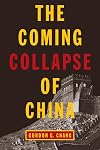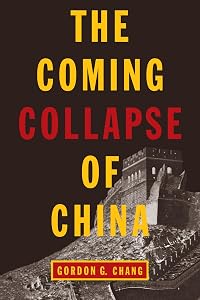
The Coming Collapse of China
by Gordon G. Chang
160 Members (2.50)
On This Page
Description
"The collapse of China is unthinkable. The consequences for its people - and for the people of the world - could be catastrophic. Three times larger than the United States, China has an economy that many predict will blossom into the world biggest by 2010. The county may be America's greatest rival, but each of us, from diplomat to businessman to ordinary consumer, has a vital interest in China's stability." "The People's Republic, however, is failing. The government is corrupt and weak, the show more economy is stalling, and the social fabric fraying in both countryside and city. As at so many times in the past, the Chinese people want change. Soon they will demand it." "The Coming Collapse of China does not flinch. It states what almost no one will say out loud: The end of the modern Chinese state is near. The People's Republic has five years, perhaps ten, before it falls. This book tells why."--Jacket. show lessTags
Recommendations




Member Reviews
Members
- Recently Added By
Published Reviews
ThingScore 75
Where is China headed? To American-scale prosperity, military domination of Asia, and an epoch of cultural renaissance? Or to hell in a handbasket? You can find learned, thoughtful and well-informed commentators committed to both points of view, and many in between. The strongest tendency of the last few years, however, has been towards deepening pessimism, and Gordon Chang's The Coming show more Collapse of China, as its title indicates, is squarely within this tendency. The author lightens his prognosis with some occasional expressions of hope, but these do not seem to me to carry much conviction, and the overall impression of his book is one of inspissated gloom.
Gordon Chang is not an academic, but a practical man who has lived and worked in China for twenty years as an advisor to American firms. He was raised in a Chinese household; his father was born in China; he knows the country very well. Probably because of his own work experience, he concentrates on the commercial and economic environment in China. You might have got the impression from some of the more upbeat commentary in our news media that the Communist Party has faded into the background, stepping aside to give China's entrepreneurial forces free rein. Nothing of the sort, says Mr. Chang: the Party's urge to control everything in sight is irresistible. It is irresistible to the cadres themselves, not least because it offers them endless opportunities to enrich themselves by corruption. And there is no organized alternative power center in Chinese society that can resist it, because the Party never has, and never will, permit any such alternative to develop. . . .
Underlying all these economic issues are deeper matters that Gordon Chang can only hint at in the prevailing structure of taboos — issues of national character and mass psychology. There is that maddening obsession with the surface of things, with the belief that if everything looks all right, then everything must be all right. "Laying straw over a minefield," is how one of Mr. Chang's informants describes a typical exercise in cosmetic enhancement, of the kind familiar to anyone who has lived in China. There is, too, the endless picking at old wounds, the tender cherishing of ancient grievances. "Yes," he points out, "the British burned the Summer Palace and the Chinese have a right to be angry. Yet the British also burned the American capital, but when was the last time you heard anyone complain about the War of 1812?" . . .
Melancholy prognostications like Gordon Chang's would be a little easier to bear if one did not know that observers have been making them for at least a hundred years. . . . Weariness of the spirit is an occupational hazard for those of who watch China. Gordon Chang closes his book with the thought that: "All the struggle and turmoil of the nineteenth and twentieth centuries are just a prelude to what will come in the twenty-first." This is probably true. Poor, poor China. show less
Gordon Chang is not an academic, but a practical man who has lived and worked in China for twenty years as an advisor to American firms. He was raised in a Chinese household; his father was born in China; he knows the country very well. Probably because of his own work experience, he concentrates on the commercial and economic environment in China. You might have got the impression from some of the more upbeat commentary in our news media that the Communist Party has faded into the background, stepping aside to give China's entrepreneurial forces free rein. Nothing of the sort, says Mr. Chang: the Party's urge to control everything in sight is irresistible. It is irresistible to the cadres themselves, not least because it offers them endless opportunities to enrich themselves by corruption. And there is no organized alternative power center in Chinese society that can resist it, because the Party never has, and never will, permit any such alternative to develop. . . .
Underlying all these economic issues are deeper matters that Gordon Chang can only hint at in the prevailing structure of taboos — issues of national character and mass psychology. There is that maddening obsession with the surface of things, with the belief that if everything looks all right, then everything must be all right. "Laying straw over a minefield," is how one of Mr. Chang's informants describes a typical exercise in cosmetic enhancement, of the kind familiar to anyone who has lived in China. There is, too, the endless picking at old wounds, the tender cherishing of ancient grievances. "Yes," he points out, "the British burned the Summer Palace and the Chinese have a right to be angry. Yet the British also burned the American capital, but when was the last time you heard anyone complain about the War of 1812?" . . .
Melancholy prognostications like Gordon Chang's would be a little easier to bear if one did not know that observers have been making them for at least a hundred years. . . . Weariness of the spirit is an occupational hazard for those of who watch China. Gordon Chang closes his book with the thought that: "All the struggle and turmoil of the nineteenth and twentieth centuries are just a prelude to what will come in the twenty-first." This is probably true. Poor, poor China. show less
added by TomVeal
Author Information
6 Works 231 Members
Gordon Chang has lived & worked in China for almost two decades, most recently in Shanghai, as counsel to the American law firm Paul Weiss. His articles on China have been published in "The New York Times", "The Asian Wall Street Journal", "The Far Eastern Economic Review", & "The International Herald Tribune". (Bowker Author Biography)
Common Knowledge
- People/Characters
- Deng Xiaoping; the PRC; the CCP
- Important places
- China
- Epigraph
- Revolution is impossible until it is inevitable.
--LEON TROTSKY - Dedication
- For the boy who left China in search of a better life---my father.
- First words
- "Seek truth from facts," said former Chinese leader Deng Xiaoping, who used that Maoist slogan to attack the foundations of Mao Zedong's China.
- Last words
- (Click to show. Warning: May contain spoilers.)"Thinkers prepare the revolution; bandits carry it out," wrote Mariano Azuela. That may have been true in the author's Mexico of a hundred years ago but not in the China of today. The Chinese need no thinkers for their next revolution, and the bandits have already started to act.
- Blurbers
- Nathan, Andrew J.; Dorn, James A.; Waldron, Arthur; Lam, Willy Wo-Lap
Classifications
- Genres
- Nonfiction, Economics, General Nonfiction, History, Business, Politics and Government
- DDC/MDS
- 951 — History & geography History of Asia East Asia: China, Taiwan, Hong Kong, Korea
- LCC
- HC427.92 .C3375 — Social sciences Economic history and conditions Economic history and conditions By region or country
- BISAC
Statistics
- Members
- 160
- Popularity
- 204,234
- Rating
- (2.50)
- Languages
- English
- Media
- Paper, Ebook
- ISBNs
- 6
- ASINs
- 2