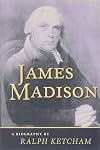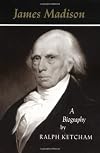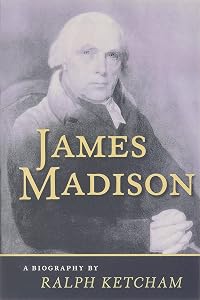
James Madison: A Biography
by Ralph Ketcham
On This Page
Description
The best one volume biography of Madison's life, Ketcham's biography not only traces Madison's career, it gives readers a sense of the man. As Madison said of his early years in Virginia under the study of Donald Robertson, who introduced him to thinkers like Montaigne and Montesquieu, "all that I have been in life I owe largely to that man." It also captures a side of Madison that is less rarely on display (including a portrait of the beautiful Dolley Madison). "Madison's personality comes show more alive in these pages, his strengths and weaknesses of mind and character clearly outlined. His great services in the Constitutional Convention of 1787 are graphically portrayed. The analysis of his political theory, and of the way in which he sought to apply it to the establishment of of government under the Constitution, is excellent. The depiction of Jeffersonian and Madisonian foreign policy up to the outbreak of the War of 1812 is clear and succinct. This is an excellent biography. American Historical Review Utilizing the vast amount of source material made available in the last 30 years, Ketcham has captured the essential man in his times and in doing so has made him understandable for us in our own day. Los Angeles Times This single volume has provided a penetrating and highly readable biography which merits distinction as the best one-volume life of Madison yet written. Virginia Magazine of History and Biography Ketcham's long-standing familiarity with Madison's life and times is evident in this accessible has written an enjoyable and scholarly narrative that will no doubt be considered of great value to Montpelier's more serious visitors, as well as students, scholars, and general readers with an interest in the founding couple. Kellie Strickland, North Carolina State University - North Carolina Historical Review. show lessTags
Recommendations














Member Reviews
An impressive feat of scholarship to write a biography of someone like James Madison whose life and career stretched from the American Revolution to the 1830s. He was the "architect" of the Constitution, congressman, secretary of state, fourth president of the United States, and elder statesman. According to Ketcham, the glue that holds Madison together is his Republican ideology. That is why he could be for a stronger federal government in the 1780s but against it in 1790s and why he was not a good war leader. Kethcam argues that Madison was not the dupe of Thomas Jefferson. There are parts I struggle with. For example, Ketcham describes Madison's Virginia Resolves of 1798 out to be more moderate than Jefferson's Kentucky Resolves, but show more I don't see it. Also, on political points Madison appears very much the Wilsonian practitioner of expediency. If so, that would undercut his Republican ideology. And he did things for purely political reasons, which is what you would expect from a professional politician, but where does that line end? Ketcham catches Madison changing some of his comments about Lafayette later in life, but doesn't delve any deeper into that theme. After having read Mary Sarah Bilder's Madison's Hand (2015) it makes me wonder how much Madison edited his papers. Finally, much scholarship has been produced since this biography was published around the Constitution, the 1790s, and the War of 1812. show less
This book was tough to get through. I enjoy biographies but this is not the most entertaining biography. However, this is the most complete biography of Madison I could find.
Madison's most defining moments in history are: "father of the constitution" a title which he was given years later, his collaboration with Jefferson and possibly being a very strong influence in purchasing land instead of seizing it, and of course, the War of 1812.
During his Presidency, Madison refused to back down from the United States having rights to the sea and did not cower to the large empires in the east. Though much "luck" was involved, Madison reaffirmed the United States as a world scene player that deserved and would not be afraid to defend, a seat at show more the table, through patience and allowing events to unfold before choosing the best path.
Madison changed his stance on a larger central government when circumstances called for it, though still rejected the size of central government that Hamilton called for.
Madison seemed to come out on the winning side of almost every major political issue of his day. I enjoyed learning about him. show less
Madison's most defining moments in history are: "father of the constitution" a title which he was given years later, his collaboration with Jefferson and possibly being a very strong influence in purchasing land instead of seizing it, and of course, the War of 1812.
During his Presidency, Madison refused to back down from the United States having rights to the sea and did not cower to the large empires in the east. Though much "luck" was involved, Madison reaffirmed the United States as a world scene player that deserved and would not be afraid to defend, a seat at show more the table, through patience and allowing events to unfold before choosing the best path.
Madison changed his stance on a larger central government when circumstances called for it, though still rejected the size of central government that Hamilton called for.
Madison seemed to come out on the winning side of almost every major political issue of his day. I enjoyed learning about him. show less
This was a huge book. Let me just start with that because the volume that I had was over 700 pages. I closed it permanently at page 384. I couldn't take anymore of the style of Ralph Ketcham. When I started this book I had already read the biography of James Madison:(The American Presidents Series). I also had read a book on the writing of the constitution and one about the War of 1812. So I was looking for details when I picked up this book. And, yes, this book is filled with details, which would have been fine if they had been distributed with some semblance of order. However, throughout the pages that I read, the author was very disjointed and constantly jumps from one time period to another.
Again, this would be fine if it was in show more different chapters, about different aspects of Madison's life, but no, this happened in the same paragraphs and on some occasions the same long sentences.
This said, I could not in good conscience recommend this book to anyone, unless they were truly looking for a mountain of details concerning Madison's inability to decide on a career, his lack of a love life until he was 43, his health issues (mainly hypochondria), and his dependence on others both financially and emotionally.
Maybe the book got better after page 384, I'll never know. show less
Again, this would be fine if it was in show more different chapters, about different aspects of Madison's life, but no, this happened in the same paragraphs and on some occasions the same long sentences.
This said, I could not in good conscience recommend this book to anyone, unless they were truly looking for a mountain of details concerning Madison's inability to decide on a career, his lack of a love life until he was 43, his health issues (mainly hypochondria), and his dependence on others both financially and emotionally.
Maybe the book got better after page 384, I'll never know. show less
I finished James Madison: A Biography by Ralph Ketcham. It took me months to get through it. The author really liked his subject, and seemed to constantly be making excuses for him. Although he did try to examine him critically from time to time throughout the book. I found it interesting that later in life Madison changed some of his original letters to, in one case, make someone look better (LaFayette), and make someone look worse (John Adams). I found it surprising that Madison was so adamantly supportive of the separation of church and state (bravo!). His belief, based on his readings, was that state-supported religion only leads to corruption of religion. He definitely supported measures that favored Virginia, but he always kept show more the national priorities in mind. I also found it kind of funny that he pushed so hard for a strong national government - until he had to make the "obnoxious" Great Compromise - the peak was reached when he thought representation in both houses would be by population. He then became much more cautious about the power granted to the general government. This bio also showed me that there has been horrible, nasty bipartisanship since Washington's second administration, so I guess I shouldn't be so depressed about the current state of national politics.
As long as the bio was, some things were mentioned in passing with no explanation, such as Shay's Rebellion. I also found it interesting that the author would say out of the blue that Jefferson and Madison weren't scheming together in Dec 1879 - why say this if there hasn't been any other comment about it previously. Sometimes I felt like there was an unnamed prerequisite that I was supposed to read before reading this tome. Then, there were quotes he included that I just found no use for, and that were not explained in any way and no realy connection to what the author was relating. Here's my favorite..."I, pilgarlic, sat entranced." show less
As long as the bio was, some things were mentioned in passing with no explanation, such as Shay's Rebellion. I also found it interesting that the author would say out of the blue that Jefferson and Madison weren't scheming together in Dec 1879 - why say this if there hasn't been any other comment about it previously. Sometimes I felt like there was an unnamed prerequisite that I was supposed to read before reading this tome. Then, there were quotes he included that I just found no use for, and that were not explained in any way and no realy connection to what the author was relating. Here's my favorite..."I, pilgarlic, sat entranced." show less
This book is so long I'm afraid I'm going to forget the beginning before I get to the end, so I am going to take notes as I go along. So far I have read the first three chapters, covering Early Boyhood, Princeton, and Search for Vocation, and I really like how the author is a thorough as possible, while also making it clear where he is just taking his best guess. It seems there is a lot we don't know about Madison's early years, but the author does his best to give us the flavor of the times based on the records of others associated with Madison.
So far I have been surprised to learn that in Virginia before 1776, Baptists were arrested for preaching their beliefs. Also, I had never thought before about how major river crossings at that show more time would have required a ferry. When did we start building bridges over our rivers? I will need another history book to figure that out.
Quick update: Having read through the Continental Congress (but not yet at the Constitution), it seems to me that the earlier chapters had more life, because the lack of documentation inspired the author to use his imagination to paint a picture for us. In these subsequent chapters he recites facts without providing context or analysis. My guess is that the great biography of Madison is yet to be written.
Final update: For a reader who is already conversant in the issues that touched Madison's professional life, this book would provide insight into Madison's thinking. However, a reader who is interested in learning about those issues in the first place is left hanging. I would need to read about ten other books before I could understand this book. However, this is the book I did read, and I probably learned something by osmosis. Also, if I ever do read those ten other books, whatever they may be, this might be a useful reference for Madison's angle. show less
So far I have been surprised to learn that in Virginia before 1776, Baptists were arrested for preaching their beliefs. Also, I had never thought before about how major river crossings at that show more time would have required a ferry. When did we start building bridges over our rivers? I will need another history book to figure that out.
Quick update: Having read through the Continental Congress (but not yet at the Constitution), it seems to me that the earlier chapters had more life, because the lack of documentation inspired the author to use his imagination to paint a picture for us. In these subsequent chapters he recites facts without providing context or analysis. My guess is that the great biography of Madison is yet to be written.
Final update: For a reader who is already conversant in the issues that touched Madison's professional life, this book would provide insight into Madison's thinking. However, a reader who is interested in learning about those issues in the first place is left hanging. I would need to read about ten other books before I could understand this book. However, this is the book I did read, and I probably learned something by osmosis. Also, if I ever do read those ten other books, whatever they may be, this might be a useful reference for Madison's angle. show less
a good & thorough account, without any noticable bias
1211. James Madison A Biography, by Ralph Ketchum (26 Mar 1973) I started this book in February, then it came due and could not be renewed and before I could check it out again somebody else did, so my finishing it was delayed till now. This is a well put together book which I enjoyed thoroughly. Reading this suggested to me I should read a biography of each president, and with only a few exceptions I have done that. [As of 13 Apr 2009 I have read at least one biography of every U.S. president who is dead except Reagan and Ford.]
Members
- Recently Added By
Lists

James Madison
19 works; 1 member

Best Biographies of U.S. Presidents
61 works; 6 members
Author Information

13+ Works 2,232 Members
Awards and Honors
Common Knowledge
- Original publication date
- 1971
- People/Characters
- James Madison; Dolley Madison
- Important places
- USA
- Important events
- The Constitution of the United State of America; War of 1812
- Dedication
- for Julia
- First words
- Frances Taylor Madison, daughter of one of the first settlers in the Piedmont county of Orange in the colony of Virginia, died on Wednesday.............
In the first preface to this book written nearly two decades ago, I noted that, with the new material available, information about Madison was "almost oppressively abundant." (Preface to the Paperback Edition)
This book seeks to record, with reasonable fairness and completeness, the life of James Madison. (Preface) - Last words
- (Click to show. Warning: May contain spoilers.)Madison's life reveals that he cherished the Union because only the cooperative power it released could bring the social justice necessary to fulfil the legal and moral equality of man. He furthermore cherished liberty because only it could open to man the opportunities due his limitless potential. His life has meaning, therefore, as long as these equations themselves are cherished and as long as men conceive government as legitimate only in pursuit of these ends.
Classifications
- Genres
- History, Nonfiction, Biography & Memoir, General Nonfiction
- DDC/MDS
- 973.51092 — History & geography History of North America United States Jacksonian Era (1809-1837) James Madison (1809-1817)
- LCC
- E342 .K46 — History of the United States United States Revolution to the Civil War, 1775/1783-1861 By period Early nineteenth century, 1801/1809-1845 Madison's administrations, 1809-1817
- BISAC
Statistics
- Members
- 481
- Popularity
- 63,167
- Reviews
- 8
- Rating
- (3.54)
- Languages
- English
- Media
- Paper, Audiobook
- ISBNs
- 4
- ASINs
- 5