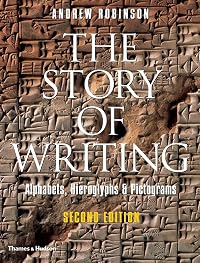
The Story of Writing
by Andrew Robinson
On This Page
Description
"Writing is perhaps humanity's greatest invention. Without it there would be no history and no civilization as we know it. The Story of Writing is the first book to demystify writing for the general reader. In a succinct and absorbing text, Andrew Robinson explains the interconnection between sound, symbol and script, and goes on to discuss each of the major writing systems in turn, from cuneiform and Egyptian and Mayan hieroglyphs to alphabets and the scripts of China and Japan today. He show more explores "proto-writing," including Ice Age symbols, tallies and Amerindian pictograms, and surveys the astonishing multiplicity of alphabets - not only Greek, Roman, Hebrew, Arabic and Indian scripts, but also the Cherokee "alphabet" and the writing of runes." "Full coverage is given to the story of decipherment, and how the words of past ages have been brought back to life through the efforts of Champollion, Ventris and others. And in a provocative chapter devoted to as yet undeciphered scripts, Andrew Robinson challenges the reader: can the code of the Indus script, Cretan Linear A, the Phaistos Disc or Easter Island ever be broken? Armchair decipherers who read this book will be well placed to make discoveries that herald the next breakthrough."--BOOK JACKET.Title Summary field provided by Blackwell North America, Inc. All Rights Reserved show lessTags
Recommendations















Member Reviews
The Story of Writing was not what I expected and more than I expected. I bought the book because of my interest in ancient scripts, languages and archaeology thinking it would be a good general overview. When I first glanced through it I thought I had bought a book more oriented toward middle school audience....that would be a wrong assumption. It is not an in depth scholarly work written for an audience with a graduate degree but it is still an engaging book for a later high school, freshman college level. It covers all of the major ancient scripts including cuneiform, Egyptian and Mayan hieroglyphs and much more. It goes into just enough depth to get you interested in learning more which I am sure is exactly what the author intended. show more The illustrations, explanations and examples are all well done. I didn't know a lot about cuneiform prior to reading this book and now I want to learn more. Also, even after reading several books about Mayan hieroglyphs I have never been able to understand the calendar system until Andrew Robinson was able to illustrate and explain it in such a clear way.
Very good. I recommend this to anyone with a budding interest in scripts and ancient languages. show less
Very good. I recommend this to anyone with a budding interest in scripts and ancient languages. show less
offers a good overview of the written language and how it has been deciphered and developed overtime, doesn't get in depth-good overview.
Interesting reading, but bad editing and glaring omissions of recent research (and some not so recent) can make for frustrating reading.
I was disappointed when I read it a couple of years back, and I forgot why. I don't intend to go back and experience the disappointment again just to find out why.
Interesting. lots of pictures/photographs.
Ratings
Members
- Recently Added By
Published Reviews
ThingScore 75
Rich in images . . . well-informed and assured.
added by Ludi_Ling
Author Information

26+ Works 2,970 Members
Andrew Robinson is the author of some 25 books on the arts and sciences, including India: A Short History and Lost Languages: The Enigma of the World's Undeciphered Scripts. He writes for The Lancet, Nature and Science.
Common Knowledge
- Original publication date
- 1995 (1st edition) (1st edition); 2007 (2nd edition) (2nd edition)
- People/Characters
- Jean-François Champollion; Michael Ventris
- Important places
- China; Japan; Egypt
- Epigraph
- I dedicate this book to my mother, who encouraged me to read.
Classifications
Statistics
- Members
- 703
- Popularity
- 40,480
- Reviews
- 6
- Rating
- (3.88)
- Languages
- 7 — Dutch, English, German, Hungarian, Norwegian (Bokmål), Spanish, Swedish
- Media
- Paper, Ebook
- ISBNs
- 14
- ASINs
- 1