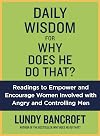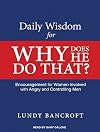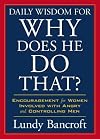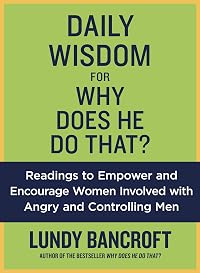
Daily Wisdom for 'Why Does He Do That?' Encouragement for Women Involved with Angry and Controlling Men
by Lundy Bancroft
On This Page
Description
Even if you've read Why Does He Do That?, it may be hard to see the truth of what is happening to you. You may feel overwhelmed by confusion, loss, and fear, and find yourself looking away from the truth and falling back into traumatic patterns .Like a constant friend, this collection of meditations is a source of strength and reassurance designed to speak to women like you, women in relationships with angry and controlling men. It helps you to digest what is happening a piece at a time, so show more that you can gain clarity, safety, and freedom. To learn to value and respect yourself-even when your partner makes it very clear that he does not-each day centers on one of seven themes designed to empower, encourage, and inspire you . . . show lessTags
Recommendations













Member Reviews
First of all: one must be very clear about differentiating what this is and what it isn't; for it can make a great difference in assessing how useful or rubbish it all is.
What it is, is a manual of sorts to empower women trapped in an abusive relationship where the abuse is verbal and emotional that is, about coercive control. It's not a book that purports to nudge you towards staying or leaving, nor does it contains instructions about how you should (or not) go on about your relationship, no matter how toxic. Since it's about empowerment, these are, indeed, choices that will belong to you, and you only. The author is very clear: it's about offering clarity, helping you to understand what, exactly, is happening to you (get that you are, show more indeed, being abused even if you are not physically hit -most abusive relationships do not involve physical violence...) and what you can do to find coping mechanisms of some sorts, not only for you, but, also, to help the children, also trapped in-between, to go through it all.
The coping mechanisms are also healthy, and straightforward. For example, he does not condone the denigration of an abusive father, to his children, by an abused mother. An abused mother is here to offer a counter-example to the abusive behaviours of her partner, and make sure that the children are safe -not to undermine a father's relationship with his own kids (again: how such relationship will build up is his own choice, not yours). Most importantly, he does not condone retaliation. It's a common trope among neo-feminists indeed that, in such relationships, female perpetrated violence should be perceived as of lesser importance since it's merely 'reactive', or 'self-defence'. It's everything but. Here are behaviours which are, also, abusive; and, again, if children are trapped in-between, it is a form of violence which will also affect them, and as damagingly. Put bluntly, her 'I did that because he did...' is as poisonous and dangerous as his 'I did that because she did...' -we ought to bear that in mind.
Is it useful, then?
Personally, as a man who went through such abuse (but perpetrated by a woman), I found it so (although I got this years after my relationship ended). I have been writing a book on domestic violence too, and I had other men, who contacted me to share their experiences about being in abusive relationships with controlling, manipulative, coercive, aggressive women, who also reported that the book had helped them to make sense of it all. So, would I recommend it? Yes, but...
But... If you are a man, you will have to read it by swapping gender. Lundy Bancroft, indeed, abides to what has been dubbed the 'feminist' view of domestic violence that is, that it's rooted in the patriarchy and men wanting to exert authority into their household as they had in society at large. As such, domestic violence is perceived as being a 'gendered crime', where most victims are women and perpetrators are men. This view, though, is also bogus.
Outside women organisations and their self-financed and self-interested studies, it has, in fact, been debunked time and again over the past five decades: 1 man out of 6 reports experiencing domestic abuse (against 1 woman out of 4), 40% of reported victims are men, who are, also, twice less likely to report, half of those seeking help through male helplines, for example, confessing to not seeking help otherwise due to fear, taboo, and stigma (a bigger share even expresses suicide ideation...). This is not a gender issue! As a matter of fact, and, again, outside women organisations relying on self-financed studies (and the mass medias echoing such lobbies) it never was: in the first women shelter ever opened (1971, London) 62 women out of 100 were also abusive themselves (just google 'Erin Pizzey', and see what had happened to her to understand why we are where we are now...).
That the author would takes such bias could be half understandable. He works with relationships where the abuse is unilateral (or perceived as so), perpetrated by a man against a woman. Yet, again, it has been proven that as many relationships involve, in fact, a woman only abusing a man; besides most abusive relationships involving so-called 'bidirectional abuse' (a dynamic where the abuse is mutual, partners abusing each other as much as each other, aggressively and defensively). As such, then, his is a bit like a doctor specialising in breast cancer, not seeing that much patients with prostate cancer in his clinic, and, so, concluding thereof that prostate cancer must be very rare indeed! It's a fallacy and a bias, but which greatly matters here too: claiming that abusive men abuse out of a sense of patriarchal entitlement is bogus. There are a multitude of reasons for why abusive people do what they do, but framing 'male authority in a household' is not it (the utter failure of the Duluth model, still widely used due to this bogus paradigm -and, I suspect, that the author use in his work- should be telling enough...). This book, then, will not help you in understanding why your abuser (if a man) is how he is! Beware.
Having said that, because the author is very helpful in pointing what coercive control is, because he is insistent about staying clear from abusive behaviours as a form of retaliation, and because he is concerned, also, about the children trapped in-between, I am ok to recommend it -both to women, and, again, men themselves. It purports to offer clarity and coping mechanisms -it does so. Its underpinning ideology, though, cannot be ignored, especially since it is targeted at abused women. Domestic violence is not patriarchal, and it is not gendered. In other words: if you are a woman who wants an understanding of your abusive male partner, then don't buy this. show less
What it is, is a manual of sorts to empower women trapped in an abusive relationship where the abuse is verbal and emotional that is, about coercive control. It's not a book that purports to nudge you towards staying or leaving, nor does it contains instructions about how you should (or not) go on about your relationship, no matter how toxic. Since it's about empowerment, these are, indeed, choices that will belong to you, and you only. The author is very clear: it's about offering clarity, helping you to understand what, exactly, is happening to you (get that you are, show more indeed, being abused even if you are not physically hit -most abusive relationships do not involve physical violence...) and what you can do to find coping mechanisms of some sorts, not only for you, but, also, to help the children, also trapped in-between, to go through it all.
The coping mechanisms are also healthy, and straightforward. For example, he does not condone the denigration of an abusive father, to his children, by an abused mother. An abused mother is here to offer a counter-example to the abusive behaviours of her partner, and make sure that the children are safe -not to undermine a father's relationship with his own kids (again: how such relationship will build up is his own choice, not yours). Most importantly, he does not condone retaliation. It's a common trope among neo-feminists indeed that, in such relationships, female perpetrated violence should be perceived as of lesser importance since it's merely 'reactive', or 'self-defence'. It's everything but. Here are behaviours which are, also, abusive; and, again, if children are trapped in-between, it is a form of violence which will also affect them, and as damagingly. Put bluntly, her 'I did that because he did...' is as poisonous and dangerous as his 'I did that because she did...' -we ought to bear that in mind.
Is it useful, then?
Personally, as a man who went through such abuse (but perpetrated by a woman), I found it so (although I got this years after my relationship ended). I have been writing a book on domestic violence too, and I had other men, who contacted me to share their experiences about being in abusive relationships with controlling, manipulative, coercive, aggressive women, who also reported that the book had helped them to make sense of it all. So, would I recommend it? Yes, but...
But... If you are a man, you will have to read it by swapping gender. Lundy Bancroft, indeed, abides to what has been dubbed the 'feminist' view of domestic violence that is, that it's rooted in the patriarchy and men wanting to exert authority into their household as they had in society at large. As such, domestic violence is perceived as being a 'gendered crime', where most victims are women and perpetrators are men. This view, though, is also bogus.
Outside women organisations and their self-financed and self-interested studies, it has, in fact, been debunked time and again over the past five decades: 1 man out of 6 reports experiencing domestic abuse (against 1 woman out of 4), 40% of reported victims are men, who are, also, twice less likely to report, half of those seeking help through male helplines, for example, confessing to not seeking help otherwise due to fear, taboo, and stigma (a bigger share even expresses suicide ideation...). This is not a gender issue! As a matter of fact, and, again, outside women organisations relying on self-financed studies (and the mass medias echoing such lobbies) it never was: in the first women shelter ever opened (1971, London) 62 women out of 100 were also abusive themselves (just google 'Erin Pizzey', and see what had happened to her to understand why we are where we are now...).
That the author would takes such bias could be half understandable. He works with relationships where the abuse is unilateral (or perceived as so), perpetrated by a man against a woman. Yet, again, it has been proven that as many relationships involve, in fact, a woman only abusing a man; besides most abusive relationships involving so-called 'bidirectional abuse' (a dynamic where the abuse is mutual, partners abusing each other as much as each other, aggressively and defensively). As such, then, his is a bit like a doctor specialising in breast cancer, not seeing that much patients with prostate cancer in his clinic, and, so, concluding thereof that prostate cancer must be very rare indeed! It's a fallacy and a bias, but which greatly matters here too: claiming that abusive men abuse out of a sense of patriarchal entitlement is bogus. There are a multitude of reasons for why abusive people do what they do, but framing 'male authority in a household' is not it (the utter failure of the Duluth model, still widely used due to this bogus paradigm -and, I suspect, that the author use in his work- should be telling enough...). This book, then, will not help you in understanding why your abuser (if a man) is how he is! Beware.
Having said that, because the author is very helpful in pointing what coercive control is, because he is insistent about staying clear from abusive behaviours as a form of retaliation, and because he is concerned, also, about the children trapped in-between, I am ok to recommend it -both to women, and, again, men themselves. It purports to offer clarity and coping mechanisms -it does so. Its underpinning ideology, though, cannot be ignored, especially since it is targeted at abused women. Domestic violence is not patriarchal, and it is not gendered. In other words: if you are a woman who wants an understanding of your abusive male partner, then don't buy this. show less
I pre-ordered this book and received it today. Already I was in tears just from the introduction. I was thinking to myself this past week, "Why is this so hard to leave when I see the truth?" The illustration of the rope hit the nail on the head. This book seems to be an encouraging, hope filled, piece of work that I am looking forward to working through one day at a time. Thank you Lundy Bancroft for being willing to encourage those of us is abusive relationships. It gives me the hope to carry on and do the next right thing for myself and my children.
I'd like to read the main book: Why Does He Do That? Inside the Minds of Angry and Controlling Men, but that wasn't available at the library. But this gives you the gist of that book in a daily format.
It's a terrific insight into these men and their treatment of women.
It's a terrific insight into these men and their treatment of women.
Ratings
Members
- Recently Added By
Lists

Recovery from Psychopath
128 works; 1 member

Healing resources
124 works; 1 member

Books for betrayed partners
31 works; 1 member

Healing resources for women
588 works; 1 member
Author Information

11 Works 1,397 Members
Lundy Bancroft has spent the last fifteen years of his career specializing in the field of domestic abuse and the behavior of abusive men, and is considered one of the world's experts on the subject.
Work Relationships
Common Knowledge
- Canonical title
- Daily Wisdom for 'Why Does He Do That?' Encouragement for Women Involved with Angry and Controlling Men
Classifications
- Genres
- Nonfiction, General Nonfiction, Sexuality and Gender Studies
- DDC/MDS
- 362.82 — Society, government, & culture Social problems and social services Social Welfare Problems of and services to other groups Families
- LCC
- HV6626.2 .B252 — Social sciences Social pathology. Social and public welfare. Criminology Social pathology. Social and public welfare. Criminology Crimes and offenses
- BISAC
Statistics
- Members
- 48
- Popularity
- 626,151
- Reviews
- 3
- Rating
- (4.00)
- Languages
- English
- Media
- Paper, Audiobook, Ebook
- ISBNs
- 4
- ASINs
- 2