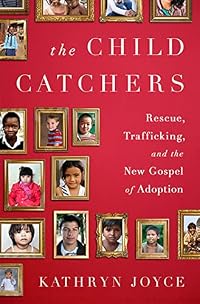
The Child Catchers: Rescue, Trafficking, and the New Gospel of Adoption
by Kathryn Joyce
On This Page
Description
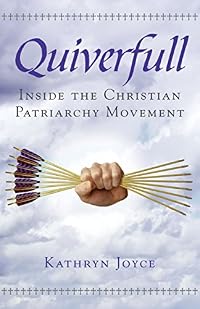
When Jessie Hawkins' adopted daughter told her she had another mom back in Ethiopia, Jessie didn't, at first, know what to think. She'd wanted her adoption to be great story about a child who needed a home and got one, and a family led by God to adopt. Instead, she felt like she'd done something wrong. Adoption has long been enmeshed in the politics of reproductive rights, pitched as a "win-win" compromise in the never-ending abortion debate. But as Kathryn Joyce makes clear in The Child show more Catchers, adoption has lately become even more entangled in the conservative Christian agenda. To tens of millions of evangelicals, adoption is a new front in the culture wars: a test of "pro-life" bona fides, a way for born again Christians to reinvent compassionate conservatism on the global stage, and a means to fulfill the "Great Commission" mandate to evangelize the nations. Influential leaders fervently promote a new "orphan theology," urging followers to adopt en masse, with little thought for the families these "orphans" may already have. Conservative evangelicals control much of that industry through an infrastructure of adoption agencies, ministries, political lobbying groups, and publicly-supported "crisis pregnancy centers," which convince women not just to "choose life," but to choose adoption. Overseas, conservative Christians preside over a spiraling boom-bust adoption market in countries where people are poor and regulations weak, and where hefty adoption fees provide lots of incentive to increase the "supply" of adoptable children, recruiting "orphans" from intact but vulnerable families. The Child Catchers is a shocking exposf what the adoption industry has become and how it got there, told through deep investigative reporting and the heartbreaking stories of individuals who became collateral damage in a market driven by profit and, now, pulpit command. Anyone who seeks to adopt -- of whatever faith or no faith, and however well-meaning -- is affected by the evangelical adoption movement, whether they know it or not. The movement has shaped the way we think about adoption, the language we use to discuss it, the places we seek to adopt from, and the policies and laws that govern the process. In The Child Catchers, Kathryn Joyce reveals with great sensitivity and empathy why, if we truly care for children, we need to see more clearly. Kathryn Joyce is a journalist based in New York City whose work has appeared in the Nation, Mother Jones, Slate, the Atlantic, and other publications. A 2011 recipient of the Knight Luce Fellowship for Reporting on Global Religion, she has also been awarded residencies and fellowship support by the Nation Institute Investigative Fund, the MacDowell Colony, the Bellagio Center, and the Pulitzer Center for Crisis Reporting. She is the author of Quiverfull: Inside the Christian Patriarchy Movement and as associate editor at Religion Dispatches. show lessTags
Recommendations


























Member Recommendations
Member Reviews
Another insightful investigation into a little-known facet of American evangelical Christianity from Kathryn Joyce, the author of the seminal work on the quiverfull movement. Joyce investigates the phenomenon of evangelical Christianity's involvement in the adoption industry and the effects their crusade to save the world's children through religious adoption have had on children, families, and governments from Ukraine to Ethiopia. The book also traces the human rights abuses that have plagued adoption for decades, from American women forced into unwed mothers' homes in the 1950s to child trafficking in Africa. This book is impeccably researched and clearly draws on academic work, but it is written in a clear, comprehensible fashion show more that doesn't bog the lay-reader down in terminology.
The book has been controversial for failing to laud everything about the adoption movement and pointing out the negative externalities it has created; some people have been taken aback by Joyce's use of economics -- namely, the phrase "supply and demand" -- to describe the adoption market. Yet the description is apt. For so many of these crooked adoption agencies, it is a market, with children stolen, parents lied to, visa applications forged, just to meet the West's huge demand for children to adopt.
I was unfamiliar with many of the stories presented in the book, including the Baby Scoop Era and the huge South Korean adoption market caused by their extremely socially conservative views on sex. For me, this book was an eye-opener. I appreciated that Joyce occasionally (certainly not overwhelming at all) tied these issues to the lack of agency given to women and the poor both in foreign countries and in America. Unfortunately, it is all too easy to exploit people with no knowledge of the law or their own rights.
If you liked [Quiverfull], you'll probably like this book as well. I certainly did. show less
The book has been controversial for failing to laud everything about the adoption movement and pointing out the negative externalities it has created; some people have been taken aback by Joyce's use of economics -- namely, the phrase "supply and demand" -- to describe the adoption market. Yet the description is apt. For so many of these crooked adoption agencies, it is a market, with children stolen, parents lied to, visa applications forged, just to meet the West's huge demand for children to adopt.
I was unfamiliar with many of the stories presented in the book, including the Baby Scoop Era and the huge South Korean adoption market caused by their extremely socially conservative views on sex. For me, this book was an eye-opener. I appreciated that Joyce occasionally (certainly not overwhelming at all) tied these issues to the lack of agency given to women and the poor both in foreign countries and in America. Unfortunately, it is all too easy to exploit people with no knowledge of the law or their own rights.
If you liked [Quiverfull], you'll probably like this book as well. I certainly did. show less
A well-researched and thoughtful look at the unintended outcomes that arise when well-meaning people from wealthy countries seek to adopt a child from a developing country. Over and over again Joyce comes back to this question: "Why aren't we helping the mothers?" Joyce cites historical statistics that indicate that, when given a choice, and when given support, women will choose to keep and raise their own children 8 out of 10 times, an outcome that seems to cross every cultural and national border. On the other hand, if the only support being offered is the message: "we will take your baby and give it to a good home," then the reverse is true. Throughout the book Joyce urges readers to think for themselves about the greater show more ramifications of adoption, and in particular, of international adoption. Joyce chronicles one country after another where an influx of money from well-meaning parents-to-be has led to corruption and child trafficking, and where unqualified adoption agencies descend on one country after another in search of the easiest adoptions and the least red tape, which in turn leads to poor placement decisions, abuse, and more corruption. The book challenged my preconceptions on many levels. I recommend it highly. show less
Do you remember that quip people give to people who are against abortion? You know, the one about how more pro-life people should be adopting. This book explains why that joke is funny, but only when it isn't taken to heart. As usual for a nonfiction title I'm reviewing, it isn't a comfortable book, but it is a good book. My reactions to it are strong. That might be because I'm a woman and have been a single mother, but this book often made my blood boil against people using women in less advantaged positions to meet the demands for children acceptable to the adoption market.
As others have mentioned, this does become a pretty repetitive read. I'm inclined to feel, though, that that's a necessity in conveying just how pervasive, and ultimately predictable, the practices of agencies like Bethany are. With such players at work, there is likely no systematic adoption without trafficking. There is certainly no international adoption without it.
PSA: Today, agencies like Bethany and other so-called pro-adoption organisations (read: adoption obsessives) are adding "adoptee care" to their services. Take, for example, Adoption UK, now
PSA: Today, agencies like Bethany and other so-called pro-adoption organisations (read: adoption obsessives) are adding "adoptee care" to their services. Take, for example, Adoption UK, now
Three stars for how repetitive Joyce could get, especially when she was trying to make certain points; and how poorly sentences and paragraphs were sometimes structured. There were multiple times I had to go back and reread a few of them to figure out what was going on. Five stars for content and research. I'd tried to read this book multiple times before finally getting through it tonight. It's a dense, fact-packed read that also examines multiple other cultures across the globe. It's emotionally difficult and utterly infuriating. It's absolutely still going, and worsening. I liked how Joyce laid out things so bluntly and was so matter-of-fact. I'm so glad I was able to read it all the way through. Highly recommended for all.
This has given me lots to think about.
Ratings
Members
- Recently Added By
Published Reviews
ThingScore 75
If one were to make a list of things evangelical Christians like, it's bound to include adopting orphans from overseas. ... Joyce details individual cases and big-picture patterns to explain the current rage for “conversion by adoption.”
added by KelMunger
Author Information

3+ Works 416 Members
Kathryn Joyce is a freelance journalist whose writing has appeared on Salon and in the Nation, Mother Jones, Newsweek, Double X, and other publications. She lives in New York City.
Awards and Honors
Distinctions
Classifications
- Genres
- Nonfiction, Sociology, General Nonfiction
- DDC/MDS
- 362.734 — Social sciences Social problems and social services Social problems of and services to groups of people Child welfare Adoption Adopted Children
- LCC
- HV875.26 .J6 — Social sciences Social pathology. Social and public welfare. Criminology Social pathology. Social and public welfare. Protection, assistance and relief Special classes Children Destitute, neglected, and abandoned
- BISAC
Statistics
- Members
- 152
- Popularity
- 214,442
- Reviews
- 6
- Rating
- (4.03)
- Languages
- English
- Media
- Paper, Audiobook, Ebook
- ISBNs
- 2
- ASINs
- 2