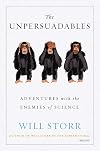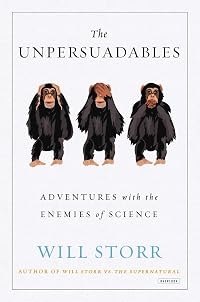
The Unpersuadables: Adventures with the Enemies of Science
by Will Storr
On This Page
Description
Interweaves personal memoir and investigative journalism with the latest neuroscience and experimental psychology research to reveal how the stories individuals tell themselves about the world shape their beliefs, leading to self-deception, toxic partisanship, and science denial.Tags
Recommendations






Member Reviews
Read at work over lunch. I'll probably buy it some time soon, though maybe not in hardcover. A great look at ways the mind makes mistakes, both sympathetic and skeptical. He ranges over a wide field, from homeopathy and Holocaust denial, to psychiatry and the skeptical movement itself. In the last part of the book Storr is on a quest to find proof that James Randi is not all he's made out to be, and of course he finds it. Rather than ridiculing and mocking those with false beliefs, he advocates trying to understand that you can also make egregious errors, that everyone does, and that this is probably not a fixable aspect of human nature. He seems to come down hard on the idea that it is immoral to have false beliefs, and I'll probably show more be thinking of that for quite a while.
4 stars oc show less
4 stars oc show less
An interesting investigation into the worlds of assorted skeptics, deniers, and holders of delusions, including creationists, smug atheists, sufferers of the Morgellon itch, paranormal researchers, and Holocaust deniers. Storr is a rationalist but he does a good job of keeping an open mind as he tries to understand why these people think the way they do. What Storr reveals is that rationalists can be as extreme in their narrow-mindedness as any religious fundamentalist, and that he can empathize with the kookiest of the bunch he profiles here, something I doubt I could ever do.
Note: this book has also been published under the name ‘The Unpersuadables’.
Journalist Will Storr embarks on a mission to find out why people believe things that go directly against evidence and science and in doing so, meets with a group of Creationists in Australia; tours Holocaust sites with David Irving and a bunch of modern day Nazis; goes through past-life regression therapy and relives his own murder in a previous life; meets sufferers of a disease which does not apparently exist, and much much more.
I really liked the first couple of chapters – the first one was where he met the Creationists (for clarity, neither he nor I want to criticise anyone’s religious beliefs; however the leader of this group spouts some frankly show more objectionable ‘ethics’ and contradicts himself several times when being interviewed by Storr) and the second chapter was where he spent time with a group of people who believed they were alien abductees. The chapter which left a metaphorical horrible taste in my mouth was the one where Storr describes time spent with Irving and other Holocaust deniers, who – scarily – even while casually airing their shocking beliefs, can easily seem like pleasant and friendly people if you are not aware of such beliefs.
The most interesting chapter was the one about the sufferers of Morgellons which is either a genuine skin disease or a delusion suffered en masse by its very earnest believers. Medical science points to the latter but there are definitely moments in Storr’s investigation which give pause for thought.
I liked that Storr is obviously sceptical about a lot of what he hears, but he tries to be compassionate and understanding and to wants to learn why people think what they do. He is open about his own past with mental or emotional problems, which I admire. However, the chapters that worked less well for me – despite being vital to the narrative – is where he discusses how the brain works, with evidence taken from medical and scientific experts.
I think I would read more by Will Storr – he can be very engaging and, when he chooses to be, also very amusing (which I would have liked more of in this book), and I would recommend to anyone interested in the subject of the brain. show less
Journalist Will Storr embarks on a mission to find out why people believe things that go directly against evidence and science and in doing so, meets with a group of Creationists in Australia; tours Holocaust sites with David Irving and a bunch of modern day Nazis; goes through past-life regression therapy and relives his own murder in a previous life; meets sufferers of a disease which does not apparently exist, and much much more.
I really liked the first couple of chapters – the first one was where he met the Creationists (for clarity, neither he nor I want to criticise anyone’s religious beliefs; however the leader of this group spouts some frankly show more objectionable ‘ethics’ and contradicts himself several times when being interviewed by Storr) and the second chapter was where he spent time with a group of people who believed they were alien abductees. The chapter which left a metaphorical horrible taste in my mouth was the one where Storr describes time spent with Irving and other Holocaust deniers, who – scarily – even while casually airing their shocking beliefs, can easily seem like pleasant and friendly people if you are not aware of such beliefs.
The most interesting chapter was the one about the sufferers of Morgellons which is either a genuine skin disease or a delusion suffered en masse by its very earnest believers. Medical science points to the latter but there are definitely moments in Storr’s investigation which give pause for thought.
I liked that Storr is obviously sceptical about a lot of what he hears, but he tries to be compassionate and understanding and to wants to learn why people think what they do. He is open about his own past with mental or emotional problems, which I admire. However, the chapters that worked less well for me – despite being vital to the narrative – is where he discusses how the brain works, with evidence taken from medical and scientific experts.
I think I would read more by Will Storr – he can be very engaging and, when he chooses to be, also very amusing (which I would have liked more of in this book), and I would recommend to anyone interested in the subject of the brain. show less
this was a really surprising and intersting book. Initially it seemed like a fairly straightforward tour of heretical ideas, but it was combined with some pretyy intense confessional passages from the author's past. Very well written, informative and entertaining
In trying to get to the source of false beliefs, Storr concludes that the instrument by which we draw our idiosyncratic conclusions―the brain―is largely at fault. Without cheap mockery and in full awareness of his own & everyone’s cognitive/psychological shortcomings, Storr’s investigation is fascinating and fatalistic, but not pessimistic. Worth a read by partisans everywhere.
Two Roads Unorthodox Russian Imperial Stout
Revolution A Little Crazy Pale Ale
Two Roads Unorthodox Russian Imperial Stout
Revolution A Little Crazy Pale Ale
Though the author interviews and examines the ideas of people who are into some very..."interesting, subjects, like holocaust deniers, faith healers, and others, he also does the same to the people within the field of skepticism. What I found interesting about this book is that the author points out that even scientific or scientific-minded skeptics can they themselves become over-biased and refuse to look at other perspectives. You even need to be skeptical of skepticism!
An interesting examination into a perspective of science that many of us wouldn't consider.
An interesting examination into a perspective of science that many of us wouldn't consider.
One obvious reason for this failure to communicate is the lack of science education beyond school. So that those who didn't succeed at it when young are forever excluded. If chemistry, for example, was offered more as a adult education class science would appear less as an exclusive group that only a small number can be part of.
That early ending of science education opens the door very wide for alternative views to gain ground. There is an Australian MOOC’s course provider, open2study that offers beginner courses in chemistry and physics; this is a far better way of increasing understanding, than just telling people they are wrong, and scientists are always right.
I'm inclined to agree that moving into dictating lifestyle choices is show more not a good move, but for me the failure of science to communicate properly was shown most clearly with the five a day campaign for fruit and vegetables.
There are extremely sound nutritional reasons for eating at least five portions of fruit and vegetables a day, but not once were those very good nutritional reasons put forward, because the assumption was that "ordinary" people wouldn't understand them. So the finger wagging approach was adopted, instead. Had a less patronising method of persuading people, that offered more detailed, and better, reasons, been used, then quite likely it might have generated more interest is science, as well as better understanding of the reasons for eating five a day.
It's this "them and us" approach that is the problem, I understand that it is a desire to protect skills and the science "community" itself, by having a closed shop approach, and I understand that the desire to protect theories that have been developed over a long time, might encourage scientists to put up "keep out" signs all over the place.
A key cause of public 'scepticism' with science is (I believe) a lack of understanding of how the Scientific Method works.
We have the Sunday Papers obsessed with single studies about cancer, heralding a study on the Antarctic (for instance) as proof that AGW is not a problem and fringe groups picking up on a ragtag of studies to prove that GMO causes cancer or vaccines make your kids stupid or fluoride is a government plot.
Scientists do sometimes cheat, or perform bad science, or are biased but the scientific method slowly eliminates these in the same way evolution gets rid of dead end designs in nature. Science loves a mystery and if an unusual finding appears in a study others will research it- and if it appears to be basically correct then more studies will build on it- if it is basically flawed it will be forgotten. It is the huge constantly growing 4 dimensional jigsaw puzzle- a scientist may be able to fit a new piece but unless all the sides fit in it may not stay there.
A lot comes down to basic science education - we should all leave school knowing what a theory is in the same way we know a noun.
But, in the end it also makes it far easier for any charlatan to offer alternative theories.
Storr, a piece of advice: crackpots are not scientists. show less
That early ending of science education opens the door very wide for alternative views to gain ground. There is an Australian MOOC’s course provider, open2study that offers beginner courses in chemistry and physics; this is a far better way of increasing understanding, than just telling people they are wrong, and scientists are always right.
I'm inclined to agree that moving into dictating lifestyle choices is show more not a good move, but for me the failure of science to communicate properly was shown most clearly with the five a day campaign for fruit and vegetables.
There are extremely sound nutritional reasons for eating at least five portions of fruit and vegetables a day, but not once were those very good nutritional reasons put forward, because the assumption was that "ordinary" people wouldn't understand them. So the finger wagging approach was adopted, instead. Had a less patronising method of persuading people, that offered more detailed, and better, reasons, been used, then quite likely it might have generated more interest is science, as well as better understanding of the reasons for eating five a day.
It's this "them and us" approach that is the problem, I understand that it is a desire to protect skills and the science "community" itself, by having a closed shop approach, and I understand that the desire to protect theories that have been developed over a long time, might encourage scientists to put up "keep out" signs all over the place.
A key cause of public 'scepticism' with science is (I believe) a lack of understanding of how the Scientific Method works.
We have the Sunday Papers obsessed with single studies about cancer, heralding a study on the Antarctic (for instance) as proof that AGW is not a problem and fringe groups picking up on a ragtag of studies to prove that GMO causes cancer or vaccines make your kids stupid or fluoride is a government plot.
Scientists do sometimes cheat, or perform bad science, or are biased but the scientific method slowly eliminates these in the same way evolution gets rid of dead end designs in nature. Science loves a mystery and if an unusual finding appears in a study others will research it- and if it appears to be basically correct then more studies will build on it- if it is basically flawed it will be forgotten. It is the huge constantly growing 4 dimensional jigsaw puzzle- a scientist may be able to fit a new piece but unless all the sides fit in it may not stay there.
A lot comes down to basic science education - we should all leave school knowing what a theory is in the same way we know a noun.
But, in the end it also makes it far easier for any charlatan to offer alternative theories.
Storr, a piece of advice: crackpots are not scientists. show less
Members
- Recently Added By
Published Reviews
ThingScore 75
"[A] searching, extraordinarily thoughtful exploration of what it means to believe anything — not just the weird things that the fanatics, eccentrics and heretics that Storr interviews believe."
added by lquilter
Author Information

11+ Works 1,555 Members
Will Storr is an award-winning journalist and novelist whose work has appeared in the Guardian, the Sunday Times, the New Yorker, and the New York Times. His books include Selfie: How the West Became Self-Obsessed and The Unpersuadables: Adventures with the Enemies of Science. His writing courses are among the most in-demand offerings of the show more Guardian Masterclasses and the Faber Academy. He lives in Kent, England. show less
Awards and Honors
Distinctions
Common Knowledge
- Canonical title
- The Unpersuadables: Adventures with the Enemies of Science
- Original publication date
- 2014
- Epigraph
- 'And then he said to me — this is honestly true — he said to me, "Well you can prove anything with facts, can't you?"'
Stewart Lee, How I Escaped My Certain Fate (2010)
'A self is probably the most impressive work of art we ever produce.'
Jerome Bruner, Making Stories: Law, Literature, Life (2002) - Dedication
- For Farrah
for ending the madness - First words
- It is Friday night in a town called Devil and the community hall is full.
- Last words
- (Click to show. Warning: May contain spoilers.)We are just ordinary heroes fighting phantom Goliaths, doing our best in the service of truth when the only thing that we really know are the pulses.
- Canonical DDC/MDS
- 001.9
- Canonical LCC
- Q172.5.H47
Classifications
Statistics
- Members
- 330
- Popularity
- 95,989
- Reviews
- 9
- Rating
- (3.81)
- Languages
- English
- Media
- Paper, Audiobook, Ebook
- ISBNs
- 10
- ASINs
- 3