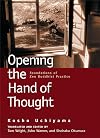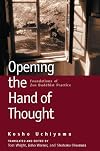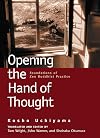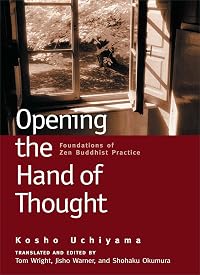
Opening the Hand of Thought : Foundations of Zen Buddhist Practice
by Kosho Uchiyama Roshi, Kōshō Uchiyama
On This Page
Description
For over thirty years, Opening the Hand of Thought has offered an introduction to Zen Buddhism and meditation unmatched in clarity and power. This is the revised edition of Kosho Uchiyama's singularly incisive classic. This new edition contains even more useful material: new prefaces, an index, and extended endnotes, in addition to a revised glossary. As Jisho Warner writes in her preface, Opening the Hand of Thought "goes directly to the heart of Zen showing how Zen Buddhism can be a deep show more and life-sustaining activity." She goes on to say, "Uchiyama looks at what a person is, what a self is, how to develop a true self not separate from all things, one that can settle in peace in the midst of life." By turns humorous, philosophical, and personal, Opening the Hand of Thought is above all a great book for the Buddhist practitioner. It's a perfect follow-up for the listener who has heard Zen Meditation in Plain English and is especially useful for those who have not yet encountered a Zen teacher. show lessTags
Recommendations






















Member Reviews
Such a treasure of a book on zazen and buddhadarma. Uchiyama has a very stripped-down, matter-of-fact, and easy-to-understand delivery of some concepts that I have struggled with. I was happy to have my own copy so I could underline and takes notes in the margin! The glossary is nice as well, and it also includes notes broken down by chapter.
I highly recommend this for anyone that practices zazen --- or even just those curious about Zen buddhism.
I highly recommend this for anyone that practices zazen --- or even just those curious about Zen buddhism.
Wise, clear, and searching, this collection of the writings of an iconoclastic Zen master takes a rational approach to transcendence, to the discovery of the unlimited depth of reality, and to understanding the self beyond our usual notions of who we are.
Kosho Uchiyama (1912–1998) was a Japanese Sōtō Zen priest, influential teacher, and origami master. He is best known for his rigorous commitment to zazen (sitting meditation) and his ability to translate ancient Zen teachings for the modern world.
Early Life and Education
Born in Tokyo, Uchiyama graduated from Waseda University in 1937 with a master’s degree in Western philosophy. This philosophical background deeply informed his later Zen teaching, allowing him to bridge Eastern practice and Western thought.
Zen Training and Leadership
Ordination: He was ordained as a priest in 1941 under the legendary teacher Kōdō Sawaki.
Antai-ji Abbotship: Following Sawaki's death in 1965, Uchiyama became the abbot of Antai-ji, a temple then show more located near Kyoto.
Style of Practice: Unlike many of his contemporaries, Uchiyama rarely traveled outside Japan, choosing instead to stay at Antai-ji to guide a diverse group of Japanese and international students. He emphasized "plain rice" practice—simple, dedicated zazen without the distractions of complex ritual. show less
Early Life and Education
Born in Tokyo, Uchiyama graduated from Waseda University in 1937 with a master’s degree in Western philosophy. This philosophical background deeply informed his later Zen teaching, allowing him to bridge Eastern practice and Western thought.
Zen Training and Leadership
Ordination: He was ordained as a priest in 1941 under the legendary teacher Kōdō Sawaki.
Antai-ji Abbotship: Following Sawaki's death in 1965, Uchiyama became the abbot of Antai-ji, a temple then show more located near Kyoto.
Style of Practice: Unlike many of his contemporaries, Uchiyama rarely traveled outside Japan, choosing instead to stay at Antai-ji to guide a diverse group of Japanese and international students. He emphasized "plain rice" practice—simple, dedicated zazen without the distractions of complex ritual. show less
note book # 821 O.K.
Ratings
Members
- Recently Added By
Author Information
25+ Works 847 Members
7 Works 626 Members
Some Editions
Common Knowledge
- Canonical title
- Opening the Hand of Thought : Foundations of Zen Buddhist Practice
- Blurbers
- Aitken, Robert; Buksbazen, John Daishin; Braverman, Arthur; Ford, James Ishmael
Classifications
Statistics
- Members
- 293
- Popularity
- 110,268
- Reviews
- 5
- Rating
- (4.44)
- Languages
- English
- Media
- Paper, Ebook
- ISBNs
- 4
- ASINs
- 3