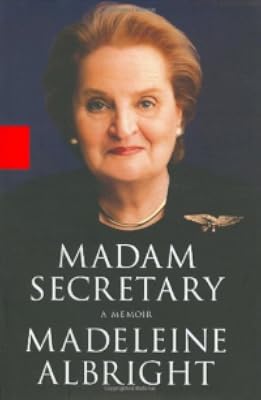
Madam Secretary: A Memoir
by Madeleine Albright
On This Page
Description
A national bestseller on its original publication in 2003, Madam Secretary is a riveting account of the life of America's first woman Secretary of State, Madeleine Albright. For eight years, during Bill Clinton's two presidential terms, Albright was a high-level participant in some of the most dramatic events of our time - from the pursuit of peace in the Middle East to NATO's intervention in the Balkans to America's troubled relations with Iran and Iraq. In this thoughtful memoir, one of show more the most admired women in U.S. history reflects on her remarkable personal story, including her upbringing in war-torn Europe and the balancing of career and family responsibilities, and on America's leading role in a changing world. With a new epilogue by the author, Madam Secretary offers an inimitable blend of Albright's warm humor, probing insights, and distinctive ideas. show lessTags
Recommendations

























Member Reviews
A highly interesting and candid memoir from a woman who made her way from the destruction of post-Second World War Europe to one of the highest governmental positions in the United States. Albright recounts her achievements and involvements in an engaging, forceful, and funny manner; while I don't agree with all her political stances or methods (she's perhaps a little one-size-fits-all in her advocacy of American-style democracy throughout the globe), I love that what she wants to be remembered for having taught her generation of women that you could get somewhere if you pushed hard enough, and for having showed to younger women the power of interrupting. Her descriptions of the negotiations in which she took part during her tenure as show more Secretary of State are lively and evocative, and give the sense of what it's like to be at the heart of such things, rather than on the outside looking in. Well worth the read if you have any interest in US foreign policy in the late twentieth century. show less
4.5 stars. This was a long read but it was enjoyable. Albright's humor and writing made the content readable. It was a good balance of history, personal commentary, and reflection. Albright is truly an incredible woman for her dedication to her passions and to serving her country. There is one thing all readers can gather from this memoir: this read really showed how human the individual political actors are. It reminded me that presidents, prime ministers, and diplomats in general are all subject to the same emotions we are. We can all throw tantrums and make decisions just to spite others. We all make mistakes and wish we did things differently in hindsight. In short, I enjoyed this memoir because it put a human face to history and show more politics. They're not just words on a page or a shape on a map. They are people led by individuals who are only human. show less
I've read a few political autobiographies because a former boss gifted them to her staff each year. She must have been a Republican because they were written by Colin Powell and Donald Rutherford. Despite being a Democrat, I found these books easy to read and enjoyable. But Madeleine Albright's Madam Secretary stands head and shoulders above both of these others in its deft balancing of the personal and the political and the often self-deprecating humor she brings to bear. Madeleine Albright was the first female Secretary of State, a remarkable achievement, made all the more impressive by the fact that she was born in Prague and immigrated to the United States as a young girl. Her father was an intellectual diplomat who sought asylum show more here because he was an ardent anti-communist. While he obtained a university job in Colorado Madeleine nevertheless did not grow up privileged or wealthy (though she did marry into wealth). She always worked very hard to get good grades and ended up getting a full scholarship to Vassar. The book covers her entire career, including her first jobs, but focuses on the last two, namely U.S. Representative to the United Nations and later Secretary of State under Clinton and the major issues in foreign policy during those years including events in Haiti, Rwanda, Somalia, Kosovo, Serbia, China, Russia, and the Middle East. She discusses her friendships and rivalries with other diplomats and heads of state and is honest about her failures as well as her successes. Her discovery, at age 60, that her parents were born Jewish and three of her grandparents perished in the Holocaust is really fascinating. She openly discusses her failed marriage to Joseph Albright and the warmth she feels for her children and grandchildren and friends and colleagues is palpable. You learn a lot about what happened in those years and why certain political decisions were made. And just as importantly, you grow to truly appreciate and feel a kinship with this modest, funny and brilliant woman who achieved so much for herself and the world and gave her best efforts to all she undertook. show less
An astonishing, engaging story, told in first person from her birth in Czechoslovakia through resignation of her post as Secretary of State under Clinton. I was lucky enough to see Albright when she came to Phoenix as part of the Speakers' Series, and I found her insightful, knowledgeable, and adept with the one-liner. ("I was required to wear a bulletproof raincoat ... so big, the material stuck out above my shoulders. I eyed the photographers warily, fearing the caption, 'Madeleine Albright, the Hunchbacked Dame.'") This book was written in collaboration with Bill Woodward (speechwriter), but I heard her voice loud and clear in these pages. I also learned a lot about the policies and our relationships with countries all over the globe show more and was in awe of her ability to understand the delicate political nuances, how aspects such as the need to "save face" with people back home or backstories going back fifty years shape negotiations. She's also acutely attuned to language. At times there would be a phrase spoken or reported in the newspapers, and I'd think nothing of it, whereas she or one of her advisors would say, "Aha! That changes things." I'd have to read the next paragraph or two to understand why. I appreciate her efforts at building coalitions, including among women at the U.N. and elsewhere. I have to confess I got a bit bogged down by the long section about the middle east, but the situation is so complicated, that was probably inevitable. I love that she includes cartoons that poke fun at herself and photographs that suggest her ability to connect with a wide variety of people. Her husband, who left her for a younger woman doesn't come off so well; and she expresses her disappointment with Clinton over the Lewinsky affair ("I was angry with the President for risking so much for less than nothing"). But she took the advice of Gabriel Garcia Marquez: "When you write your memoirs, remember: do not be angry." It's a long book, but definitely worth the 500 pages. This was a bookclub pick, and though it is my first book by Albright, I will read more. This book was published in 2003, and I will be interested to see how/if two additional decades alter her views or focus. show less
https://fromtheheartofeurope.eu/madam-secretary-by-madeleine-albright/
My closest encounter with Madeleine Albright was in Banja Luka in the summer of 1997, when she descended on the Bosnian Serb capital with the full force of the State Department to visit the local leader, President Biljana Plavšić. The US government took over the central Hotel Bosna for the day; I was among the crowds that watched as the official motorcade took the Secretary of State from the hotel to the President’s offices in the main government building, the Banski Dvor. But the Banski Dvor is literally across the road from the Hotel Bosna, the front doors being less than 100 metres apart; the American motorcade was literally longer than the distance it needed show more to travel. It was a strange sight.
Anyway, this is a fascinating if rather long first-person account of life on the way to the top, and then at the top, of American politics. Though born in Prague in 1937, her family fled to the USA after the Communist take-over in 1948 and she settled down to become a smart American in an immigrant family. Her father, formerly a zech diplomat, became a political science professor; she followed in his footsteps, but also managed to catch a superbly well-connected journalist husband, which can’t have done any harm as she rose in DC.
A side hobby of fund-raising got her the attention of Democratic veteran Ed Muskie, who hired her for his Senate team in 1976; Zbig Brzezinski then snagged for the the National Security Council in the Carter presidency. The Democrats were out of office for the next twelve years, though she was involved as a senior foreign policy adviser in the unsuccessful 1984 and 1988 campaigns. Finally, a victorious Bill Clinton appointed her as ambassador to the United Nations in 1993, and Secretary of State in 1997, shortly before my near brush with her in Bosnia. She was also closely involved with the National Democratic Institute, my employers in Bosnia, though she had stepped back from it while in office. The book was published in 2002, very soon after the end of the Clinton presidency.
The circumstantial detail of her life before Washington is all very interesting, but like most readers I was fascinated by the insider accounts of Washington (and New York) policy-making. The Rwanda genocide, the Bosnia and Kosovo wars, the escalation against Saddam Hussein (which was firmly bipartisan in Washington in those days), relations with China and Russia, and above all the ins and outs of the Middle East from the high point of the Oslo accords in 1993 to the failure at Camp David in 2000, are all lucidly described; I am more familiar with some of these than others, but had no difficulty in following the thread. She is pretty clear on her own motivation, which usually coincided with US policy – though not always; she happily confirms that she tended to be on the hawkish side regarding the use of force, particularly after Rwanda.
There is a particularly moving chapter where, newly appointed as secretary of state, she discovers that her parents were Jewish and that three of her grandparents, who she remembered from her own childhood, had been killed in the Holocaust (one grandfather had died in 1938). Her parents had brought her up as a Catholic and she had no idea of her personal connection. Having been delving into my own family history of late, I know the feeling of genealogical surprises, though I don’t think that anything quite like that is lying in wait for me.
Anyway, it’s a lengthy book, but I found it enlightening. show less
My closest encounter with Madeleine Albright was in Banja Luka in the summer of 1997, when she descended on the Bosnian Serb capital with the full force of the State Department to visit the local leader, President Biljana Plavšić. The US government took over the central Hotel Bosna for the day; I was among the crowds that watched as the official motorcade took the Secretary of State from the hotel to the President’s offices in the main government building, the Banski Dvor. But the Banski Dvor is literally across the road from the Hotel Bosna, the front doors being less than 100 metres apart; the American motorcade was literally longer than the distance it needed show more to travel. It was a strange sight.
Anyway, this is a fascinating if rather long first-person account of life on the way to the top, and then at the top, of American politics. Though born in Prague in 1937, her family fled to the USA after the Communist take-over in 1948 and she settled down to become a smart American in an immigrant family. Her father, formerly a zech diplomat, became a political science professor; she followed in his footsteps, but also managed to catch a superbly well-connected journalist husband, which can’t have done any harm as she rose in DC.
A side hobby of fund-raising got her the attention of Democratic veteran Ed Muskie, who hired her for his Senate team in 1976; Zbig Brzezinski then snagged for the the National Security Council in the Carter presidency. The Democrats were out of office for the next twelve years, though she was involved as a senior foreign policy adviser in the unsuccessful 1984 and 1988 campaigns. Finally, a victorious Bill Clinton appointed her as ambassador to the United Nations in 1993, and Secretary of State in 1997, shortly before my near brush with her in Bosnia. She was also closely involved with the National Democratic Institute, my employers in Bosnia, though she had stepped back from it while in office. The book was published in 2002, very soon after the end of the Clinton presidency.
The circumstantial detail of her life before Washington is all very interesting, but like most readers I was fascinated by the insider accounts of Washington (and New York) policy-making. The Rwanda genocide, the Bosnia and Kosovo wars, the escalation against Saddam Hussein (which was firmly bipartisan in Washington in those days), relations with China and Russia, and above all the ins and outs of the Middle East from the high point of the Oslo accords in 1993 to the failure at Camp David in 2000, are all lucidly described; I am more familiar with some of these than others, but had no difficulty in following the thread. She is pretty clear on her own motivation, which usually coincided with US policy – though not always; she happily confirms that she tended to be on the hawkish side regarding the use of force, particularly after Rwanda.
There is a particularly moving chapter where, newly appointed as secretary of state, she discovers that her parents were Jewish and that three of her grandparents, who she remembered from her own childhood, had been killed in the Holocaust (one grandfather had died in 1938). Her parents had brought her up as a Catholic and she had no idea of her personal connection. Having been delving into my own family history of late, I know the feeling of genealogical surprises, though I don’t think that anything quite like that is lying in wait for me.
Anyway, it’s a lengthy book, but I found it enlightening. show less
Madeleine Albright served in Bill Clinton’s administration as UN Ambassador and Secretary of State – the first female ever in that role. Since Clinton was especially active in international diplomacy, she held a front-row seat and observed many international characters and diplomatic ventures. Further, her career broke the glass ceiling for women in government, and she did it while being a doting mother, grandmother, and even a divorcee. Finally, along with her birth family, she was a Czech refugee after World War II and thus exhibited many noble characteristics of the American Dream of an immigrant’s building a life.
This memoir starts by delving into her family’s background. Her Czech father was a diplomat and an outspoken show more advocate for democracy in mid-century Europe. That position made his family personae non gratae in a Warsaw Pact country after the rise of communism. He was able to find asylum in America and a teaching position at the University of Denver. Obviously, his daughter Madeleine functioned as one of his premier students, but he also counted Condeleezza Rice, the second female Secretary of State, on his list of one-time students. Madeleine’s affinities for diplomacy and democracy thus grew as parts of a family affair.
Albright’s perspectives on the failed Middle East peace process also receive special attention in this memoir. As in Bill Clinton’s memoirs, she is able to capture unique scenes and personalities that drove negotiations oh-so-close to success. She also details why it failed in her view and what future rounds need to change. She is finally able to foresee early steps accounting for the process’s ultimate, unfortunate collapse. Along with other attendees at Camp David, her account deserves a prominent place in the historical record.
It’s hard to criticize someone’s unique account of historical matters. Obviously, some will disagree with her political perspective as a Democrat. And just as obviously, future historians will debate the strengths and weaknesses of her approach and decisions. In fact, she herself does that to her own record in the conclusion and epilogue! Her tale is well-constructed and elegantly articulated. She is relatively fair even to those she disagreed with and does not comport herself as vindictive. I was a teenager consumed with school activities when she was in the cabinet, so I enjoyed getting to know the history of the 1990s at a deeper level than I grasped then. This book also taught me deeper roots of some current geopolitical problems. For both of those benefits, I am grateful to have read this book. show less
This memoir starts by delving into her family’s background. Her Czech father was a diplomat and an outspoken show more advocate for democracy in mid-century Europe. That position made his family personae non gratae in a Warsaw Pact country after the rise of communism. He was able to find asylum in America and a teaching position at the University of Denver. Obviously, his daughter Madeleine functioned as one of his premier students, but he also counted Condeleezza Rice, the second female Secretary of State, on his list of one-time students. Madeleine’s affinities for diplomacy and democracy thus grew as parts of a family affair.
Albright’s perspectives on the failed Middle East peace process also receive special attention in this memoir. As in Bill Clinton’s memoirs, she is able to capture unique scenes and personalities that drove negotiations oh-so-close to success. She also details why it failed in her view and what future rounds need to change. She is finally able to foresee early steps accounting for the process’s ultimate, unfortunate collapse. Along with other attendees at Camp David, her account deserves a prominent place in the historical record.
It’s hard to criticize someone’s unique account of historical matters. Obviously, some will disagree with her political perspective as a Democrat. And just as obviously, future historians will debate the strengths and weaknesses of her approach and decisions. In fact, she herself does that to her own record in the conclusion and epilogue! Her tale is well-constructed and elegantly articulated. She is relatively fair even to those she disagreed with and does not comport herself as vindictive. I was a teenager consumed with school activities when she was in the cabinet, so I enjoyed getting to know the history of the 1990s at a deeper level than I grasped then. This book also taught me deeper roots of some current geopolitical problems. For both of those benefits, I am grateful to have read this book. show less
Loved this memoir of Madeleine Albright's life. She really covers everything from her childhood in Prague and Europe, her teen years in Colorado, her marriage, her divorce, being a single parent, trying to find her footing as a woman in politics and academia, her time in the U.N., and her role as Secretary of State.
I got just a tiny bit bored during some of the minutia about the politics and world events toward the end of the book, but overall this was really good. At its best when she's describing her "real life" vs. her work life.
Original publication date: 2001
Author’s nationality: American, Czech born
Original language: English
Length: 736 pages
Rating: 4 stars
Format/where I acquired the book: kindle purchase
Why I read this: show more interested in the topic/life show less
I got just a tiny bit bored during some of the minutia about the politics and world events toward the end of the book, but overall this was really good. At its best when she's describing her "real life" vs. her work life.
Original publication date: 2001
Author’s nationality: American, Czech born
Original language: English
Length: 736 pages
Rating: 4 stars
Format/where I acquired the book: kindle purchase
Why I read this: show more interested in the topic/life show less
Members
- Recently Added By
Lists

Biographies: Women
112 works; 1 member
Author Information

18+ Works 5,544 Members
Madeleine Korbelová Albright was born May 15, 1937 in the Smíchov district of Prague, Czechoslovakia. She attended Wellesley College, in Wellesley, Massachusetts, on a full scholarship, majoring in political science and graduated in 1959. Her senior thesis was written on Czech Communist Zdenek Fierlinger Her PhD is from Columbia University. She show more holds honorary degrees from Brandeis University; the University of Washington; Smith College; University of Winnipeg; the University of North Carolina at Chapel Hill , and Knox College. Albright worked as an intern for The Denver Post and as a picture editor for Encyclopædia Britannica. She was invited to organize a fund-raising dinner for the 1972 presidential campaign of U.S. Senator Ed Muskie of Maine.This association with Muskie led to a position as his chief legislative assistant in 1976. However, after the 1976 U.S. presidential election of Jimmy Carter, Albright's former professor Brzezinski was named National Security Advisor, and recruited Albright from Muskie in 1978 to work in the West Wing as the National Security Council's congressional liaison. Albright joined the academic staff at Georgetown University in Washington, D.C., in 1982, specializing in Eastern European studies. In 1992, Bill Clinton returned the White House to the Democratic Party, and Albright was employed to handle the transition to a new administration at the National Security Council. In January 1993, Clinton nominated her to be U.S. Ambassador to the United Nations. Albright soon took office as the 64th U.S. Secretary of State on January 23, 1997 and she became the first female U.S. Secretary of State and the highest-ranking woman in the history of the U.S. government. Albright now serves as a Professor of International Relations at Georgetown University's Walsh School of Foreign Service. Her title Prague Winter: A Personal Story of Remembrance and War, 1937-1948 made The New York Times Best Seller list for 2012. Her most recent book is Fascism: A Warning. (Bowker Author Biography) show less
All Editions
Some Editions
Awards and Honors
Awards
Distinctions
Common Knowledge
- Canonical title*
- Madame le Secrétaire d'État. Mémoires
- Original title
- Madam Secretary
- Original publication date
- 2003
- People/Characters
- Madeleine Albright; Bill Clinton; Colin Powell; Slobodan Milošević; Saddam Hussein
*Some information comes from Common Knowledge in other languages. Click "Edit" for more information.
Classifications
- Genres
- Biography & Memoir, Nonfiction, General Nonfiction, History
- DDC/MDS
- 973.929092 — History & geography History of North America United States 1901- Cold War, Vietnam War, Digital Age (1953-2001) Bill Clinton (1993-2001) North American Free Trade Agreement, Impeachment of Bill Clinton, Balanced Budget Surplus Era Standard subdivisions Biography
- LCC
- E840.8 .A37 .A3 — History of the United States United States Later twentieth century, 1961-2000 Biography (General)
- BISAC
Statistics
- Members
- 1,416
- Popularity
- 16,755
- Reviews
- 20
- Rating
- (3.93)
- Languages
- 13 — Arabic, Czech, Danish, Dutch, English, Estonian, French, German, Norwegian (Bokmål), Polish, Russian, Spanish, Swedish
- Media
- Paper, Audiobook, Ebook
- ISBNs
- 35
- UPCs
- 1
- ASINs
- 10