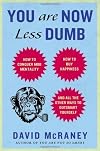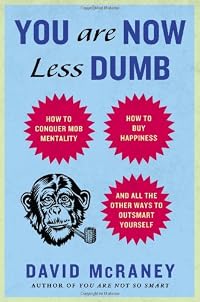
You Are Now Less Dumb: How to Conquer Mob Mentality, How to Buy Happiness, and All the Other Ways to Outsmart Yourself
by David McRaney
On This Page
Description
The popular blogger and author of the best-selling "You Are Not So Smart" shares more discoveries about self-delusion and irrational thinking, analyzing 15 additional ways people routinely fool themselves in areas ranging from attraction and time wasted to best intentions and the true price of happiness.Tags
Recommendations



Member Recommendations
Member Reviews
"The research suggests that the average person thinks she is not the average person. She thinks most people are dumb, and that she is not like most people."
My favorite thing about this book is not just the neat psychological tricks we nearly all play on ourselves (although that too!) but the fact that the author, David McRaney, describes them in a way that even I, brain fog girl, could understand. His writing style is playful and sometimes and even laugh-out-loud amusing. (As in, "Magical amulets do not exist, and even if they did, think about how expensive it would be to hire a factory full of wizards to enchant enough of them for worldwide distribution.") You don't get that in many psychology books!
My favorite thing about this book is not just the neat psychological tricks we nearly all play on ourselves (although that too!) but the fact that the author, David McRaney, describes them in a way that even I, brain fog girl, could understand. His writing style is playful and sometimes and even laugh-out-loud amusing. (As in, "Magical amulets do not exist, and even if they did, think about how expensive it would be to hire a factory full of wizards to enchant enough of them for worldwide distribution.") You don't get that in many psychology books!
Having read this, I am now less dumb. However, I don't feel like it, given that I am a walking pile of cognitive biases, mental shortcuts and self-delusion (same as the rest of you). Learning a little about this stuff is a mixed blessing because you start seeing logical fallacies being committed everywhere; by yourself and others. I continue to enjoy the author's podcast series (You Are Not So Smart), and this book is a footnoted expansion of much of that work. I can't recommend this book more highly - it is fairly short, very accessible and very, very interesting.
This was a "bedtime storybook" that I read aloud to my eleven-year-old. (Yes, really.) And we really enjoyed it. My kid is into science so I'd recently added a few non-fiction science books to the shelf where he chooses his next book from. He sometimes watches the Brain Games show on Netflix, so he had some context going in, and largely this book was written at an accessible enough level, though there were a few examples or case studies that were sexual (not lewd) in nature, but nothing too far.
The book is organized into chapters on common delusions or fallacies, most of which boil down to in the end your brain's need to tell itself a story about you, a you who makes sense and is generally a good person and makes rational choices, and show more the ways that goes wrong when your decisions aren't rational, or something endangers your view of yourself as good. It's why you sometimes get mad at someone you've unintentionally wronged, why you double-down when someone challenges a deeply held belief.
As some have noted, this book is a little shy on strategies to beat these fallacies (which the title might lead you to believe this book is about). I think there are a lot of us who'd like tips on how to talk to people who may have voted a certain unstable, misogynist, racist narcissist into office, for example. But for that, you need another book. But don't discount the value of this -- the understanding and insight into why. show less
The book is organized into chapters on common delusions or fallacies, most of which boil down to in the end your brain's need to tell itself a story about you, a you who makes sense and is generally a good person and makes rational choices, and show more the ways that goes wrong when your decisions aren't rational, or something endangers your view of yourself as good. It's why you sometimes get mad at someone you've unintentionally wronged, why you double-down when someone challenges a deeply held belief.
As some have noted, this book is a little shy on strategies to beat these fallacies (which the title might lead you to believe this book is about). I think there are a lot of us who'd like tips on how to talk to people who may have voted a certain unstable, misogynist, racist narcissist into office, for example. But for that, you need another book. But don't discount the value of this -- the understanding and insight into why. show less
Similar to his last one - "You Are Not So Smart", but I found this one to be a bit more boring. Some of it is a retread from the last book, or similar enough to the last one just in changed up ways, that it felt like reading a bit of a repeat. But not completely. There is still a lot of new stuff, a lot of different stuff. But for some reason, this one just didn't engage me as much as the first one. Still interesting and fascinating stuff to read about how our brains work and deceive ourselves. Would still recommend the two books, but just know this one is a bit more of a slog going into it perhaps. Though everyone's mileage may vary.
Mildly interesting commentary on a variety of experiments that shows humans aren't as rational as they think. Genetics and cultural conditioning drives much of human behavior and judgment making, and despite thinking we act based on evidence, often the contrary is true. Also has an excellent commentary on "deindividuation", where humans act differently within the anonymity of a crowd than they would alone.
I devour pop psychology books, the nonfiction equivalent of potato chips. This one was had a heavy dose of studies, some going back several decades. Studies verified a variety of individual and group behaviors. 'Looking forward to reading the prequel.
This book has pushed me into a serious existential crisis. I will likely be melancholy and insufferable for at least a month.
Members
- Recently Added By
Author Information

6 Works 2,260 Members
Awards and Honors
Awards
Common Knowledge
- Canonical title
- You Are Now Less Dumb: How to Conquer Mob Mentality, How to Buy Happiness, and All the Other Ways to Outsmart Yourself
- Alternate titles
- You Can Beat Your Brain: How to Turn your Enemies into Friends, How to Make Better Decisions, and Other Ways to Be Less Dumb
- Original publication date
- 2013
- Blurbers
- Popova, Maria
Classifications
- Genres
- General Nonfiction, Nonfiction, Science & Nature
- DDC/MDS
- 153.4 — Philosophy and Psychology Psychology Conscious mental processes and intelligence Thought, thinking, reasoning, intuition, value, judgment
- LCC
- BF441 .M428 — Philosophy, Psychology and Religion Psychology Psychology Consciousness. Cognition
- BISAC
Statistics
- Members
- 402
- Popularity
- 77,011
- Reviews
- 9
- Rating
- (3.88)
- Languages
- English
- Media
- Paper, Audiobook, Ebook
- ISBNs
- 8
- ASINs
- 6