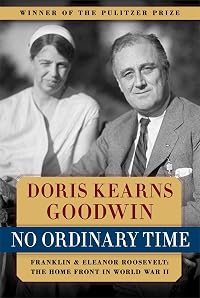
No Ordinary Time: Franklin and Eleanor Roosevelt: The Home Front in World War II
by Doris Kearns Goodwin
On This Page
Description
This New York Times best-seller is the compelling chronicle of a nation during a time of incredible change. With detail and drama, a Pulitzer Prize-winning author expertly reveals the importance of the Roosevelt White House in the great destiny of the United States. Ultimately, she creates an intimate portrait of the Roosevelts, fusing their human vitality with the monumental scale of domestic and foreign affairs during the Second World War.Tags
Recommendations









Member Reviews
If I could give a rating of 10 stars, this book would receive all the stars!
We visited Hyde Park last year and this book was highly recommended by both our tour guide and other visitors.
This is the definitive story of Franklin and Eleanor Roosevelt, with their assets and their foibles. As a baby boomer, I've heard about them my entire life but had not studied them. Ms. Goodwin is a terrific author, not only with her research ability, but her skill in analyzing information and creating a captivating narrative. Sometimes her information isn't what we want to read; that is the value of the book; she presented all the information: the positive and the negative. The reader develops an understanding of Franklin and Eleanor's lives as they show more were, not as we wish they had been.
Eleanor was ahead of her time in many of her endeavors especially in worker, sexual and racial equality; Franklin's wisdom was based on taking the time to ponder and develop his plans. With Franklin's disability, Eleanor became his legs on the ground, traveling to see, and reporting to Franklin what she saw. She was always going. While Franklin needed her observations and insight, her inability to relax and socialize and sometimes to see what was happening closer to home, also caused problems in their relationship.
All of the personal aspects of Franklin and Eleanor's lives were intertwined in the background as Franklin, as President of the United States, was leading the country through the Depression of the 30s, then during the prevalent theme of the people promoting isolationism as it became obvious that we needed to be building up for war, then entering World War II.
It is quite a story and Ms. Goodwin deftly maneuvered through its entirety. show less
We visited Hyde Park last year and this book was highly recommended by both our tour guide and other visitors.
This is the definitive story of Franklin and Eleanor Roosevelt, with their assets and their foibles. As a baby boomer, I've heard about them my entire life but had not studied them. Ms. Goodwin is a terrific author, not only with her research ability, but her skill in analyzing information and creating a captivating narrative. Sometimes her information isn't what we want to read; that is the value of the book; she presented all the information: the positive and the negative. The reader develops an understanding of Franklin and Eleanor's lives as they show more were, not as we wish they had been.
Eleanor was ahead of her time in many of her endeavors especially in worker, sexual and racial equality; Franklin's wisdom was based on taking the time to ponder and develop his plans. With Franklin's disability, Eleanor became his legs on the ground, traveling to see, and reporting to Franklin what she saw. She was always going. While Franklin needed her observations and insight, her inability to relax and socialize and sometimes to see what was happening closer to home, also caused problems in their relationship.
All of the personal aspects of Franklin and Eleanor's lives were intertwined in the background as Franklin, as President of the United States, was leading the country through the Depression of the 30s, then during the prevalent theme of the people promoting isolationism as it became obvious that we needed to be building up for war, then entering World War II.
It is quite a story and Ms. Goodwin deftly maneuvered through its entirety. show less
"Churchill once said that to encounter Franklin Roosevelt, with all his buoyant sparkle, his iridescent personality, and his inner elan was like opening your first bottle of champagne. Roosevelt genuinely liked people, he enjoyed taking responsibility, and he adored being president. Alone among our modern presidents, he had “ ‘no conception of the office to live up to, ‘” political scientist Richard Neustadt noted, “ ’he was it. His image of the office was himself-in-office.’” He did not have the time or the inclination for a melancholy contemplation of the “burdens” of the presidency. “ ‘Wouldn’t you be President if you could?” he once naively asked a friend. “ ‘Wouldn’t anybody?’ ”
Written in the show more exact same format as Team of Rivals, Goodwin once again does what she does best: teach history by telling a story. Just like my experience in reading TOR, I expected to learn a lot of things I had not known before and to be interested until the end. What surprised me was how enamored I became with the eccentric Roosevelts (especially Eleanor) and how entertaining this book was. All of the fiction writers in the world could not come up with a story this interesting!
No Ordinary Time starts on the evening of May 9, 1940. President Franklin Delano Roosevelt, now in his second term in office, has just received the call that Hitler’s armies have simultaneously attacked Holland, Belgium, and Luxembourg, and France. “The phony war” was over. Although this was not a big surprise to anybody, it was not a matter of if but when, the timing could not have been worse.
The United States, still nursing wounds and memories from World War I and the Great Depression, were reluctant to engage in another conflict. England, herself so unprepared for war, according to the author, were borrowing canons from museums! Compared to Germany’s military, the U.S. had nothing in terms of materiel and man power in terms of either quantity and quality. Compounding the situation further, many of the U.S. isolationists felt that the country was protected by the oceans. In his address to a joint session of Congress a week after the attacks, “Nearly a third of the president’s address was devoted to a skillful schoolmasterly description of the flying times from Greenland, the Azores, and the Caribbean Islands to key American cities, to show that, in an age of air warfare, despite the claims of the isolationists, the natural barriers of the Atlantic and Pacific oceans no longer afforded the same protection they had in the past … he warned that Nazi Germany not only had more planes than all its opponents combined, but appeared to have a weekly productive capacity that was far greater than that of its opponents. How could America respond to his alarming situation? Roosevelt’s answer was bold. He asked for … an additional half-million men for the army, to purchase guns and equipment, to build modern tanks, and to construct naval ships. The he made a dramatic call for a staggering productive capacity of fifty thousand planes a year, which would in only twelve months put America ahead of Germany, creating an aerial armada second to none in the world. ….According to Irving Holley, an army historian, “ ‘the President’s big round number was a psychological target to lift sights and accustom planners in military and industrial circles alike to thinking big.’ “
“To cope with present dangers, he admitted, the nation requires “ ‘a toughness of moral and physical fiber,’” but these are precisely “ ‘the characteristics of a free people, a people devoted to the institutions they themselves have built.’”
When he conveyed the idea that the country could rise up over the obstacles it faced, nobody could argue with him. Struck with polio as an adult and paralyzed because of it, everybody knew that Roosevelt had had his own uphill battles to climb. Under any other leader, with things looking so bleak, things may have turned out very differently. Roosevelt’s brilliance was the way he made the war everybody’s war. He expected the American people to pull together, take on the impossible and succeed, and they did. Isaiah Berlin wrote that “Roosevelt ‘believed that with enough energy and spirit anything could be achieved by man.’” His bedrock faith in the American people proved contagious. History shows that not only did the country of Roosevelt meet his expectations, but exceed them. Historian Bruce Catton tries to put it into perspective:
“ ‘Say we performed the equivalent of building two Panama Canals every month with a fat surplus to boot; that’s an understatement, it still doesn’t begin to express it all, the total is simply beyond the compass of one’s understanding. Here was displayed a strength greater even than cocky Americans in the old days of unlimited self-confidence had supposed; strength to which nothing – literally nothing, in the physical sense – was any longer impossible.’”
During the not-so-ordinary time of the Roosevelt administration, the White House itself wasn’t a typical White House, it was more of a hotel where guests of the President and/or the First Lady would come and stay, sometimes for years. Famously, one of the strongest friendships he ever enjoyed was with Winston Churchill. Brought together because of the war, the two seemed like they had been best friends all their lives. When spending time together personally, they would work very hard on the pressing issues of the war and then, when all that could be done was done, they would go off and play even harder. Both world leaders were very social and were very great conversationalists. Much to Eleanor’s dismay, both enjoyed a good stiff drink too. Roosevelt made friends quickly and seemed to thrive when surrounded by people who helped him in his work and who could help him relax. His wife didn’t fit into that latter group.
While FDR was a mix of hard work and hard play, it seemed his estranged wife was a case of hard work and no (at least hardly any) play. Many times the First Lady was on the go from the break of dawn to the next break of dawn! Eleanor Roosevelt came from wealth as well as FDR, but her childhood was not nearly as happy. Her alcoholic father, who adored her, died when she was young and her mother never seemed to approve of Eleanor. Growing up with a low sense of self-esteem, things changed when she went to England to school and met a teacher who praised Eleanor for her intelligence. She blossomed at that school. After marrying FDR, her confidence would falter again under her overbearing mother-in-law. FDR’s mother seemed to have a say in every aspect of the young Roosevelts’ life, even how the children were raised. Eleanor’s self-esteem plummeted. Her friendships with some other women (to her mother-in-law’s chagrin many of them lesbians, who FDR’S mother termed “she-men”), however, would prove an important fountain for her emerging self-confidence. Her friends encouraged her to teach (which she reluctantly gave up after going to the White House) and to write. Her column “My Day” appeared in thousands of newspapers six days a week across the country. When she discovered a lengthy affair FDR had been having in the early years of their marriage, instead of divorcing, which would have been “political suicide” for FDR (also rumor has it that his mother had vowed to disinherit him if he divorced), the two reinvented their “marriage.” They lived separate lives; yet there was a seemingly unbreakable bond of affection and mutual admiration between them. Eleanor was more than happy to serve as FDR’s legs and eyes out among the people. From FDR she learned how to look beyond the surface in a situation and get a real feel of how people were being treated. This became Eleanor’s cause: people, most notably those living on the fringes of society.
It made no sense to Eleanor to fight for democracy abroad but not at home. She was very concerned about the plight of the needy (and started her own community in the Appalachians), the African-American population, the role of women in the work force, the refugee children in England who needed a safe place to come during the war, and the displaced Jewish refugees. (Eleanor wanted to provide easier access for the displaced Jewish refugees here; but FDR thought the best way to help the Jewish population was simply win the war.) She was dead set against the internment camps for the Japanese after Pearl Harbor. She didn’t see the great social changes she wanted to, yet great strides were made, albeit painfully and slowly. The desegregation of the military and in the factory started in the WWII years. A lot of these changes came about because Eleanor Roosevelt lent her voice and position to these causes. She was well loved by many and hated by as many because of it. If FDR would be confronted about her, he would say “She’s my wife. I can’t do anything about her.” So, while President Roosevelt’s main focus remained outward - on how to win the war abroad; Eleanor focused inwardly – on how to win the war at home. It was a great balancing act and it worked.
Franklin Delano Roosevelt was the only U.S. president to be elected for an unprecedented four terms. His death in April 1945, only a few months into his fourth term, (and sadly, only a few short weeks before the victory in Europe), sent the country into a state of mourning. Many teenagers and young adults of that era had not known any other President. “Those who had just reached the legal voting age of twenty-one in time for his fourth election had been only nine years old when he took the oath of office for the first time. Schoolgirl Anne Relph remembered riding her bicycle back to the playground after hearing that Roosevelt had died, “ ‘and feeling, as a child, that this was going to be the end of the world, because he was the only president I’d ever known. I was almost not aware that there could be another president. He had always been THE PRESIDENT, in capital letters. ‘”
“It may well be that a social revolution is not possible without war or violent internal upheaval. These provide a unity of purpose and an opportunity for change that are rarely preset in more tranquil times. But as the history of other countries and America’s own experience after World War I illustrates, war and revolution are no guarantee of positive social change. That depends on the time, the nation, and the exercise of leadership. In providing that leadership, Franklin Roosevelt emerges as the towering public figure of the twentieth century.”
5 Stars is not enough for this book that won Goodwin the Pulitzer Prize. show less
Written in the show more exact same format as Team of Rivals, Goodwin once again does what she does best: teach history by telling a story. Just like my experience in reading TOR, I expected to learn a lot of things I had not known before and to be interested until the end. What surprised me was how enamored I became with the eccentric Roosevelts (especially Eleanor) and how entertaining this book was. All of the fiction writers in the world could not come up with a story this interesting!
No Ordinary Time starts on the evening of May 9, 1940. President Franklin Delano Roosevelt, now in his second term in office, has just received the call that Hitler’s armies have simultaneously attacked Holland, Belgium, and Luxembourg, and France. “The phony war” was over. Although this was not a big surprise to anybody, it was not a matter of if but when, the timing could not have been worse.
The United States, still nursing wounds and memories from World War I and the Great Depression, were reluctant to engage in another conflict. England, herself so unprepared for war, according to the author, were borrowing canons from museums! Compared to Germany’s military, the U.S. had nothing in terms of materiel and man power in terms of either quantity and quality. Compounding the situation further, many of the U.S. isolationists felt that the country was protected by the oceans. In his address to a joint session of Congress a week after the attacks, “Nearly a third of the president’s address was devoted to a skillful schoolmasterly description of the flying times from Greenland, the Azores, and the Caribbean Islands to key American cities, to show that, in an age of air warfare, despite the claims of the isolationists, the natural barriers of the Atlantic and Pacific oceans no longer afforded the same protection they had in the past … he warned that Nazi Germany not only had more planes than all its opponents combined, but appeared to have a weekly productive capacity that was far greater than that of its opponents. How could America respond to his alarming situation? Roosevelt’s answer was bold. He asked for … an additional half-million men for the army, to purchase guns and equipment, to build modern tanks, and to construct naval ships. The he made a dramatic call for a staggering productive capacity of fifty thousand planes a year, which would in only twelve months put America ahead of Germany, creating an aerial armada second to none in the world. ….According to Irving Holley, an army historian, “ ‘the President’s big round number was a psychological target to lift sights and accustom planners in military and industrial circles alike to thinking big.’ “
“To cope with present dangers, he admitted, the nation requires “ ‘a toughness of moral and physical fiber,’” but these are precisely “ ‘the characteristics of a free people, a people devoted to the institutions they themselves have built.’”
When he conveyed the idea that the country could rise up over the obstacles it faced, nobody could argue with him. Struck with polio as an adult and paralyzed because of it, everybody knew that Roosevelt had had his own uphill battles to climb. Under any other leader, with things looking so bleak, things may have turned out very differently. Roosevelt’s brilliance was the way he made the war everybody’s war. He expected the American people to pull together, take on the impossible and succeed, and they did. Isaiah Berlin wrote that “Roosevelt ‘believed that with enough energy and spirit anything could be achieved by man.’” His bedrock faith in the American people proved contagious. History shows that not only did the country of Roosevelt meet his expectations, but exceed them. Historian Bruce Catton tries to put it into perspective:
“ ‘Say we performed the equivalent of building two Panama Canals every month with a fat surplus to boot; that’s an understatement, it still doesn’t begin to express it all, the total is simply beyond the compass of one’s understanding. Here was displayed a strength greater even than cocky Americans in the old days of unlimited self-confidence had supposed; strength to which nothing – literally nothing, in the physical sense – was any longer impossible.’”
During the not-so-ordinary time of the Roosevelt administration, the White House itself wasn’t a typical White House, it was more of a hotel where guests of the President and/or the First Lady would come and stay, sometimes for years. Famously, one of the strongest friendships he ever enjoyed was with Winston Churchill. Brought together because of the war, the two seemed like they had been best friends all their lives. When spending time together personally, they would work very hard on the pressing issues of the war and then, when all that could be done was done, they would go off and play even harder. Both world leaders were very social and were very great conversationalists. Much to Eleanor’s dismay, both enjoyed a good stiff drink too. Roosevelt made friends quickly and seemed to thrive when surrounded by people who helped him in his work and who could help him relax. His wife didn’t fit into that latter group.
While FDR was a mix of hard work and hard play, it seemed his estranged wife was a case of hard work and no (at least hardly any) play. Many times the First Lady was on the go from the break of dawn to the next break of dawn! Eleanor Roosevelt came from wealth as well as FDR, but her childhood was not nearly as happy. Her alcoholic father, who adored her, died when she was young and her mother never seemed to approve of Eleanor. Growing up with a low sense of self-esteem, things changed when she went to England to school and met a teacher who praised Eleanor for her intelligence. She blossomed at that school. After marrying FDR, her confidence would falter again under her overbearing mother-in-law. FDR’s mother seemed to have a say in every aspect of the young Roosevelts’ life, even how the children were raised. Eleanor’s self-esteem plummeted. Her friendships with some other women (to her mother-in-law’s chagrin many of them lesbians, who FDR’S mother termed “she-men”), however, would prove an important fountain for her emerging self-confidence. Her friends encouraged her to teach (which she reluctantly gave up after going to the White House) and to write. Her column “My Day” appeared in thousands of newspapers six days a week across the country. When she discovered a lengthy affair FDR had been having in the early years of their marriage, instead of divorcing, which would have been “political suicide” for FDR (also rumor has it that his mother had vowed to disinherit him if he divorced), the two reinvented their “marriage.” They lived separate lives; yet there was a seemingly unbreakable bond of affection and mutual admiration between them. Eleanor was more than happy to serve as FDR’s legs and eyes out among the people. From FDR she learned how to look beyond the surface in a situation and get a real feel of how people were being treated. This became Eleanor’s cause: people, most notably those living on the fringes of society.
It made no sense to Eleanor to fight for democracy abroad but not at home. She was very concerned about the plight of the needy (and started her own community in the Appalachians), the African-American population, the role of women in the work force, the refugee children in England who needed a safe place to come during the war, and the displaced Jewish refugees. (Eleanor wanted to provide easier access for the displaced Jewish refugees here; but FDR thought the best way to help the Jewish population was simply win the war.) She was dead set against the internment camps for the Japanese after Pearl Harbor. She didn’t see the great social changes she wanted to, yet great strides were made, albeit painfully and slowly. The desegregation of the military and in the factory started in the WWII years. A lot of these changes came about because Eleanor Roosevelt lent her voice and position to these causes. She was well loved by many and hated by as many because of it. If FDR would be confronted about her, he would say “She’s my wife. I can’t do anything about her.” So, while President Roosevelt’s main focus remained outward - on how to win the war abroad; Eleanor focused inwardly – on how to win the war at home. It was a great balancing act and it worked.
Franklin Delano Roosevelt was the only U.S. president to be elected for an unprecedented four terms. His death in April 1945, only a few months into his fourth term, (and sadly, only a few short weeks before the victory in Europe), sent the country into a state of mourning. Many teenagers and young adults of that era had not known any other President. “Those who had just reached the legal voting age of twenty-one in time for his fourth election had been only nine years old when he took the oath of office for the first time. Schoolgirl Anne Relph remembered riding her bicycle back to the playground after hearing that Roosevelt had died, “ ‘and feeling, as a child, that this was going to be the end of the world, because he was the only president I’d ever known. I was almost not aware that there could be another president. He had always been THE PRESIDENT, in capital letters. ‘”
“It may well be that a social revolution is not possible without war or violent internal upheaval. These provide a unity of purpose and an opportunity for change that are rarely preset in more tranquil times. But as the history of other countries and America’s own experience after World War I illustrates, war and revolution are no guarantee of positive social change. That depends on the time, the nation, and the exercise of leadership. In providing that leadership, Franklin Roosevelt emerges as the towering public figure of the twentieth century.”
5 Stars is not enough for this book that won Goodwin the Pulitzer Prize. show less
What it says on the tin - a portrait of the First Couple, 1940-1945. It's exhaustively researched, and I found it, at times, exhausting in the level of detail. Goodwin does an excellent job of giving us Franklin and Eleanor's stories, but also of painting a portrait of their relationship to one another and how it worked and didn't. In the end, I found it rather sad. I learned a lot and have a much better understanding of what was happening "at home" during the war.
4.25 stars
4.25 stars
A very fine, readable history book. Goodwin straddles the personal with the historical well. She is interested in people, not only those in power, but the shocking numbers are there as well, of the ships/planes/ammunition, as well as the military and the losses.
I got a powerful sense of the Roosevelts and their complicated relationship. Their great differences in personality, yet their synchronicities, their love and respect, their flaws. Also their coteries, the people that supported and loved them, in a very intricate group of colleagues who were as much family, as professional support.
The homeland politics was as fascinating as that in the international arena, as was the friendship between FDR and Churchill. I learnt a lot. Including show more clarification of something I had heard years ago, but was not certain occurred. Someone once told me that FDR knew that Pearl Harbour was about to happen, and that he had no choice but to let it do so if he wanted to bring the American people fully into the war. This it seems wasn't far off the mark, except he wasn't expecting the attack to be on Pearl Harbour. He knew the sanctions the US put on Japanese oil would lead to some kind of attack, but he expected it would be in the Philippines or Far East. Had he realised Pearl Harbour would be the target, the ships moored there would have been moved.
Eleanor's focus especially on homeland issues had a great impact, especially in regard to race and gender issues. Quite frankly I'd have her as our Prime Minister any day. One of her biggest flaws though was due to her fine health, it lead her to overlook, not see ill health in those who suffered it, including latterly in her husband. She didn't know when to step back, and persisted in adding to the pressure on his shoulders. That said, on the occasions he rebuffed her suggestions, he often revisited his decisions. She was his eyes and ears domestically, while he was focusing on the international. In her last years after his death, she played an important role in the United Nations. She was also the instigator of taking actions earlier in relation to how things needed to be put into place for peace, and the GI Bill very much was influenced by her. show less
I got a powerful sense of the Roosevelts and their complicated relationship. Their great differences in personality, yet their synchronicities, their love and respect, their flaws. Also their coteries, the people that supported and loved them, in a very intricate group of colleagues who were as much family, as professional support.
The homeland politics was as fascinating as that in the international arena, as was the friendship between FDR and Churchill. I learnt a lot. Including show more clarification of something I had heard years ago, but was not certain occurred. Someone once told me that FDR knew that Pearl Harbour was about to happen, and that he had no choice but to let it do so if he wanted to bring the American people fully into the war. This it seems wasn't far off the mark, except he wasn't expecting the attack to be on Pearl Harbour. He knew the sanctions the US put on Japanese oil would lead to some kind of attack, but he expected it would be in the Philippines or Far East. Had he realised Pearl Harbour would be the target, the ships moored there would have been moved.
Eleanor's focus especially on homeland issues had a great impact, especially in regard to race and gender issues. Quite frankly I'd have her as our Prime Minister any day. One of her biggest flaws though was due to her fine health, it lead her to overlook, not see ill health in those who suffered it, including latterly in her husband. She didn't know when to step back, and persisted in adding to the pressure on his shoulders. That said, on the occasions he rebuffed her suggestions, he often revisited his decisions. She was his eyes and ears domestically, while he was focusing on the international. In her last years after his death, she played an important role in the United Nations. She was also the instigator of taking actions earlier in relation to how things needed to be put into place for peace, and the GI Bill very much was influenced by her. show less
As always, DKG tells it like a story AND marshals the historical facts, synthesizing a great and illuminating read that easily holds your interest. FDR, Eleanor, Churchill, Stalin, and all the other players come to life as they participate in the great events of the time. Goodwin captures the flaws and the missteps as well as the heroic and brilliant actions.
It is hard to imagine popular history being better--or more definitive. Using dozens of interviews, diary citations, private correspondence, oral histories, and more traditional sources, the reader becomes a fly on the wall in the White House from FDR's first inauguration in 1932 (with references to earlier times as well for both FDR and ER) to his death in 1945. In one sense, the volume is an example of how press coverage of the Presidency has changed. Not one photo was ever taken showing FDR as a victim of polio, unable to move his legs at all. His affair with Lucy Mercer is examined in detail from its first moments during the First World War to its resumption in the later years of WWII (facilitated by FDR's daughter Anne); yet, no show more reporter ever mentioned the liaiason. The FDR-ER marriage was atypical: the love of a brother and sister perhaps, but not of a husband and wife. After ER found out about the Mercer affair in 1918, she never again shared FDR's bedroom. Yet the two were dependent upon each other totally to validate and explicate their lives. FDR's charm, political skill, courage, and all-around greatness emerges: Winston Churchill was completely smitten by the man. (There's entertaining material on Churchill as well.) ER emerges as a great woman whose place in American history should be almost as high as her husband's. However, she is also seen as someone who hectored FDR daily; she was incapable of relaxation and drove everyone around her to work and do more work. A headline in a Washington paper described her independence--and frequent separations--from her husband: "ER spends night in White House!" It becomes obvious why FDR might seek a less demanding and abrasive companion, as he was able to carry great loads and still pause to enjoy cocktail chatter each evening. ER was an early and very public advocate of civil rights, of women's workplace equality and independence, of the idea of a comprehensive Federal safety net (including decent housing and daycare) decades before others. She had many intimate relationships with both women and men (although it is not conclusive whether any of these reached the sexual stage). Certainly other women were in love with her, just as many, especially in conservative parts of the nation (such as the south) found her advocacy to be totally inappropriate and offensive. There was no such ambivalence about FDR: when he died, the whole nation was shocked and mournful; millions stood waiting for his train-borne casket to pass at all hours of the day and night, and in all weather. He emerges as one this country's most beloved leaders ever, someone who defined American greatness in the first half of the 20th century. show less
A mammoth sized bio of the Roosevelt's leading up to and during WWII, fascinating on audiobook, though it took forever. I must admit, I quizzed my mother and father-in-law much of the time while listening to this. Peppering them with questions about what it was like back when they were teenagers during the war and what were their memories of FDR and Eleanor. I really enjoyed this! A must for anyone that's interested in this time period and FDR. Not much more to say than that!
Members
- Recently Added By
Lists

Top Five Books of 2013
1,562 works; 715 members

Books about World War II
241 works; 22 members

al.vick-parents books
301 works; 1 member

r/History Recommended Reading List
603 works; 12 members

Club Read's Recommended Nonfiction Written by Women
618 works; 30 members
Read with a Friend
17 works; 1 member

THE WAR ROOM
813 works; 24 members
Author Information

17+ Works 23,256 Members
Doris Kearns Goodwin was born in Brooklyn, New York on January 4, 1943. She received a bachelor of arts degree from Colby College in 1964 and a Ph.D. in government from Harvard University in 1968. She taught at Harvard University and worked as an assistant to President Lyndon Johnson during his last year in the White House. She has written show more numerous books including The Fitzgeralds and the Kennedys, Lyndon Johnson and the American Dream, Wait Till Next Year, and The Bully Pulpit: Theodore Roosevelt, William Howard Taft, and the Golden Age of Journalism, and Leadership: In Turbulent Times. She has received numerous awards including Pulitzer Prize in history, the Harold Washington Literary Award, the Ambassador Book Award for No Ordinary Time: Franklin and Eleanor Roosevelt: The Home Front in World War II, and the Lincoln Prize and the Book Prize for American History for Team of Rivals: The Political Genius of Abraham Lincoln. (Bowker Author Biography) show less
Some Editions
Awards and Honors
Awards
Distinctions
Work Relationships
Has as a student's study guide
Common Knowledge
- Original title
- No Ordinary Time: Franklin and Eleanor Roosevelt: The Home Front in World War II
- Original publication date
- 1994-09-01
- People/Characters
- Franklin Delano Roosevelt; Eleanor Roosevelt; Lucy Rutherford
- Important places
- USA
- Important events
- World War II (1939 | 1945); World War II, American Home Front
- Dedication
- To my sons,
Richard, Michael, and Joseph - First words
- On May 10, 1940, Hitler invaded Holland, Luxembourg, Belgium, and France, bringing the "phony war" to an end, and initiating a series of events which led, almost inevitably, to America's involvement in history's greatest arme... (show all)d conflict.
- Quotations
- They are not dead who live in lives they leave behind. In those whom they have blessed they live a life again.
- Last words
- (Click to show. Warning: May contain spoilers.)As President Roosevelt wished, it contains no decoration and no inscription except the following: FRANKLIN DELANO ROOSEVELT / 1882-1945 / ANNA ELEANOR ROOSEVELT / 1884-1962
- Original language
- English
Classifications
- Genres
- History, Biography & Memoir, General Nonfiction, Nonfiction
- DDC/MDS
- 973.9170922 — History & geography History of North America United States 1901- World Wars and Depression Era (1901-1953) Franklin Delano Roosevelt (1933-1937) New Deal, Social Security Act Standard subdivisions History, geographic treatment, biography Biography
- LCC
- E807 .G66 — History of the United States United States Twentieth century Franklin Delano Roosevelt's administrations,
- BISAC
Statistics
- Members
- 3,590
- Popularity
- 4,544
- Reviews
- 46
- Rating
- (4.32)
- Languages
- English, Portuguese
- Media
- Paper, Audiobook, Ebook
- ISBNs
- 22
- ASINs
- 25