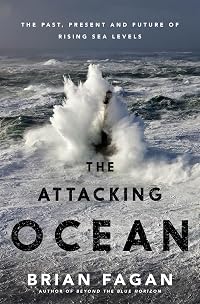
The Attacking Ocean: The Past, Present, and Future of Rising Sea Levels
by Brian Fagan
On This Page
Description
A history of climate change describes the dramatic evolution and stabilization of the oceans before the rise of humans approximately 6,000 years ago, tracing a significant rise in global temperatures since 1860 and how a rising sea level is affecting world populations. By the best-selling author of The Great Warming.Tags
Recommendations



























Member Reviews
An interesting archeological perspective on climate change, its effect on sea levels and the consequent effect on human civilizations. Makes one think about what the current changing climate will mean for the present world.
It told me what I wanted to know, although I will admit, I dozed off more than once while reading the first half of the book. I had no problem staying awake through the second half, though. My super-short synopsis is: Sea levels have risen before, but there have never been so many millions of people living in permanent communities so close to the water, and the outlook is not good.
In this book, Brian Fagan takes a look at the changing sea levels over the entire span of human civilization, from the end of the Ice Age to our current levels. He also takes a look at the complex relationship between the growing human population and the oceans along which we live.
Fagan provides a variety of case examples over a variety of ages all over the globe that show how rising ocean levels are as ancient as the Earth and that humans have usually adapted to the changing sea levels. There is also some discussion on how the Netherlands and a few other countries have dealt with reclaiming or at least keeping the ocean at bay; and how feasible (politically and financially) these options are for poorer countries. Fagan also briefly show more discusses the deleterious effect that the destruction of coastal estuaries, mangroves, barrier islands and wetlands, as well as excessive ground water pumping, has on mitigating the effects of storm surges, hurricanes, tsunamis and floods etc. Fagan also provides a brief explanation why rising sea levels are important, for example: in terms of loss of agricultural land and increased salinity in ground water resulting in less food production; loss of living land resulting in large migrations to other places that don’t want or can’t afford an excessive influx of people; the destruction of coastal cities/villages; and large financial expenditure to rebuild damaged infrastructure or flood barriers etc.
The book is fairly interesting and well written, but the various examples tend to have a lot of similarities, probably made unavoidable by the nature of the subject. One interesting feature of this book is the second table of contents which arranges chapters in terms of regions rather than chronologically, providing an alternative reading order. Maps of the different regions are provided but these don’t show up very well in the ebook. show less
Fagan provides a variety of case examples over a variety of ages all over the globe that show how rising ocean levels are as ancient as the Earth and that humans have usually adapted to the changing sea levels. There is also some discussion on how the Netherlands and a few other countries have dealt with reclaiming or at least keeping the ocean at bay; and how feasible (politically and financially) these options are for poorer countries. Fagan also briefly show more discusses the deleterious effect that the destruction of coastal estuaries, mangroves, barrier islands and wetlands, as well as excessive ground water pumping, has on mitigating the effects of storm surges, hurricanes, tsunamis and floods etc. Fagan also provides a brief explanation why rising sea levels are important, for example: in terms of loss of agricultural land and increased salinity in ground water resulting in less food production; loss of living land resulting in large migrations to other places that don’t want or can’t afford an excessive influx of people; the destruction of coastal cities/villages; and large financial expenditure to rebuild damaged infrastructure or flood barriers etc.
The book is fairly interesting and well written, but the various examples tend to have a lot of similarities, probably made unavoidable by the nature of the subject. One interesting feature of this book is the second table of contents which arranges chapters in terms of regions rather than chronologically, providing an alternative reading order. Maps of the different regions are provided but these don’t show up very well in the ebook. show less
Seems like an awful lot of ink to formulate just a few main ideas. Having endured to the end, I now know more about rising sea levels than I expected or desired.
The past, present, and future of rising sea levels
Ratings
Members
- Recently Added By
Lists

BingoDOG - Books With Natural Disasters: Nonfiction
18 works; 5 members

For Science!
39 works; 5 members

Climate Change
87 works; 7 members

Recommended Books about Climate Change
30 works; 2 members
Author Information

118+ Works 9,571 Members
Brian Fagan is emeritus professor of anthropology at the University of California, Santa Barbara. A former Guggenheim fellow, he has written many internationally acclaimed, popular books about archaeology, including The Little Ice Age, The Great Warming, and The Lang Summer. He lives in Santa Barbara, California.
Common Knowledge
- Canonical title
- The Attacking Ocean: The Past, Present, and Future of Rising Sea Levels
- Original publication date
- 2013
- Important events
- climate change (sea level change)
- Epigraph
- It came to the megacity at dusk, deceptively and unequally . . . In the lowlands, near the seashores, the harbors, the bays, the Sound, the river: apocalypse. The very ocean rose, tsunami-like, relentless, terrifying, bringi... (show all)ng devastation by flood and wind and wind-shipped fire, and for some ten million people in a swath a thousand miles wide and encompassing sixteen states, darkness and dread.
—Hendrik Herzberg on Hurricane Sandy,
The New Yorker, November 12, 2012 - Dedication
- To
Atticus Catticus Cattamore Mooose
A splendid beast who did everything he could to stop this book being wrtten by dancing on the keyboard at inopportune montents.
And he never has to worry about sea leve... (show all)ls. - First words
- Almost all my life, I've lived by the sea.
- Last words
- (Click to show. Warning: May contain spoilers.)The soner we confront our predicament head-on, the better, for our challenge is to master the earth.
- Blurbers
- Moore, Andrew M.T.; Scarborough, Vernon; Parker, Bruce
- Original language
- English
Classifications
Statistics
- Members
- 93
- Popularity
- 345,293
- Reviews
- 5
- Rating
- (3.25)
- Languages
- English
- Media
- Paper, Audiobook, Ebook
- ISBNs
- 6
- ASINs
- 2