On This Page
Description
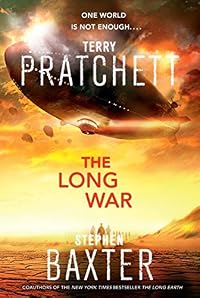
A new America called Valhalla grows restless under the controlling long arm of the Datum government, while all of the Long Earth is infused by the song of the trolls who are starting to react to humanity's thoughtless exploitation, bringing humankind to the brink of war.Tags
Recommendations









Member Recommendations
Member Reviews
Second in the Pratchett/Baxter 'Long Earth' sequence, this one is named for a war that actually - slight spoiler here - gets averted. The (potential) war is between a reactionary US administration that oddly looks not unlike the Trump administration (though this book predates that by three years) and distant human colonies more than a million alternate Earths away but which America considers that it has some claim to sovereignty over. The echoes of both the War of Independence ('no taxation without representation') and the War between the States (the issue here being over the treatment and status of the sentient 'trolls', native to another alternate Earth) are fairly clear.
There are a good number of characters carried over from the show more first book; only a few of them get well-drawn, though there is another oddly prescient character, a Greta Thunberg lookalike; and I found myself surprisingly affected by the fate of one of the many pov characters. We also meet a race of sapient canines; we're not supposed to think of them as dogs, just as we aren't supposed to think of ourselves as monkeys; but once one of the writers has put the word 'beagles' in the mind of the Joshua Valenté character, it becomes impossible not to think of these sapients as - well, as beagles. On their hind legs. The description of their society is well thought through; but the damage has already been done, and many readers will not take this segment of the novel seriously.
I suspect that a lot of people wrote this novel off for a number of reasons (potboilery, too many hands, Pratchett's illness are three that it could be accused of), but once I got used to the pace - short chapters and quite a few pov characters - I warmed to it (though the fact that I'd come to this book straight from one that was densely plotted and fairly slow-moving might have helped). I did find that I hit an expository lump about halfway through (Baxter's, I presume) and thought "At last! Something I can get my teeth into!" There's a lot of ideas in there that are only hinted at, some of which I suspect are picked up in later volumes; and ideas are thrown off in all directions.
I shall persevere with this series as I have a lot of time for both writers, and the titles of the next three novels hint at more inventiveness. show less
There are a good number of characters carried over from the show more first book; only a few of them get well-drawn, though there is another oddly prescient character, a Greta Thunberg lookalike; and I found myself surprisingly affected by the fate of one of the many pov characters. We also meet a race of sapient canines; we're not supposed to think of them as dogs, just as we aren't supposed to think of ourselves as monkeys; but once one of the writers has put the word 'beagles' in the mind of the Joshua Valenté character, it becomes impossible not to think of these sapients as - well, as beagles. On their hind legs. The description of their society is well thought through; but the damage has already been done, and many readers will not take this segment of the novel seriously.
I suspect that a lot of people wrote this novel off for a number of reasons (potboilery, too many hands, Pratchett's illness are three that it could be accused of), but once I got used to the pace - short chapters and quite a few pov characters - I warmed to it (though the fact that I'd come to this book straight from one that was densely plotted and fairly slow-moving might have helped). I did find that I hit an expository lump about halfway through (Baxter's, I presume) and thought "At last! Something I can get my teeth into!" There's a lot of ideas in there that are only hinted at, some of which I suspect are picked up in later volumes; and ideas are thrown off in all directions.
I shall persevere with this series as I have a lot of time for both writers, and the titles of the next three novels hint at more inventiveness. show less
The Long War is the second volume in the Long Earth series and continues where the opening volume, The Long Earth, left off. Essentially, the whole series is just one long story, so jumping in at this point may leave the reader a little confused or, at least, less focused on what matters in this story than perhaps they should be.
A major theme of this series is to explore convergent evolution. That is, how might evolution have driven the emergence of intelligence in different ways on different, but similar, worlds where humans do not exist. In short, and to paraphrase another scifi franchise, life will find a way. The action here is really subordinate to revelations regarding other sentient species across the Long Earth and how humans show more react to and interact with them. As one can expect, humans do not play well with others.
The action set pieces here are generally sketchily drawn and rushed to their conclusion. It is as if the authors want to concentrate on the consequences of these events rather than describing the events themselves.
A solid follow up the series opener, The Long Earth, and a book that expands the science and sociology surrounding humans and their reactions to effectively infinite land and to alien contact (except these are not really aliens, but Earth species that have emerged from a different set of evolutionary branches). show less
A major theme of this series is to explore convergent evolution. That is, how might evolution have driven the emergence of intelligence in different ways on different, but similar, worlds where humans do not exist. In short, and to paraphrase another scifi franchise, life will find a way. The action here is really subordinate to revelations regarding other sentient species across the Long Earth and how humans show more react to and interact with them. As one can expect, humans do not play well with others.
The action set pieces here are generally sketchily drawn and rushed to their conclusion. It is as if the authors want to concentrate on the consequences of these events rather than describing the events themselves.
A solid follow up the series opener, The Long Earth, and a book that expands the science and sociology surrounding humans and their reactions to effectively infinite land and to alien contact (except these are not really aliens, but Earth species that have emerged from a different set of evolutionary branches). show less
The Long War, the second book in The Long Earth series by Terry Pratchett and Stephen Baxter, gets a lot of things right. It corrects some of the structural missteps that the first book suffered.
And yet, I don't enjoy this one as much as its predecessor.
Which is not to say that The Long War isn't a good science fiction novel. It is, and I enjoyed the few hours it took me to read it. I don't think it's possible for two such talented authors to write something that isn't good. The narrative structure is smoother than the first book in the series—the transitions between the various story threads are less haphazard. The tone of the writing is clearer—there are no discordant notes between the seriousness and the humor this time show more around.
It's nice to spend time with these characters again and to catch up with them ten years after the conclusion of The Long Earth. This sequel expands our knowledge of the Long Earth, spending more time exploring the Joker worlds. It introduces a few new characters and some very interesting new species for us to contend with. It answers some of the questions about the nature of the Long Earth raised in the wake of the first book and teases some new ones.
The greatest strength of The Long War is its central conflict. This work examines how human beings react to and treat the non-human humanoids we encounter in the Long Earth. The premise is uncomfortably realistic and critical. As an exploration of politics and human nature, this book hits even closer to home than the first one.
For all its strengths, though, The Long War doesn't excite me as thoroughly as The Long Earth does. It's unavoidable that a sequel can't replicate the same sense of discovery as the first book in the series, but even accounting for that this story just isn't as interesting.
The characters seem to have lost their sense of wonder, which means the reader loses it, too. Perhaps it would be unrealistic for these people to retain wondrousness for their world after ten years of living in it, but the loss is a sad one. I suspect that's the point but it still makes the story less engaging.
Much of my disappointment with this novel stems from its title—The Long War. With a title like that, I expect it to be a war story (I'm a sucker for a good war story). But there's no war in this book. There's the possibility of war, the threat of war, a build-up toward war… But war never actually breaks out.
This apparent contradiction between the title and the plot is intentional and it gets explained at the end. The authors use it to posit a very interesting possibility about one way that the Long Earth affects humanity.
But up until that point, I find myself increasingly confounded that there's no war in a book that says it's about a war. This confusion colors my entire experience of the novel.
Beyond this personal disappointment, The Long War suffers from one significant failing:
One of the plot lines is completely unnecessary, as far as I can see. It's a narrative thread that adds to the milieu of the Long Earth, and I suspect that some of the characters introduced in this part of the story will become more important in subsequent books, but it has no discernible effect on the rest of plot. It's disconnected from the main conflict of the story. You could remove this thread from the narrative entirely and it wouldn't change anything.
I'm confident that the reasons for its inclusion will become apparent in the next books in the series. But its irrelevance to this novel is a point of failure.
The Long War is another good science fiction novel from two extremely talented writers, who obviously love developing and exploring this world. It's good enough that it leaves me excited to discover what will happen next.
But it's not as good as its predecessor. show less
And yet, I don't enjoy this one as much as its predecessor.
Which is not to say that The Long War isn't a good science fiction novel. It is, and I enjoyed the few hours it took me to read it. I don't think it's possible for two such talented authors to write something that isn't good. The narrative structure is smoother than the first book in the series—the transitions between the various story threads are less haphazard. The tone of the writing is clearer—there are no discordant notes between the seriousness and the humor this time show more around.
It's nice to spend time with these characters again and to catch up with them ten years after the conclusion of The Long Earth. This sequel expands our knowledge of the Long Earth, spending more time exploring the Joker worlds. It introduces a few new characters and some very interesting new species for us to contend with. It answers some of the questions about the nature of the Long Earth raised in the wake of the first book and teases some new ones.
The greatest strength of The Long War is its central conflict. This work examines how human beings react to and treat the non-human humanoids we encounter in the Long Earth. The premise is uncomfortably realistic and critical. As an exploration of politics and human nature, this book hits even closer to home than the first one.
For all its strengths, though, The Long War doesn't excite me as thoroughly as The Long Earth does. It's unavoidable that a sequel can't replicate the same sense of discovery as the first book in the series, but even accounting for that this story just isn't as interesting.
The characters seem to have lost their sense of wonder, which means the reader loses it, too. Perhaps it would be unrealistic for these people to retain wondrousness for their world after ten years of living in it, but the loss is a sad one. I suspect that's the point but it still makes the story less engaging.
Much of my disappointment with this novel stems from its title—The Long War. With a title like that, I expect it to be a war story (I'm a sucker for a good war story). But there's no war in this book. There's the possibility of war, the threat of war, a build-up toward war… But war never actually breaks out.
This apparent contradiction between the title and the plot is intentional and it gets explained at the end. The authors use it to posit a very interesting possibility about one way that the Long Earth affects humanity.
But up until that point, I find myself increasingly confounded that there's no war in a book that says it's about a war. This confusion colors my entire experience of the novel.
Beyond this personal disappointment, The Long War suffers from one significant failing:
One of the plot lines is completely unnecessary, as far as I can see. It's a narrative thread that adds to the milieu of the Long Earth, and I suspect that some of the characters introduced in this part of the story will become more important in subsequent books, but it has no discernible effect on the rest of plot. It's disconnected from the main conflict of the story. You could remove this thread from the narrative entirely and it wouldn't change anything.
I'm confident that the reasons for its inclusion will become apparent in the next books in the series. But its irrelevance to this novel is a point of failure.
The Long War is another good science fiction novel from two extremely talented writers, who obviously love developing and exploring this world. It's good enough that it leaves me excited to discover what will happen next.
But it's not as good as its predecessor. show less
Imagine. Endless space. Endless opportunity. Endless resource. Endless freedom? Apparently not.
The Long Earth is a seemingly endless chain of Earths stretching away from our Earth, ‘Datum’ Earth, which is unique among the earths as being the only one on which mankind evolved. All the other Earths, each one just one step, dimension, call it what you will, away from one another, are mankind free.
This exhibits itself principally, it would appear, by their being a lot more trees on these earths. That is, until mankind learns how to step, move from one earth to the next, and take an axe with them.
There’s a neat geological twist played out here. The closer to Datum Earth an Earth is, the more like Datum it is, apart from all the extra show more trees and, presumably, oodles more squirrels. But as you step further and further away, changes begin to happen, as every geological or astral alternative is played out. So you get Earths that are gripped in an ice age, or are more watery. There’s even ‘the Gap’, where an asteroid strike has removed Earth altogether.
The message is clear, there’s room enough for everyone, for every eventuality.
And mankind is keen to take advantage of that, by heading out, out, out into all that space. Of course, being mankind, it might leave all those pesky annoyances of modern life behind on Datum, but takes along a full complement of prejudice and stupidity. So, folk setting up faith based communities build a church before a stockade and learn the hard way that pointy wood is better than prayer for holding off wild animals. Others take a less than tolerant attitude to those that they find on the Earths they wish to colonise.
The colonial’s sense of entitlement comes in part from the idea of the ‘footprint’, that if an area on Datum Earth is a certain country, then those boundaries apply to the alternative Earths too. And that’s where the trouble starts, because that’s certainly the view of the Datum American government. Trouble is, when you show up at a pioneer town and demand loyalty and, er, taxes, the pioneers, who a) left America for a reason and b) are, well, pioneers, may well not agree.
Floating from Earth to Earth are airships, the best way to step and to travel round Earths with no transport infrastructure (or just a crap on), not to mention having the virtue of being able to float above any trouble.
The Long War builds on the story established in The Long Earth, and develops many of the same characters pleasingly. Mankind is now established across hundreds of thousands of Earths and what is seen by some as merely lots of individuals making a place for themselves and establishing their version of utopia, it’s seen by others as the ultimate insurance policy; mankind might destroy itself on Datum, the colonies would survive.
Trouble is, the colonies don’t really think of themselves as colonies anymore, but rather ‘home’ to a lot of people who don’t really think they owe allegiance to the USA.
Which is why the US government sends a fleet of airships up and down the long earth, just to remind folk that they are American citizens, whether they want to be or not. Predictably, the folk being informed they are American citizens react just as you would expect American pioneers who left America because they wanted to make their own life to react.
There’s plenty of quirk here, and some neat ideas. Lobsang, the is he/isn’t he sentient computer continues to provide the best entertainment. The humans, either busy colonising or championing the rights of the other intelligent inhabitants of the long earth come over as a bit bloody worthy, like people who make their own wine and bang on about it, except they are making their own civilizations.
The Long War is at its best when its exploring the weirdness of endless earths and the way in which individuals react to that weirdness, rather than describing endless examples of the American dream. That said, it’s not a bad examination of how quick some are to adapt, and how slow some are to welcome change. show less
The Long Earth is a seemingly endless chain of Earths stretching away from our Earth, ‘Datum’ Earth, which is unique among the earths as being the only one on which mankind evolved. All the other Earths, each one just one step, dimension, call it what you will, away from one another, are mankind free.
This exhibits itself principally, it would appear, by their being a lot more trees on these earths. That is, until mankind learns how to step, move from one earth to the next, and take an axe with them.
There’s a neat geological twist played out here. The closer to Datum Earth an Earth is, the more like Datum it is, apart from all the extra show more trees and, presumably, oodles more squirrels. But as you step further and further away, changes begin to happen, as every geological or astral alternative is played out. So you get Earths that are gripped in an ice age, or are more watery. There’s even ‘the Gap’, where an asteroid strike has removed Earth altogether.
The message is clear, there’s room enough for everyone, for every eventuality.
And mankind is keen to take advantage of that, by heading out, out, out into all that space. Of course, being mankind, it might leave all those pesky annoyances of modern life behind on Datum, but takes along a full complement of prejudice and stupidity. So, folk setting up faith based communities build a church before a stockade and learn the hard way that pointy wood is better than prayer for holding off wild animals. Others take a less than tolerant attitude to those that they find on the Earths they wish to colonise.
The colonial’s sense of entitlement comes in part from the idea of the ‘footprint’, that if an area on Datum Earth is a certain country, then those boundaries apply to the alternative Earths too. And that’s where the trouble starts, because that’s certainly the view of the Datum American government. Trouble is, when you show up at a pioneer town and demand loyalty and, er, taxes, the pioneers, who a) left America for a reason and b) are, well, pioneers, may well not agree.
Floating from Earth to Earth are airships, the best way to step and to travel round Earths with no transport infrastructure (or just a crap on), not to mention having the virtue of being able to float above any trouble.
The Long War builds on the story established in The Long Earth, and develops many of the same characters pleasingly. Mankind is now established across hundreds of thousands of Earths and what is seen by some as merely lots of individuals making a place for themselves and establishing their version of utopia, it’s seen by others as the ultimate insurance policy; mankind might destroy itself on Datum, the colonies would survive.
Trouble is, the colonies don’t really think of themselves as colonies anymore, but rather ‘home’ to a lot of people who don’t really think they owe allegiance to the USA.
Which is why the US government sends a fleet of airships up and down the long earth, just to remind folk that they are American citizens, whether they want to be or not. Predictably, the folk being informed they are American citizens react just as you would expect American pioneers who left America because they wanted to make their own life to react.
There’s plenty of quirk here, and some neat ideas. Lobsang, the is he/isn’t he sentient computer continues to provide the best entertainment. The humans, either busy colonising or championing the rights of the other intelligent inhabitants of the long earth come over as a bit bloody worthy, like people who make their own wine and bang on about it, except they are making their own civilizations.
The Long War is at its best when its exploring the weirdness of endless earths and the way in which individuals react to that weirdness, rather than describing endless examples of the American dream. That said, it’s not a bad examination of how quick some are to adapt, and how slow some are to welcome change. show less
I liked this one even more than book one. Now that humanity has become more established in the stepwise worlds, relations between Datum and the rest have become more complicated, an people are encountering more sentient life abroad. Conditions are right for a war, except they are also exactly right for the opposite. How can you have a war with a group that can always just walk away? As usual, Lobsang is in the middle of everything, but now he has Sister Agnes, to mind him. Love the characters.
While the plot, dialogue and characterizations often fall flat to me, the well-thought-out infinite worlds with all of their variations are enough to keep me going on this series and keep it at a steady three stars.
The title of this book is kinda misleading, I think. Maybe it was intended to drum up excitement in a way that may not have been needed. The first book of the Long Earth spans across more than a million alternate Earths that we are now able to "step" across, and the implications are explored at least in the early days quite well.
This one takes place 25 years into the colonization phase and we're in a cooperative space with "trolls" humanoids that grew up being able to "step" and have a singing language that is much smarter as a whole for their species than is generally understood by us stupid humans.
Of course, the idiots of our species start killing them off while others work with the others in tandem, and then there's also the OTHER show more humanoids we jokingly named Elves and Kobolds and First Person Singular (for a singular intelligence that developed to devour whole Earths).
This might be the reference to the title, but if so, it's more about humans fighting human nature and trying to limit the danger of our shortsightedness as bigots on Datum Earth (Or original home) spew vitriol about all the people who left, turning into a religious and economic and political quagmire.
Even so, this book still remains, at its core, an adventure that's part western, part hard-sf, and all a brilliant mesh of Baxter's vision and science and Pratchett's great worldbuilding and characters.
Oh, and the end is a real kicker. I can't wait to get on the rest of these novels. It's damn fun and easy, despite its apparent hard-sf premise of many-worlds. :) MANY worlds. :) show less
This one takes place 25 years into the colonization phase and we're in a cooperative space with "trolls" humanoids that grew up being able to "step" and have a singing language that is much smarter as a whole for their species than is generally understood by us stupid humans.
Of course, the idiots of our species start killing them off while others work with the others in tandem, and then there's also the OTHER show more humanoids we jokingly named Elves and Kobolds and First Person Singular (for a singular intelligence that developed to devour whole Earths).
This might be the reference to the title, but if so, it's more about humans fighting human nature and trying to limit the danger of our shortsightedness as bigots on Datum Earth (Or original home) spew vitriol about all the people who left, turning into a religious and economic and political quagmire.
Even so, this book still remains, at its core, an adventure that's part western, part hard-sf, and all a brilliant mesh of Baxter's vision and science and Pratchett's great worldbuilding and characters.
Oh, and the end is a real kicker. I can't wait to get on the rest of these novels. It's damn fun and easy, despite its apparent hard-sf premise of many-worlds. :) MANY worlds. :) show less
Members
- Recently Added By
Lists

Wishlist
50 works; 1 member

Emily's Reviews
14 works; 1 member

Books featuring monks and/or nuns
165 works; 32 members

Books Read in 2020
4,379 works; 124 members
Talk Discussions
Past Discussions
Reading Long Earth by Pratchett & Baxter in Science Fiction Fans (May 2014)
The sequel to The Long Earth in All Things Discworldian - The Guild of Pratchett Fans (February 2013)
Author Information

429+ Works 578,360 Members
Terry Pratchett was on born April 28, 1948 in Beaconsfield, United Kingdom. He left school at the age of 17 to work on his local paper, the Bucks Free Press. While with the Press, he took the National Council for the Training of Journalists proficiency class. He also worked for the Western Daily Press and the Bath Chronicle. He produced a series show more of cartoons for the monthly journal, Psychic Researcher, describing the goings-on at the government's fictional paranormal research establishment, Warlock Hall. In 1980, he was appointed publicity officer for the Central Electricity Generating Board with responsibility for three nuclear power stations. His first novel, The Carpet People, was published in 1971. His first Discworld novel, The Colour of Magic, was published in 1983. He became a full-time author in 1987. He wrote more than 70 books during his lifetime including The Dark Side of the Sun, Strata, The Light Fantastic, Equal Rites, Mort, Sourcery, Truckers, Diggers, Wings, Dodger, Raising Steam, Dragons at Crumbling Castle: And Other Tales, and The Shephard's Crown. He was diagnosis with early onset Alzheimer's disease in 2007. He was knighted for services to literature in 2009 and received the World Fantasy award for life achievement in 2010. He died on March 12, 2015 at the age of 66. (Bowker Author Biography) show less

260+ Works 43,820 Members
Some Editions
Awards and Honors
Awards
Distinctions
Series

Belongs to Publisher Series
Work Relationships
Common Knowledge
- Canonical title
- The Long War
- Original title
- The Long War
- Original publication date
- 2013-06-18
- People/Characters
- Joshua Valienté; Lobsang; Agnes; Sally Linsay; Monica Jansson; Maggie Kauffman (show all 36); Jack Green; Herb Lewis; Helen Valienté; First Person Singular; Douglas Black; Nelson Azikiwe; Thomas Kyangu; Jacques Montecute; Roberta Golding; Bill Chambers; Roderick Bacon; Angela Hartmann; Ray Hartmann; Nathan Boss; Wu Yue-Sai; Martarita Jha; Philip Mott; Marlin Jackson; Jim Starling; Christopher Pagel; Juliet Pagel; Frank Wood; Gareth Eames; George Abrahams; Agnes Abrahams; Wotan Ulm; Li-Li; Charles Kafka; Shi-mi; Second Person Singular
- Important places
- Valhalla; Datum Earth; The Long Earth; The Rectangles; New Zealand
- Dedication
- For Lyn and Rhianna, as always
T.P.
For Sandra
S.B. - First words
- On an alternate world, two million steps from Earth:
The troll female was called Mary by her handlers, Monica Jansson read on the rolling caption on the video clip. - Last words
- (Click to show. Warning: May contain spoilers.)Her hand was very cold.
- Original language
- English
Classifications
Statistics
- Members
- 2,216
- Popularity
- 9,056
- Reviews
- 71
- Rating
- (3.42)
- Languages
- 11 — Czech, English, Estonian, Finnish, French, German, Hungarian, Polish, Portuguese, Spanish, Turkish
- Media
- Paper, Audiobook, Ebook
- ISBNs
- 39
- ASINs
- 12