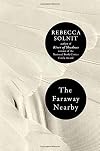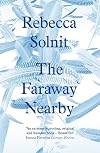
The Faraway Nearby
by Rebecca Solnit
On This Page
Description
A companion to "A Field Guide for Getting Lost" explores the ways that people construct lives from stories and connect to each other through empathy, narrative, and imagination, sharing anecdotes about historical figures and members of the author's own family.Tags
Recommendations
Member Reviews
I liked this circular meditation all the way through. Solnit writes like some of my visual artist friends think and talk about their art, and even though she can fall into the Artsy Super-structured Essay trap once in a while I basically very much liked what she was up to—discursions on many things of interest to me, among them dealing with a parent's dementia, compassion, storytelling, libraries, illness, myths and the forms they take, the natural world. Mostly, and one of my very favorite subjects, writing about association-making, and she did a great job. I'll definitely read more of her work.
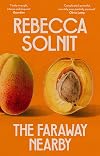
At first, I was utterly captivated by this memoir of Solnit's life as she worked through her changing relationship with her mother as that woman's memory fails and her personality changes. Solnit uses a harvest of apricots from a tree in her mother's yard as a metaphor for this experience: she sorts through the rotting fruit and ends with a few jars of lovely preserves and apricot liqueur. This moving and very apt image runs throughout the events in the book where we see Solnit reconciling her memories of a harsh, judgmental mother with the need to take care of a woman now helpless to navigate, literally, through her life. This is the first book I have read by Solnit and so I am not certain if she always does this, but it is one show more continual linkage of metaphor and image used to reveal meaning. She talks about Frankenstein and the Arctic and parlays that discussion into one of Che Guevara, who like Frankenstein, began as a doctor wishing to help people and ended up as someone very different. She then moves on to her own surgery and her subsequent stay in Iceland. For three-quarters of the book this worked for me tremendously. By the end, though, it was beginning to feel a bit like a party trick: look what I can do. That may be a harsh and undeserving judgement. Maybe it was just me and my mood and should be discounted, or maybe too much of any fruit turns sour in the mouth after awhile. show less
This is a lovely, discursive journey through Rebecca Solnit's enviable brain. Solnit tells the story of the gradual progression of her mother's dementia and examines their difficult relationship. But she does so much more, delving into fascinating essays on Frankenstein, Iceland, art and empathy, leprosy and so much more. Her argument, made both explicitly in the text and implicitly by the way the book swirls around its topic, is that life is an unending chain of coincidence and randomness that we transform into stories and that each of us is made up of not only our own experiences but the stories of everyone around us, all of which are connected and contingent. It's beautifully done, marrying fascinating and thoughtful research, honest show more and courageous memoir and a broad argument about life and what it means to live. I'm looking forward to diving into the rest of her work. show less
In The Faraway Nearby, there is ticker of sorts at the bottom margin of the book. It's a running marquee where Rebecca Solnit tells a continuous story about the Madagascar moth, the Hemiceratoides hieroglyphica, that drinks the "tears of sleeping birds." Solnit writes about the moth and the birds as two characters in orbit with each other, a “… a sleeper and a drinker, a giver and a taker, and what are tears to the former is food to the latter.” It's a story that rolls across the pages, literally, and is completely separate from the main act.
There's a kind of do-si-do dance to reading this book, which brought to mind the last book I read, S. by Doug Dorst, a book that had multiple layers of text, multiple layers of postmodern show more frosting. Solnit does a lot of this. It's fitting, considering that Solnit writes, "The sentence can run away with you." And so can the story.
So if Solni isn't writing a natural history of moths in The Faraway Nearby, what is she writing? In the first chapter, Solnit starts off trying to define stories and storytelling: "It's all in the telling. Stories are compasses and architecture; we navigate by them, we build our sanctuaries and prisons out of them, and to be without a story is to be lost in the vastness of the world that spreads in all directions like arctic tundra or sea ice."
And so Solnit weaves in a whole cavalcade of stories, about:
- boxes of apricots and canning;
- her experience in Iceland as a resident writer;
- the lives and work of other storytellers or writers, like Scheherazade, the Marquis de Sade, and Mary Shelley (some great analysis re: Frankenstein);
- leprosy, mammograms;
- Wu Daozi, a Tang Dynasty muralist in the Imperial Palace;
- Cinderella and other fairy tales; and
- a bunch of other vignettes and sundries from history.
But the main act is centered on her mother. Solnit doesn't have an easy relationship with her mother, a woman struggling with Alzheimer's. In fact, the relationship is downright fraught with bitterness and slights. But Solnit soldiers on, telling us, "To love someone is to put yourself in their place, which is to put yourself in their story.” Solnit shows us glimpses of her mother, telling anecdotes that are honest and raw. She shows great empathy for her mother, if not love, which happens to be a quality that Solnit holds most sacred for a storyteller, empathy for others.
To paraphrase a line in the book, she's telling us stories, but really those stories are telling her. They are revealing her.
I found out in an NPR interview that the book’s title is actually from the artist Georgia O’Keeffe. O'Keefe would sign her letters to her friends in New York mailed from the deserts of New Mexico, “the faraway nearby.” It's the perfect title for this book. She brings readers near; it feels very intimate. But then she also keeps readers at a distance.
This has much to do with Solnit's writing style, which is meandering and digressive. Reading this felt like being dragged by the wrist by a manic friend into a day-long treasure hunt of sorts. It's a bit discordant, like Symphonie Fantastique-discordant. Solnit gives us a compilation of personal stories wrapped up like little truffles stuffed with luscious bits of natural history, art history, literature, philosophy, and the writing life. Solnit changes subjects often, seeming to introduce a totally new topic only to tie things together again later. But she doesn't just make connections between ideas and topics and draw out their common themes. No. She loops back constantly, building a kind of tapestry of stories. Over, under, under, over. There's the big picture, but it's one that's threaded on a loom of smaller stories.
She uses these stories to "tell" herself but manages to conceal herself, too, as if parrying or dodging our scrutiny when we get too close. This did get a little exasperating at times, especially when I was enjoying a particular track and then suddenly she switches. At times, these recursive loops feel overly defensive. But no matter. “People disappear into their stories all the time,” writes Solnit. And “we never tell the story whole." Figuring out life is like looking up at the Milky Way where "[you] are forever picking out constellations from it to fit who and where [you] are.” If you're reading A Faraway Nearby and get to the end feeling like, 'what was it all about?', remember the moth drinking the tears of sleeping birds. show less
There's a kind of do-si-do dance to reading this book, which brought to mind the last book I read, S. by Doug Dorst, a book that had multiple layers of text, multiple layers of postmodern show more frosting. Solnit does a lot of this. It's fitting, considering that Solnit writes, "The sentence can run away with you." And so can the story.
So if Solni isn't writing a natural history of moths in The Faraway Nearby, what is she writing? In the first chapter, Solnit starts off trying to define stories and storytelling: "It's all in the telling. Stories are compasses and architecture; we navigate by them, we build our sanctuaries and prisons out of them, and to be without a story is to be lost in the vastness of the world that spreads in all directions like arctic tundra or sea ice."
And so Solnit weaves in a whole cavalcade of stories, about:
- boxes of apricots and canning;
- her experience in Iceland as a resident writer;
- the lives and work of other storytellers or writers, like Scheherazade, the Marquis de Sade, and Mary Shelley (some great analysis re: Frankenstein);
- leprosy, mammograms;
- Wu Daozi, a Tang Dynasty muralist in the Imperial Palace;
- Cinderella and other fairy tales; and
- a bunch of other vignettes and sundries from history.
But the main act is centered on her mother. Solnit doesn't have an easy relationship with her mother, a woman struggling with Alzheimer's. In fact, the relationship is downright fraught with bitterness and slights. But Solnit soldiers on, telling us, "To love someone is to put yourself in their place, which is to put yourself in their story.” Solnit shows us glimpses of her mother, telling anecdotes that are honest and raw. She shows great empathy for her mother, if not love, which happens to be a quality that Solnit holds most sacred for a storyteller, empathy for others.
To paraphrase a line in the book, she's telling us stories, but really those stories are telling her. They are revealing her.
I found out in an NPR interview that the book’s title is actually from the artist Georgia O’Keeffe. O'Keefe would sign her letters to her friends in New York mailed from the deserts of New Mexico, “the faraway nearby.” It's the perfect title for this book. She brings readers near; it feels very intimate. But then she also keeps readers at a distance.
This has much to do with Solnit's writing style, which is meandering and digressive. Reading this felt like being dragged by the wrist by a manic friend into a day-long treasure hunt of sorts. It's a bit discordant, like Symphonie Fantastique-discordant. Solnit gives us a compilation of personal stories wrapped up like little truffles stuffed with luscious bits of natural history, art history, literature, philosophy, and the writing life. Solnit changes subjects often, seeming to introduce a totally new topic only to tie things together again later. But she doesn't just make connections between ideas and topics and draw out their common themes. No. She loops back constantly, building a kind of tapestry of stories. Over, under, under, over. There's the big picture, but it's one that's threaded on a loom of smaller stories.
She uses these stories to "tell" herself but manages to conceal herself, too, as if parrying or dodging our scrutiny when we get too close. This did get a little exasperating at times, especially when I was enjoying a particular track and then suddenly she switches. At times, these recursive loops feel overly defensive. But no matter. “People disappear into their stories all the time,” writes Solnit. And “we never tell the story whole." Figuring out life is like looking up at the Milky Way where "[you] are forever picking out constellations from it to fit who and where [you] are.” If you're reading A Faraway Nearby and get to the end feeling like, 'what was it all about?', remember the moth drinking the tears of sleeping birds. show less
Solnit's writing is, as always, beautiful and evocative. The Faraway Nearby seems more a memoir than her other works, as she speaks with solemn wisdom about her mother's gradual withdrawal from life due to Alzheimer's, her travels to primordial Iceland, and the power and importance of storytelling. While her writing is broad in scope, with tales of writer Mary Shelley and Dr. Frankenstein, the spiritual transformation of a young Che Guevara, and fairy tales from around the world, Solnit's writing is most poignant as she reflects upon her turbulent relationship with her mother and its shifts as her mother's mind disintegrates with the progression of her disease. A deeply felt collection of writings.
“You have an intimacy with the faraway and distance from the near at hand… the depth of that solitude of reading and then writing took me all the way through to connect with people again in an unexpected way. It was astonishing wealth for one who had once been so poor.” Every other page of this book has been dog eared because it’s just overflowing with moving passages about life, death, family, art, nature, faith and the connectedness of all things. Lyrical, reflective and profound.
I'm in love with how much this author is in love with the subjects she wanders through. I couldn't tell you what exactly this book is about, except that she has an intense fascination that showers you with creativity, sharing so many different ways of thinking.
I could only read it a few pages at a time, or else I started losing some of the depth. It's no quick read because of how much it will cause you to reflect on your own life.
I could only read it a few pages at a time, or else I started losing some of the depth. It's no quick read because of how much it will cause you to reflect on your own life.
Members
- Recently Added By
Lists

50 Books by Women Authors
50 works; 10 members

2014 Notable Books for Adults
26 works; 5 members

BBC Radio 4 Bookclub
341 works; 13 members

One Book, Many Authors
441 works; 40 members

Five star books
1,767 works; 110 members

Books Read in 2017
4,249 works; 129 members

Not the NYT list of top 100 21st century books
100 works; 6 members
Author Information

48+ Works 17,189 Members
Rebecca Solnit writes extensively on photography and landscape. She is a contributing editor to Art Issues and Creative Camera and is the author of three books. She has contributed essays to several museum catalogues including Crimes and Splendors: The Desert Cantos of Richard Misrach and the Whitney Museum's Beat Culture and the New America. She show more was a 1993 recipient of a National Endowment for the Arts Fellowship. (Bowker Author Biography) show less
Awards and Honors
Awards
Distinctions
Notable Lists
Common Knowledge
- Canonical title
- The Faraway Nearby
- Original publication date
- 2014
- Important places
- Iceland
- Original language
- English
- Canonical DDC/MDS
- 814.6
- Canonical LCC
- PS3569.O585
Classifications
Statistics
- Members
- 815
- Popularity
- 33,883
- Reviews
- 24
- Rating
- (4.10)
- Languages
- English, German, Portuguese, Swedish
- Media
- Paper, Audiobook, Ebook
- ISBNs
- 11
- ASINs
- 5